Showing posts with label Joy. Show all posts

Saturday, August 10, 2013

WE MUST ENDURE LIFE'S DIFFICULTIES WITH JOY (PART 4 ) — from the book The Salvation of Sinners


When God appeared to Saint Stephen the first martyrin Heaven, He manifested Himself with glory:“he looked up steadfastly into Heaven, and he
saw the glory of God, and Jesus standing on the right hand of God” (Acts 7:55).


When God opened the heavens and appearedto the prophet Ezekiel, “It was the appearance of the glory of the Lord” (Ez. 1:28).


Similarly, when God appeared high on the summit of Mount Sinai, He made Himself manifest with much glory(cf. Ex. 19:16)
. However, when He appeared to Moses on the earth, He made Himself manifest within the burning bush: a plant full of prickly thorns(cf.Ex. 3:2)
.
The Lord did so in order for us to realize and comprehend that He Who is worshipped and glorified in Heaven by the saints and angels is foundhere on the earth within the thorns of sorrows. Just as Moses was deemed worthy of beholding God's glory on Mount Sinai only after first seeing
Him here on the earth amongstthe thorns, likewise it is necessary for us to labor to find the Lord first
here on the earth within the thorns of sorrows and hardships if we wish to behold the glory and bliss of His heavenly Kingdom in the next life.


How foolish and ungrateful we are! If happiness and delight are concealed within sorrows, why should we detest hardships and difficulties? Shouldn't we rather thirst for them since through them we acquire Paradise and Christ Himself,
Who is the actual source of all happiness and contentment? When the venerable and God-bearing SaintIgnatius found out that he would be fed to the lions, he was overcome with great joy and cried out gleefully,


"When will the beasts come to devour my body? I am wheat of my Lord, and I must be milled by the teeth of the lions in order to become sweet bread for my Lord. Now I am truly starting to become His disciple!"Saint Andrew the Apostle desired for quite some time to suffer for the love of Christ. Eventually he was sentenced to be crucified. When he was brought before his dearly beloved Cross, he voiced the following with jubilation, "Hail, O
most-holy and precious Cross!
For the longest time, exceedingly have I desired
thee, and, finally, thou art about to fulfill my dream.


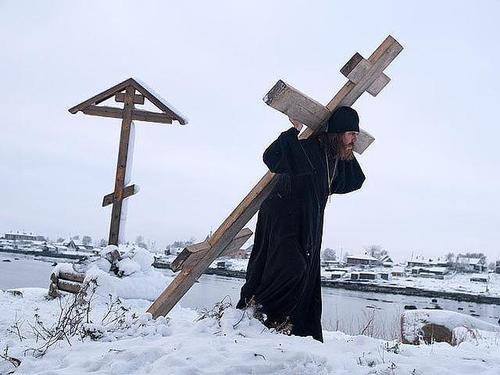
Behold, I proceed with elation to thee. Rejoice as thou receiveth me, the disciple of Him Who hung from thee."Since every good thing and all glory comes to us through the Cross, come my dear Christians! Let us extol and praise it; let us venerate it reverently; let us yearn for it wholeheartedly. And when it comes to us from time to time, let us embrace it and receive it joyfully—because through it we receive many divine gifts and graces. This is the key that opened Paradise for us. We are blessed if we learn to love the cross of sorrows and if we endure difficulties with thankfulness; for then we will be pleasing to God and loved by Christ. And since we will have suffered with Christ and been crucified along with Him in this life, we will be glorified with Him in the next life(cf. Rom. 8:17 &
2Tim. 2:11-12) unto the endless ages of ages. Amen.

Thursday, August 8, 2013

True joy comes from seeing God in all things


True joy comes from seeing God in all things, knowing God in all things. To know of God in the wisdom of the mind, this brings shimmers of peace and a foretaste of joy. Yet such joy is bounded, able to be swayed; for he who knows God’s presence but in part, still is able to imagine His absence. One, who sees God only in this place or in that, sees Him missing from those places in between. His joy is fleeting, for as in a moment it arises in the perception of God’s presence, so it retreats in the illusion of His absence. The one whose joy is stable, solid and penetrating, is he who knows of God’s presence among all things, with all things, and in all things. Even as in the temple, so, too, in the school. Even as in the Church, so, too, in the field. From the brightest star to the smallest blade of grass, he sees the beautiful mystery of Christ present as all in all. He beholds the leaf with reverence, as the vessel of his direct encounter with the grace of God. He beholds his sister with love, seeing in her the energies of the blessed Divinity. He begins to see God present in more and more, and absent from less and less; until he comes to the divine realization that there is no place that God is not, that the whole of creation around him shimmers in radiance with the presence of the Most Holy. He understands that perceptions of God’s absence are but an illusion in which there is no truth.
Then is joy most full, most pure. Then it is unfailing, for in all things is God encountered; and where God is, there true joy also abides. Even in sorrow, joy is known; for the earth itself cries out in witness of Christ’s presence in the sorrow — of the divine love that pervades even the deepest human grief. In loneliness, one too finds joy: for all creation sings of the Creator’s grace, and through it the Creator Himself is present, reaching out to His children.
Behold God the all-present, all-loving, all-merciful Father, everywhere existing and ever the same. Behold the source and giver of joy, abounding in this world of life. Behold God indeed, who has the power to save and the compassion to redeem.

Monday, July 29, 2013

WE MUST ENDURE LIFE'S DIFFICULTIES WITH JOY (PART 3)—from the book The Salvation of Sinners—


If we carefully considered and examined the weight of the Lord's Cross, our own cross would seem minute and light as a feather. The Lord was hanging
on the Cross completely naked and without any help from anyone. This is why He voiced, "My God, My God, why hath Thou forsaken Me?" (Mt. 27:46). We, on the other hand, are neither naked nor nailed to and hanging from such a cross.


On the contrary, we receive considerable consolation from our friends and
relatives during difficult moments. Additionally, God has promised to be next to
us in times of sorrow, and with His help we can endure any hardship.How pathetic we are! Our true God endured various tortures and suffered
such a cruel death on account of our sins. We insignificant and wretched sinners, on the other hand, cannot tolerate even the slightest pain, which our good Lord sends for our own benefit and correction. Oh, how foolish it is for us to seek
Christ in comfort and pleasure!


Christ prayed for them who crucified Him: "Forgive them, O Father, for they do not know what they are doing" (Lk. 23:34), whereas we do not want to forgive anyone who hurts us even a bit. The good thief confessed Christ while he was on
the cross, and we ungrateful sinners ridicule Him along with the evil thief saying, "If You are the Son of God, save Yourself and us" (Lk. 23:39). In times of difficulty we deny Him by contending, "If You
are God, deliver us from our cross, and we will believe in You (Mt. 27:43).


You should allow ungodly and evil people to suffer, not us. We have done nothing wrong..."Oh, how unrighteous and insensitive we are! We sit back and allow a thief to surpass us in the faith! A condemned criminal in a state of such harsh
suffering and punishment was able to understand better than us the benefit of sorrows! We should mimic the good thief and confess Christ during every sorrow and hardship—even bitter death itself
—, welcoming difficulties not as remorseful and repentant criminals but as true Christians and genuine children of God.


If the Lord entered into the glory and bliss (which He as the rightful owner was always entitled to)
after first suffering and enduring His Passion (cf.Hb. 12:2), how much more fitting is it for His servants to suffer in order to inherit the Kingdom that does not belong to them? How is it possible for us slaves to have it easier than our Master, or as

students to be greater than our Teacher? Christ
suffered for us, and we do not want to suffer in order to save our own soul? The Son of God chose to ascend to the Father through scorn and humiliation, and we worthless worms desire recognition and praise?


My dear brothers, when we experience difficulties and sorrows, let us not only endure them patiently without complaining, but let us rejoice—because,
indeed, "The sufferings of this present life are not worthy of and cannot be compared to the future glory that will be revealed to us" (Rom. 8:18).

Monday, July 8, 2013

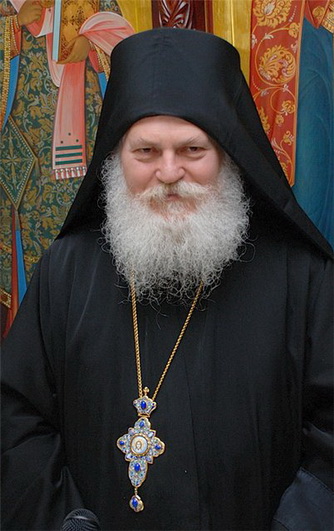
"Do Not Look for Joy Outside of Yourself" ( Elder Ephraim of Vatopaidi )


A talk given in the New-Tikhvin women's Monastery, Ekaterinburg, Russia, October, 2011, during the visit of the Cincture of the Mother of God to Russia.


Your Eminence, eminent bishops, honorable fathers, dear Mother Abbess, brothers and sisters! It is a great joy for me to be in your monastery once again. As you know, this time we have arrived with the holy Cincture of the Mother of God. This is a very special holy shrine — very precious from the spiritual point of view. By God's providence we have brought the relic to this city in order to sanctify the city, and of course, for the sake of the monastics who live here. We know how pleasing the monastic life, and in general the existence of monasteries is to the Mother of God. We know how many times in the history of the Church the Mother of God appeared to chaste and pure souls and said, "There is my icon, take it and build a monastery." The Holy Mountain is the only existing monastic republic, dedicated entirely to her. The Most Pure Virgin is the Protectress of Mt. Athos. She herself told St. Peter the Athonite to go and live on the Holy Mountain, and said that he and his co-strugglers will be under her direct Protection. "I myself will be your Protectress, Healer, and Nourisher," she said. Appearing to St. Athansius the Athonite, she said the same thing she had said to St. Peter, adding, "I will be your Economissa (steward) and I will take care of all of you; but I want only one thing from you—that you keep your monastic vows." And to this day we, the Athonites, delight in her patronage and special intercession.

Therefore, my dear ones, it is a great blessing that we have come to monasticism. Our elder Joseph of Vatopedi of blessing repose very often said to us, "There is no greater blessing for a person than when God calls him to the monastic life. May the monk never, not even for a second, ever forget that God Himself called him." When we remember how we left the world, what went along with us then, we see that God's grace was upon us, that it accomplished our renunciation of the world, and led us to the monastery. Here we must fulfill three virtues in their entirety: non-acquisitiveness, obedience, and chastity. These virtues lead us in the spiritual life, root us in it, and help us attain the fullness of maturity in Christ.

Monasticism is the path of perfection, and therefore we monastics are called to acquire the fullness of grace. Not long ago, one monk came to me and said, "You know, I have no time to read." I said to him, "My child, the monastery is not a place of reading. You have come to the monastery not to read, and not even to pray. You have come to deny yourself and submit yourself to spiritual guidance. If you give yourself over in obedience to the abbot and not try to get as comfortable as possible in this life, then you will fulfill Christ's commandment exactly. He never said anything accidently, but always unmistakenly, and He said to us monks: Whoever will come after me, let him take up his cross and follow Me."

Whoever in the monastery fulfills his own desires and dreams is not denying himself. A monk should not have any dreams at all—no ambitions or plans. He comes as a man condemned to death, lifts his arms and says to the abbot, "Do with me as you will." By this he fulfills another of Christ's words: "He who wants to save his own soul will lose it." And if a monk understands the meaning of these words and places them at the foundation of his life, he will have a correct understanding of podvig, and all his problems will be solved. He becomes an organ of God's Providence and fully imitates our Lord Jesus Christ, Who, although sinless, came and stood on the level of us penitents, as if He also needed repentance. Christ did not just give commandments from the heavens for us to observe; He Himself came to us and demonstrated them to us in practice. And what did He say to us, absolutely clearly? "I have come not to do my own will, but the will of my Father Who sent Me." Our blessed elder Joseph told us in his talks, "What do you think, brothers: if Christ were to fulfill His own will—would that have been sinful? Nevertheless, He did not do that, so that He could be One Who first does, and then teaches." Man's will and desire is a brass wall. Not a clay, not a stone, not a cement, but a brass wall separating him from God. Blessed is the monk who obeys. Obedience is not a discipline; it is something different. Obedience is when you give over your heart. Monastic life is fully Christ-centered. Therefore the elder does not use his spiritual children's obedience for his own purposes. His task is to convince the monk to submit his will to the will of God.

If you have any questions, ask them and I will answer them if I can.

—How can one notice the appearance of a sinful thought, and cut off in time a passionate thought that infect us while it is still at the state of suggestion?

—Do not be over-preoccupied with thoughts—they need to be treated with disdain. One monk in our monastery once came to me and said, "I need to confess." I saw that he was carrying a notebook. I asked him, "What is that you have?" "It is my confession," he answered. "Well, give it to me," I said. "I will read your notebook." Just imagine—thirty pages of thoughts! I said to him, "Do you think you need to confess every thought that comes into your head? You'll end up in a psychiatric hospital that way!" He had written down even the thoughts that came to him during services. I told this brother, "Thoughts that come in do not mean anything." Even if the mind inclines toward them for a moment, this does not mean anything, absolutely nothing! Forget them! You need to confess only those thoughts that do not go away for a long time, that stay in the mind for days or weeks; but in general thoughts are soap bubbles.

I will tell you about yet another incident from life. One young man, a church-going man, fell into gluttony—he wanted to eat a shish kebob on a Wednesday, and went to buy it. He came to the store and the salesman said, "Forgive me but I just sold the last one." This young man then came to me and said, "This is what happened, and I would have eaten a shish kebob!" I said to him, "But you did not eat it? That is all! You gave in to a thought, but did not sin in deed." How is it with us? First there is the thought, and then it becomes a word, and then a deed. But a sin is considered committed when it becomes a deed. Therefore, be attentive and do not be preoccupied much with thoughts; disdain them. "For the thoughts of mortal men are miserable" (Wis. 9:14), literally, "Thoughts are cowardly"

—Fr. Ephraim, to what do you think monastics in Russia should be paying particular attention, so that our monasteries would be stronger and flourish?

—You need to pay attention to obedience. A monk should obey and not have passionate attachments; this especially relates to women monastics. I have one women's monastery, and when I go there, it all begins: "Geronda, pray for my aunt, my nephew, my nephew's neighbor. Geronda, pray for my brother, for my sister's friend." You shouldn't be concerned with your aunt's, your nephews' or their neighbors' needs. Pay attention to this, because the virtue of exile is particularly hard for women; they tend to be very attached to their relatives. They start praying fervently for them, but under the guise of prayer for their relatives, their hearts cleave to them again. Obedience, however, tells us to give ourselves wholly to Christ. Whoever does not renounce his property, says the Lord, cannot be my disciple. These are the words of Christ, Who was merciful, Who was a teacher of mercy! But do you remember what the man said after the Savior called him to follow Him? "Allow me to go and bury my father." He was not lying, after all; he would have done just that. But Christ said, "No let the dead bury their dead. You follow Me." Why do you think He said that? Because man's mind is called to illumination, and compared to this illumination, this sanctity, everything is insignificant, nothing. Or, for example, many people write letters to their relatives who are monks. The brothers ask me, "Geronda, should I answer the letter?" "No," I say, "you don't need to answer it. Pray for them, and that will be your greatest offering."

—How can a complicated and responsible monastic job having to do with monastery property management be combined with the commandment not to care for tomorrow?

—Whoever cares for these things is doing them in obedience—he has a "carefree care". St. Silhouan the Athonite was the steward, not even of the monks, but of the lay workers. At the same time he was a great man of silence, a true hesychast. Pay attention to this! Do you remember how he himself admitted in his recollections: "The abbot told me to be the steward of the workers, and I inwardly resisted. 'Oh, father, what are you burdening me with…'" He did not accept it right away only inwardly, and did not show swift obedience, although he went and did this job. But the level of his spiritual progress did not allow him the right to resist even inwardly. He himself admitted that for this resistance against the abbot he had headaches his whole life as a penance. So, be very careful. Look at how Christ mysteriously, in an amazing way equated the will of a lawful organ—that is, the abbot—with His own will. What does He say? "Whoever hears you hears Me, and whoever rejects you rejects Me." Therefore, another great saint of our times, Elder Porphyrius of Kavsokalyvia, emphasized the significance of joyful obedience.

—How can repentance be combined with spiritual joy, compunction and inner peace? Both are needed, but apparently contradict each other.

—To the extent that a person repents and has that inner lamentation commanded by Christ, he will feel simultaneously that this lamentation is joy-producing. Do not contemplate spiritual things by using the feelings or sentimentality. One may weep because he has a psychological problem, another weeps from sentimentality, while a third weeps for spiritual reasons. Unfortunately, we have not worthily responded to God's call—I am speaking of myself—and we do not measure up to God's grace and long-suffering for us. But we have known holy elders, our contemporaries, who had compassion for people and prayed for everyone with great pain of heart. They were always peaceful, joyful, and easy to be around. This is the wonder of a spiritual person.

—Do you think that the monastic virtues of the ancient fathers are possible in modern monasticism?

—Both monasticism and man have always been the same throughout all times. Of course, people of the twenty-first century unfortunately do not have the same self-mastery or strength as the ancients had. But if a person wants this, he can labor in asceticism according to his strength and experience the same grace as did the ancient fathers.

—How can we avoid depression when repenting? Where is the boundary between repentance and depression?

—In order to help us discern this, we have spiritual guides. One day a nun came to elder Porphyrius, who was clairvoyant. She had read much about remembrance of death and had begun to feel depressed from it, because it was beyond her strength. As soon as the elder saw this nun he could immediately see what the problem was. Before she even said anything, he said to her, "You do not have a blessing to exercise the remembrance of death. Think only about Christ's love." Thus, the podvig of repentance should be directed by a spiritual guide who looks at each person's spiritual state. When my elder, Joseph of Vatopedi, was young, he put much effort into self-criticism and began to get depressed because of it. Then our "grandfather", Joseph the Hesychast, said to him, "Son, work with this—but only a little, not too heavily." Of course, after maturing spiritually he had no problem with this practice.

It is because the spiritual state of the monk must be observed that the holy fathers prescribed that the spiritual father, the abbot, be always in the monastery. Of course, he can be absent for a few days, but in general he is continually with the brothers. Our laypeople, for example, see their spiritual father once or twice a month, the more reverent ones once a month; continual association with a spiritual father is not for them. But the holy fathers did institute this for monks because monks are as if walking a tightrope, and they need continual help.

—How can we discern salvific memory of death from ordinary fear of death, which even non-religious people feel?

—One person told me that he used to be very afraid of death. After he began coming to Mt. Athos, this fear disappeared completely. God gave him such a gift. Psychological fear is not a good fear; it rejects [death], but remembrance of death in Christ is victory over death.

Once a group of pilgrims came to our monastery, and after Compline I talked with them a little. I do not know why, but I began to talk with them about remembrance of death. There was one psychologist among them. He said to me later, "Father, we came to you on the Holy Mountain, and you began talking to us about such sad things." At first I did not understand what had happened. He then said, "Couldn't you have found something else to talk about? Why talk about death?" He was continually tapping his wooden armchair—a superstitious action against the evil eye. However, remembrance of death in Christ does not cause depression in people—it fills them with joy. After all, in Christ we conquer death, and pass over from death into life! We monks are the heralds of eternal life. Why? Because we already have a presentiment of the Kingdom of God in our hearts. Do you remember what Abba Isaiah said? "Remember the Kingdom of Heaven, and it will draw you in little-by-little." That is why a monk is always joyful. He already tastes the Kingdom of God with his spiritual senses. And the Lord Himself says that this Kingdom is within us.

—How can we fulfill the Apostle's command: "Be joyful at all times" and acquire true spiritual joy?

—When a monk gradually obtains constant communion with God, the fruits of this communion will be joy. True joy is not a psychological but a spiritual state. St. Nectarios, a great saint of our times, put it very well in a letter he wrote: He who seeks sources of joy within himself has gone astray, and is in a state of delusion. For example, one person we love, comes from abroad to our monastery. Naturally, we rejoice that he is with us. But as much as we rejoice in his presence, we equally grieve when he leaves. We can take this thought further. We love a certain person, but God takes him from us and he leaves this life, and the love we had for him turns into equal pain after his death. Therefore, a person should not absolutize the joys that are outside of him. The source of joy is in his heart; it is the constant presence of grace. Therefore a man of God is always peaceful and calm at both joyful and sad events.

—How can we unite the commandment of love for neighbor with the obligation to be concentrated and silent?

—Here also discernment is needed, because we often fall into extremes. For example, one of our brothers in the monastery did not have a very good voice. I said to him, "You know, son, don't sing in the catholicon (the main church), but sing in our smaller churches, with three or four other fathers". So he came one day to sing; there were four of them, but then the cook came and then there were five. The brother stopped singing and said to the cook, "Either you or me." The cook was surprised. "Why?" he said. The brother answered, "The Elder blessed me to sing only when there were up to four brothers in the choir." What am I trying to say? We must have a correct understanding of our spiritual father's commandments. We have to know when to talk and when to be silent. After all, silence can come from egoism, or neurasthenia; but there is also spiritual silence. I once asked my monks not to talk during services. So, during a service, one brother came up to another brother and asked him about something to do with the kitchen, and instead of answering him, the other showed him by a gesture that it is forbidden to talk (he placed his finger over his lips). This is not obedience. He was obligated to answer because this was something necessary. But when a monk loves silence, God gives him the opportunity and the time to be silent.

Elder Ephraim of Vatopaidi
Sunday, April 7, 2013

"Do Not Look for Joy Outside of Yourself"


Elder Ephraim of Vatopaidi 


A talk given in the New-Tikhvin women's Monastery, Ekaterinburg, Russia, October, 2011, during the visit of the Cincture of the Mother of God to Russia.


A talk given in the New-Tikhvin women's Monastery, Ekaterinburg, Russia, October, 2011, during the visit of the Cincture of the Mother of God to Russia.
Your Eminence, eminent bishops, honorable fathers, dear Mother Abbess, brothers and sisters! It is a great joy for me to be in your monastery once again. As you know, this time we have arrived with the holy Cincture of the Mother of God. This is a very special holy shrine — very precious from the spiritual point of view. By God's providence we have brought the relic to this city in order to sanctify the city, and of course, for the sake of the monastics who live here. We know how pleasing the monastic life, and in general the existence of monasteries is to the Mother of God. We know how many times in the history of the Church the Mother of God appeared to chaste and pure souls and said, "There is my icon, take it and build a monastery." The Holy Mountain is the only existing monastic republic, dedicated entirely to her. The Most Pure Virgin is the Protectress of Mt. Athos. She herself told St. Peter the Athonite to go and live on the Holy Mountain, and said that he and his co-strugglers will be under her direct Protection. "I myself will be your Protectress, Healer, and Nourisher," she said. Appearing to St. Athansius the Athonite, she said the same thing she had said to St. Peter, adding, "I will be your Economissa (steward) and I will take care of all of you; but I want only one thing from you—that you keep your monastic vows." And to this day we, the Athonites, delight in her patronage and special intercession.
Therefore, my dear ones, it is a great blessing that we have come to monasticism. Our elder Joseph of Vatopedi of blessing repose very often said to us, "There is no greater blessing for a person than when God calls him to the monastic life. May the monk never, not even for a second, ever forget that God Himself called him." When we remember how we left the world, what went along with us then, we see that God's grace was upon us, that it accomplished our renunciation of the world, and led us to the monastery. Here we must fulfill three virtues in their entirety: non-acquisitiveness, obedience, and chastity. These virtues lead us in the spiritual life, root us in it, and help us attain the fullness of maturity in Christ.
Monasticism is the path of perfection, and therefore we monastics are called to acquire the fullness of grace. Not long ago, one monk came to me and said, "You know, I have no time to read." I said to him, "My child, the monastery is not a place of reading. You have come to the monastery not to read, and not even to pray. You have come to deny yourself and submit yourself to spiritual guidance. If you give yourself over in obedience to the abbot and not try to get as comfortable as possible in this life, then you will fulfill Christ's commandment exactly. He never said anything accidently, but always unmistakenly, and He said to us monks: Whoever will come after me, let him take up his cross and follow Me."
Whoever in the monastery fulfills his own desires and dreams is not denying himself. A monk should not have any dreams at all—no ambitions or plans. He comes as a man condemned to death, lifts his arms and says to the abbot, "Do with me as you will." By this he fulfills another of Christ's words: "He who wants to save his own soul will lose it." And if a monk understands the meaning of these words and places them at the foundation of his life, he will have a correct understanding of podvig, and all his problems will be solved. He becomes an organ of God's Providence and fully imitates our Lord Jesus Christ, Who, although sinless, came and stood on the level of us penitents, as if He also needed repentance. Christ did not just give commandments from the heavens for us to observe; He Himself came to us and demonstrated them to us in practice. And what did He say to us, absolutely clearly? "I have come not to do my own will, but the will of my Father Who sent Me." Our blessed elder Joseph told us in his talks, "What do you think, brothers: if Christ were to fulfill His own will—would that have been sinful? Nevertheless, He did not do that, so that He could be One Who first does, and then teaches." Man's will and desire is a brass wall. Not a clay, not a stone, not a cement, but a brass wall separating him from God. Blessed is the monk who obeys. Obedience is not a discipline; it is something different. Obedience is when you give over your heart. Monastic life is fully Christ-centered. Therefore the elder does not use his spiritual children's obedience for his own purposes. His task is to convince the monk to submit his will to the will of God.
If you have any questions, ask them and I will answer them if I can.
—How can one notice the appearance of a sinful thought, and cut off in time a passionate thought that infect us while it is still at the state of suggestion?
—Do not be over-preoccupied with thoughts—they need to be treated with disdain. One monk in our monastery once came to me and said, "I need to confess." I saw that he was carrying a notebook. I asked him, "What is that you have?" "It is my confession," he answered. "Well, give it to me," I said. "I will read your notebook." Just imagine—thirty pages of thoughts! I said to him, "Do you think you need to confess every thought that comes into your head? You'll end up in a psychiatric hospital that way!" He had written down even the thoughts that came to him during services. I told this brother, "Thoughts that come in do not mean anything." Even if the mind inclines toward them for a moment, this does not mean anything, absolutely nothing! Forget them! You need to confess only those thoughts that do not go away for a long time, that stay in the mind for days or weeks; but in general thoughts are soap bubbles.
I will tell you about yet another incident from life. One young man, a church-going man, fell into gluttony—he wanted to eat a shish kebob on a Wednesday, and went to buy it. He came to the store and the salesman said, "Forgive me but I just sold the last one." This young man then came to me and said, "This is what happened, and I would have eaten a shish kebob!" I said to him, "But you did not eat it? That is all! You gave in to a thought, but did not sin in deed." How is it with us? First there is the thought, and then it becomes a word, and then a deed. But a sin is considered committed when it becomes a deed. Therefore, be attentive and do not be preoccupied much with thoughts; disdain them. "For the thoughts of mortal men are miserable" (Wis. 9:14), literally, "Thoughts are cowardly"
—Fr. Ephraim, to what do you think monastics in Russia should be paying particular attention, so that our monasteries would be stronger and flourish?
—You need to pay attention to obedience. A monk should obey and not have passionate attachments; this especially relates to women monastics. I have one women's monastery, and when I go there, it all begins: "Geronda, pray for my aunt, my nephew, my nephew's neighbor. Geronda, pray for my brother, for my sister's friend." You shouldn't be concerned with your aunt's, your nephews' or their neighbors' needs. Pay attention to this, because the virtue of exile is particularly hard for women; they tend to be very attached to their relatives. They start praying fervently for them, but under the guise of prayer for their relatives, their hearts cleave to them again. Obedience, however, tells us to give ourselves wholly to Christ. Whoever does not renounce his property, says the Lord, cannot be my disciple. These are the words of Christ, Who was merciful, Who was a teacher of mercy! But do you remember what the man said after the Savior called him to follow Him? "Allow me to go and bury my father." He was not lying, after all; he would have done just that. But Christ said, "No let the dead bury their dead. You follow Me." Why do you think He said that? Because man's mind is called to illumination, and compared to this illumination, this sanctity, everything is insignificant, nothing. Or, for example, many people write letters to their relatives who are monks. The brothers ask me, "Geronda, should I answer the letter?" "No," I say, "you don't need to answer it. Pray for them, and that will be your greatest offering."
—How can a complicated and responsible monastic job having to do with monastery property management be combined with the commandment not to care for tomorrow?
—Whoever cares for these things is doing them in obedience—he has a "carefree care". St. Silhouan the Athonite was the steward, not even of the monks, but of the lay workers. At the same time he was a great man of silence, a true hesychast. Pay attention to this! Do you remember how he himself admitted in his recollections: "The abbot told me to be the steward of the workers, and I inwardly resisted. 'Oh, father, what are you burdening me with…'" He did not accept it right away only inwardly, and did not show swift obedience, although he went and did this job. But the level of his spiritual progress did not allow him the right to resist even inwardly. He himself admitted that for this resistance against the abbot he had headaches his whole life as a penance. So, be very careful. Look at how Christ mysteriously, in an amazing way equated the will of a lawful organ—that is, the abbot—with His own will. What does He say? "Whoever hears you hears Me, and whoever rejects you rejects Me." Therefore, another great saint of our times, Elder Porphyrius of Kavsokalyvia, emphasized the significance of joyful obedience.
—How can repentance be combined with spiritual joy, compunction and inner peace? Both are needed, but apparently contradict each other.
—To the extent that a person repents and has that inner lamentation commanded by Christ, he will feel simultaneously that this lamentation is joy-producing. Do not contemplate spiritual things by using the feelings or sentimentality. One may weep because he has a psychological problem, another weeps from sentimentality, while a third weeps for spiritual reasons. Unfortunately, we have not worthily responded to God's call—I am speaking of myself—and we do not measure up to God's grace and long-suffering for us. But we have known holy elders, our contemporaries, who had compassion for people and prayed for everyone with great pain of heart. They were always peaceful, joyful, and easy to be around. This is the wonder of a spiritual person.
—Do you think that the monastic virtues of the ancient fathers are possible in modern monasticism?
—Both monasticism and man have always been the same throughout all times. Of course, people of the twenty-first century unfortunately do not have the same self-mastery or strength as the ancients had. But if a person wants this, he can labor in asceticism according to his strength and experience the same grace as did the ancient fathers.
—How can we avoid depression when repenting? Where is the boundary between repentance and depression?
—In order to help us discern this, we have spiritual guides. One day a nun came to elder Porphyrius, who was clairvoyant. She had read much about remembrance of death and had begun to feel depressed from it, because it was beyond her strength. As soon as the elder saw this nun he could immediately see what the problem was. Before she even said anything, he said to her, "You do not have a blessing to exercise the remembrance of death. Think only about Christ's love." Thus, the podvig of repentance should be directed by a spiritual guide who looks at each person's spiritual state. When my elder, Joseph of Vatopedi, was young, he put much effort into self-criticism and began to get depressed because of it. Then our "grandfather", Joseph the Hesychast, said to him, "Son, work with this—but only a little, not too heavily." Of course, after maturing spiritually he had no problem with this practice.
It is because the spiritual state of the monk must be observed that the holy fathers prescribed that the spiritual father, the abbot, be always in the monastery. Of course, he can be absent for a few days, but in general he is continually with the brothers. Our laypeople, for example, see their spiritual father once or twice a month, the more reverent ones once a month; continual association with a spiritual father is not for them. But the holy fathers did institute this for monks because monks are as if walking a tightrope, and they need continual help.
—How can we discern salvific memory of death from ordinary fear of death, which even non-religious people feel?
—One person told me that he used to be very afraid of death. After he began coming to Mt. Athos, this fear disappeared completely. God gave him such a gift. Psychological fear is not a good fear; it rejects [death], but remembrance of death in Christ is victory over death.
Once a group of pilgrims came to our monastery, and after Compline I talked with them a little. I do not know why, but I began to talk with them about remembrance of death. There was one psychologist among them. He said to me later, "Father, we came to you on the Holy Mountain, and you began talking to us about such sad things." At first I did not understand what had happened. He then said, "Couldn't you have found something else to talk about? Why talk about death?" He was continually tapping his wooden armchair—a superstitious action against the evil eye. However, remembrance of death in Christ does not cause depression in people—it fills them with joy. After all, in Christ we conquer death, and pass over from death into life! We monks are the heralds of eternal life. Why? Because we already have a presentiment of the Kingdom of God in our hearts. Do you remember what Abba Isaiah said? "Remember the Kingdom of Heaven, and it will draw you in little-by-little." That is why a monk is always joyful. He already tastes the Kingdom of God with his spiritual senses. And the Lord Himself says that this Kingdom is within us.
—How can we fulfill the Apostle's command: "Be joyful at all times" and acquire true spiritual joy?
—When a monk gradually obtains constant communion with God, the fruits of this communion will be joy. True joy is not a psychological but a spiritual state. St. Nectarios, a great saint of our times, put it very well in a letter he wrote: He who seeks sources of joy within himself has gone astray, and is in a state of delusion. For example, one person we love, comes from abroad to our monastery. Naturally, we rejoice that he is with us. But as much as we rejoice in his presence, we equally grieve when he leaves. We can take this thought further. We love a certain person, but God takes him from us and he leaves this life, and the love we had for him turns into equal pain after his death. Therefore, a person should not absolutize the joys that are outside of him. The source of joy is in his heart; it is the constant presence of grace. Therefore a man of God is always peaceful and calm at both joyful and sad events.
—How can we unite the commandment of love for neighbor with the obligation to be concentrated and silent?
—Here also discernment is needed, because we often fall into extremes. For example, one of our brothers in the monastery did not have a very good voice. I said to him, "You know, son, don't sing in the catholicon (the main church), but sing in our smaller churches, with three or four other fathers". So he came one day to sing; there were four of them, but then the cook came and then there were five. The brother stopped singing and said to the cook, "Either you or me." The cook was surprised. "Why?" he said. The brother answered, "The Elder blessed me to sing only when there were up to four brothers in the choir." What am I trying to say? We must have a correct understanding of our spiritual father's commandments. We have to know when to talk and when to be silent. After all, silence can come from egoism, or neurasthenia; but there is also spiritual silence. I once asked my monks not to talk during services. So, during a service, one brother came up to another brother and asked him about something to do with the kitchen, and instead of answering him, the other showed him by a gesture that it is forbidden to talk (he placed his finger over his lips). This is not obedience. He was obligated to answer because this was something necessary. But when a monk loves silence, God gives him the opportunity and the time to be silent.
Archimandrite Ephraim of Vatopedi
Translation by OrthoChristian.com

29 / 11 / 2011

Saturday, March 30, 2013

The Difference Between Worldly Joy and Divine Joy


-Elder,When the Apostle Paul writes,The fruit of the Spirit is love,joy...,(Gal 5;22) does he mean that joy is an indication of a proper life?
-Yes,because there is worldly joy,and divine joy.When something is not spiritual,pure there cannot be true joy and peace in the heart.The joy experienced by a spiritual person is not the worldly joy sought by many today.Let's not mix things up.Did the Saints have the kind of joy we are seeking today?.Did Panagia(Mother of God) have such joy?Did Jesus go around laughing?Which Saint has gone through this life without pain?Which Saint had the joy sought by many present-day Christians who do not want to hear anything unpleasant,who do not want to worry or lose their serenity?If i do not want to worry or be troubled so that i may be happy,if i do not want to lose my serenity so that i may be meek,then i am indifferent.

Spiritual meekness and meekness out of indifference are two different things.Some people say,"I must be cheerful because I am a Christian.I must be calm because i am a Christian"Such people are not Christians.
Do you understand?That is indifference,it is worldly joy.One who has these worldly elements is not a spiritual person.
A spiritual person is a mass of pain.That is to say,a spiritual person is pained over circumstances,over people,but is compensated for this pain by divine consolation.He does feel pain,but inside he also feels divine consolation,for God is pouring blessings from Paradise and man is overjoyed with divine love.
This is the joy,the spiritual joy,which is not expressed but,
rather,abounds in the heart.
Taken from Elder Paisios of Mount Athos Spiritual Counsels Vol 2 "SPIRITUAL AWAKENING"

Wednesday, December 12, 2012

Joy


What does it mean to be joyful? What makes you happy?  Do you find a endless cycle of happiness and joy followed by sadness, sorrow, pain or even despair.  This is the normal pattern in today's life.  We gear ourselves up for a big event, a dinner out, a sports activity, and achievement of a new position or rank, an increase in salary, then, once we have experienced this that we anticipated with such eagerness, have experienced the joy of it, we are left feeling a bit empty.  This kind of joy does never lasts.


Monk Moses the Athonite tells us,
Some think that joy will be found in unbridled fun, shameless revels, the overnight hunt for pleasure, the celebration of drunkenness, the drunkenness of luxury, extravagance and indulgence. If one could photograph the depths of the hearts of these patrons of so-called entertainment centers, we would observe an abyss of pain, desolation, coldness and hard loneliness. Joy is not sold in any store nor bought with little or much money..... They return from secular entertainment jaded, downcast, sad, more alone. Some think that all rich people are quite happy. This is a big lie, which often is confirmed by the same. 
Our self-efforts to create happiness are all in vain.  What ever we seek through our own will is temporary.  In the end it does not satisfy.  Our souls seek more,  something that is beyond our own will.  True and lasting joy only comes from God.  It comes when we are in touch with what is divine and above our human will.  It brings us lasting life-giving warmth, peace, inner cheerfulness, and an unbothered conscience.  True joy is liberating.


Monk Moses says,
Wanting to become independent and self-deified, he became estranged automatically from the source of his great joy. Joy is for the soul of man what bread and water is for his body. Joy is divine inspiration, life-giving warmth, the mother of health and sister of wonderful consolation.... Joy is the light of the virtuous. It springs from the depths of existence. It is not something make-believe, exterior, illusory, but something quite profound and certainly more important. 
One who does not seek God, and act willfully through His grace, cannot experience lasting joy.


Moses the Monk tells us,
Basil the Great points out that an ungodly person cannot be completely and truly joyful. Sophocles in Antigone will say: "Man without God is a seafaring pauper." Saint John Chrysostom says that good will and true joy do not come with the size of one's possessions, nor the amount of one's money, nor the size of one's sovereignty, nor physical strength, nor luxurious tables, nor fashionable clothing, but only in spiritual accomplishments and a good conscience.
The endless food of joy is virtue. The selfish, the individualist, the miser, the hater cannot be happy. Joy cannot be jealous of anyone, nor hostile nor hateful. One's joy is gained with humility, patience, truth, freedom and love. True joy comes lovingly to every sincere, honorable, heroic and saintly person. Our age suffers from a lack of true joy, and sorrow is at a surplus through evil and dishonor. The option is open for the acquisition of true joy indeed.
Related Posts Plugin for WordPress, Blogger...