Showing posts with label
Metropolitan Avgoustinos Kantiotes.
Show all posts
Showing posts with label
Metropolitan Avgoustinos Kantiotes.
Show all posts

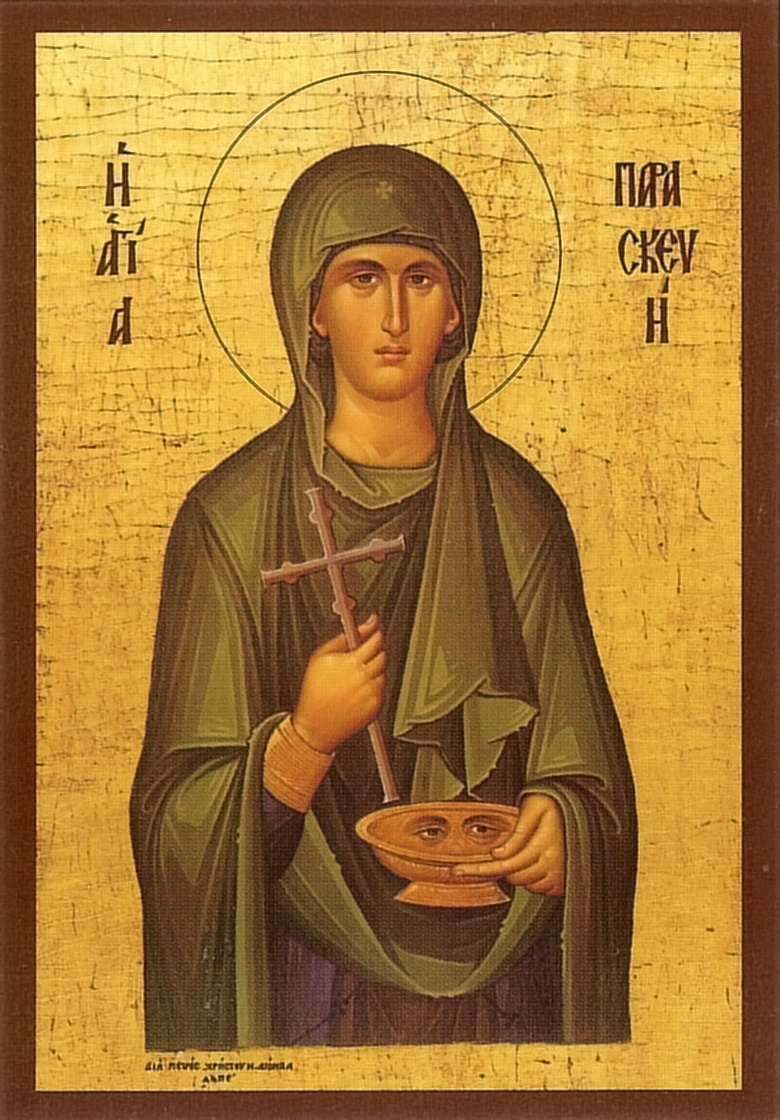
St. Paraskevi the Great Martyr
Homily on St. Paraskevi by Metropolitan Avgoustinos Kantiotes (+2010)
"A Bedrock of Virtue"
St. Paraskevi was not an ordinary woman. She was a spiritual meteor, a bedrock of virtue, unshakable amid the ocean of the corrupt community.
She implemented that which Christ said, that: “He who hears my words and keeps them resembles a house built upon the rock, and though the rains came and the winds and the rivers fell upon it, the house was not shaken.” (Matthew 7:24-25) And St. Paraskevi was a bedrock of virtue. Foamy waves fell upon her, the greatest waves of life.
First, the wave of corruption fell upon her. She was not born in a small village. She was born in the most corrupted city, which in the Holy Scriptures is called the Babylon of the world due to its corruption (Revelation 17:5). She was born in Rome, in a suburb of Rome. But however, she remained uplifted. She was a lily among the dung of her community.
Let us all hearken to this, for when we see some woman being led astray, we say: “The community is responsible.” Yes, the community is responsible, I don't deny this. But she herself is also responsible. Give me a woman who loves Christ like St. Paraskevi, and throw her into the most corrupted community, and no wave and no devil could shake her.
As soon as one wave left, a stronger wave fell upon her: the wave of orphanhood. This wave is terrible. St. Paraskevi was orphaned of her father and her mother. Because of this she is a protector of orphans. She was orphaned at that age when children could become prey to unscrupulous traffickers who try to exploit them. But she stood tall even while an orphan. She had within her a great fervor for holiness, the life of virginity and grandeur.
Woe to the woman who does not have these great desires. No matter how high she climbs, no matter how many qualifications she has, she is deplorable. It is better to be an unlettered villager, which is like a lily, like the flowers that grow in the crags of the rocks of our homeland.
Therefore, the waves of corruption and orphanhood fell upon her, but she remained untouched. Because of this I call her a rock. Furthermore, another rock fell upon her, that of money, of wealth. After the death of her pious parents, she remained the sole inheritor of their vast property, which they left to her.
Every other girl would think differently. One might buy silken clothes, one might go to dances and gatherings, one might run right and left, would go on trips, would experience the spirit of the sinful life. St. Paraskevi however did the opposite.
Money is a great temptation. It is better to be a blessed poor person. Thrice-blessed are little huts, more than great homes. Because in huts dwell diamonds, while in the palaces and the large homes dwell many times prideful souls, who do not love Christ.
Money fell into the hands of St. Paraskevi. But she did what St. Anthony did, who had also inherited vast property. He went into church one day. His ear hearkened to the Priest who was reading the Gospel: “Sell your goods and give them to the poor.” (Matthew 19:21) Sell everything and give them to the poor. Anthony heard this. And he did not say that Christ was saying this to others. He distributed his property to the poor. As he hearkened to the words of Christ, so did St. Paraskevi. She kept only a small amount, and with this she founded a small sisterhood of orphan women virgins, who were dedicated to preaching, to enlightenment and to philanthropy.
So many foamy waves fell upon St. Paraskevi. Finally, the red wave of blood fell upon her! It was a time when only one would be heard to be a Christian, and one would be put in prison. They seized her at that hour when she had gathered the girls together to teach them. They led her before the judge. They asked her: “Are you a Christian?” She responded: “I boast that I am a Christian.” “We give you,” they said, “three days time to deny Christ.” “No,” the Saint responded, “I don't need time to decide. From this instant I dedicated to sacrifice my life for Christ. Do whatever you wish.”
And her martyrdom began. They threw her in a dungeon in the prison. They whipped her with bullwhips. They threw her to the wild beasts. They threw her into a cauldron with burning tar and oil. She endured many forms of martyrdom, but all of these she conquered through the power of Christ.
At the end, her hour came. They took her to a temple of the idols with statues of the false gods. She knelt, closed her eyes and made a mystical prayer to God. Immediately, there was an earthquake. The statues fell to the earth and became dust.
They couldn't stand it anymore. Thousands of barbarous hands of the idolaters seized her, took her outside and to the place of execution. Her face was shining like the sun. She knelt, prayed and thanked God. Finally, she was beheaded by a Roman soldier. And while her precious head fell down, and her blood watered the earth, her soul, white as a dove, flew to the heavens.
Since then, how many years have passed! But as long as the world will exist, the name of St. Paraskevi will remain unto eternity. For: “The memory of the righteous is unto eternity.” (Psalms 111:6)
My brethren, St. Paraskevi is an example for all of us. But foremost, she is an example of a virtuous life and faith for women and young people. In this age of great corruption, she is the example and the mirror for virtue for womanhood
We live in a time of Babylon, a time of the Apocalypse, when the devil is roaring. He tries to strike the whole world. But most of all, he rabidly fights to strike and to soil girls and women. He wants not a single girl to remain unsoiled.
He fights we terrible magazines and newspapers. He soiled our girls with terrible brochures, with movies, with TV shows, which are schools of crime and dishonor. He soils them with mixed baths, with terrible photographs, with corrupting dances, with parties. The day will come when you will not find a pure girl. What will we do?
To arms, my brethren, to arms! Not to physical weapons, but to spiritual ones. Fathers, mothers, look towards the honor of your girls.
I'm finished, but rather, I'm not yet finished, because I want to be paid. What payment? Money? I am a monk and I leave that to you. I will not finish my homily unless my soul is satisfied.
Do you want your homes to be blessed and your girls to be secure? Today, the feast of St. Paraskevi, I entreat you all to do three things. First, go straightaway to your home, and look everywhere to find terrible articles and pictures, and gather them to light them with a holy fire to burn them all. Second, I recommend to all of you to go buy the life of St. Paraskevi and an icon of hers to hang in your home, and speak to your children: “My daughter, my child, become like St. Paraskevi.” And the third thing? Having done the first two, light a candle for the wayward women, those who live in filth and dishonor, and say to St. Paraskevi: “St. Paraskevi, you who are a lily of heaven, help these women of Greece, the women of the whole world to return near the Panagia, near to God, near to Greece, so that we might all have the protection of the Holy Trinity”, Whose blessings I pray might be with you all. Amen.
+Bishop Avgoustinos
(homily delivered in Chaidari, Athens, before 1967)
(amateur translation of text from source)

St. Paraskevi the Great Martyr
Through the prayers of our Holy Fathers, Lord Jesus Christ our God, have mercy on us and save us! Amen!
source

The Beloved Physician
“Embrace Luke, the beloved physician” (Col. 4:14)
Today, my beloved, is a feast and celebration. St. Luke celebrates, one of the stars which enlightens the heaven of our holy Church.
Who was St. Luke? It is not sufficient to hear the name and to celebrate the memory of a Saint. We must know his life, and above all, imitate his virtues. As the holy Chrysostom said: “To celebrate a Saint is to imitate the Saint.” Because of this, let us say a few words about this Saint.
Luke! And his name alone reveals something, it has meaning. The word “Luke”, as philologists say, comes from the Latin root (lux) which means “light”. From this are derived other words as well. For example, “Lyceum” [corresponding to high school in modern Greece], meaning the school that enlightens, and woe if this school does not enlighten but darkens. Lyceum=the school that enlightens, and Luke=enlightened, radiant. He, of course, was not enlightened from the start, for initially he was an idolater. He was born when everyone worshiped idols and made them gods. He was a Greek by lineage. His homeland was Antioch, that great center of Hellenism in the East. That was his life before Christ, until he believed.
His calling was to be a physician (there was at that time a great medical school in Tyre). Furthermore, according to tradition, he had the talent of drawing pictures. Studying medicine, he found himself in Thebes of Viotia, and heard the Apostle Paul, came to know him, believed in Christ, was baptized a Christian, and therefore named Luke—enlightened.
From then on he followed the Apostle Paul. The life of Paul, however, was not like the life of today's priests and bishops, as we partake of silence and general comfort. It was a hard life, with poverty, trials, persecutions, shipwrecks, martyrdom, the cross. How many times was he not cast out, seized, flogged, imprisoned, and stoned (by Judeans and idolaters and Roman emperors)? And ultimately he was beheaded in Rome.
Throughout all of these situations, Luke did not abandon Paul. He remained near him, near him through these events, near him through his afflictions, near him through all the trials, until the end of his life. Among the fellow workers of Paul, Luke takes the greatest place, of whom he writes: “Luke, the beloved physician” (Col. 4:14). He names him “physician”, because he must have been useful to him many times, when the Apostle Paul was sick and had need of medical care.
Luke did not see Christ with his eyes, but he heard of the Lord from those who were “witnesses and servants” of the apostolic preaching (Luke 1:2), and especially from the Apostle Paul. This made a great impression on him, such that he could give a faithful representation of the Lord, and of the apostles and the life of the first Church. He believed deeply, and that which he believed, he preached. And as the Apostle Paul completed his path, Luke fled from Rome. He began to travel and to preach the Gospel of Christ. He circled throughout all of Greece, and finally, he returned to Thebes, where, according to a tradition, he became bishop, and there peacefully gave up his holy soul at the age of 80.
He preached with his tongue, he preached with his life and his example, he preached with his miracles. He will forever preach, however, with his God-inspired writings, and especially his Gospel. Whoever reads the Gospel according to Luke, thinks that he is watching the life of Jesus Christ like a movie. The Gospel of Luke is the sweetest Gospel. It is characterized as the Gospel of love, of forgiveness, of mercy, the Gospel of the compassion of God. One of these is the following:
In the Gospel of Luke is found the story of a sinful woman. She had worked orgies. She knew many men and was corrupted. The supposedly holy people in Israel, the Scribes and Pharisees, cut off communion with her, did not approach her, nor even told her a good morning. This woman one day went to Christ. He did not cast her out. He let her be, and she approached Him, knelt, sprinkled His feet with her tears and with her myrrh, and using her hair has a towel, wiped the spotless feet of the Lord. But because Christ accepted her actions, the others were scandalized. “Oh my, what is she doing?!” they said, “If he were a prophet, he would know who is touching him...” And then Christ said a great saying, which is impossible to measure, and which strikes me so deeply. Listen to what He says: “Her sins, which are many, are forgiven, for she loved much.” (Luke 7:47) In other words, the Scribes and Pharisees did not love Him, the “Learned” of that age did not love Him, the Romans did not love Him. This wretched woman loved Him, and she shed bitter tears of repentance. She sensed the redemption which Christ grants.
The Gospel of Luke is the Gospel of Joy. It begins from the Annunciation of the Theotokos, with the greeting of Gabriel: “Rejoice, O Full-of-Grace...” (Luke 1:28), and proceeds with the Nativity of Christ, and the joyous angelic message: “Behold, I bring you tidings of great joy...” (Luke 2:10), and ends again with the joy of the Apostles when they saw Christ ascending to the heavens: “And they, having worshiped Him, returned to Jerusalem with great joy” (Luke 24:52). The Gospel is joy. There is no other true joy anywhere. Joy is Christ. Whoever is tried, approaches, and believes like Luke did, he will see that his sorrow becomes joy, and his darkness, light.
All of us, beloved, are sick—not as much bodily as spiritually—and all of us have need of healing. Because of this, Christ founded His Church, for it to be a hospital for all men. He Himself is “The Physician of our Souls and Bodies” (Divine Liturgy), and He offers healing, medicine and therapy. His fellow workers in this healing work are the chosen men that He called, the Holy Apostles, the Holy Fathers, and the Clergy of today.
Luke was a physician of bodies, who placed his scientific knowledge towards the service of every sick person in pain. However, he himself had need of a physician, the Physician of the Soul. And he found the Physician. He found him in the person of the Apostle Paul, who led him to the hospital of the Church. But the Apostle Paul, before he could offer spiritual healing to Luke, he himself had needed this, which he received walking on the road to Damascus, from our Lord Jesus Christ Himself, Who is the Physician of physicians. In other words, the Apostle Paul and the Evangelist Luke, in the Church of Christ, approached as sick men, and having been healed, with the grace of the Lord, became physicians of the others.
On the feast of the holy physician Luke, I now direct this towards those who share his art.
My beloved physicians, nurses, and all those who serve the sick in any way! No one dishonors the worth of your sacrifice. Everyone knows this and confesses this. But I want to remind you that man is not only a body, he is also a soul. And when you offer healing and therapy to others' bodies, know that you also need healing of your souls. You have a soul that is immortal and beyond all worth; take care of it. You behold the reality daily that this life ends. Work towards your eternal healing. Imitate in this way your protector, St. Luke. Approach with faith the Physician of physicians, and the healer of the whole human existence.
I pray that our Lord Jesus Christ, through the intercessions of the Evangelist Luke, may always be with you. Amen.
+Bishop Avgoustinos (Metropolitan Augustine Kantiotes of Florina, of blessed memory)
http://full-of-grace-and-truth.blogspot.ca/2014/10/homily-of-metropolian-avgoustinos.html