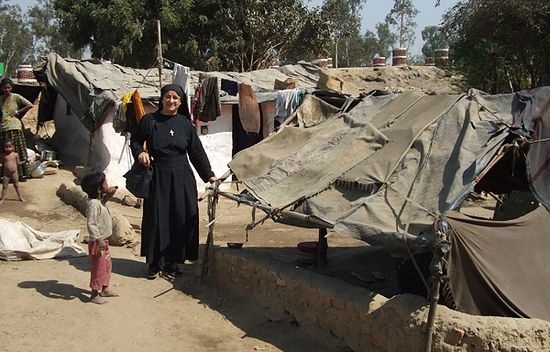
Sister Hatune Dogan visits a slum city in India
It is the season of “peace on Earth,” but Sister Hatune Dogan has a chill in her spirit that could only be felt in a time of war.
The Orthodox Christian nun feels it with each new atrocity committed against the Yazidi and Christian minorities of Syria and Iraq. She feels it in the church burnings across Egypt and the slaughter of innocent children in Pakistan.
For this reason she brought a word of warning to Americans in a visit last week to Minnesota, where she spoke to several church groups.
Today's political climate draws her back to 1915 and her native Turkey, when her family experienced the cruelty of the Ottoman caliphate, which slaughtered 3 million Christians and reduced others to second-class status under subjugation, or “dhimmitude.”
ISIS is nothing new, she said, just the re-emergence of Islam's dark side.
“ISIS is not fanatic. ISIS is not more terrible. ISIS is real Muslim believers who like to follow the Quran and Muhammad,” said the founder of Warburg, Germany-based Sister Hatune Foundation, a worldwide relief organization that has been honored by the German government for its dedication to human rights.
“Others say they are Muslim. They say they believe Quran, but they don't follow it,” she said.
Armenian Christians accounted for about half of the 3 million who lost their lives in Turkey, but the other half were Christians of various ethnic backgrounds – Greek Orthodox, Syrian Orthodox and Protestants. All felt the boot of jihad against their heads.
Sister Hatune arrived last Thursday at the Atlanta airport for a stopover on her way back to Germany. She was dressed in traditional black garments and a habit covering her hair. She wore a simple wooden crucifix around her neck and carried with her a well-worn copy of the Quran, which has become her constant companion wherever she goes to teach about the current situation in the Middle East.
She believes Christians in the West should learn what is written in the Muslim holy book. If they did, they would realize that the Islamic State, also called ISIS, is not doing anything that hasn't been done in the past by devout Muslims who have conquered a people they see as “infidels.”
Where are all the Christians?
Sister Hatune points to the fact that 96 percent of the people who populated the Middle East at the turn of the eighth century were Christian. Now, that Christian population has dwindled to 6 percent. Turkey was once almost all Christian, but now it is 0.03 percent Christian. Iraq had 1 million Christians under Saddam Hussein, but now only a few thousand remain, and the churches of Baghdad will be mostly empty this Christmas.
“Where are these Christians? Where are these people? Just ask yourself,” said the fearless nun, whose native tongue is Aramaic.
Her family initially lived in Turkey as Jews, but later her entire village converted to Christianity.
Born in 1970 the middle daughter of 10 children, Sister Hatune learned to speak 13 languages, but none make her more proud than Aramaic.
“This is the language of Jesus,” she told WND.
The Sister Hatune Foundation works in 35 countries with Matthew 25:34-40 as its mission statement – feeding, clothing, sheltering and providing medical care to the poor and persecuted of the world. She has been making regular trips to the Middle East since 2005, and ISIS presents a new challenge: trying to rescue orphaned children from its clutches.
Sister Hatune returned to her home convent in Germany for only a few days before she will make another trip to the Middle East to celebrate Christmas with persecuted Christians. She was with them in November when she visited refugee camps in Iraq, Jordan, Lebanon and Turkey. She also sneaked into Syria to meet with Christians there.
“They need your support. Without your support they can't continue,” she says in avideo showing her with a group of Yazidi refugees. “They live like animals. Starving. No food. Unsanitary. No one should have to live like this.”
It's a plight she is all too familiar with. Her question “What happened to all the Christians?” is purely rhetorical and completely personal. Her family lived through the genocide of 1915 in Turkey, the country from which her parents fled in 1985.
Her great-aunt Sarah lived through the persecution in Zaz, a small village in southeastern Turkey, in 1915.
“She was 18 years old, very beautiful. One of the Muslim men saw her and said, ‘She is beautiful. She belongs to me,'” Sister Hatune said.
Sarah had four brothers, a mother and father, several cousins, aunts and uncles living in the village.
“Twelve in all, in October 1915, they killed in front of her eyes,” Sister Hatune said, motioning with her hands and speaking in a thick accent. “Shot them in front of her eyes.”
The operation was carried out by Islamic jihadists, both Turks and Kurds, with the blessing of the Turkish army.
“It was planned,” she said.
In all, 365 members of her family's church, St. Demetrios, were murdered, representing about half of the village's population.
“First they shot them. More than half were still alive so they burned them alive in the church in 1915 in my village,” she said.
Her great-grandmother had two children and was forced in 1921 to beg her Muslim masters to let her keep one of them and raise him as a Christian.
It is the same experience playing out today under ISIS in Iraq and Syria.
“The most beautiful ones they take for their wives and say ‘now you have to be Muslim,'” said Sister Hatune.
The others are forced to convert or die. Many have been slaughtered in front of their parents. She has one video smuggled out of Iraq that shows three young boys, around 5 or 6 years old, being psychologically tormented by their eventual killer.
“Tell me which one should I cut first,” the man asks them in Arabic.
A long butcher knife sits on a table beside him.
“Come put your head here,” he says, as the boys scream in terror.
They take a step back, but the confines of the small room leave nowhere to run.
When neither boy steps forward to volunteer his neck, the man yells: “Come all of you. Come all of you!”
He grabs one of the boys. The one in the white shirt. The boy screams and the other two cry.
“Are you ISIS?” the man yells over the screaming boy. “Are you ISIS?”
“No!” the boy answers through his tears.
All three were beheaded. The nun said she received the video from a relative of the three boys.
In another video, shot in 2013, three Christian priests are shown being led out into a field with their hands bound. A Muslim man wrestles one priest to the ground and slices his head off while several hundred Muslims yell: “Allahu Akbar! Allahu Akbar! Allahu Akbar!”
‘I Believe in Action'
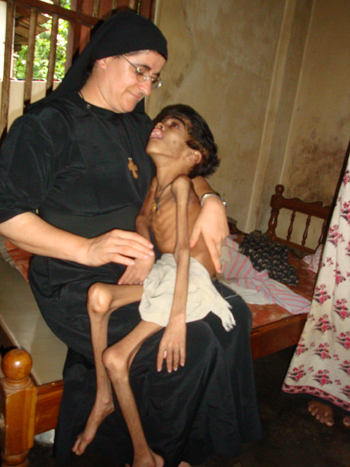 Sister Hatune holds a malnourished boy in India, one of the dozens of countries in which her foundation works.Drawing on her own family background, Sister Hatune has recently finished work on her 13th book, “I Believe in Action,” written to commemorate the 100th anniversary of the Christian genocide in Turkey. In this book she compares the life of Jesus to that of Muhammad, Islam's main prophet.
“I not write from my head. All facts,” she said. “Muhammad came and he brought killing, beheading, pedophilia. He slept with a 9-year-old girl, he married when she was 6 years old. We know because she says it herself in the Hadith. In Yemen today, where Shariah is the law, they have to marry the girl before her first menstruation, maximum of age 13, because it is written.”
Sister Hatune thumbs through her Quran and finds another verse that she says leads Muslims to murder Christians in the Middle East.
“Twenty-five times in Quran it says to kill Christians because we are involved in polytheism,” she said, explaining that Muslims do not understand the concept of the Holy Trinity. “Also it says to not make friends with Christians.”
Europe is on its way to becoming the next battleground for Islam, especially Belgium and France, where Muslims make up 6 to 10 percent of the population. Sister Hatune's adopted country of Germany is at least 4 percent Muslim and has more than 4,000 mosques.
“A mosque is not just for prayer,” the nun said. “It is to prepare to kill the unbeliever and control the world.”
In the Quran there are 97 verses against the unbeliever.
“And there are verses against the Christians who say God is Father, Son and Holy Spirit, or that Jesus is the Son of God. They have to be beheaded, the head cut off from the neck; no other interpretation. This is what the Muslims are doing. Normal Muslims, who are really Muslims, have to follow this rule,” she said. “There will never be peace on Earth if these verses of the Quran are not stopped. It is in the Quran, Hadith and sunna 36,800 times, the words ‘cut,' ‘kill' or ‘attack.' How can there be peace on Earth?”
The Quran also gives Muslim men permission to rape girls and women who are held captive as slaves (Sura 23:5-6).
In conquered cities, ISIS has marked the homes of Christians with a red symbol of the Nazarene. They are then visited by ISIS militants who bring unspeakable horrors upon the families.
Sister Hatune says it is justified under Sura 5:33 in the Quran, which states:
“Indeed, the penalty for those who wage war against Allah and His Messenger and strive upon earth [to cause] corruption is none but that they be killed or crucified or that their hands and feet be cut off from opposite sides or that they be exiled from the land.”
Muslim apologists in the West say the verse is taken out of context by “Islamophobes,” but Sister Hatune believes otherwise.
“Those of us Christians from Middle East. We know them. We know their rules,” she said.
Today there are 57 Islamic countries living under Islamic law.
“Education is not allowed for the girls. The women are created for the sex for the gents,” she said. “If she becomes raped she has to bring four men with her as witness. Of course it is impossible, so she will be stoned. There are so many women and girls who die from stoning.”
Sister Hatune recalls going to school in Turkey as a young girl. Even though everyone in her village was Christian, no Christians were allowed to hold positions of authority under Islamic law, so all her teachers were Muslim. If the Christian children were caught going to church the teacher would beat them, usually by striking their hands with a metal rod.
She said the Turkish government confiscated all the guns from Christians before launching a violent jihad against them.
“Village by village they came and said, ‘If you don't give your guns we will put you in prison for seven years,'” she said.
At the age of 14 Sister Hatune left Turkey with her parents in 1985, finding refuge in Germany. She joined a monastery there called the Sisters Serving Christ when she was 16.
“We were a rich family. They threatened my father to cut him here,” she said with a tug on the lower portion of her ear. “He run away. He said this is enough. We must leave everything and go.”
Watch video below of Sister Hatune relating her life story growing up under the “hard persecution” of the Turkish regime, which she said “pretends to be liberal” but is one of the world's most fanatical Muslim countries.
Theodore Shoebat, son of former Palestinian terrorist-turned Christian Walid Shoebat, described Sister Hatune in a Dec. 30, 2013 article as a modern-day Mother Theresa.
“Hatune's willingness to help the persecuted is so immense that it surpasses what anyone is doing today in the Middle East,” Shoebat wrote. “She has visited 38 countries and worked in the Ministry of Charitable and Social Service in Zimbabwe, Turkey and in India. Her righteous deeds of course receive the vociferous wrath of the jihadists, in the words of Dogan, ‘I get 18 death threats in seven languages.'”
A message for America
Sister Hatune came to America last week to seek donations for her ministry to the persecuted minorities of Iraq, Syria, Egypt and India. Most of these minorities are Christian but many in Iraq and Syria are of the ancient Yazidi sect. In one video Sister Hatune appears in a Yazidi refugee camp surrounded by families who have nothing but the clothes on their backs.
She came to America with a plea for help. But she also came with a message for Americans.
“America is inviting its own slaughterers to its door,” she said, referring to the U.S. policy of taking in Muslim refugees through the United Nations refugee program.
WND reported Dec. 11 that the U.N. has assigned 9,000 mostly Muslim refugees from Syria for resettlement in U.S. cities and towns and the U.S. has accepted nearly 2 million from Muslim countries since 1992.
“You have already a parallel society in America,” Sister Hatune said. “In 50 years they will kill your grandchildren before your eyes. The Middle East is already here. It is here. It is not far from here. It is at your door.”
That's a message many churches in Minnesota were not ready to hear, said Debra Anderson, who heads a local chapter of ACT! For America and sponsored Sister Hatune's recent visit.
“She wanted to do something active. She felt faith without works was dead,” Anderson said. “But it was rough trying to get her invited to speak at the churches in Minnesota. Some of it was her message. She is very critical of the Muslim governments.”
One church group that invited her to speak gave her a reception that Anderson described as “cool.”
They visited an order of Catholic nuns and “five or six of them walked out near the end of her presentation,” she said.
“Some of the photos of human suffering she showed in her presentation; I think they were really shaken,” Anderson said. “I don't know that they had ever been challenged in their way of thinking like that. But it was all facts. We told them to check out other experts.
“But I had this one nun just interrupt me and say, ‘I am not going to listen to her anymore,'” Anderson said. “I had a hard time getting her into the churches. I really did.”
Anderson said she put out a request for speaking venues to some 800 people on her email list representing various Christian denominations.
Only a few responded with invitations.
One of the nuns from the convent in Minnesota interrupted Sister Hatune's presentation with a specific concern.
“Sister, that's enough,” she said, voicing her concern about a potential backlash against Muslims in the community if Sister Hatune's documentation were to ever get widely disseminated.
But while some were repelled by the stories of thousands of girls being raped and the images of Christians being crucified by ISIS or Muslims playing soccer with the heads of their victims, others responded by coming up afterward and asking how they could get more information and possibly get involved in helping these persecuted Christians.
“My mission is to help the suffering people where they are,” Sister Hatune said. “They cannot come to me, so I go to them. One hundred percent of donations go to the suffering people. We are all volunteer. We are total independent. We have no big donor now. I wish. We have two fish and five loaves, and God is multiplying.”
The work is carried out by 5,000 volunteers with no paid staff, Sister Hatune said.
An elderly German man left the Orthodox nun a small stipend to live on when he died. She pays out of her own pocket for travel, or has a sponsor pay for her flight, as was the case with her trip to Minnesota.
Now she is making plans to return to the Middle East for Christmas, hoping to bring some gifts for children.
One of those who heard her message asked her if she was afraid.
“Everyone has fear,” Sister Hatune said. “But I am called to show solidarity. You do that, not with talk, but with action, with duty. Jesus is my body guard.”
The nun says Islamic culture is basically “like a dog,” in that it must be confronted. If there is a void or a weakness in the Christian culture, the Muslims will sense that weakness and continue to march through and intimidate the native culture.
“You cannot be afraid of Islam culture,” she said. “If you run, they will come after you like dog culture. You must stand your ground. I don't say fight. I say resist. I say to them, ‘Stop. I don't want you. I have my own God.' They come here thinking to conquer the country. If they don't accept the American way of life, go back to your home. The government has to understand this.”
http://www.pravoslavie.ru/english/76204.htm


