Showing posts with label Monasticism. Show all posts

Wednesday, August 28, 2013

So Your Child Wants to be a Monastic?


The following talk (slightly condensed) was given [in 1984] at the Saint Herman Winter Pilgrimage in Redding, California.

I should like to ask you to think of something you may not have considered before, How would you feel if your son or daughter expressed the desire to enter a monastery? You may be Orthodox, and very devout; you may he diligent in attending services and reading spiritual books; you may have tried your best to raise your children in an Orthodox manner; you may even admire monasticism. Nonetheless, how would you really feel?


We live in a time and society quite different from Greece and Holy Russia, where monasticism was a visible and acceptable part of life. It was not uncommon for entire families to make pilgrimages to monasteries. Few people today, however, have any significant exposure to monasticism and it is little wonder that in our un-Orthodox and even anti-Christian society, the very thought of one’s child becoming a monastic can seem very threatening.

There are a number of reasons one can give for such a reaction. Lack of familiarity breeds fear. Not a few people imagine monasticism to be very grim and even inhuman. They may envision their child locked behind a grating and subsisting for the rest of his or her life on bread and water. The other extreme is an equally- erroneous view of a romanticized spiritual state in which the child spends his days floating above the ground in an exalted state of endless holiness. In both cases it is imagined that entering a monastery presupposes leaving behind the human race. The reality of the monastic life is a far cry from either of these extremes. Your son or daughter—who is always late, leaves socks and soda bottles everywhere and is generally infuriating–will not turn into an instant anchorite. Anyone who leaves the world for the monastery brings all of his weaknesses and defects with him. He may learn to overcome some of them; others he will have until bodies, In any case, if your child becomes a monastic, he or she will not be living without human warmth and human relationships, and in spite of everything, you will still recognize them as being one of your own progeny.

Whatever your initial reaction to the issue of monasticism and your child, it depends to a great extent on how you as a parent view the Orthodox family and your position as an Orthodox individual in the contemporary secular world. Surrounded as we are by worldly standards and a materialist culture, we forget that Christ calls all of His followers to separate themselves from the world: Be not of this world. This is the trumpet call of monasticism. With this understanding, you should be more ready to peacefully acquiesce to the son or daughter who has found it in his heart to answer this call by taking upon himself the monastic yoke.
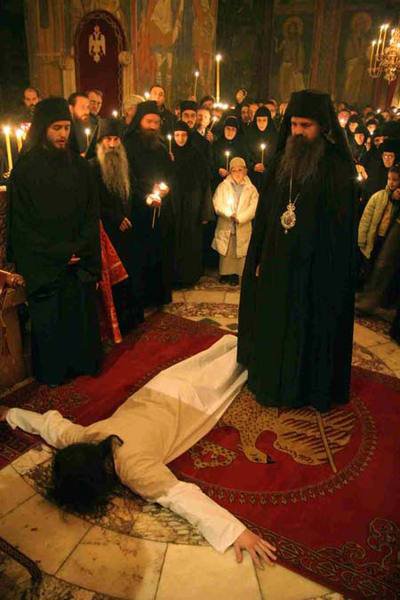


We are, however, the unfortunate products of our fallen nature, and it is rare that even a pious Orthodox parent is thrilled to hear that their offspring desires to enter a monastery. More often there arise some very strong reactions in the heart which, however innocent and well-intentioned, are nonetheless aspects of our fallen emotional and psychological nature – and a sad reflection of our un-Orthodox background and environment. With this in mind we can examine some of the emotional responses which this issue so often evokes.

Verbally, the various emotions stem from the pivotal question, “Why?” Why does anyone leave the world to enter a monastery? If the reason is legitimate, it is because in spite of all his failings and weaknesses, your child loves God more than anyone or anything in the world–more than the life you helped shape him for, more than his automobile, more than the school to which you were going to send him, more than his family… And here the very natural feeling of jealousy arises. As parents you may endeavor to replace God as being central in your child’s affections and persuade him to forsake monasticism, If you succeed, you will only make the child unhappy, and if you fail, you’ re going to feel very hurt.

Secondly. you may feel estranged or shut out from your child’s life. If your daughter goes to a monastery, and it’s a life you have not shared, you may feel you can’t relate to her. If she married, even if she moved a thousand miles away, you would very likely feel that you were still more a part of her life than if she became a nun and lived 50 miles away. A married daughter would still need advice on how to cope with the children’ s illnesses or how to manage a tight budget. On the other hand, if she were in a convent, you could hardly give her advice on how to do Matins, and even if you are Orthodox, you might feel emotionally adrift and very awkward with this suddenly foreign someone in black whose life is so different from your own. Then there is also the fact that most parents look forward to being grandparents, this is a big issue, especially with mothers.

You may feel threatened. You spend your whole life nurturing the well-being of your children: you feed them and worry over them; you help them to discover their abilities and you encourage them to develop their talents. Perhaps your son is a natural musician or your daughter a born lawyer, and you spend your life supporting them–emotionally and financially–and preparing them to be successful in the world. And after all these years of effort and anxiety, they suddenly decide they want no part of it, they don’t want the world, nor the life that you envisioned for them. This can be a very threatening and painful revelation. Very often parents feel that in rejecting the world, their child is also rejecting them. This is not necessarily true at all, but this feeling sparks most of the disputes between parents and their children over the issue of monasticism. Here also parents may feel they have failed in some way in their raising of the child, that he or she should choose such an “aberrant” path in life. This is also a painful thought.

The rather heated emotions which may arise over the issue of monasticism and one’s child frequently result in a barrage of reproaches. The following examples are not in the least hypothetical; they come from a list of actual remarks made by real mothers and fathers, some of whom consider themselves to be devout Orthodox. Their responses illumine the essence of the dispute as it is felt in the heart of those who are Orthodox and yet live in the world. They’ve said that we are not taking responsibility for ourselves; that we are just leaning on someone else so as to avoid having to make our own decisions. They say that if we love our neighbor we should be working to improve society and not dropping out of it into some euphoric dream. We often hear that monasticism is mere ostentation, some kind of fake spirituality: “Why don’t you stick it out in the world like the rest of us, where you have to deal with real life and real problems?” They say monasticism is selfish, egocentric, it divides and ruins the family; monasticism is “financially unstable”: What about your future security? Why don’t you just get a good job and send them all the money?…

While these remarks are quite varied, there is a common denominator, and that is worldliness. They are all rooted in a very worldly orientation. It is the complete and absolute rejection of this perspective on the part of the monastic aspirant which often makes the dispute between parents and child so violent, Although perhaps unconscious, the parents’ message underlying all this is: Conform yourself to the world; fit in; get a secure job; settle down; do what everyone else does…; spirituality is fine, but there’s no need to be extreme. We have already seen, however, that Christianity is otherworldly; by its very notate it is extreme: if you lose your life you shall gain it; if you try to hang onto it you will lose it; God became man that men might become gods. What could be more extreme?

Seek ye first the kingdom of God

Orthodoxy is the means by which we ascend unto God, through surrendering our own ego and self-will. Orthodoxy means war–against one’s fallen nature, against the devil, and against the world. This applies to all Orthodox Christians. Even those who live in the world–who have children and hold jobs–are required to keep themselves in some sense apart from the world. And there can be no compromise. The world is not and cannot be our home, and whether we choose to marry Christ or an earthly spouse, we can in no sense marry’ the world. We see, however, that it is precisely this desire–to have both God and the world–that is at the rooter the conflict evoked by the child’s entrance into monasticism. Experiencing their own reaction to the child’s rejection of the world may make the parents realize, perhaps as never before, their own attachment to the world, and how unwilling they are to sever themselves from the values and desires of the anti-Christian society in which they live.

It is especially difficult to struggle against the accepted view of the family which in this country has received a pseudo-religious status; youngsters are often all but worshipped as gods by their parents who see them as fulfilling their own egos. This is not Orthodox; it is, in fact, very destructive of our Orthodoxy which teaches that children are not the possession of their mothers and fathers: they are not playthings of their parents’ imaginations. Children are given by God for a time that they may be raised up in the knowledge of Him, and after that He summons them as He will. The duty of parents is not to prepare children to settle comfortably in the world, but to shepherd their souls, to prepare them to battle against the fallen world. Those who choose to fight in the front lines are those who hear the monastic calling. If your child wants to enlist in that war, he will swear before God and man that despite his sinfulness and frailties that overwhelm him at every hour of the day, he cannot find rest apart from God.

If such is the inclination of your child, do not hold him back, however logical your reasons For wanting to do so may be. If the desire for monasticism is simply a fanciful notion, they will find out soon enough, and nothing will be harmed by their trying. If, however, such a desire has indeed been planted by God as a means of their achieving salvation, don’t thwart it by trying to persuade him first to finish school or experience life in the world. Bring to mind the countless number of monastics, both men and women, whose spiritual legacy has so greatly enriched our holy Orthodox Church. If your child has the desire and determination to follow in their steps, however weakly, bless him, let him go. And may this blessing be also unto your own salvation and that of others.

Saturday, August 3, 2013

Hagiorite Orthodox monasticism


The Hagiorite Orthodox monasticism is not isolated from the world; it is not unsociable. On the contrary, one might say that the genuine monk is more sociable than the laity, since he directly communicates with the supreme social Being, the Creator of man and society: the Lord. As hagiorite monks we ache and worry about the future of man theses days. Many discontented people visit the Holy Mountain, distraught by impossible troubles which cause a deadlock. The wrong way of living is the main culprit for all the hardships; that is, life outside the Church.

Our times are such that everything surrounding us and our values is going through a crisis. Scientific and technological advances affect our social lives; consumerism, hedonism, the ideological chaos and the abundance and confusion of theories as well as globalization indicate that modern man finds himself at a crucial turning point in his history.

Under these circumstances, it is very difficult even for a thoughtful adult to have a clear cut idea of his status and recognize what his truly personal options are without being swayed by other factors or to understand where he can move freely and how he is being dominated by something or someone. If this is tricky for a mature person imagine how complicated it is for a student or a pupil, who also have to deal with their hitherto unrecognizable fits and starts at an age when they ought to establish their personalities and create their own identity!

Education is an institution which aims to cultivate one as a person, to develop his spiritual values and complete his personality. The Ancient Greek philosopher, Plato, used to say: “All knowledge when separated from justice and virtue is seen to be cunning and not wisdom” (Plato Collected Dialogues: Menexenus: p 196, 246e-247a). If our ancestors thought that knowledge cultivates the soul through virtue and it that it is not an external acquisition, how are we supposed to deal with it since we are not only orthodox Christians but also the descendants of the ancient Greek philosophers, the Apostles and of the Great Fathers of our Church?

In every country, education is irrevocably connected to its history, its culture and its tradition. In our island, Cyprus, Orthodoxy was the model on which education was based, since it was a shaping, life-giving factor, not just for Education but for other institutions as well.

After the British rule which lasted almost a century, foreign elements intruded into our orthodox tradition. Especially after the ‘May 1968 movement’, which begun in France and influenced the moral and social fabric of our society with the so-called sexual liberation, the denunciation of institutions, of social structures and of religion, Education changed and followed the trends and the demands of the times. It complied with the theory of usefulness and it concentrated in producing graduates who would produce, consume, develop and make money; in other words it promoted the economic and technological advancement in a bizarre way. Thus Education no longer meets the existential needs of a person, neither does it deal with moral issues or cultivate virtue; it is indifferent to religion and does not wish to be defined as ‘orthodox’.

We have unfortunately learnt that nowadays our Educational system, at all three levels, does not contribute towards the formation of a responsible, well rounded person, the true person, the traditional orthodox Cypriot. Even at the elementary level there is an attempt to cut off pupils from their traditional roots. Moreover, many intellectuals wish to modernize and secularize the Church and remove the Christian faith from the state; that is, they wish the Church to “conform to this world” (Romans 12, 2) in order to seemingly modernize it. These things cause distress and a lot of pain to the faithful and to those who love our country. Pray, where do all these take place? They take place in Cyprus, the mainly orthodox and culturally esteemed island of the Saints.

Our Educational system seems to be the product of the modern technological explosion which splits the body from the spirit, dividing man and steering him towards materialism. It deprives him of the ability to genuinely hope, to be honest in his transactions and his conscience and to remain free inside. It mostly supports his ability to move freely in scientific circles, finally feeding him with dry knowledge and education, which according to St Paul merely “puffs him up” (A Corinthians 8, 1). That is, it makes him proud, egoistic, selfish and generally speaking, full of passions. The main purpose of those who attend the Lyceum and the universities is to find a job. Of course this is what they must aim at, but it must not be their only aspiration.

Education as a measure of quality must seek to regenerate one’s heart and transform his soul. It must not seek productivity or meet the needs of the state. It must be independent from these in order to produce free persons, whom it will steer towards self-perception and the knowledge of God and will offer them a comprehensive education, which will transform them. It must not deform them with the supply of dry knowledge or make them chase after grades, inciting their attachment to the ephemeral materialism.

Teachers and those responsible at the Ministry of Education should aim to offer a proper education to the young ones, i.e. an education in Christ. They should travail in birth until “Christ is formed” in their hearts as St Paul says (Galatians 4, 19). The school and the university ought to become spiritual wombs in which a person, man in Christ, will be able to grow and mature spiritually. The school ought to cultivate genuine, eternal persons through Grace, which will be complete in the image of the only true and eternal person, Christ. This can be accomplished with the cooperation of the Church. It is only in the Orthodox Church that Christ and spiritual life are experienced. The Church is not an administrative body, a human institution, but a god-man institution; it is the body of Christ.

Teenagers and young people will not attain a high quality of life through the upgrade and renewal of the external, educational means; but this kind of life is the effulgence of the performance of someone who is cultivated inside through the Holy Spirit. It is the kind of life achieved through the compliance and the sensitization of those people who leave their mark on the lives of the young. However, we are not here to apportion blame but to sensitize people’s hearts.

Pupils and students ought not to think and act for their interest; they ought not to choose a profession to gratify their pride and their self-interest regardless of whether it will undermine them as persons. In the old days, one would choose his profession according to his skills and his abilities, namely his aptitude. These days, unfortunately the choice depends on the resulting social status or its economic prospects. Thus, one’s ability comes second. This trend is aggravated by unemployment and the fact that youngsters can no longer follow the profession they like. In this way a job often becomes servitude.

When choosing his profession a young person, who is faithful, ought to also take into account the prospects for his personal advancement and his culmination in Christ, which is a Christian’s main mission. (St Gregory of Nyssa: What is the name of a Christian or his profession?) One’s profession ought not to be seen independently but must constitute a means to advance one’s life in Christ. The Christian is called to discharge his professional duties “as to the Lord and not unto men” (Colossians: 3, 23).

All professions are good -from the road cleaner to the university professor- so long as they are performed honestly, conscientiously and meticulously. The Lord placed our forefathers in Paradise to “work it and keep it” (Gen. 2, 15).Even Christ, in His life on earth, was working as a carpenter. St Basil, the Great, says that the Church has hunters, builders, farmers, shepherds, athletes and solders as its members; each one of them ought to discharge his duties conscientiously. (St Basil: Homily on “watch thyself”). The various professions ought not to just meet a person’s needs but benefit others as well. St Paul urges each one of the Ephesians to “labor, doing honest work with his own hands, so that he may have something to share with anyone in need” (Ephesians 4, 28).

Any pupil, student or worker will be consistent in his job, his relationship with others and the Lord, if he has recognized the true meaning of his life. Namely, to accomplish his personal sanctification, his deification, which is the final objective for the creation of man.

For this reason blessed Elder Justin Popovic from Serbia was stressing that everyman is called to sanctification. Thus, a scientist may become a holy scientist, a philosopher- a holy philosopher, a farmer- a holy farmer, a rich man – a holy rich-man, a pauper- a holy pauper, an old man –a holy old man, a student- a holy student and a pupil – a holy pupil. (Justin Popovic: Man and God-Man)

This means that the evangelic message of sanctification can be applied by any man, of any social standing at any age. The struggle to attain sanctification gives life its true meaning. This struggle, albeit hard, is also sweet and full of joy, since divine Grace is walking along with the fighter. Man becomes sanctified by participating in the uncreated divine energies, irrespective of whether he is at the stage where he is struggling to cleanse himself from the passions or has attained illumination or has reached the final stage of deification. He who tries to become sanctified constantly strives to increase, advance spiritually, touch and taste dispassion. Dispassion according to St John Climax is “a never-ending perfection” (St John Climax: Climax: Homily 19th). He who experiences dispassion, i.e. sanctification, is experiencing a lasting, intense spiritual state. This state, which is the experience of divine Grace, cannot be compared to any joy or experience on earth.

If the young ones are to be better placed against Education and be able to choose the right profession so that Education will not be diluted and transformed into a job-finding vehicle, they ought to give up seeking worldly knowledge but strive to attain spiritual knowledge as described by St Paul. They ought not to seek to appease their selfish, money-oriented interests while ignoring and impinging on their spiritual needs. On the other hand, parents but realize that children are not their property but independent, unique persons. The usual habit parents have in trying to realize their own aspirations and designs through their children, torments their offspring.

Finally, educators- teachers and university professors- ought to recognize that genuine education shapes people who will offer themselves and their skills to serve others. If this is to be achieved, educators ought to demonstrate an honest and genuine care in their teaching and not simply discharge a barren, professional duty with the ultimate aim to make money. They ought to be deeply conscientious, intellectually and spiritually mature and be ready to sacrifice themselves; in addition they ought to live a pure life with integrity and orthodox conscience and ought to acquire sincere faith in Christ. Both teachers and pupils ought to learn at the great school, called Church.

source: Translated by Olga Konari Kokkinou from the Greek edition: Αρχιμ. Εφραίμ Βατοπαιδινού Καθηγουμένου Ι. Μ. Μ. Βατοπαιδίου, Αθωνικός Λόγος, Ιερά Μεγίστη Μονή Βατοπαιδίου, Άγιον Όρος 2010.

Friday, May 10, 2013

Monasticism


In our times many people and especially young people desire to see their ideas and the content of their faith embodied. To have people who live their faith and the hope in Christ with all its consequences is a great contribution to our society which, today, has an horizon­tal orientation. A contemporary Orthodox hierarch, referring to the three monastic vows of celibacy, poverty and obedience, quite aptly points out: "the evangelical exhortations of purity dedicated to God, poverty and obedience are based upon the word and example of our Lord and are recommended by the Apostles and the Fathers, as well as by the teachers and pastors of the Church, and are a divine gift which the Church received from the Lord, and which she preserves through His Grace".
Specifically, monks are not part of the Church's hierarchic structure: they do however belong to her life and participate in her sanctity. The monk is not sepa­rated from communion with his brothers nor is he indifferent to the world and its problems.
The true monk does not live inwardly, separated from the world, nor has he abandoned his responsibility for the world. He lives for the entire world with which he feels deeply united. His vocation and his charisma is to be a prophet and a preacher of the coming Kingdom, a living icon and proof of the future life.
In the life of the world the monk constitutes the indicator, the finger pointing towards heaven and reveals to the world another reality, the reality of heaven.
He deeply believes in the new creation "in Christ"; by his life he proclaims the superiority of the Kingdom of heaven vis-a-vis this life, and by his actions con­fesses: " I look forward to the resurrection of the dead and to the life of the future age".
This contribution is great, especially in today's world where everything is orientated towards the earth and runs the risk of being condemned unto death.

Related Posts Plugin for WordPress, Blogger...