On an island far from the mainland, the Valaam monastery is one of the Russian Orthodox Church's holiest and most isolated sites. Join James Brown as he meets the monks, mucks in with the volunteers, and encounters a special group of children in one of most spiritual places in the country.
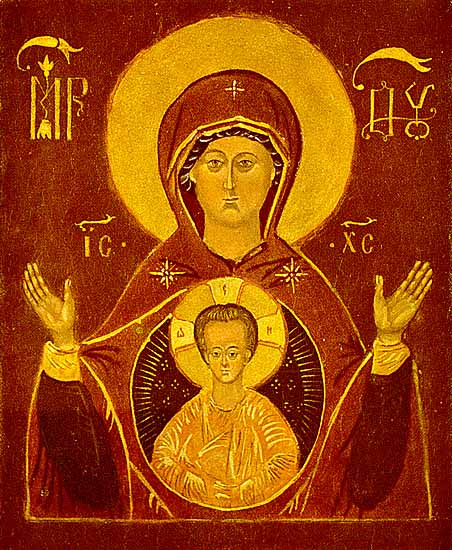
In the 13th century, during the dreadful period of the Tartar invasion of Russia, the devastated province of Kursk was emptied of people and its principal city, Kursk, became a wilderness. Now, the residents of the city of Rylsk, which had been preserved from invasion, often journeyed to the site of Kursk to hunt wild beasts. One of the hunters, going along the bank of the river Skal, which-was not very far from ruined Kursk, noticed an icon lying face down on the ground next to the root of a tree. The hunter picked it up and found that it was an icon of the Sign, such as was enshrined and venerated in the city of Novgorod. At this time, the icon's first miracle was worked, for no sooner had the hunter picked up the sacred image than there immediately gushed forth with great force an abundant spring of pure water. This took place on September 8th in the year 1295.
The hunter constructed a small wooden chapel and placed the newly manifested image of the Mother of God therein. The residents of Rylsk began to visit the place of the manifestation of this holy object and the icon was glorified by miracles all the more. Prince Vasily Shemyaka of Rylsk ordered that the icon be brought to the city of Rylsk itself and this was done in a solemn manner, for the people of the city went forth to met the icon of the Mother of God; but Shemyaka himself declined to attend the festivities and for this reason was punished with blindness. The prince, however, repented and straightway received healing. Moved by this miracle, Shemyaka constructed a church in the city of Rylsk in honor of the Nativity of the All-Holy Theotokos, and there the miraculous icon was enshrined on September 8th, the day of its manifestation, appointed as the annual feast date.
But the icon vanished in a miraculous manner and returned to the place of its original appearance. The residents of Rylsk continually brought it back, but each time it returned to its former place. Then, understanding that the Mother of God was well pleased to dwell in the place of the manifestation of her image, they eventually left it there in peace. Innumerable pilgrimages streamed to the site and services of supplication were celebrated there by a certain priest whose name was Bogoliub and who dwelt at the site of the wooden chapel and struggled there in asceticism.
In the year 1383, the province of Kursk was subjected to a new invasion of Tartars. They decided to set fire to the chapel, but it refused to burn, even though they piled up fuel all around it, and so the superstitious barbarians fell upon the priest Bogoliub, accusing him of sorcery. The pious priest denounced their foolishness and pointed out the icon of the Mother of God to them. The malicious Tartars laid hold of the holy icon and cut it in two, casting the pieces to either side. The chapeI then caught fire and the priest Bogoliub was carried off a prisoner.
In his captivity, the God-loving elder kept the Faith, placing his hope on the all-holy Mother of God, and his hope did not fail him. Now, one day as he was guarding flocks and passing the time by singing prayers and doxologies in honor of the Mother of God, there passed by some emissaries of the Tsar of Moscow.
They heard this chanting, arranged to ransom the priest from captivity, and Bogoliub returned to the former site of the chapel. There he found the pieces of the miraculous icon which the Tartars had cast away. He picked them up and straightway they grew together, although the signs of the split remained. Learning of this miracle, the residents of Rylsk gave glory to God and to His all-pure Mother. Again they attempted to transfer the holy icon to their city, but once more the miraculous image returned to its former place. A new chapel was then built on the original site of the icon's appearance and here it remained for about 200 years.
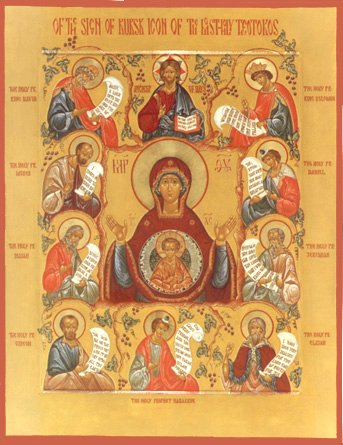
The city of Kursk was revived in the year 1597 at the command of Theodore Ivanovich of Moscow. This pious Tsar, who had heard of the miracles of the icon, expressed his desire to behold it, and in Moscow, the icon was greeted with great solemnity. The Tsaritsa, Irene Theodorovna, adorned the holy icon with a precious riza. At the command of the Tsar, the icon was set in a silver-gilt frame upon which were depicted the Lord of Hosts and prophets holding scrolls in their hands. The icon was subsequently returned and, with the close cooperation of the Tsar, a monastery was founded on the site of the chapel. A church, dedicated to the Life-bearing Spring, was built above the same spring that had appeared when the icon was first revealed and the monastery attached to it was called the Kursk Root Herrnitage in honor ofthe manifestation of the icon at the root of the tree.
During an invasion of Crimean Tartars, the icon was transferred to the cathedral church of Kursk, and an exact copy was left at the Hermitage. Tsar Boris Godunov bestowed many precious gifts for the adornment of the icon and even the pretender, the false Dimitry, who desired to call attention to himself and to win the support of those who lived in the vicinity of Kursk, venerated this icon and placed it in the royal mansions where it remained until the year 1615.
While the icon was absent from the city of Kursk, the grace-bearing aid of the Mother of God did not forsake that city, for when in the year 1612 the Poles laid siege to Kursk, certain of the citizens beheld the Mother of God and two radiant monks above the city. Captured Poles related that they, too, had beheld a woman and two radiant men on the city walls, and that this woman made threatening gestures at those who were conducting the siege. The citizens then made a vow to construct a monastery in honor of the all-holy Theotokos and to place the miraculous icon therein. The besiegers were quickly put to flight and in gratitude to their heavenly helper, the people of Kursk built a monastery in honor of the all-holy Theotokos of the Sign.
In 1676, the icon of the Mother of God of the Sign was borne to the Don River to bless the forces of the Don Cossacks. In 1684, a copy of the miraculous icon of the all-holy Theotokos of the Sign was sent to the Monastery of the Root by the sovereigns and great princes Ivan and Peter Alexievich. This copy was set in a silver-gilt frame and a command was made that this copy be borne wherever Orthodox warriors went into battle.
In the year 1812, the Kursk Civic Society sent to General Kutuzov a copy of the miraculous icon of Kursk, setting it in a silver-gilt frame. The commander expressed his gratitude to the citizens of Kursk and his belief that Kursk would remain free, thanks to the protection of the Queen of Heaven.
In March of 1898 a group of anarchists, desiring to undermine the faith of the people in the wonderworking power of the icon, decided to destroy it. They placed a time bomb in the Cathedral of the Sign, and at two o'clock in the morning a horrendous explosion rent the air and all the walls of the monastery were shaken. The frightened monastic brethren rushed immediately to the cathedral, where they beheld a scene of horrible devastation. The force of the blast had shattered the gilded canopy above the icon. The heavy marble base, constructed of several massive steps, had been jolted out of position and split into several pieces. A huge metal candlestick which stood before the icon and been blown to the opposite side of the cathedral. A door of cast iron located near the icon had been torn from its hinges and cast outside, where it smashed against a wall and caused a deep crack. All the windows in the cathedral and even those in the dome above were shattered. Amid the general devastation, the holy icon remained intact and even the glass within the frame remained whole. Thinking to destroy the icon, the anarchists had, on the contrary, become the cause of its greater glorification.
Every year on Friday of the ninth week after Pascha, the icon of the Sign was solemnly borne in procession from the Kursk Cathedral of the Sign to the place of its original manifestation at the Kursk Hermitage, where it remained until September 12. On September 13, it was again solemnly returned to the city of Kursk. This procession was instituted in the year 1618 in memory of the transfer of the icon from Moscow to Kursk and to commemorate its original appearance.
During the Bolshevik revolution, the icon was removed from the Cathedral of the Sign on April 12, 1918. Search was made for the icon but without result. The holy object was discovered under the following circumstances: Not far from the monastery there lived a poor girl and her mother who for three days had not had anything to eat. At that time Kursk was controlled by the Bolshevik regime. On May 3, the girl, a seamstress, went off to the marketplace in search of bread. Returning home at about one o'clock in the morning, she passed by a well which, according to tradition, had been dug by St. Theodosius of the Caves. There, on the edge of the well, she beheld a package wrapped in a sack, and when she opened it, in the package she found the sacred icon, which apparently had been left there by those who had stolen it.
At the end of October 1919, when the White Russian Army was evacuating the city of Kursk, twelve monks of the monastery transferred the icon to the city of Belgorod, from which it was again transferred, first to Taganrog and Ekaterinodar, and then to Novorossiisk. During the evacuation, with the permission of Metropolitan Anthony Khrapovitsky who was then President of the Higher Ecclesiastical Administration in Southern Russia, the icon was taken aboard the steamship St. Nicholas by Bishop Theophan of Kursk on March 1, 1920, and was transported to the city of Thessalonica. On April 3, Bishop Theophan took the icon to the city of Pec, the ancient capital of Serbia. For four months the icon remained in Pec, and in September, at the request of Baron Wrangel, it was returned again to the Crimea. A year after departing from the city of Kursk, on October 29, 1920, the holy image against left its native land during the evacuation of the White Army and those Russian people who refused to submit to the Soviet regime. After arriving again in the Kingdom of the Serbs, Croatians and Slovenes, with the blessing of Patriarch Dimitry, the holy icon remained with Bishop Theophan in the Serbian monastery of Yazak on Frushkaya Mountain. From the end of 1927, the icon was to be found in the Russian church of the Holy Trinity in the city of Belgrade.
With the blessing of the Synod of Bishops, Bishop Theophan bore the icon around to various places where Russians of the diaspora dwelt. During World War II, when Belgrade was subjected to bombardment and other tribulations associated with the war, the miraculous icon became a rampart of hope for all that approached it with sincere prayer.
The steadfast companion of those Russian people who did not accept the satanic authority, this great and ancient holy object, which remained in Moscow during the dreadful turmoil of the 17th century, was removed from Yugoslavia in the autumn of 1944 together with those who again fled the godless regime. From ruined Vienna, the icon was borne to the tranquil city of Carlsbad to which the Synod of Bishops had been evacuated. With the approach of the Bolsheviks it was again transferred to Munich in the spring of 1945. The holy icon proved to be an unending consolation to many thousands of people who were experiencing all the trials and tribulations of the latter years of World War II. From Munich the icon was borne to Switzerland, France, Belgium, England, Austria, and many cities and camps in Germany itself. Subsequently, the icon was transferred to the New World where it had its permanent residence first in the New Kursk Hermitage in Mahopac, N.Y., and then in the Synod's Cathedral Church of the Mother of God of the Sign in New York City, the residence of the First Hierarch of the Russian Orthodox Church Abroad. At present, by decree of the Council of Bishops of the Russian Orthodox Church Abroad, a festival is held in honor of the icon at the New Kursk Hermitage in Mahopac, N.Y., on the Sunday nearest the feast of the Nativity of the Most Holy Theotokos, and in the Synod's Cathedral of the Mother of God of the Sign in New York City on November 27/ December 10.
Recent Miracles of the Kursk Icon
of the Most Holy Theotokos
Since its miraculous appearance in the forest of Kursk in the 13th century, the wonderworking icon of the Mother of God, known as the Kursk Root Icon of the Sign, has been a constant source of healing, comfort and deliverance from calamity to countless numbers of Orthodox Christians, most prominent among who was St. Seraphim of Sarov himself, a native of Kursk. In his childhood he was healed of a serious malady through the intercessions of the Most Holy Theotokos when her miraculous icon stopped at the home of the Moshnin family.
With its departure from the Russian land following the defeat of the White Army, the icon did not cease its miraculous aid to all who with faith sought the heavenly intercession of the Mother of God.
A book entitled The Hodigitria of the Russian Emigration, authored by Bishop Seraphim (later Archbishop of Chicago and Detroit, now reposed), was published in 1955 (in Russian), giving a lengthy account of the history of the Kursk icon and the miracles performed by it. In 1976 Archbishop Seraphim issued a supplement to this book, containing more recent accounts of miracles which he had gathered in the course of some 20 years. It is this latter supplement which we are presenting here in English translation for the edification of our readers, as well as an account published subsequently in the newspaper Orthodox Russia.
A Series of Miracles in one Family
From a Letter to Archbishop Seraphim of Chicago
The first to be healed was my wife (at that time she was not yet my wife). It happened thus: Galina Alexandrovna, with her mother, Vera Dionysiyevna, came to live in our DP camp, Purshen, near Mulldorf (80 km from Munich) in the spring of 1949. She was a healthy, young, energetic woman, but in the middle of the summer she fell ill, severe pains began and she had to enter the DP hospital. There the causes of her sickness could not be discovered and so she was treated by guesswork; basically she was given pain killers. The sickness, however, continued to develop, the pains kept growing more severe, and her body quickly weakened.
Within a month and a half, upon our demand, she was transferred to a German hospital in the small city of Mulldorf, not far from the camp hospital. The doctors there could not establish the cause of her sickness either; according to all the symptoms, the cause was gallstones, but repeated X-ray tests did not confirm this.
September ended and G.A. had become a skin-covered skeleton (exactly as in Turgenev's Living Relics). At the beginning of October she could not even sit up, let alone walk; the nurses (Catholic nuns) had to feed her with a spoon. During the last weeks her temperature was very high. It was impossible to perform an operation because of the complete weakening of her body and her high temperature. The German doctors (perhaps to "wash their hands") decided to send her to the DP hospital in Munich. We knew that she would not be able to endure the trip, and it was doubtful that she would make it there alive.
At that time, the feast of the Protection of the Most Holy Theotokos was approaching our camp's patronal feast. A visitation by the miraculous Hodigitria icon (icon of Kursk) was expected, accompanied by the First Hierarch Metropolitan Anastassy, Fr. George Grabbe and a protodeacon. I was a member of the parish council and was entrusted with the duty of meeting the icon, Vladyka and the clergy upon their arrival in the city of Mulldorf (they were traveling by automobile), and accompanying them to the guest house, previously prepared.
On the eve of the feast I left the camp for town early, intending to make one more check on the readiness of the suite in the guest house, and to visit the patient. By 10 a.m., having completed my business, I came to G.A. I told her of the preparations for the feast, of how the wonder-working icon and Vladyka Anastassy were coming, and how I would go at two in the afternoon to the agreed place and meet them there. Because of her weakness she could barely speak. She lay there with her eyes closed. At times I even thought that she did not hear everything that I was saying. Then suddenly she opened her eyes, somehow looked at me very attentively, and we said at the same time, "What if the icon could be brought here!" (to the hospital). I said, naturally, that I would ask Vladyka about this, but I myself deeply doubted the possibility, for shortly after their arrival the icon and clergy were to depart for the camp. There was time for only a brief rest after the long trip.
At twelve o'clock I left the hospital. I had still two hours until the arrival of the icon, but somehow I automatically went quietly to the meeting-place. Suddenly, when I had not even gone three blocks, someone called me, and I saw Father George who was waving to me from the automobile. I ran to them, received a blessing, and shortly we were already in the guest-house. Two feelings crowded inside of me: first, how good it was that I had come early and met the visitors on time, and secondly, that they had arrived two hours earlier than scheduled, meaning that there was hope of serving a moleben at the sick woman's bedside.
As soon as the guests were accommodated in the guest-house, I expressed my request to Fr. George, and he passed it on to Vladyka. Vladyka immediately gave a blessing to Fr. George and the protodeacon, and we at once drove to the hospital.
At first G.A. greeted the icon with only a joyful, clear gaze. The moleben began and the sick woman crossed herself several times. Then again. When Fr. George blessed her with the icon, she raised herself from the bed without any help, and on her knees venerated the icon, and this at a time when, for ten days already, she had not only been unable to lift her head from her pillow, but also the nurses had been wiping perspiration from her face — she had been so weak.
After the moleben Fr. George encouraged her with a good word, and having said good-bye, we left. The next day, the feast of the Protection of the Most Holy Theotokos, after the liturgy and festal dinner, I went to the hospital. The nurses told me that the sick woman had slept well the whole night, her temperature was normal, and that she felt much better. When I entered the room I was amazed by the significant change in G.A. 's condition. She looked decidedly better than she did the day before, and conversed with me freely. Due to the late hour I stayed for a very short time and went home. The next day, Saturday, the hospital's main doctor, Dr. Loucks, confirmed the significant improvement in the patient's condition and, having canceled her transfer to Munich, scheduled an operation for the following Monday.
During the operation it was discovered that the gallbladder was so filled with stones that it was beginning to rupture. In view of this condition the journey to Munich might well have ended fatally.
In this whole story it is especially miraculous that: 1) the crisis came just when the icon was scheduled to arrive at our camp; 2) in spite of the previously established time of arrival, Vladyka Anastassy arrived with the icon two hours early, which gave us an opportunity to visit the patient; 3) without any particular reason I went to the meeting-place two hours earlier than scheduled and, fortunately, met the visitors; 4) G.A.'s sick body, without any physical reasons, battled the fever and strengthened significantly at first so much that, although she had already lain immobile for a long time, she was able to rise up on her knees and venerate the icon, and then, within three days, she gained so much strength that she was able to endure a long and difficult operation. But at the time of the visit of the icon the stones were still present. She ate nothing after the moleben, and, as a result of complete weakening, she had no internal "reserves." Of course, only the inexplicable power of God, through the intercession of the Holy Virgin, could have restored the sick woman's strength. 5) The experienced doctor believed in the reality of such an improvement and decided to perform the operation — of course, only by inspiration from above. All this, by the mercy of God and the miraculous help of our Sovereign Lady through her holy icon, led to a fortunate ending — the complete recovery of the sick woman. After the operation she recovered quickly; soon, she checked out of the hospital. In December, together with her mother, she left for Munich for the emigration committee, and in March of the next year, 1950, departed for the U.S.
In the beginning of 1950, when G.A. was before the emigration committee, I also was called before the same committee. At the preliminary medical checkup, spots were discovered on my lungs, and I was sent to the Gauting sanitarium for a detailed examination, and, if necessary, for treatment. I was very disappointed. I did not wish to remain in Germany, nor did I wish to take leave of G.A ., as during the time of her illness we became close friends, and after her recovery we considered marriage after arriving in the U.S. G.A. often visited me in the sanitarium, which was located near Munich. Now we had switched roles, and here, not long before her departure for the U. S ., she brought me a prosphora and said that she had been in the Synodal church and asked that a moleben for my health be chanted before the miracle-working icon. During those days the final examination of my lungs began. Many X-rays and bacteriological examinations were made. As a result, the doctors came to the following conclusion: my lungs were normal and there were no obstacles to me entering the U.S.A. After an appropriate waiting period I left for the Funk armory — the emigration center in Munich — from where I departed for the U.S.A. in the month of August. Thus did our Most Holy Lady aid me.
Having met with G.A. in the U.S.A., we were married in the beginning of 1951. As at this time I was thirty-eight years old and G.A. thirty-five; we wanted very much to have children and considered that at our age it was not yet too late. On the other hand, the years were going by and we remained childless. More than three years had passed, and we had lost hope (I had even stopped paying for the "Blue Cross Maternity Plan"). In the autumn of 1954, on the feast day of our church, "The Joy of All That Sorrow." as was customary, the miracle-working icon came to us. Vladyka Anastassy and you, dear Vladyka, were with us then; at that time you recorded from my wife's words, the miracle which had occurred with her.
We did not arrange it, but, on our own (as much as our strength would allow), both of us prayed fervently before the holy image that we would be granted a child. Now the Most Holy Theotokos, having heard our prayers, granted us her favor a third time: in nine and a half months, in August of 1955, God gave us our daughter Marina. In spite of our age, all the illnesses we had undergone, and all the adversities of the terrible years past, the child was born completely healthy, and today, glory to God, is growing strong and healthy, and studies very well.
The next great miracle took place during the winter of 1964-65.
As far back as the spring of 1964, I had begun to experience stomach pains. I think it was from the day in Munich when I had slipped on an icy sidewalk and fallen. It should be mentioned that in April of 1947I underwent a serious operation in Germany, in the same hospital where G.A. had hers. My operation was required because of an intestinal volvulus. After the operation peritonitis (abdominal inflammation) occurred, and only with God's help did I survive.
Now, after my fall, I began to experience more frequent and severe intestinal pain. Steadily, although very slowly, I began to lose weight. By autumn I felt so bad that I had to enter the hospital on the 1 6th of September. Long and thorough examination of the intestines did not reveal any changes, but only a severe distortion of the stomach (as a result of the scar tissue formations after peritonitis). It was decided that an operation be performed; this was done on the 28th of September, and the next day I was given the joyous news that no cancer had been found (in all such cases cancer is presupposed). Although my stomach was completely mutilated by the scar tissue, it was brought into order and "all would be well." Within a day, however, I suddenly began to vomit heavily and something not unlike dysentery began. It turned out that the passage to my intestines had closed.
For three weeks I was in great pain and lived only on artificial, intravenous food. Finally on the l9th of October a second operation, now on the intestines, was performed; it was necessary to remove a large section of the small intestine. The operation was a very serious and long one (5 hours). During this time I weakened completely and became emaciated.
At this time our patronal feast was approaching (November 6th) and we hoped that our wonder-working icon would come and aid us. My wife and nine-year-old daughter, seeing how my condition was growing worse, also suffered greatly and awaited the feast day and arrival of the icon. It turned out, however, that Metropolitan Philaret was going to Australia for a long visit and was to take the icon with him. We were greatly disappointed and lost heart.
Then, after the second operation, my temperature rose greatly. For a long time I was unconscious. An internal abscess began which, fortunately, erupted externally, and a fistula formed. All that I drank and ate (liquid food) began to pour out through this fistula. My life was being supported only by artificial feeding and blood transfusions.
Three more weeks passed and a third operation was performed (on the 10th of November). The abscess was cleaned and a drainage passage established through which, with special equipment, everything passing through was pumped out. I turned into a skeleton with skin stretched over it, but awaited, not death, but the return of the icon from Australia. In our prayers my wife and I asked that the Lord preserve my life for the sake of our small daughter, and more so, as here we had no relatives. For long months I lay in this fashion, all the while with a little tube in my stomach, through which streamed all that I ate and drank, and with needles in my arms, through which I received food and, at times, blood. In this way I was supported physically; spiritually, my whole family and I were being supported by our close friends. Many times our parish priest, Fr. Eugene Lyslov, visited me in the hospital. He heard my confession and gave me Holy Communion before the second operation. He constantly offered up prayers for my health in our church. Similarly the assistant priest, Fr. Nicholas Kotar, visited me often, prayed with me and comforted me. All of these — and the parishioners of our church, and friends and acquaintances (including Americans) diligently supported my family morally and financially. Many (especially a member of the parish sisterhood, Nina M.) visited me often in the hospital, by which they greatly helped me to bear the ordeal.
The feasts of the Entry into the Temple of the Most Holy Theotokos, St. Nicholas day and the Nativity of Christ passed by, and I remained in the same situation, but finally somewhat of an improvement took place. The drainage tube was pushed out by the gradually-growing internal tissues and, little by little, food began to pass the normal way.
On February 4th I was allowed to return home in the sanitarium car. For two weeks I lay at home in a more-or-less bearable condition, but then suddenly internal hemorrhaging began again. The fistula completely reopened and I returned to my state of one and-a-half months earlier. My wife informed Fr. George Grabbe of the new deterioration (at that time she was constantly informing Fr. George about my condition and finding out when the icon would arrive). Fr. George said that the icon would not arrive from Australia, but that he would come the next day and serve a moleben to the Righteous John of Kronstadt. Fr. George brought along the skoufia of St. John and a small icon of the saint. The moleben was served. Fr. George placed the skoufia on me. After the moleben he calmed me as usual with his kind words and left.
There was no improvement in my health, but St. John, our new Russian intercessor and wonderworker, helped me in another way. My doctor, apparently having decided that surgically he could not help me any more, refused to place me in the hospital again (in spite of the severe deterioration of my health after the hemorrhage). However, soon after the moleben our family doctor, Dr. Khartoun (who helped us financially), came to me, and seeing that my condition had become critical, phoned the surgeon yet again, and this time the latter agreed with him, and I was taken to the hospital; this was the 8th of March. In the hospital I was strengthened by blood transfusions, and again they began intravenous feeding; but, as before, all the food I consumed ran out through the reopened fistula.
Again the long days in the hospital dragged by, but at long last my wife brought me the happy news that Vladyka Philaret was returning to New York with the wonder-working icon. She had already spoken with Fr. George by telephone (we live in Philadelphia, 90 miles from New York) and he had promised her to bring the icon soon after it would arrive in New York. Finally, Vladyka returned, and the day Fr. George would come with the icon was scheduled. After my one-and-a-half-year period of severe illness, my wife, daughter and I had our spirits uplifted. Our faith in the mercy of God and in the already oft-received help of our Most Holy Lady through her wonder-working icon, during all this time did not burn out, and now it burned again even more strongly.
Finally, the important and decisive day arrived. My wife and daughter (she had not gone to school that day) came to me early. Being seriously and hopelessly ill, I was in a private room all the time, and my young daughter was allowed to see me only because of the exceptional situation. That afternoon Fr. George arrived with Hieromonk Anastassy. They brought in the icon, blessed my family and me, and the moleben began. Then I confessed and received Holy Communion. All the while the icon was above me on a special table, and I held on to it with the one hand free from the needle of intravenous feeding. I placed the cross from around my neck on the icon, and it remained there for the duration of the moleben. I felt so well, as if my own mother, who could help her child with any problem, had come to me.
After the moleben each of us prayed privately and we venerated the icon. Fr. George blessed us all with it once more, and they left.
Shortly after, our good friend Irene Nicholaevna P. visited me. She works in one of Philadelphia's hospitals, where she is in charge of a laboratory. In our conversation she expressed the thought that a precise bacteriological examination be made of a sample from the fistula, and if any harmful bacteria were found, attempt to destroy them with appropriate medicines. We agreed with her, but knowing how the local doctors did not like anyone's advice, were sure that our request would not be fulfilled. During this time this had occurred more than once.
All the same, the next morning, during the doctor's rounds, I told my doctor the idea. At first, as he had earlier in this type of circumstance, he looked at me agitatedly and I could see what he was ready to say. Then he suddenly smiled, and having thought for a while, said, "Well, we can try it." Right then they took the sample for analysis. The analysis revealed the presence of harmful bacteria, which did not allow the wound to heal. Accordingly, the doctor prescribed a new antibiotic of English origin. The result was quickly (in comparison to the duration of the illness) evident. Within a week the sore began to reduce rapidly, and in three weeks the wound healed completely. All that remained was a slightly visible little wound, like a pinprick. I began to gain weight gradually. I was already able to sit up, and soon, with the help of the nurses, or of my daughter, could take my first steps.
The Pascha of the Lord was drawing near. We began to hope that we could celebrate it together at home. So it happened; on the l5th of April, exactly seven months from the day I entered the hospital, I went home, and soon the feast of the Holy Resurrection of Christ arrived. When, during the night, my wife and daughter returned home from the service, we exchanged the Paschal kiss, and I was able to share the cheese paskha with them.
A great miracle! Throughout half a year none of the multitude of doctors had thought of such a simple thing as an analysis of the exuded fluid, and this not because of apathy. They all wanted very much to help me by all means. It is perfectly clear that the Most Holy Lady placed the idea into Irene Nicholaevna's head. It was she who directed the doctor, and instead of the already-prepared "No," he said, "Well, we can try it." As a result, after being in a hopeless condition for half a year, I got on my feet, and this not before, but rather immediately after the wonder-working icon visited me.
Of course, I remained an "invalid." Now (today it is exactly three years since the second operation) I am very weak, can eat only softened food, walk for only very short distances (2-3 blocks), and must often stay in bed for long periods of time. However, since the autumn of 1965 I work two or three days a week, and this, together with my wife's small earnings, allows us to exist and raise our daughter, who is now twelve years old.
Glory to God! Glory to His Most Holy Mother — our Protectress! Glory to her honorable miracle-working icon!
Sergei Shenuk
Editor's note: This letter was written in 1967. Several years ago SA. Shenuk was ordained to the holy priesthood and until recently served as assistant priest in his parish church in Philadelphia.
The Healing of a Woman Hopelessly ill With Tuberculosis.
I ask forgiveness for being so late in informing you of the healing from a hopeless stage of tuberculosis of my fiancee, later my wife Maria, nee Smimova.
On Sunday, the 9th of September 1952, together with the now deceased Alexandra Feodorovna Luper, we went to visit the Russian girl Maria Smimova, who was a patient at the Nomerheide Sanitarium in Holland.
The journey was long and difficult. Along the way Alexandra Feodorovna told me the following about Maria. During the last war, in 1942, at the age of 15 she was forcibly deported to Germany to work. The overburdening work in unsanitary conditions, together with the poor food, ruined Maria's health.
With the approach of the American army, and fearing retaliation from the retreating German soldiers, in the spring of 1944 Maria fled with several Russian girls to southern Holland. Until the end of the war she lived there in hiding with a kind Dutch widow. In the spring of 1945, already after the end of the war, Maria began to cough up blood. She lay for some time at the home of the widow who had taken her in, and then she was able to enter a tuberculosis sanitarium. It was at this sanitarium that the late A.F. Luper introduced me to her. I liked Maria very much, from the first glance. Because of her open, kind, happy face, her optimism, and her desire for life, after three or four visits I fell in love with her.
Soon after my first visit, my emigration visa to the USA arrived with a term of one half year. Until meeting Maria I wanted to leave for North America. And now, at once, both love and the visa. Which was I to choose?
My financial situation was extremely unsatisfactory, I was not in a position to support Maria, and I decided with her approval, to go to prosperous America so as to support her from there and save money for the future. By that time I had already proposed to Maria, and we had become engaged. Departing I convinced Maria that upon my honor I would not forget her, and that we would see each other again.
Leaving the sanitarium, I met the senior nurse (a Catholic nun) named Archangela, who was in charge of the wing Maria was staying in. I told the nun that I was going to America, and that I wanted to know in what condition Maria's health was at the time. She replied that Maria was a hopeless case, and that there was not the slightest chance for her recovery. Both lungs had become infected, the right one especially. The stomach cavity was infected by TB and an operation was pointless. The doctors had ceased to prescribe medicines for the ill woman, except for pain killers, and her days were numbered.
This news, as it were, splashed me with cold water, but I thought, "Who can number days? Only God! We are all in the hands of the Lord God!" I heatedly replied to the nurse, "I believe that God exists and that she will recover."
In March I was already in San Francisco. I was taken in by the late Fr. John Kliarovich. Soon I found work and friends, but I did not forget that in a TB sanitarium in Holland lay my fiancee.
I wrote her letters every week and often sent her parcels and money. I do not remember exactly: it seems in the summer of 1953 Metropolitan Anastassy arrived in San Francisco with the Kursk wonder-working icon of the Mother of God. It was the all-night vigil. Vladyka Anastassy was serving with Vladyka Tikhon and a multitude of clergy. On the analogion in the middle of the church, all in the glow of many candles, lay the miracle-working image. I also put up a candle and for the first time in my life drew near and venerated this great and holy icon. I was caught up by an unusual feeling of joy and reverence. For the first time in several years I saw tears of compunction on many faces. The holy wonder-working icon lay some two or three paces from me! The unusual spiritual fervor engulfed me. Some kind of link of the present and past passed before me. I did not feel time — I was outside of time. I relived my childhood and youth. Everything was here in this image, and somehow, involuntarily, a fervent mental prayer began to pour forth of its own accord. "Little Mother and Protectress, heal my ailing Maria, and unto the end of my days I will not eat meat on Wednesdays and Fridays!" (At that time I did not know that by church regulations, Orthodox Christians are not permitted to eat meat on Wednesdays and Fridays.)
With this thought I venerated the wonder-working image once more and went to Metropolitan Anastassy to be anointed and to receive a blessing.
Soon I found out that Maria's condition had become much better. And the doctor decided that she was able to withstand an operation. Having received news about this from Maria, I fervently prayed to the Heavenly Queen for a fortunate outcome of the operation. Sometime after the operation Maria was able to rise from her bed and take short walks. On the other hand, it was impossible to bring her to America. I then decided to return to Holland. On April 16, 1956, Maria left the sanitarium, and on April 25th of the same year I arrived in Rotterdam, where I was greeted at the dock by the onetime "hopelessly ill" Maria.
We were married long ago. Glory to God in the highest! Glory to the Most Holy Lady and Theotokos — the Hodigitria of our Church Abroad — the Kursk Root Mother of God!
Ήταν πολύ κουραστικό αυτό το ταξίδι. Είχε, εξάλλου, πολύ καιρό να το κάνει. Θυμόταν τον εαυτό του στο Λύκειο, όταν πήγε να επισκεφτεί για τελευταία φορά τη γιαγιά του, την κυρα-Θοδόσαινα στα Τρόπαια της Γορτυνίας.
Και τώρα, τριτοετής φοιτητής της Φιλοσοφικής, να που ξαναπαίρνει τον ίδιο δρόμο. Τι τον έκανε να φύγει από την Αθήνα, τη «Βαβυλώνα τη μεγάλη»; Ούτε και ο ίδιος ήξερε. Πάντως ένα είναι σίγουρο, πως πνιγόταν. Πνιγόταν από τους φίλους, τα μαθήματα, τους γονείς, απ’ όλους. Ένιωθε πως κανείς δεν τον καταλάβαινε, κανείς δεν μπορούσε να γίνει κοινωνός στην αναζήτησή του για πλέρια αλήθεια και γνησιότητα. Κι αυτή ακόμη η χριστιανική του παρέα τον έπνιγε. Όλοι τους ήταν τακτοποιημένοι, όλοι τους είχαν ταμπουρωθεί πίσω από κάποιες συνταγές, κάποιες ρετσέτες σωτηρίας και δεν έλεγαν να κουνηθούν από ‘κει. Μα αυτός... Αυτός ήταν διαφορετικός.
Δεν βολευόταν σε σχήματα και σε κουτάκια. Ήθελε να βιώσει τον Χριστιανισμό αληθινά, όχι κίβδηλα. Να μπει στο νόημα παρευθύς και όχι να καμαρώνεται τον ευσεβή. Εξάλλου, του φαινόταν τόσο απλοϊκό και ανόητο να υιοθετήσει μια τυποκρατική και ευσεβιστική χριστιανική βιωτή τη στιγμή που η ίδια του η επιστήμη, αλλά και η έμφυτη τάση του γι’ αναζήτηση, για ψάξιμο και ψηλάφηση του αληθινού τον ωθούσε προς μια άλλη ζωή. Μα, πόσο δύσκολο ήταν, Θεέ μου! Πόσο βασανιζόταν! Κάποια στιγμή ένιωσε πως είχε φτάσει στο απροχώρητο. Το κεφάλι του πήγαινε να σπάσει...
- Πάω στη γιαγιά μου στα Τρόπαια, φώναξε μια μέρα στο σπίτι και αφήνοντας πίσω του φωνές για μαθήματα και εξετάσεις, μήτε ο ίδιος ξέρει πότε, βρέθηκε στο λεωφορείο.
Και να που ζύγωνε στο σπίτι της γιαγιάς του. Ντάλα ο ήλιος πάνω από το κεφάλι του κι από παντού να ‘ρχονται χίλιες ευωδιές από την ανοιξιάτικη, αρκαδική φύση. Δεν πρόλαβε όμως ο άμοιρος να ρουφήξει λίγο βουνίσιο αέρα, όταν ακούστηκε η γνώριμη τσιριχτή φωνή της γειτόνισσας:
- Μαριγώωωω! Τρέξε καλέ, ήρθε ο Αλέκος! Την επόμενη στιγμή είδε να ξεπροβάλλει από το πλινθόκτιστο σπιτάκι η γιαγιά του σκουπίζοντας τα παχουλά της χέρια στην ποδιά της και λέγοντας:
- Καλώς τον πασά μου, καλώς τον γιόκα μου, καλώς ήρθες, Αλέκο μου! Κι αμέσως βρέθηκε στην αγκαλιά της. Τι ήταν αυτό; Σα να μπήκε σε λιμάνι απάνεμο, σα να του ‘φυγε όλη η αντάρα του μυαλού του. Ξαφνικά άδειασε και την αγκάλιασε κι αυτός.
- Καλώς σε βρήκα, γιαγιά. - Κόπιασε, γιέ μου, να ξαποστάσεις.
Μόλις μπήκε στο χαμηλοτάβανο σπιτάκι, τον συνεπήρε η μυρωδιά της σπανακόπιτας και του λιβανιού. Σίγουρα η γιαγιά είχε φουρνίσει από το πρωί ακόμη και είχε λιβανίσει το σπίτι τρεις- τέσσερις φορές.
- Πάλι λιβάνι γιαγιά; - Α! Όλα κι όλα, άμα δεν κάνω τα θεοτικά μου τρεις φορές την ημέρα, δεν μπορώ να κοιμηθώ. - Και σαν τι λες; - Μνήσθητί μου, Κύριε! Ό,τι λέει η Σύνοψη. - Και τα εννοείς; - Γιέ μου, αυτά είναι μυστήρια του Θεού, ποιος να τα εννοήσει; Αλλά μη γνοιάζεσαι, σα δεν καταλαβαίνω εγώ, νογά ο Θεός και βλέπει τον κόπο μου, νογά κι ο Διάολος και καίγεται. - Χμ, καλά τα λες, είπε συγκαταβατικά.
- Στάσου, να σου φέρω λίγη σπανακόπιτα, μόλις την έβγαλα από το φούρνο. Κι έφυγε αμέσως για την κουζίνα, το βασίλειό της. Ο Αλέκος έμεινε μόνος του στο καθιστικό. Αισθανόταν άνετα και ζεστά εκεί, μολονότι ήξερε πως, εάν έκανε τη ζωή της γιαγιάς του σε τούτο το χωριό, σίγουρα θα τρελαινόταν. Η καημένη! Δεν ήξερε πολλά γράμματα, αλλά το Ευαγγέλιο δεν έλεγε να το αφήσει από τα χέρια της. Μέρα – νύχτα το διάβαζε. Όταν λέει «γιαγιά Μαριγώ» του ‘ρχεται πάντα η ίδια εικόνα στο μυαλό: Μια γριούλα παχουλή, με σφιχτοδεμένο κότσο να κάθεται στην πολυθρόνα και να διαβάζει το Ευαγγέλιο ψιθυριστά. Δυστυχώς, η γιαγιά δεν ήξερε τίποτα από Φιλοσοφία. Θυμάται μια φορά που της ανέφερε τον Heidegger. Τον κοίταξε με τρόμο στα μάτια και είπε:
- Παναγιά μου, οι Γερμανοί, ο Θεός να φυλάει την Ελλάδα μας! Η καημένη ήταν αδαής. Δεν αναζητούσε καμιά αλήθεια. Δεν σκοτιζόταν για καμιά ψυχολογική σχολή. Ο Αλέκος έριξε μια ματιά στον τοίχο, αμέτρητες εικόνες. Η γιαγιά είχε μαζέψει όλους τους Αγίους της οικογένειας. Κι όμως αρκούσε ένας σταυρός.
- Γιαγιά, τι τις θες τόσες εικόνες;
- Μνήσθητί μου, Κύριε! Και πώς θα παρακαλέσω τον Αγιαλέξανδρο, σαν δεν έχω την εικόνα του; Άσε το άλλο, κάθε φορά που γιορτάζει Άγιος με εικόνα, το σπίτι έχει πανηγύρι. Άσε όμως αυτά, πες μου τα δικά σου, παλικάρι μου.
Και τότε, άγνωστο γιατί, ο Αλέκος άνοιξε την καρδιά του όπως δεν την είχε ανοίξει ποτέ, ούτε στον πνευματικό του, ούτε και στους γέροντες στο Άγιο Όρος όπου βρισκόταν συχνά – πυκνά. Της είπε για τις αγωνίες του, τη βασανιστική του πορεία για ανεύρεση της αλήθειας, την προσπάθεια ελευθερώσεως του εαυτού του από τα δεσμά της συμβατικότητας και του ηθικισμού, ώστε να ‘ρθει σε κοινωνία αληθινή με το πρόσωπο του πλησίον. Της είπε ακόμη για την αδυναμία του να σταθεί μπροστά στο Θεό χωρίς τη μάσκα του ευσεβή που τον στοιχειώνει από τα παιδικά του χρόνια. Της είπε, της είπε, της είπε... και τι δεν της είπε. Ακολούθησε μια μεγάλη παύση. Η κυρα-Θοδόδαινα έκανε τον σταυρό της αργά – αργά και είπε:
- Μνήσθητί μου, Κύριε! Δεν κατάλαβα γρι. Μπερδεμένα μου τα λες, ματάκια μου. Και θαρρώ πως τα ‘ χεις και στο μυαλό σου μπερδεμένα. Ευαγγέλιο διαβάζεις; - Ορίστε; - Εκκλησία πας; - Δεν καταλαβαίνω... - Την προσευχή σου την κάμεις; - Τι εννοείς, γιαγιά; - Τον πλησίον σου τον συντρέχεις; - Θαρρώ πως δε με κατάλαβες.
- Αχ παιδάκι μου, εσύ δεν εννοείς να καταλάβεις πως τα πράγματα του Θεού είναι απλά. Δε χρειάζονται πολλές θεωρίες μήτε αξημέρωτες συζητήσεις. Μονάχα τούτο χρειάζεται, να ξαστερώσεις από τις φιλοσοφίες και να πιαστείς από το ρούχο του Χριστού σαν εκείνη τη γυναίκα στο Ευαγγέλιο, να δεις πως τι λένε... την ξέχασα, δεν πειράζει. Τα άλλα όλα θα τα κανονίσει ο Χριστός. Είναι δικές του δουλειές. Άσε Τον. Ξέρει τι κάνει.
Δεν κάθισε πολύ στα Τρόπαια, στο σπίτι της γιαγιάς του. Μια – δυο μέρες. Ήταν αρκετές. Είδε πράγματα που θα τον συνόδευαν για πολύ καιρό. Είδε τη γιαγιά του να κάνει ατελείωτες μετάνοιες. Την είδε να συντρέχει τη χήρα με τα τρία βυζανιάρικα παιδιά. Την είδε να μαζεύει στο σπίτι της κάθε λογής κουρασμένο στρατοκόπο και να αποθέτει στα χέρια των φτωχών ολάκερη τη σύνταξη του μακαρίτη. Την είδε να κοινωνά την Κυριακή και να λάμπει σαν τον ήλιο όλη τη μέρα. Μυστήρια του Θεού! Σαν έφυγε με το λεωφορείο για την Αθήνα στριμωγμένος σ ‘ ένα κάθισμα κρατώντας κεφτεδάκια (πεσκέσι της γιαγιάς) σκεφτόταν όσα έζησε τούτες τις λίγες μέρες. Μια μυρωδιά λιβανιού του 'ρθε στη μύτη και μια φωνή να του υπενθυμίζει: «Τα πράγματα του Θεού είναι απλά».
Κάποιος ιερεύς, σε μία αγρυπνία, και ενώ είχε αρχίσει την Προσκομιδή, δυσκολευόταν, τρόπον τινά, με μόνο το φως ενός κεριού να διαβάζει τα ονόματα.
Ξαφνικά, διαπίστωσε ότι το φως του κεριού, πού ήταν παραπλεύρως, όλως περιέργως, εγένετο πιο δυνατό! Και τότε αναρωτήθηκε: -Πώς είναι δυνατόν; Πώς φέγγει περισσότερο τώρα το κερί;
Κι όπως γύρισε το κεφάλι του, βλέπει να στέκεται μπροστά του στα τρία τέσσερα μέτρα με πολύ σεβασμό και ευλάβεια ένας Άγγελος.
Στην αρχή απολιθώθηκε, μαρμάρωσε στη θέση του και έκανε αρκετή ώρα να συνέλθει. Αλλά ή παρουσία του Αγγέλου, του γλύκανε την ψυχή κατά τέτοιον τρόπον, ώστε ή κατάνυξης μέσα του να αυξηθεί πολύ, να απόκτηση ή ψυχή του πολύ μεγάλη γλυκύτητα, μία, τρόπον τινά, ένωση με την παρουσία του αγίου Αγγέλου. Και παρόντος του αγίου Αγγέλου, τελείωσε την ιερά Πρόθεση, είπε το «Ευλογημένη ή βασιλεία...» και άρχισε τη Θεία Λειτουργία.
Ο Άγγελος ήταν πάντοτε παρών, μέχρι πού τελείωσε και την Κατάλυση.
Ο ιερεύς δεν μπορούσε να συγκράτηση την συγκίνηση του, την κατάνυξη και το δέος, πού τον είχε καταλάβει μπροστά σ' αυτήν την παρουσία, διότι ήταν ένα γεγονός, πού του συνέβαινε πρώτη φορά στη ζωή του. Άλλωστε, αυτά τα γεγονότα συμβαίνουν, δεν ξέρω! πιθανόν να κάνω λάθος, μια-δύο φορές στη ζωή ενός ευλαβούς και ταπεινού ιερέως.
Ασφαλώς όμως θα υπάρχουν κι άλλοι άγιοι ευλαβέστατοι και χαριτωμένοι κληρικοί παντός βαθμού, πού έχουν θεϊκές αποκαλύψεις κάπως πιο συχνά! Ό Θεός γνωρίζει... Ο παππούλης, παρέμεινε στη θέση του. Δεν ξεντύθηκε, κάθισε σε μια καρέκλα μέσα στο ιερό Βήμα και συνεχώς έκλαιγε. Έκλαιγε και δεν μπορούσε να συνέλθη από την κατάνυξη, το δέος και την συντριβή πού ένιωθε.
Έτσι παρέμεινε για ώρα πολλή απολαμβάνοντας με συγκίνηση και ταπείνωση όσα βίωσε στη Θεία Λειτουργία με την παρουσία του άγιου Αγγέλου.
Ό διακριτικός και άγιος Γέροντας του με διαβεβαίωσε για την αλήθεια του γεγονότος.
Από τότε ή πίστης του ιερέως αυτού έγινε βράχος ακλόνητος, αυτός δε με πολύ δέος στην καρδιά λειτουργούσε πλέον τα πανάχραντα Μυστήρια.
Ιησού ...;Χριστέ ...;. είμαι ένα απλό παιδί, αν και έκλεισα τα 17 μου. Είναι η ηλικία της εφηβείας, αλλά δε θέλω και δε μπορώ να τη σκέφτομαι. Δυσκολεύομαι.
Σου γράφω κάποιες σκέψεις. Δεν είμαι σίγουρος ότι θα τις λάβεις. Δεν έχεις κάποια διεύθυνση. Δε ξέρω που βρίσκεσαι και στο κάτω- κάτω ποιος είσαι Εσύ. Ο κόσμος δε μου λέει σχεδόν τίποτα για Σένα. Δε Σε γνωρίζει και ούτε που θέλει να Σε γνωρίσει. Προσπάθησα να μάθω κάποια πράγματα για Σένα, αλλά δεν κατάφερα τίποτα. Ούτε τουλάχιστον τα' όνομά Σου δε προφέρουν οι άνθρωποι που βρίσκονται γύρω μου. Και τότε, Χριστέ, πώς να Σε βρω; Που βρίσκεσαι; Ποιος είσαι;
Πώς να είμαι βέβαιος ότι υπάρχεις; Ότι με γνωρίζεις, ότι μ' αγαπάς, ότι έχεις και για μένα μια σταγόνα αγάπης; Οι γύρω μου...
... δε Σε βλέπουν, κοντά τους δε Σε αισθάνομαι. Πολλοί απ' αυτούς που με περιτριγυρίζουν υποφέρον από εγωισμό, από υποκρισία, από μίσος. Δε μου λεν τίποτε για Σένα. Δε θέλουν να Σε βρουν, να Σε αισθανθούν, να Σε συναντήσουν.
Όταν τους ρωτάω κάτι για Σένα μου γελούν ειρωνικά και με κοιτάζουν με περιφρόνηση. Δεν έχουν χρόνο και για Σένα. Ίσως δεν πιστεύουν σε Σένα. Είναι απασχολημένοι με τα προβλήματά τους, τα τόσο μικρά, τα τόσο πρόσκαιρα, τα τόσα ποταπά.
Και με πονάει το ότι πάντοτε φαίνονται χαρούμενοι και ευτυχισμένοι. Το χαμόγελο εμφανίζεται στα χείλη τους. Φαίνονται να ζουν τη ζωή τους. Εγώ όμως δεν μπορώ να αισθανθώ έτσι. Ίσως δε ξέρεις πόσο συχνά με βαρύνει η λύπη, η αδυναμία, η μοναξιά ...;
Ίσως θα ήθελα να είμαι σαν αυτούς ...; Αλλά κάτι από τα βάθη της καρδιάς με σταματάει! Συχνά αισθάνομαι εγκαταλελειμμένος ανάμεσά τους. Αισθάνομαι σαν ένα νησί λύπης και πόνου στο μέσο ενός "ωκεανού ευτυχίας". Γιατί αυτοί μπορούν να είναι ευτυχισμένοι κι εγώ όχι; Ποιος κάνει λάθος Χριστέ; Αυτοί ή εγώ; Αν υπάρχεις γιατί δεν έρχεσαι να μου δώσεις μια καθαρή και σίγουρη απάντηση;
Όσοι δεν έχουν ιδέα για Σένα, δεν ξέρουν τίποτε άλλο από το να διασκεδάζουν, να ζουν τη ζωή τους και τα νειάτα τους. Αλλά με εμένα τι θα γίνει; Σαν να έχω στη ψυχή μου ένα παιδάκι που κοιτάζει γύρω του τους ανθρώπους και του έρχεται να κλαίει ...; δεν καταλαβαίνω συχνά λόγους και συμπεριφορές ...;
Γιατί μόνο τα μάτια μου έχουν δάκρυα πόνου; Μόνο εγώ πρέπει να κλαίω; Μόνο εγώ δεν έχω το δικαίωμα να είμαι ευτυχισμένη. Μήπως Εσύ μ' εμποδίζεις να είμαι σαν τους άλλους; Και γιατί το κάνεις αυτό; Ίσως δεν καταλαβαίνω τι περιμένεις από εμένα ...; Ίσως δε μπορώ να διακρίνω το θέλημά Σου ...;
Όλοι μου ζητούν, σχεδόν με υποχρεώνουν να είμαι σαν αυτούς ...; Αλλά Εσύ δε λες τίποτα. Απολύτως τίποτα ...; ούτε μια λέξη! Και πώς να ξέρω τι θέλεις από εμένα; Τρέφομαι με δάκρυα και πάλι με δάκρυα ...; Δε μπορώ να κλάψω μπροστά στους φίλους μου. Ξέρεις καλά ότι κοντά τους προσπαθώ να χαμογελώ και να φαίνομαι ευτυχισμένος. Ενώ αν κάποια μέρα δεν καταφέρω να υποκριθώ τον ευτυχισμένο και η λύπη μου πιέζει όλη μου την ύπαρξη κανείς δε με ρωτάει τι έχω. Άραγε δεν τους ενδιαφέρει; Μήπως δε βλέπουν και δεν καταλαβαίνουν;
Αγαπώ το Θεό, αλλά δεν ξέρω πώς να το αποδείξω ...; Αρχίζω να πιστεύω ότι τα πάντα είναι μάταια! Ποιος μπορεί να τα καταλάβει όλα αυτά; Σε ποιόν να παραπονεθώ;Παλεύω με τον εαυτό μου και προσεύχομαι σε Σένα. Κανείς δε με μαθαίνει πως και τι πρέπει να σου πω. Προσεύχομαι όπως μου έρθει. Έφτασα να κρύβομαι ακόμη κι από την οικογένειά μου. Οι γονείς μου χαίρονται όταν πηγαίνω στη ντισκοτέκ, αλλά δε χαίρονται όταν προσεύχομαι. Ποιος έχει δίκιο, Ιησού; Και γονατίζω στα κλεφτά και ψάχνω λόγια. Ίσως πιο πολύ κλαίω. Τι θέλεις να σου πω; Πιστεύω ότι ξέρεις τα πάντα και δεν έχεις ανάγκη τα λόγια μου, αλλά ωστόσο αισθάνομαι ότι με ακούς. Και αν δεν αισθανόμουν ούτε από Εσένα έλεος και αγάπη, είμαι σίγουρος ότι θα τρελαινόμουν από τον πόνο και τη μοναξιά. Ίσως δεν προσεύχομαι καλά. Ίσως και να μην προσεύχομαι καθόλου. Αλλά προσπαθώ. Πρέπει! Επειδή δε μπορώ να είμαι σαν αυτούς που δεν προσεύχονται ...;
Για Σένα γνωρίζω ότι δεν μπορείς παρά να συγχωρείς και ν' αγαπάς. Ακόμη ξέρω ότι στο πέρασμά Σου από τη γη το κάθε δευτερόλεπτό Σου ήταν ένας ωκεανός πόνου. Δε γέλασες ούτε μια φορά! Ίσως να χαμογέλασες λίγο ...;Ξέρω σίγουρα ότι έκλαψες ‡ όχι για σένα αλλά για τους άλλους. Και ξέρω ότι δεν υποσχέθηκες σε κανέναν στη γη ευτυχία, εδώ και τώρα. Υποσχέθηκες όμως τα καλύτερα για την Βασιλεία των Ουρανών. Αλλά γιατί όλα αυτά; Τελικά δε μπορείς να δώσεις κάτι για τη θλιμμένη μου εφηβεία; Δεν αξίζω ένα χαμόγελο και μία ώρα ευτυχίας;
Πόσο θα ήθελα να μου απαντήσεις.
Δηλαδή να καταλάβω ότι ο κόσμος με υποχρεώνει να υποφέρω; Ίσως έτσι να είναι. Μου είναι εύκολο να Σου γράψω ότι ο κόσμος γύρω μου είναι εγωιστής, ψεύτης και διεστραμμένος. Εσύ τα ξέρεις καλύτερα από εμένα! Με πληγώνει η αδιαφορία τους. Με πληγώνει η κακία και η υποκρισία τους.
Σε ποιον να παραπονεθώ; Σ' αυτούς που δεν κλαίνε πια; Ακόμη θέλω να σου πω ότι με πονάει η βρωμιά που βλέπω γύρω μου. Πόσην υπομονή να κάνω ακόμα και για πόσο ακόμη θα μπορέσω να διατηρήσω αυτή τη σταγόνα αξιοπρέπειας και αγνότητας ανάμεσα σε ανθρώπους που δεν ξέρουν τίποτε άλλα απ' το να μιλάνε και να σκέφτονται βρώμικα; Πώς να εξηγήσω σε Σένα τον Αναμάρτητο ότι σ' αυτόν τον κόσμο τα πάντα συνοψίζονται στη διαφθορά; Δε βλέπεις άραγε τη γενική κατάπτωση που τείνει να με ρουφήξει σαν ένας τυφώνας; Όλοι θέλουν μόνο σεξ, ναρκωτικά, δυνατές συγκινήσεις
Δεν έμεινε σχεδόν τίποτα καθαρό σ' αυτόν τον κόσμο. Σου γράφω ειλικρινά ότι προσπαθώ με όλη μου τη ψυχή να πιστέψω σε Σένα. Και αναρωτιέμαι αν θα τα καταφέρω ...; Ο κόσμος που δημιούργησες θα έπρεπε να είναι καλός. Έτσι τον θέλησες, έτσι τον αγάπησες. Αλλά τώρα τι καλό υπάρχει σ' αυτόν; Μέχρι και το χορτάρι, η ομορφιά ενός λουλουδιού και το χαμόγελο ενός παιδιού «τσαλαπατούνται» ή και αγνοούνται. Και τότε τι και ποιος με βοηθάει να πιστέψω σε Σένα;
Έγινα στόχος ειρωνειών των γύρω μου. Εάν μιλούσα βρώμικα και ζούσα μια ζωή πρόστυχη κανείς δε θα γελούσε μαζί μου. Δε θα έβλεπαν κάτι το διαφορετικό, θα με θεωρούσαν δικό τους. Ωστόσο εγώ δε θέλω να φτάσω να γίνω αυτό που τώρα με αηδιάζει.
Εάν Εσύ, Ιησού, ζούσες για μια μέρα στην κοινωνία που εγώ ζω, τι θα έκανες; Αλλά ποιος μπορεί να μου πει; Όλοι χαίρονται γύρω μου, εγώ δεν τα καταφέρνω. Ώρες-ώρες απελπίζομαι Ιησού. Αξίζει να υποφέρω κι αν ο κόσμος έχει δίκιο όταν μου λέει ότι δεν υπάρχεις, ότι είσαι ένας μύθος; Μήπως δεν κάνω τίποτε άλλο από το να χάνω τις χαρές και τις ικανοποιήσεις της νιότης; Μήπως μετά το θάνατο δεν υπάρχει τίποτα; Μήπως δε θα είμαι ευτυχισμένος και στην άλλη ζωή;
Μήπως δε βλέπεις ότι πολλοί γύρω μου δεν πιστεύουν σε Σένα; Πολλοί ορκίζονται ότι είδαν εξωγήινους και ότι θα ήθελαν πολύ να υπάρχουν, αλλά Εσένα δε Σε δέχονται. Πιστεύουν σε χαμένους πολιτισμούς, αλλά για Σένα δε θέλουν ν' ακούσουν. Θέλω ακόμη να ξέρεις ότι κάποιες φορές η μοναξιά μου γίνεται απόλυτη. Δε ξέρω σε ποιον να έχω εμπιστοσύνη. Ποιος είναι στ' αλήθεια φίλος μου; Ζω 17 χρόνια σ' αυτή τη γη και ακόμη δεν ξέρω σε ποιον να έχω εμπιστοσύνη. Συχνά προδόθηκα, συχνά πληγώθηκα. Από ποιον; Από εκείνους που το περίμενα λιγότερο, που περίμενα μια αληθινή στήριξη ...; Αν θα ήμουν σίγουρη ότι είσαι κοντά μου ...; Αν θα μπορούσα για λίγα λεπτά ν' ακουμπήσω το κεφάλι μου στην αγκαλιά Σου και να αισθανθώ ότι Κάποιος με συγχώρησε και με αγάπησε πραγματικά.
Εσύ άραγε είχες φίλους; Δείξε μου, μάθε μου τι είναι φιλία! Κάποιος μου είπε ότι οι κορυφές των βουνών δεν έχουν πατηθεί τόσο όσο οι πλατείες. Όσο πιο ψηλά ανεβαίνεις, τόσο λίγοι σε συντροφεύουν στο δρόμο. Εγώ προσπαθώ να ανέβω προς Εσένα. Γι' αυτό μένω όλο και πιο μόνος. Όλο και πιο απογοητευμένος. Μ' εγκαταλείπουν σταδιακά όλοι όσοι είχα εμπιστοσύνη. Δε με καταλαβαίνουν, δε με πιστεύουν. Ίσως δε φταίνε αυτοί. Δεν μπορούν να μου δώσουν ότι ζητώ, επειδή δεν έχουν από πού. Δεν τους έμαθε κανείς τι είναι αφοσίωση, φιλία, ειλικρινής αγάπη, αυτοθυσία ...;Ίσως!
Οι άνθρωποι δε δίνονται πια ολοκληρωτικά. Μένει πάντοτε μια σκιά εγωισμού στον καθένα μας. Ίσως και φοβούνται να δοθούν ολοκληρωτικά θυσιάζοντας τον εαυτό τους. Ίσως και να μη μου έχουν εμπιστοσύνη. Ίσως και εγώ όμως ν' απογοητευτώ τους άλλους. Αλλά ωστόσο έχω ανάγκη ένα στήριγμα σ' αυτόν τον κόσμο, έναν ώμο ν' ακουμπήσω το κεφάλι μου.
Έχω ανάγκη κάποιον που να σκέφτεται και να αισθάνεται σαν εμένα. Να έχω τουλάχιστον που και που τη βεβαιότητα ότι δεν περιπλανιέμαι μάταια σ' έναν κόσμο ψεύτη και εγωιστή. Έχω την ανάγκη να λέω κάπου τον πόνο μου.
Θα ήθελα να τα λέω όλα αυτά σε Σένα. Αλλά μερικές φορές μου φαίνεται ότι είσαι πολύ μακριά! Γιατί άφησες μια τόσο μεγάλη απόσταση ανάμεσα σε εσένα και σε εμένα Ιησού; Γιατί κάποιες σπάνιες φορές αισθάνομαι ότι μ' αγαπάς, ότι με συγχωρείς, ότι με βοηθάς σε κάθε στιγμή της ζωής μου, ενώ τις πιο πολλές φορές αισθάνομαι ότι ούτε δεν ξέρεις εάν υπάρχω. Μήπως επειδή αμαρτάνω και οι αμαρτίες μου Σε απομακρύνουν και σε λυπούν; Μήπως πιστεύεις ότι μου αρέσει να βυθίζομαι στη λάσπη, τη βρωμιά την οποία και εγώ σιχαίνομαι και θέλω ν' απαλλαγώ απ' αυτήν μια για πάντα;
Μισώ την αμαρτία, αλλά μου φαίνεται αδύνατον να μην κάνω λάθος. Όταν πέφτω, αισθάνομαι κατάθλιψη. Τότε καταλαβαίνω τι είναι κόλαση.Αλλά είμαι ένα παιδί, Ιησού και είμαι αδύναμο. Είμαι μόνος σ' έναν κόσμο βρώμικο και υποκριτή. Αλήθεια, δεν τα ξέρεις όλα αυτά; Και ωστόσο αμαρτάνω ...; Μερικές φορές μισώ τον εαυτό μου. Θα έδινα το παν να ξεκινώ κάθε φορά απ' την αρχή. Αλλά ξέρω ότι δε γίνεται ...; Και υπόσχομαι να μην επαναλάβω το ίδιο λάθος.
Τι είναι το καλό; Τι είναι το όμορφο; Ποιος θα με μάθει; Ποιος θα με μάθει; Ποιος θα μου δείξει; Με αφήνεις να διαλέξω μόνος. Ξέρω ότι σέβεσαι την ελευθερία μου ...; Αλλά δώσε μου ένα σημάδι ότι βρίσκομαι στον καλό δρόμο!
Σε παρακαλώ και κάτι ακόμη ...; Να μου πεις ποιος είμαι και ποιος ο σκοπός μου στη γη. Οι άλλοι με ειρωνεύονται όταν ακούν αυτή μου την επιθυμία. Εσύ μ' έφερες σ' αυτόν τον κόσμο; Και τι περιμένεις από εμένα;
Υπάρχει Ιησού ζωή μετά το θάνατο; Την απάντηση δε μπορώ να τη βρω στους γύρω μου. Αυτοί ζουν μόνο για το σήμερα. Για να ικανοποιούν τις ορέξεις και τις επιθυμίες τους. Δε σηκώνουν τα μάτια τους πέρα από τον ορίζοντα, πέρα από το αύριο. Είναι αλήθεια ότι κάνουν πλάνα για το μέλλον. Σε πλάνο όμως διανοητικό και υλικό. Μου φαίνεται ότι θεωρούν τους εαυτούς τους, αθάνατους, ποτέ δε θέτουν το θέμα του θανάτου. Ποιον να πιστέψω; Βοήθα με να πιστέψω ...;
Λέγονται τόσα πολλά για Σένα ...;Υπάρχουν γνώμες που αντιφάσκουν ολοφάνερα, Χριστέ! Όλο και πιο λίγες φωνές λένε ότι είσαι ο Υιός του Θεού ο ενανθρωπήσας για τη σωτηρία μας. Για να μη πω και ότι για το Σταυρό και την Ανάσταση μόνο στις εκκλησίες μιλάνε πια. Για πολλούς δεν Είσαι παρά ένας άνθρωπος σαν όλους τους άλλους. Σε κατέβασαν στο επίπεδό τους, σ' έκαναν κατ' εικόνα και καθ' ομοίωσή τους, μήπως και τους κρίνεις, μήπως και αποκτήσεις κανένα δικαίωμα να τους επιπλήξεις για κάτι. Αυτοί θέλουν να Είσαι ένας σαν κι αυτούς. Το ίδιο βρώμικος, το ίδιο άσχημος, το ίδιο εμπαθής.
Ενώ Εσύ, Χριστέ, δε λες τίποτα. Δε θέλεις κι Εσύ να υπερασπιστείς τον εαυτό Σου;
Διάβασα το «Μύθο του Μεγάλου Ιεροεξεταστή». Πόσο δίκιο είχε ο ιδιοφυής συγγραφέας! Εσύ δεν ξέρεις να υπερασπιστείς τον εαυτό Σου. Δεν το έκανες ούτε μπροστά στον Πιλάτο. Δεν το έκανες ούτε μπροστά στα εκατομμύρια των Πιλάτων και των Ιούδων των ημερών μας. Εσύ μόνο σωπαίνεις, αγαπάς και σε όσους εξομολογούνται τις αμαρτίες τους στον πνευματικό, σβήνεις τις αμαρτίες τους με το σπόγγο του ελέους Σου. Ίσως θα έπρεπε εγώ να σωπάσω και Εσύ να μιλάς ...; θα έπρεπε η βρωμιά και το κακό να εξαφανιστούν, ενώ ότι είναι καθαρό και όμορφο να έχει μια ευκαιρία στη ζωή και στο φως.
Θα ήθελα να Σου γράψω κι άλλα. Αλλά Εσύ τα ξέρεις όλα. Εσύ δεν έχεις ανάγκη τα λόγια μου, αλλά εμένα, την καρδιά μου. Εσύ δεν έγραψες τίποτα ...;ούτε μια λέξη. Εσύ μόνο αγάπησες. Θυσιάστηκες και θεράπευσες τις αδυναμίες μας και τα βάσανά μας.
Ο Άγιος Ιωάννης Χρυσόστομος γράφει ως εξής για εκείνους που δημιουργούν ταραχή μέσα στην εκκλησία και που αποχωρούν από την εκκλησία πριν ολοκληρωθεί η Θεία Λειτουργία του Θεού:
"Μερικοί δεν πλησιάζουν την Θεία Κοινωνία τρεμάμενοι αλλά με ταραχή, σπρώχνοντας ο ένας τον άλλον, πυρωμένοι από θυμό, φωνασκούντες, μαλώνοντες, σπρώχνοντες τον διπλανό τους, γεμάτοι ταραχή. Περί αυτού σας έχω μιλήσει πολλές φορές και δεν θα παύσω να μιλώ για αυτό.
Δεν βλέπετε την τάξη στην συμπεριφορά στους παγανιστικούς Ολυμπιακούς αγώνες, όταν ο "Ταξιθέτης" περνά μέσα από την αρένα φορώντας στεφάνι στο κεφάλι, ντυμένος με μακρύ ένδυμα, κρατώντας ραβδί στο ένα χέρι, καθώς ο κήρυκας αναγγέλλει να γίνει ησυχία και τάξη; Δεν είναι χυδαίο, εκεί - όπου κυβερνά ο διάβολος - να γίνεται τόση ησυχία και εδώ, που ο Χριστός μας προσκαλεί σε Αυτόν τον Ίδιον, να γίνεται τόση φασαρία; Στην αρένα, ησυχία - και στην εκκλησία, αναστάτωση! Γαλήνη στην θάλασσα, και φουρτούνα στο λιμάνι!
Όταν σας προσκαλούν σε γεύμα, δεν πρέπει να αποχωρείτε πριν από τους άλλους, παρ' ότι έχετε χορτάσει πριν από τους άλλους, και εδώ, που τελείται το γεμάτο δέος μυστήριο του Χριστού, και ενώ ακόμη συνεχίζουν οι ιερατικές πράξεις, εσύ φεύγεις εν μέσω αυτών και εξέρχεσαι; Πώς μπορεί να συγχωρηθεί αυτό; Πώς μπορεί να δικαιολογηθεί αυτό;
Ο Ιούδας, μόλις εκοινώνησε στον Μυστικό Δείπνο εκείνη την τελευταία βραδιά, έφυγε βιαστικός ενώ οι υπόλοιποι παρέμειναν στο τραπέζι. Βλέπετε, ποίων το παράδειγμα ακολουθούν εκείνοι που βιάζονται να αποχωρήσουν πριν από την τελευταία ευχαριστία;"
In order to live a Christian life and sustain the spirit within us, private and communal prayers are essential. Just as it is necessary to add oil to an image-lamp so that it does not go out, so is it essential to attend church services and pray there with faith, understanding and fervor. Because through self-restraint a prayer becomes more sincere and fervent, it is necessary to live in moderation and to fast. Nothing extinguishes the spirit within us as quickly as immoderation, overindulgence and a dissipated way of life.
Κάποτε, σ’ ένα εκκλησιαστικό βιβλιοπωλείο μπήκε μια γριούλα για να ψωνίσει!
Κατευθύνθηκε προς τον υπάλληλο του βιβλιοπωλείου και ζήτησε την Καινή Διαθήκη! Ο υπάλληλος πρόθυμος, την εξυπηρέτησε αμέσως! Στο κατάστημα εκείνη τη στιγμή έτυχε να βρίσκεται και κάποιος ιερέας! Βλέποντας την γριούλα να αγοράζει την Καινή Διαθήκη αναρωτήθηκε αν την ήθελε για την ίδια ή για κάποιον άλλον, καθώς την θεώρησε αρκετά μεγάλη για να ξέρει να διαβάζει! Πήρε το θάρρος λοιπόν, και την ρώτησε:
-Γιαγιάκα, για σένα την θέλεις την Καινή Διαθήκη; -Μάλιστα, πάτερ μου, απάντησε εκείνη!
-Αλήθεια; Ξέρεις να διαβάζεις; -Όχι! Απάντησε η γριούλα, εντελώς φυσιολογικά! -Και τότε τι θα την κάνεις την Καινή Διαθήκη αν δεν μπορείς να την διαβάσεις; την ξαναρώτησε ο ιερέας! -Να παιδί μου, του απάντησε η γριούλα! Την κρατάω αγκαλιά, πάω μπροστά στην εικόνα του Χριστού, του δείχνω την Καινή Διαθήκη και του λέω: “Χριστέ μου δεν ξέρω να διαβάζω, αλλά ότι λες σε αυτό το βιβλίο, βάλτο εδώ μέσα” και με ένα ελαφρύ χτύπο του χεριού της, έδειξε την καρδιά της!
Ζούσε στην Αθήνα πρό ετών κάποιος άνθρωπος πού τον έλεγαν Νικόλαο. Ταπεινός, ευσεβής, με τη νηστεία του, την αγρυπνία του και με «Θεϊκές καταστάσεις» όπως γράφει στις άγιες προσευχές του. Είχε μάλιστα και την αρετή της ελεημοσύνης.
Στα 35 χρόνια του, εφόσον τακτοποίησε τις άγαμες αδελφές του, απεφάσισε κι΄ αυτός να παντρευτεί. Όπως ήταν φυσικό, εφόσον ήταν και ευσεβής, θα έπρεπε να ψάξει να βρεί μία κοπέλα μέσα από την Εκκλησία, και πιθανόν να πείτε και μέσα από τις αδελφότητες, και οπουδήποτε αλλού υπήρχε ευλάβεια και ευσέβεια σε χώρους χριστιανικούς.
Αλλά όμως εκείνος διάλεξε κάτι άλλο…
Πήγε λοιπόν στην πλατεία Βάθης και πήγε σε ένα σπίτι της αμαρτίας. Και την πρώτη κοπέλα που τον υποδέχτηκε, της είπε : -«Σήκω και έλα μαζί μου. Έταξα στο Θεό να γλυτώσω μια ψυχή από τη λάσπη. Έλα να σε βγάλω από δω μέσα. Θέλεις να γίνεις γυναίκα μου;» Βέβαια κεραυνός να έπεφτε στο κεφάλι εκείνης τής κοπέλας, δεν θα ξαφνιάζονταν τόσο πολύ, όπως ξαφνιάστηκε εκείνη τη στιγμή. Την ευκαιρία βέβαια δεν την έχασε και έτσι δέχτηκε. Την δέχτηκε με την προϋπόθεση ότι θα εξομολογείτο και θα άρχιζαν μία καινούργια ζωή, όπως και πράγματι έγινε.
Η πρώην άσωτη γυναίκα ήταν πλέον στο πλευρό του Νικόλα σαν αγνότατο ρόδο. Φρόνιμη και σιωπηλή με τα νεανικά της χρόνια φωτεινά πλέον, απ’ τη μετάνοια και την εξομολόγηση στο καθαρό της πρόσωπο. Πέρασε έτσι αρκετός καιρός. Αλλά η αμαρτία όμως είναι δυνατή, και δεν παρατάει εύκολα τα πλάσματα που δουλέψανε γι’ αυτήν, και για το μεγάλο αφεντικό της αμαρτίας που λέγεται διάβολος. Έτσι λοιπόν η γυναίκα του Νικόλα, κύλισε ξαφνικά στην παλιά αμαρτία, και έγινε τώρα πλέον μοιχαλίδα. Σαν να την έπιασε βέβαια ένα είδος τρέλας.
Της μίλησε ο Νικόλας, ο καλός εκείνος σύζυγος, -«Κοίταξε», της είπε, «δεν σου κρατάω καμιά κακία. Θα σ’ αφήσω όσα λεφτά έχω και το σπίτι ακόμα, και εγώ θα πάω στο Άγιο Όρος. Και αν με κρατήσουν εκεί θα γίνω μοναχός, αν όχι, θα γυρίσω πίσω, και θα δούμε τι θα κάνουμε.» Και έφυγε… Φτάνοντας ο Νικόλας στο Άγιο Όρος, έψαξε και έμαθε για έναν περίφημο και άγιο πνευματικό, ας τον πούμε παπα-Σάββα, και πήγε να τον συμβουλευτεί. Σαν τον άκουσε εκείνος, πήρε αυστηρή όψη και του είπε: -«Δεν έχεις καμιά δουλειά εδώ πέρα. Αμαρτάνεις μόνον που το σκέπτεσαι. Έταξες να σώσεις την γυναίκα σου. Να πας πίσω να την ξαναπάρεις κοντά σου. Και προσπάθησε με τη ζωή σου, με νηστεία, αγρυπνία και προσευχή και ελεημοσύνη να την σώσεις…»
Αποσβολώθηκε ο Νικόλας, κοντοστάθηκε, του φάνηκε πολύ βαριά αυτή η εντολή του πνευματικού, κατάλαβε όμως ύστερα από προσευχή που έκαμε κατά την διάρκεια της αγρυπνίας εκεί στο κελάκι εκείνου του αγιασμένου γέροντος και πήρε την απόφαση να γυρίσει πίσω. Άνοιξε την αγκαλιά του, άνοιξε το σπιτικό του και την ξαναπήρε μέσα. Εκείνη ύστερα από την όλη αυτή διαδικασία, συγκινήθηκε, εξομολογήθηκε και έβαλε καινούργια αρχή. Μα η αμαρτία είναι και γλυκιά και δυνατή και ισχυρή. Και η γυναίκα ξαναέπεσε, και ξαναέπεσε, και ξαναέπεσε, και ξαναέπεσε… Ο Νικόλας υπέμενε, καρτερούσε, αγρυπνούσε ώρες, γονατιστός προσευχόταν γι’ αυτήν, σιωπούσε και νήστευε, νήστευε εξαντλητικά.
Ερεθισμένη από αυτήν την ανοχή πρόσθεσε στην ντροπή και κάτι άλλο πλέον, την άσχημη συμπεριφορά της. Άρχισε να τον φωνάξει, να τον ξεφτιλίζει, να τον βρίζει, να τον ματώνει καθημερινά με την θηριώδη εκείνη συμπεριφορά της, την διαβολική.
Πόσο θα μπορούσε αλήθεια να βαστάξει ο ανεξίκακος εκείνος άγιος άνθρωπος του αιώνος μας; Περνούσαν τα χρόνια και ο Σταυρός γινόταν όλο και πιο αβάσταχτος. Έδειχνε σιγά σιγά να λυγίζει.
Και ξημέρωνε ημέρα της Καθαράς Δευτέρας.
Την πέρασε γονατιστός, λύγισε μπροστά στην σιωπή του Θεού που έδειχνε πως δεν νοιαζόταν πλέον για το πλάσμα του. Έπεσε μπροστά στο εικονοστάσι και με λυγμούς φώναξε: -«Θεέ μου, ή φώτισέ την και δώσε της μετάνοια αληθινή, ή πάρε με. Δεν αντέχω άλλο τούτο το βάσανο 15 ολόκληρα χρόνια». Δεκαπέντε ολόκληρα χρόνια! Η γυναίκα του που ήλθε απέξω από την αμαρτία, γιατί είπαμε ήτανε νύχτα και ξημέρωνε η Καθαρά Δευτέρα, ήταν μια τέτοια ημέρα, που τον βρήκε γονατιστό και άκουσε και τα λόγια που έλεγε κλαίγοντας τούτος ο άνθρωπος, τη συγκλόνισε κυριολεκτικά, την πήραν τα κλάματα, … κατάλαβε την άβυσσο των κριμάτων της, … ήταν «η εν πολλαίς αμαρτίαις περιπεσούσα γυνή», αλλά η μετανοημένη πλέον. Κεραυνοχτυπημένη λοιπόν από την θεία φώτιση, σωριάστηκε στα πόδια του και φώναξε:
«Συγχώρεσέ με, δεν είμαι μόνο τιποτένια, αλλά για τελευταία φορά. Για τελευταία και μοναδική φορά συγχώρεσέ με». Και κείνος πάλι την συγχώρεσε. Και ακολούθησαν μετά από κείνην την βραδιά που ξημέρωνε η Μεγάλη Σαρακοστή και η Καθαρά Δευτέρα, ακολούθησαν χρόνια ευτυχίας, και με παιδιά μέσα στην οικογένεια, δύο αγγελούδια που τους χάρισε ο Πανάγιος Θεός, και ευλογία ήλθε μια για πάντα σε αυτό το σπιτικό, χάρις στην αγία υπομονή, τη μεγάλη καρδιά και την συγχωρητικότητα αυτού του ανθρώπου του Νικολάου, χάρις στην προσευχή του, χάρις στην υπομονή του, την ματωμένη υπομονή του, την πολλή του προσευχή και τα πολλά του τα δάκρυα.
Τελικά έσωσε έναν άνθρωπο !
Τώρα εγώ και σεις, αν ήμασταν στη θέση του, τι θα κάναμε; Γιατί αυτός ο άνθρωπος, όταν αύριο μεθαύριο κοιμηθεί, θα μας κρίνει επάνω στην Βασιλεία των Ουρανών για το πόσο υπήρξαμε ανεκτικοί στα σφάλματα του πλησίον μας. Δεν λέω του συντρόφου μας, λέω του πλησίον μας, του οποιουδήποτε πλησίον μας.
Και πόση προσευχή κάναμε γι’ αυτόν, και πόση νηστεία, και πόσα δάκρυα χύσαμε για να αλλάξει ζωή, για να αλλάξει διαγωγή. Αυτή είναι η αληθινή ζωή του Ευαγγελίου. Αυτή είναι η πράξις των Πράξεων των Αποστόλων, των συμβουλών των Αποστόλων, των εντολών του Αγίου Θεού, αυτή είναι η πράξις, την οποία πρέπει να την δείχνουμε με την ζωή μας κάθε μέρα. Πάντως εκείνο που θέλω να παρακαλέσω όλους σας, είναι να ενθυμούμεθα ότι την αρετήν θα την διαπράττουμε όσο το δυνατόν δύναται στα κρυφά, μέσα στο ταμείον της καρδιάς μας, όπου θα θησαυρίζουμε τις αρετές του Αγίου Θεού, για να ωφεληθούμε…
Να ωφεληθούμε όχι μόνον εμείς προσωπικά, αλλά για να ωφεληθεί και ο σύντροφος της ζωής μας, να ωφεληθούν τα παιδιά μας και τα εγγόνια μας, και να δημιουργήσουμε με την δική μας αγιασμένη ζωή, με τη δική μας ανεξικακία, με την δική μας συγχωρητικότητα, με τη δική μας ολόθερμη αγάπη, όχι την ψεύτικη, όχι την φαινομενική, όχι των χειλέων, την καρδιακή αγάπη, να δημιουργήσουμε μία ασπίδα, ένα προπέτασμα πως θα το πώ, μια ασφάλεια, γύρω από την οικογένειά μας…
Έτσι ώστε χάριν ημών και χάριν των προσωπικών μας αγώνων, και της αγάπης που θα έχομε προς τον Θεόν και τον πλησίον, όταν θα έρθουν οι δύσκολες ώρες, -και έρχονται, δεν καθορίζουμε είπαμε ημερομηνίες, αλλά έρχονται,- να μας ασφαλίσει ο Θεός.
Να πιάνουμε το σάπιο δένδρο και να ζωντανεύει, το ξερό και να βγάζει καρπούς, να σταυρώνουμε το άδειο μπουκάλι και να γεμίζει από λάδι. Θα το κάνει το θαύμα αυτό ο Θεός στούς δικούς Του ανθρώπους, αφού το έκανε και στον άπιστο τον αχάριστο εκείνον Ισραηλιτικό λαό, για σαράντα ολόκληρα χρόνια στην έρημο.
Θα το κάνει και σε μας ο Χριστός όταν έρθουν οι δύσκολες αυτές ώρες, αρκεί να είμεθα από σήμερα και από τούτη τη στιγμή κοντά εις τον Πανάγιο Θεόν. Η αγάπη του Αγίου Θεού, εύχομαι νάναι πάντοτε μαζί σας,
Αγιος Νεκτάριος- θαύμα Το θαύμα της ιάσεως του Αγίου Νεκταρίου. Αφηγείται ο γέρων Νεκτάριος, ηγούμενος του προσκυνήματος Αγίου Νεκταρίου Καμάριζας - Λαυρίου
Μου είπαν κάποτε πώς ένα βράδυ με καθαρό ουρανό αν κοιταξω ψηλά στα αστέρια θα δω χιλιάδες ματάκια να με κοιτάνε. Κι είναι τα φωτάκια αυτά χιλιάδες παιδικές ψυχούλες που δεν πρόλαβαν να φωτίσουν σ' αυτό τον κόσμο κι έμειναν να μας κοιτάζουν από ΄κει πάνω με παράπονο.
Παράπονο βουβό αλλά όχι κατηγορηματικό, κι ας έχουν κάθε δικαίωμα να μας κατηγορήσουν. Να μας ανακηρύξουν φταίχτες που δεν τους δώσαμε την ευκαιρία να δουν το ήλιο μες τα μάτια, να τρέξουν σε καταπράσινα λειβάδια, να αναντέψουν τη θάλασσα, να γελάσουν, να κλάψουν, να χτυπήσουν. Να ζήσουν....
Επιστολή στην κοπέλα που δεν μπορεί να αποφασίσει αν πρέπει να παντρευτεί ή να πάει στο μοναστήρι
“Εφόσον αμφιταλαντεύεσαι, κόρη, να ξέρεις ότι είσαι περισσότερο για γάμο παρά για μοναστήρι. Για μοναχικό βίο είναι εκείνοι στους οποίους δεν υπάρχει αμφιβολία. Ο άγιος Σάββας δεν δίσταζε, ούτε η αγία Θεοδώρα, ούτε η αγία Ξένια, ούτε η Ευφημία, ούτε τόσες πολλές άλλες, οι οποίες υπήρξαν πραγματικές καλλιτέχνιδες του μοναχικού βίου.
Επειδή ” ού πάντες χωρούσι τον λόγον τούτον, αλλ΄οις δέδοται. ”
Εσύ λές πως συχνά τα βράδια κάθεσαι μαζί με τη μητέρα σου δίπλα στη φωτιά, και απαριθμείτε λόγους υπέρ και λόγους κατά. Ενώ εγω σου λέω: όσοι λόγοι και να είναι, και πάλι δεν θα αποφασίσουν οι λόγοι σε ποια πλευρά θα γύρεις αλλά η έλξη.
Η αγάπη στέκει πάνω από όλους τους λόγους.
Και εάν δεν σε οδηγήσει η αγάπη προς τον Χριστό στη μοναχική ησυχία του μοναστηριού, τότε η αγάπη για τον κόσμο θα σε κρατήσει στον κόσμο και θα σε καθοδηγήσει στο γάμο. Όμως και σ΄αυτή την δεύτερη περίπτωση εσύ μπορείς να είσαι ευλογημένη με την ευλογία της Σάρας και της Ραχήλ, μα και της ίδιας της μητέρας σου.
Η μεγάλη αγάπη προς τον Θεό δεν αντέχει τον κόσμο, δεν αγαπά συντροφιές, ζητά την μοναξιά.
Τούτη η αγάπη κίνησε χιλιάδες ψυχές, ώστε να απομακρυνθούν από τον πλατύ δρόμο του κόσμου στις βουβές ερημιές. Ώστε να συναντηθούν μόνες με τον αγαπητό Κύριο. Ώστε να έχουν μυστική συνάντηση με τον Δημιουργό τους, ο Οποίος είναι όλος αγάπη και κατ΄ όνομα και κατ΄ ουσία. Όμως πριν απ΄όλα, για να αξιωθούν αυτού του οράματος και τούτης της συνάντησης. Οι μοναχοί και οι μοναχές επωμίζονται και την νηστεία και τον κόπο, και την ταπείνωση και την αγρυπνία, και την φτώχεια και την υπακοή και όλες τις άλλες ασκήσεις μόνο και μόνο για να αξιωθούν αυτής της πνευματικής συνάντησης με τον Κύριο τους.
Και σ΄αυτό τον στενό δρόμο η ψυχή αξιώνεται αυτής της συνάντησης όταν απελευθερωθεί, καθαριστεί και στολιστεί. Από τί έχει απελευθερωθεί η ψυχή των απομονωμένων; Από όλους τους γήινους δεσμούς και την μεροληψία. Από τί να καθαριστεί; Από κάθε σωματική και γήινη αγάπη, από την αγάπη για το σώμα, για τους συγγενείς και τους φίλους, για το χωριό τους ή την πόλη, για την περιουσία, τα ενδύματα, τα φαγητά, τα κοσμήματα κλπ.
Με τί η ψυχή να στολιστεί; Μόνο με την αγάπη προς τον Χριστό, η οποία περιέχει μέσα της όλα τα άλλα στολίδια, όλο το μαργαριτάρι της πίστης, όλο τον άργυρο της ελπίδας και όλα τα πολύτιμα πετράδια όλων των άλλων αρετών.
Το σώμα που νηστεύει εξυπηρετεί τον μοναχό μόνο ως καθαρισμένο και ελαφρύ σκέπασμα τούτου του απέραντου ουράνιου πλούτου.
Έτσι σου γράφω όχι για να σε προσελκύσω στην μοναχική ζωή αλλά περισσότερο να σε αποτρέψω απ΄αυτήν. Επειδή εάν με ταλαντευμένο πνεύμα απομακρυνθείς από τον κόσμο, η λαχτάρα για τον κόσμο θα δυναμώσει μέσα σου και φοβάμαι θα σε καταβάλει. Και θα είσαι με το σώμα στο μοναστήρι και με την ψυχή στον κόσμο. Και ο κόσμος περισσότερο βασανίζει στον καθρέφτη της ψυχής παρά στην πραγματικότητα.
Να ευχαριστείς τον Θεό που εκτός από τον στενό δρόμο των μοναχών έδειξε και ένα λίγο πλατύτερο δρόμο προς την σωτηρία και την αιώνια ζωή. Ξεκίνα κόρη αυτόν τον πλατύτερο δρόμο, που αρμόζει περισσότερο στην κλίση σου. Ξεκίνα αυτόν τον δρόμο αλλά και πάλι με φόβο Θεού και εξ ολοκλήρου με εμπιστοσύνη στον Θεό. Αφού να ξέρεις και αυτός ο ευκολότερος δρόμος, δίχως Θεό δεν αντέχεται.


 In March of 1898 a group of anarchists, desiring to undermine the faith of the people in the wonderworking power of the icon, decided to destroy it. They placed a time bomb in the Cathedral of the Sign, and at two o'clock in the morning a horrendous explosion rent the air and all the walls of the monastery were shaken. The frightened monastic brethren rushed immediately to the cathedral, where they beheld a scene of horrible devastation. The force of the blast had shattered the gilded canopy above the icon. The heavy marble base, constructed of several massive steps, had been jolted out of position and split into several pieces. A huge metal candlestick which stood before the icon and been blown to the opposite side of the cathedral. A door of cast iron located near the icon had been torn from its hinges and cast outside, where it smashed against a wall and caused a deep crack. All the windows in the cathedral and even those in the dome above were shattered. Amid the general devastation, the holy icon remained intact and even the glass within the frame remained whole. Thinking to destroy the icon, the anarchists had, on the contrary, become the cause of its greater glorification.
 Κάποιος ιερεύς, σε μία αγρυπνία, και ενώ είχε αρχίσει την Προσκομιδή, δυσκολευόταν, τρόπον τινά, με μόνο το φως ενός κεριού να διαβάζει τα ονόματα.


