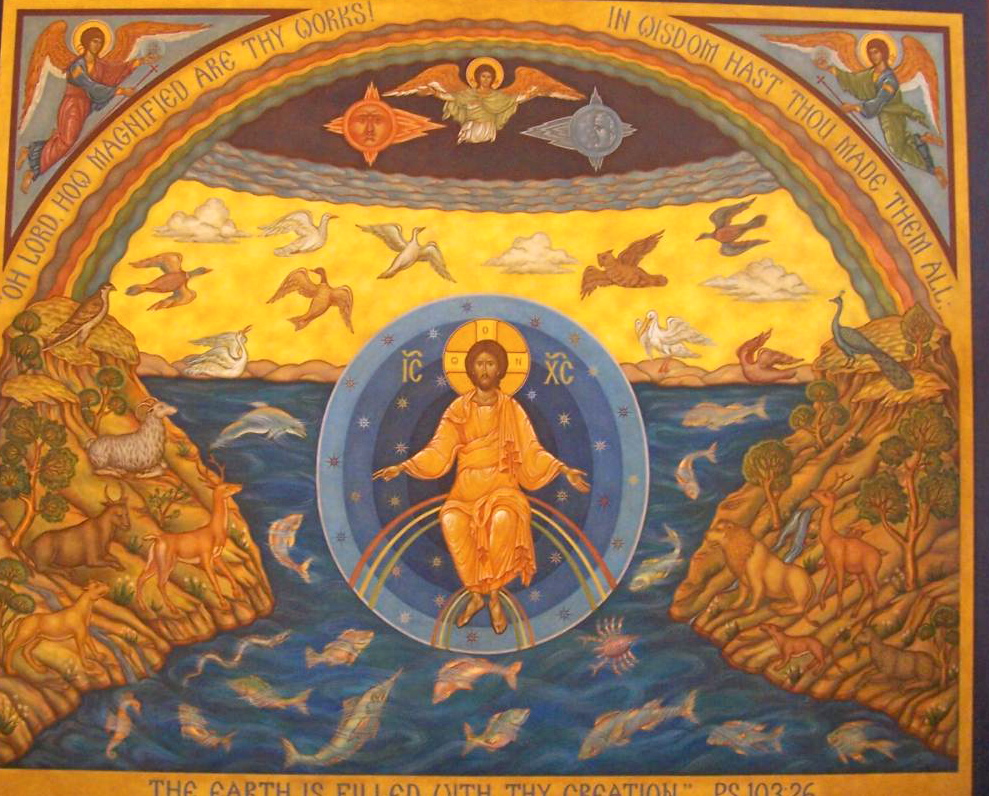
The Creator of All [1]
Metropolitan Avgoustinos (Kantiotes) of Florina
All things were made by him; and without him was not anything made that was made. (John 1:3)
Who is Christ? We hear one, two thousand different opinions. One person says he is a philosopher, another that he is a sociologist, and yet another that he is a poet. Others say still other things. Today’s Gospel reading gives us the correct answer: it says that Christ is God. You believe this? Then you are a Christian. You don’t believe this? Then you are not. You may well belong to one school of philosophy or another, but you are not a Christian!
Christ is God, then. He is not just a man; he is the God-man Jesus of Nazareth, who was crucified and who is God. In this passage, we hear that there was never a time when the Son and Word of God did not exist. There was indeed a time when man did not exist – science even concedes this – but there was never a time when Christ, the second person of the Triune God, did not exist. The Holy Trinity; Father, Son and Holy Spirit. Three suns in one sun; three-sunned Divinity. All Holy Trinity, have mercy on your world!
Further on, the Gospel says that Jesus Christ, the second person of the Holy Trinity, is he through whom all things were made – all things both seen and unseen. “All things,” it says, “were made by him; and without him was not anything made that was made.” (John 1:3). This requires analysis.
These God-inspired words speak of the world’s ontology, of the creation of things in other words. One of humanity’s ten greatest spiritual men, Blessed Augustine (whose name I unworthily bear), says that all the created things around us, from those we see through a telescope to those which may only be seen through a microscope, belong to the following four categories.
To the first category belong those things which are endowed with ‘being’ and being alone. In other words, they simply exist. What are these? They are the dust of the earth, the water, stones, the hills, priceless and useless metals, minerals, but also the heavenly bodies – the stars and even the galaxies.
To the second category belong those things which have something beyond being: they grow. What are these? They are the plants and the trees. Beyond existence, these things grow. Where does a tree begin? As a small seed. This seed then falls to the earth and grows. It is watered and it grows. It sprouts; it grows and develops, becoming a great tree.
On to the third category. According to Blessed Augustine, those things which belong to this category have something beyond existence and growth: they feel. Which things are these? These are the animals. A cute little lamb, for example, exists, grows and feels. It feels pain. O how it suffers these very days at the hands of men who slaughter it for their Paschal feast! Animals feel. Some of them even have senses which are stronger than those of other beings. The eagle, for example, has a sharp eye, he has crystal-clear vision, or what we call an ‘eagle-eye’, which allows him to soar as high as the sun and yet from this height he is able to discern the most miniscule thing on the earth below. The dog has both a very keen sense of smell and excellent hearing. I have read somewhere that in London the police have special dogs, as well as officers equipped with whistles which, when blown, cannot be heard by man. Only the dogs can hear these whistles. When the dogs hear these whistles they run immediately to find the officer calling them. The dog is also the first animal to sense an earthquake; he senses it even before the seismograph.
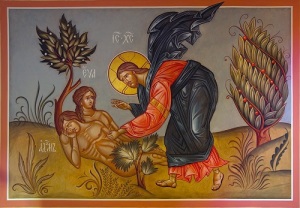
In summary; rocks have ‘being’, they just ‘are'; the trees both ‘are’ and ‘grow'; the animals ‘are’, ‘grow’ and ‘feel’. And now we have arrived at the peak of the ladder of beings; we have arrived at man. Man is matter, he is earth – we do not deny it! – and thus he has ‘being’. He grows, since from an embryo, from a little child, he grows into a full-grown man. He also feels, for he too experiences pain. He does not have these things alone, however; he also has something beyond these. What does he have beyond these? It is that he thinks; he has a mind. O, the human mind! Let them say, let them shout, that man comes from the ape, from the orangutan! This is a grave error. What separates us from the animals is the ability to think. The mind is a great thing. Next to it, the computer is nothing. The computer is nothing – a toy – next to that incomprehensible piece of equipment which we call the human intellect. It is this which separates us from all other beings. It is by means of the intellect that man understands, that he plans, that he invents, that he creates. Take an ape. Put him in school for ten years. He will not learn the alphabet; he will only grunt! From the time he is a young student, man grows in knowledge, eventually becoming a wise researcher or inventor. He is capable of progress on account of his intellect.
There are, then, four categories of beings. First, those things that ‘are'; second those things that ‘are’ and ‘grow'; third, those things that ‘are’, ‘grow’ and ‘feel'; and fourth, those things that ‘think’. Have we finished with the ladder of beings, I wonder? No! Because there exist not only those being that we see, but also those we cannot see. Those things that we see are few in comparison with those we cannot see. Beyond the world we see is found the invisible world which is infinite and wondrous. It is in this world that the bodiless hosts, the heavenly powers, the angels and archangels, are found, as well as the souls of men which have passed from the earth, and the demons who of their own will fell away from the aim for which they were created.
My brothers, this is the pyramid of beings, “of all things visible and invisible,” and at the peak of this pyramid is the Creator, the Triune God. As the Fathers and teachers of our Church teach, all things are made by the Father, through the Son, in the Holy Spirit. This dogma, this truth of our faith, is affirmed in today’s Gospel which says concerning the Son and Word of the Father: “All things were made by him; and without him was not anything made that was made.” The Son and Word of God, who humbled himself and came down to the earth, was incarnate, was crucified, and who arose from the dead and whose resurrection we celebrate today, is he, “by whom all things were made”.
All things, everything, from the smallest to the greatest, from the grass which we walk on to the huge trees, from the mite to the elephant, and from the atom to the planets and galaxies which swirl in outer space, all things were made by Christ. Do you believe this? Then you are a Christian. You don’t believe this? That is your right. Christ and the Church do not need followers. I am in favour of a Church of quality, not a Church of quantity. Thousands of faithless people are not worth one faithful Christian. He who believes does not say, “I have my opinion”. What is your opinion, sir? What God says here in the Gospel: “All things were made by him; and without him was not anything made that was made.”
To Christ himself, the eternal God – in spite of the atheists and unbelievers of all ages – to him be glory, honour and worship unto the ages of ages. Amen.
[1] From the book Εμπνευσμένα Κηρύγματα Ορθοδόξου Ομολογίας και Αγιοπατερικής Πνοής (Orthodoxos Kypseli: Thessaloniki, 2011), 22-26. Translated by Fr John Palmer.

http://lessonsfromamonastery.wordpress.com/
Οὔτε ἡ πνευματικὴ σωτηρία οὔτε ἡ κοσμικὴ σωτηρία (δηλαδὴ ἡ ἔξοδος ἀπὸ τὴν κρίση ποὺ μαστίζει τὴν ἐποχή μας) μπορεῖ νὰ ἐπέλθει ἀπὸ τοὺς κοσμικοὺς ἄρχοντες. Χρειάζεται πνευματικὴ ἀφύπνισις καὶ μετάνοια ἡ ὁποία νὰ ἑλκύσει τὴν Χάρη τοῦ Θεοῦ, ὥστε αὐτὴ νὰ θεραπεύσει τὰ ἀσθενῆ καὶ νὰ πραγματοποιήσει τὰ ἀδύνατα. Δὲν εἶναι δυνατὸν ὁ Ἅγιος Πορφύριος νὰ εἶπε ὅτι συγκεκριμένος πολιτικὸς ἄρχοντας θὰ σώσει τὴν Ἑλλάδα, διότι μιὰ τέτοια ἄποψη δὲν τὸν ἐξέφραζε. Ὁ ἀφυπνιστὴς τοῦ λαοῦ πρέπει νὰ εἶναι πνευματικὸς ἄνθρωπος, ποὺ θὰ ὁδηγήσει τὸν λαὸ στὴ μετάνοια, ἡ ὁποία θὰ ἐφελκύσει τὴν χάρη τοῦ Θεοῦ καὶ θὰ ὁδηγήσει τὸν λαὸ σὲ ἔξοδο ἀπὸ τὴν κρίση.
Άγιος Πορφύριος
http://www.porphyrios.net/
When a child is Baptized into the Orthodox Church, he is linked to the Church’s spiritual powers, including the intercessory power of the Saint—as one united to Christ—after whom he is named. Throughout his life, the intercession, comfort, and protection of this Saint, as part of the Grace flowing from Christ, is available to him. It is for this reason, indeed, that we Orthodox celebrate, considering birthdays to be of secondary or minor importance.
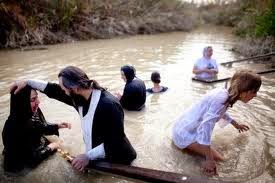
When adults are Baptized into the Orthodox Church, they must take the name of an Orthodox Saint, if their previous name was not Orthodox. They must also use this name at all times. Otherwise, they will have broken the very bond of Baptism, which includes the establishment of a close and real relationship between the Christian and the Saint to whom he is spiritually joined in that Baptism. In the unthinkable, but all too frequent, case of modernists who Baptize or Chrismate converts and fail to give them Orthodox names, these converts should go to a sober, traditionalist Priest and ask that an Orthodox name be assigned, also asking that this be done in conjunction with a service of supplication to the Saint whose name they are taking. That name should subsequently be used at all times, without exception—among friends, at school, at work, etc. It can be added to a convert’s former name on a driver’s license and other forms of identification, since the law allows the addition of such a religious name, as long as it is not for the purpose of fraud or misrepresentation.
Needless to say, then, the idea of “Church names,” taken from the Latin practice of having confirmation names, is unacceptable to Orthodox and constitutes a perversion of the Church’s teaching. It involves a denial of spiritual consolation which is dangerous and which will have consequences for the believer that will be understood only fully at the Day of Judgment. Those who persist in ignoring Church tradition in this matter are simply playing with disbelief, blasphemy, and their souls.
 Το αφιέρωμα στους Εύζωνες απο το πρακτορείο Reuters σήμερα εντυπωσιάζει!
Οι φωτογραφίες των Ευζώνων σε στιγμές προσωπικές - όταν ντύνονται καθώς και στο διάλειμμα τους - ρίχνει λίγο φως στα παρασκήνια της προεδρικής φρουράς που η ιστορία της ξεκινά το 1867.
Οι Εύζωνες είναι παγκοσμίως γνωστοί για την ενδυμασία που φέρουν. Η φουστανέλα σχεδιάστηκε ως στολή για την Ανακτορική παλιότερα και σήμερα Προεδρική Φρουρά.

Η ιστορία των ευζωνικών ταγμάτων (αργότερα συνταγμάτων) ξεκινά το 1867, με την ίδρυση τεσσάρων ταγμάτων, καθένα από τα οποία διέθετε οργανωτική δύναμη τεσσάρων λόχων. Κεντρική τους αποστολή ήταν η φύλαξη της μεθορίου. Το 1868 προστέθηκε σε κάθε τάγμα ευζώνων και πέμπτος λόχος. Η αρχική σύνθεση αυτών των ταγμάτων αποτελούνταν από εθελοντές, υπαξιωματικούς ή οπλίτες, οι οποίοι συνήθως κατάγονταν από ορεινές περιοχές.
Η ένδοξη δράση των ευζωνικών ταγμάτων κατά τη διάρκεια των Βαλκανικών Πολέμων υπήρξε καταλυτική με αποτέλεσμα οι εύζωνες να λάβουν στη συνείδηση του ελληνικού λαού την εικόνα ηρώων. Έντονη δράση είχαν τα ευζωνικά τάγματα και κατά τη διάρκεια των υπόλοιπων ένοπλων συγκρούσεων του 20ου αιώνα στις οποίες είχε εμπλακεί ο ελληνικός στρατός (Μικρασιατική Εκστρατεία, Πρώτος και Δεύτερος Παγκόσμιος Πόλεμος).

Από το 1914, ως ιδιαίτερη μονάδα ευζώνων συγκροτείται η Ανακτορική Φρουρά. Ο τίτλος της έχει μετατραπεί αρκετές φορές από τότε (Φρουρά Σημαίας, Φρουρά Μνημείου Αγνώστου Στρατιώτη, Βασιλική Φρουρά, Προεδρική Φρουρά). Η σημερινή της ονομασία είναι «Προεδρική Φρουρά», η οποία της αποδόθηκε το 1974, μετά τη κατάρρευση της δικτατορίας Παπαδόπουλου.
Ιδιαίτερα ξεχωριστή θέση στην ιστορία των ευζωνικών ταγμάτων κατέχει το 5/42 Σύνταγμα Ευζώνων, κυρίως λόγω της δράσης του κατά τη διάρκεια της Μικρασιατικής Εκστρατείας. Πέρα από την αποτελεσματικότητα του κατά τη διάρκεια των πρώτων στρατιωτικών επιχειρήσεων, το Σύνταγμα αυτό απέκτησε φήμη για τη δράση του μετά την κατάρρευση του ελληνικού μετώπου και την αποσύνθεση του ελληνικού στρατού, τον Αύγουστο του 1922). Πιο συγκεκριμένα, κάτω από την καθοδήγηση του διοικητή του Νικόλαου Πλαστήρα, το 5/42 Σύνταγμα Ευζώνων έφτασε απολύτως συντεταγμένο στον Τσεσμέ, από όπου και διαπεραιώθηκε στο νησί της Χίου.
Ο Συνταγματάρχης Δημήτριος Ψαρρός οργάνωσε το 5/42 Σύνταγμα το 1942 για να εναντιωθεί στον φασίστα κατακτητή. Έδωσε πολλές ηρωικές μάχες στα βουνά της Στερεάς Ελλάδος εναντίον του κατακτητή και το Σύνταγμα για ακόμη μια φορά έγινε το «Ασκέρι του Διαβόλου».


Υπάρχει ένας μεγάλος αριθμός συμβολισμών που αποδίδονται στα χαρακτηριστικά της ευζωνικής στολής. Για παράδειγμα, ο αριθμός των δίπλων της φουστανέλας φημολογείται πως είναι ίσος με τη διάρκεια (σε έτη) της περιόδου της Τουρκοκρατίας, δηλαδή 400. Παρόλ' αυτά, οι φουστανέλες που φέρουν στις μέρες μας οι Εύζωνες, σπάνια έχουν ακριβώς 400 δίπλες.

Τα υπόλοιπα μέρη που συγκροτούν την ευζωνική στολή είναι:
Το φάριο (ή φάρεο). Είναι το καπέλο του εύζωνα. Το φάριο έχει κόκκινο χρώμα και είναι κατασκευασμένο από τσόχα. Στη θέση του μετώπου φέρει το ελληνικό εθνόσημο. Χαρακτηριστικό κομμάτι του φάριου αποτελεί η μακριά μαύρη φούντα, κατασκευασμένη από μετάξι. Το σχήμα της θεωρείται πως συμβολίζει το δάκρυ του Χριστού στη Σταύρωση.
Το πουκάμισο. Είναι λευκού χρώματος και έχει χαρακτηριστικά μεγάλο άνοιγμα μανικιών. Το λευκό χρώμα, το οποίο κυριαρχεί σε ολόκληρη την ευζωνική στολή, θεωρείται πως συμβολίζει την αγνότητα των εθνικών αγώνων.
Η φέρμελη. Είναι το γιλέκο του εύζωνα. Αποτελεί το δυσκολότερο, όσον αφορά την κατασκευή του, κομμάτι της ευζωνικής στολής. Διαθέτει λευκά και επίχρυσα νήματα, με τα οποία απεικονίζονται σχέδια λαογραφικής σημασίας. Ένα από αυτά αποτελούν τα αρχικά Χ και Ο, τα οποία θεωρείται ότι αντιστοιχούν στις λέξεις χριστιανός και ορθόδοξος.
Παράταξη ευζώνων: Διακρίνονται η φουστανέλα, οι ευζωνικές κάλτσες, οι καλτσοδέτες και τα τσαρούχια
Οι κάλτσες. Είναι λευκές και κατασκευασμένες από μαλλί. Κάθε εύζωνας φέρει από δύο κάλτσες σε κάθε πόδι. Οι κάλτσες στηρίζονται στη μέση του εύζωνα, κάτω από τη φουστανέλα, με τη βοήθεια μιας δερμάτινης ζώνης που ονόμάζεται ανάσπαστος.
Οι καλτσοδέτες. Είναι μαύρου χρώματος και κατασκευασμένες από μετάξι.
Τα τσαρούχια. Είναι τα υποδήματα του εύζωνα. Είναι κόκκινου χρώματος και κατασκευασμένα από δέρμα. Στη σόλα κάθε τσαρουχιού βρίσκονται καρφωμένα περίπου 60 καρφιά, τα οποία είναι υπεύθυνα για τον επιβλητικό ήχο που ακούγεται κατά το βηματισμό ενός εύζωνα. Κατά μέσο όρο, το κάθε τσαρούχι ζυγίζει τρία κιλά. Χαρακτηριστικό κομμάτι των τσαρουχιών αποτελούν οι μαύρες φούντες στις οποίες καταλήγουν οι μύτες τους. Θεωρείται πως η αρχική τους χρήση ήταν να κρύβονται σε αυτές μικρά κοφτερά αντικείμενα που θα μπορούσαν αιφνιδιαστικά να τραυματίσουν τον εχθρό σε μία «σώμα με σώμα» μάχη. Άλλη άποψη είναι ότι οι φούντες προστάτευαν τα δάχτυλα των ποδιών από το χιόνι και τα κρυοπαγήματα.
Οι δερμάτινες φυσιγγιοθήκες.

Η ευζωνική στολή που περιγράφεται παραπάνω αποτελεί την επίσημη εκδοχή. Οι εύζωνες που φυλάσσουν το Μνημείο του Αγνωστου Στρατιώτη φέρουν αυτή τη στόλη μόνο τις Κυριακές ή κατά τη διάρκεια εθνικών εορτών. Τις υπόλοιπες μέρες φέρουν την καθημερινή ευζωνική ενδυμασία. Σε αυτήν, το λευκό πουκάμισο, η φέρμελη και η φουστανέλα αντικαθίστανται από τον ντουλαμά, τη χαρακτηριστική στολή των αγωνιστών του Μακεδονικού Αγώνα, βασισμένη στην παραδοσιακή ενδυμασία του χωριού Άλωνα Φλώρινας. Ο χειμερινός ντουλαμάς είναι σκούρου μπλε χρώματος, ενώ ο θερινός ανοικτού καφέ. Σε εθιμοτυπικές εκδηλώσεις της Προεδρικής Φρουράς, ορισμένοι εύζωνες φέρουν τις παραδοσιακές στολές της Κρήτης και του Πόντου, ως αναγνώριση της συμβολής αυτών των περιοχών στους εθνικούς αγώνες.


Οι σημερινοί εύζωνες εκτελούν μόνο αποστολές τελετουργικού χαρακτήρα. Η πλέον γνωστή είναι η συμβολική φύλαξη του Μνημείου του Άγνωστου Στρατιώτη, που βρίσκεται στην Πλατεία Συντάγματος, δίπλα στην Βουλή των Ελλήνων. Σκοπιές όμως ευζώνων υπάρχουν και στο Προεδρικό Μέγαρο και στην πύλη του στρατοπέδου της Προεδρικής Φρουράς, πρώην στρατόπεδο Βασιλέως Γεωργίου Β΄, που βρίσκεται στο ΒΑ. άκρο του Εθνικού Κήπου με είσοδο από την οδό Ηρώδου του Αττικού.
Από τις πολλές αρετές που κοσμούσαν την απλή και καθαρή ψυχή του Ηγουμένου παπα-Χαραλάμπους Διονυσιάτου, ξεχώριζε η ελεημοσύνη. Δεν είχε όρια. Τα έδινε όλα. Κανείς δεν έφευγε με άδεια χέρια. Καμμία άλλη αρετή δεν εξομοιώνει τόσο τον άνθρωπο με τον Θεό, όσο η ελεημοσύνη, κατά τον άγιο Χρυσόστομο. Και τον Γέροντα παπα-Χαράλαμπο που είχε την αρετή της ελεημοσύνης, τον συγχωρούν όσοι ευεργετήθηκαν απ’ αυτόν, και φυσικά και ο ίδιος ελεήθηκε από τον Θεό. Αιωνία η μνήμη του π. Χαραλάμπους του ελεήμονος. Μερικά περιστατικά θα δείξουν το μέγεθος της ελεημοσύνης του, που στην εποχή του δεν είχε τον όμοιό του. Θα του άξιζε να χαρακτηρίζεται “νέος ελεήμων”, σαν τον άγιο Ιωάννη τον Ελεήμονα.

Όταν εγκαταστάθηκε στο Κελλί Μπουραζέρι με την συνοδεία του οι προκάτοχοί του Ρώσσοι του άφησαν κληρονομιά αρκετές λίρες. Ο παπα-Χαράλαμπος. επειδή αυτές δεν τις απέκτησε με τον ιδρώτα του, τις πήρε και τις μοίρασε στα Μοναστήρια.
Πολλές φορές, όταν του ζητούσε βοήθεια κάποιος φτωχός, έδινε όλα τα χρήματα που είχε το ταμείο του Κελλιού και υστέρα δεν είχαν να αγοράσουν τρόφιμα.
Οι πατέρες καλλιεργούσαν τον κήπο. Άφηναν έξω από την μάνδρα στον δρόμο, καφάσια με κηπευτικά και μπορούσαν οι περαστικοί να παίρνουν όσα ήθελαν.
Όταν ήταν στο Μπουραζέρι, πολλοί πατέρες της Καψάλας τον είχαν παρηγοριά, Ό,τι χρειάζονταν, πήγαιναν εκεί να το ζητήσουν. Και ο ίδιος με χαρά έδινε περισσότερα απ’ ό,τι του ζητούσαν. Όταν ήθελαν ζώο για να μεταφέρουν κάτι, πήγαινε ο ίδιος να το σαμαρώσει. Όταν στην θεία Λειτουργία έρχονταν πατέρες, ο ίδιος πήγαινε μετά την θεία Λειτουργία στην πόρτα, μην προλάβουν και φύγουν, για να τους κρατήσει να φάνε στην τράπεζα ή να τους δώσει κουμπάνια. Μία φορά έδωσε σ’ έναν ασκητή ένα καρπούζι τόσο μεγάλο, που εκείνος δεν μπορούσε να το σηκώσει.
Πέρασε κάποτε από ένα γυναικείο μοναστήρι της Ηπείρου. Είπε στις αδελφές να τον αφήσουν λίγο να προσευχηθεί μόνος του στην θαυματουργό εικόνα της Παναγίας. Έπειτα άφησε έναν φάκελλο με αρκετά χρήματα. Οι αδελφές συγκινήθηκαν αλλά και θαύμασαν, γιατί τότε είχαν μεγάλη ανάγκη από αυτά τα χρήματα.
Όταν έγινε Ηγούμενος στου Διονυσίου, μοίραζε ευλογίες σε όλους. Έβλεπες στην πύλη του Μοναστηριού αραδιασμένες φιάλες, μπετόνια, νταμιτζάνες που έφερναν οι πατέρες από την έρημο, τις οποίες με εντολή του γέμιζαν κρασί, ρακί, λάδι και τις έδιναν ευλογία στους ασκητές μαζί με κηπευτικά, ψωμί και άλλα τρόφιμα.
Το μοναστήρι του Διονυσίου έχει ένα Μετόχι στην Χαλκιδική χιλιάδων στρεμμάτων δασικής έκτασης. Όταν του ζήτησε γνωστός του Γέροντας μία μικρή έκταση για το Ησυχαστήριό του, ο παπα-Χαράλαμπος ήθελε να του δώσει την μισή.
Ως Ηγούμενος λειτουργούσε κάθε μέρα. Τα χρήματα που του έδιναν για τις Λειτουργίες διάφοροι, δεν τα έβαζε στο ταμείο της Μονής, αλλά τα μοίραζε ελεημοσύνη.
Όταν περνούσε φτωχός με πανταχούσα, ρωτούσε τον κάθε Προϊστάμενο πόσα να του δώσουν. Έπειτα ρωτούσε, πόσο κάνουν όλα μαζί αθροισμένα αυτά που πρότειναν οι προϊστάμενοι και συμπλήρωνε: «Και άλλα τόσα από μένα».
Κάποτε έβαλε κανόνα σε νέο να κάνει έναν αριθμό μετάνοιες. Του φάνηκαν πολλές. «Άφησέ τις», του είπε ο παπα-Χαράλαμπος, «θα τις κάνω εγώ». Ο νέος φιλοτιμήθηκε και ύστερα τις έκανε.
Ζήτησε να εξομολογείται στον παπα-Χαράλαμπο ο διακο-Διονύσιος ο Φιρφιρής και του είπε: «Αν θέλεις να έρθεις σε μένα, πρέπει πρώτα να κλείσεις το μαγαζί». Ο γερο-Διονύσιος τον άκουσε και έκλεισε το μαγαζί εκκλησιαστικών ειδών που είχε στις Καρυές.
Κάποιος ανέφερε στον παπα-Χαράλαμπο ότι ένας γνωστός παπάς λέγει ότι η κανδήλα της Παναγίας στων Ιβήρων δεν κουνιέται μόνη της, αλλά την κουνούν οι καλόγεροι, και του απάντησε: «Να του πεις να βγάλει τα ράσα».
Κάποτε του είπε γνωστός του ότι ο Πατριάρχης ζητά να προσεύχεται γι’ αυτόν. Απορούσε, έκανε τον Σταυρό του και έλεγε: «Και πού με ξέρει έμενα;». Και στενοχωρημένος συμπλήρωνε: «Αλλοίμονο στον μοναχό που έχει όνομα και δεν έχει χάρη».
Κάποτε βρέθηκε στο Κονάκι τους στην Θεσσαλονίκη. Εκείνη την ημέρα είχε εκεί κοντά λαϊκή αγορά. Πήγαινε με τον μοναχό που τον συνόδευε στον κάθε μικροπωλητή, και από την ελεήμονα διάθεσή του αγόραζε κάτι για να τους βοηθήσει. Από την μεγάλη του απλότητα, όταν πέρασε μπροστά από κάποιον που πουλούσε γυναικεία καλλυντικά, χωρίς να γνωρίζει τι είναι αυτά, αγόρασε και από εκεί κάτι, ενώ το καλογέρι του έλεγε να μην πάρουν για να μη σκανδαλίσουν.
Διηγείτο ο παπα-Χαράλαμπος: «Τις πρώτες δύο-τρεις βραδιές που ήρθα και έμενα στο ασκητήριο του γερο-Ιωσήφ ως κοσμικός, ο διάβολος τέτοια λύσσα είχε, που δε μ’ άφηνε να κοιμηθώ και να κάνω προσευχή. Πάω να κοιμηθώ και να, ο διάβολος επάνω μου ολόκληρος. Πότε σαν σκύλος, πότε σαν άνθρωπος, πότε σαν λιοντάρι. Εγώ από τον φόβο μου σηκωνόμουν και έκανα προσευχή. Έμεινα άυπνος τελείως και την ημέρα δεν μπορούσα να κάνω τα καθήκοντά μου, να προσευχηθώ. Όταν με ρώτησε ο Γέροντας πώς περνώ, του είπα τι συμβαίνει· με συμβούλεψε, όταν κοιμάμαι και έρχεται ο διάβολος από το ένα μέρος, να γυρίζω από το άλλο. Να κάνεις τον Σταυρό σου, να γυρίζεις από το άλλο πλευρό και θα φύγει, Μη δίνεις σημασία. Θα μάθεις να τον πολεμάς και ύστερα δε θα τον προσέχεις καθόλου. Έτσι πράγματι και έγινε».
«Αφού έπαθα μερικές φορές από το θέλημά μου και είδα ότι ο Γέροντας έχει δίκαιο, έπειτα έβαλα μυαλό. Από τότε ούτε σκεπτόμουν τι θα κάνω. Ό,τι πει ο Γέροντας. Τίποτα δε σκεπτόμουν. “Κάνε παπά αυτό”, μου έλεγε, “ να ‘ναι ευλογημένο”, “Πήγαινε, παπά, εκεί”, “να ‘ναι ευλογημένο”. Σαν υποτακτικός δεν είχα στόμα. Μόνο αυτιά. Μου έλεγε ο Γέροντας κάτι και αμέσως έτρεχα να κάνω την εντολή του Γέροντα. Έκτοτε πήρα πολλή χάρη. Όταν άρχισα να μην αντιλέγω στον Γέροντα και στους αδελφούς ακόμη, με επισκεπτόταν η χάρις συχνά. Πλημμύρισα από χάρι κάνοντας υπακοή».
Κάθε Δευτέρα, Τετάρτη και Παρασκευή, ενώ δούλευε ως συνήθως πάρα πολύ, εξομολογούσε, έκανε τη νύχτα αγρυπνία και πολλές μετάνοιες, δεν έτρωγε τίποτε. Όταν το στόμα του ξηραινόταν, έπινε μόνο λίγο νερό.
Δύο μοναχοί επισκέφθηκαν το μοναστήρι του Διονυσίου. Ζήτησαν να δουν τον γνωστό τους ηγούμενο παπα-Χαράλαμπο και τους είπαν ότι είναι στο γραφείο του. Χτύπησαν την πόρτα λέγοντας το «Δι’ ευχών των αγίων Πατέρων ημών…». Άνοιξε λίγο την πόρτα, έβγαλε μόνο το κεφάλι του έξω ο πανοσιώτατος Καθηγούμενος να δει ποιος είναι, και με απλότητα και φυσικότητα τους είπε: «Θέλω ακόμα εικοσιπέντε μετάνοιες να τελειώσω τον κανόνα». Έκλεισε την πόρτα, τελείωσε τις μετάνοιες και ύστερα απλά και εγκάρδια τους κάλεσε να μπουν στο ηγουμενικό γραφείο. Οι πατέρες θαύμασαν την ακρίβεια στην άσκηση και την απλότητα του αγίου Γέροντος.
Ο παπα-Χαράλαμπος έβγαζε με ένα καλογέρι του κοκκινόχωμα και πέρασε κάποιος έφιππος. Το ζώο φοβήθηκε και τον έριξε κάτω. Εκείνος άρχισε να βρίζει τον παπα-Χαράλαμπο με τα χειρότερα λόγια. Ο Γέροντας, ενώ άκουγε τις βρισιές, δεν είπε τίποτε και ήταν ήρεμος.
Έλεγε: «Η μικρή αμέλεια φέρνει την μεγάλη και μετά την πτώση. Η μικρή βία, την μεγάλη βία και αυτή ύστερα τον αγιασμό».
«Εμείς οι Πνευματικοί, θα πάμε στην κόλαση από τις πολλές οικονομίες που κάνουμε».
Αγαπούσε ιδιαίτερα τους μοναχούς που έκαναν πολλά κομποσχοίνια. Κάποιος έκανε σε έξι ώρες αγρυπνία 120 τριακοσάρια.
Ήταν τόσο καθαρός και ασκανδάλιστος, ώστε έλεγε: «Να με βάλεις να κοιμηθώ σ’ ένα μπουλούκι γυναίκες μέσα, δεν αισθάνομαι τίποτε». Σε όλη του την ζωή μία φορά έπαθε ενυπνιασμό.
Έλεγε ο παπα-Χαράλαμπος ότι τις σαρκικές αμαρτίες τις αγνοούσε παντελώς. Σαν Πνευματικός αργότερα έμαθε ότι γίνονται σαρκικές αμαρτίες. Τόση καθαρότητα είχε.
Άκουγε στην εξομολόγηση βαρείες αμαρτίες και με απλότητα και απορία έλεγε: «Αλήθεια είναι; Κάνουν όλα αυτά;».
Κάποιος μοναχός στο Μοναστήρι συχνά παρεξηγείτο με τον Ηγούμενο. Πήγαινε το πρωί ο παπα-Χαράλαμπος, χτυπούσε την πόρτα του και εκείνος δεν απαντούσε από πείσμα. Του έλεγε παρακλητικά και ταπεινά: «Πάτερ… άνοιξε να συγχωρεθούμε, θα λειτουργήσω», και ήθελε να του βάλει μετάνοια.
Έλεγε: «Όποιος θέλει να πάει στην έρημο πρέπει να έχει δάκρυα. Αν δεν έχει να μην πάει μόνος του».
Έλεγε: «Ο νους στην ακολουθία να πηγαίνει στην ευχή όχι στα ακούσματα».
Ο παπα-Χαράλαμπος ήταν πολύ γερός οργανισμός και επί ώρες προσευχόταν όρθιος. Στην θεία Λειτουργία έκλαιγε συνέχεια και το πρόσωπό του αλλοιωνόταν, γινόταν αγγελικό, έτσι που δεν τον γνώριζες. Όταν τελείωνε την Λειτουργία, το πρόσωπό του ερχόταν στο φυσικό.
(«Από την Ασκητική και Ησυχαστική Αγιορείτικη Παράδοση», Άγ. Όρος 2011, σ. 655-662) Πηγή: fdathanasiou.wordpress.com
http://pemptousia.com/
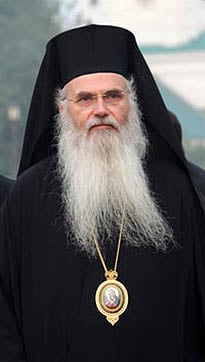
Metropolitan Nikolaos of Mesogaias
The spiritual influence of Mount Athos is indisputable and certainly stems from the fact that many men have attained holiness through their secret ascetic struggles there. In recent years many pilgrims have found peace of mind and repose on the Mountain, together with spiritual guidance and support.
The higher one rises, scientists tell us, the weaker the force of gravity becomes, the less one feels the pull of the earth, the looser one’s connection with it becomes, the easier one can shrug off its pressures and demands, the lighter one becomes.
The closer, too, one feels to heaven, which, though so vague, is so real and so desirable. Although less tangible, it seems more real than the earth. The higher one rises, the clearer the air becomes, the sharper one’s hearing, the broader the horizon, the closer one draws to the truth, and the truth is more convincing than reality.
Of all the holy sites in the Orthodox world, Mount Athos is the place where for over a thousand years the monastic life has been lived in its most absolute form. The passing centuries may have stamped their ‘worldly’ influence on the Mountain; even there men may display their weaknesses or even passions, which is only natural, and modern ‘civilisation’ may have done its damage, but in an inexplicably mystical way the Mountain has retained its blessed character, the constant and unique evidence of its grace, its rare and singular spiritual strength, and its dynamic relationship in space and time with the Lord God and the Kingdom of Heaven. Its philosophy of life has not been jeopardised by wrong choices, has not been harmed by a bad process of modernisation, and has not been corrupted by the times or by men, whoever they may be. Its truth endures.
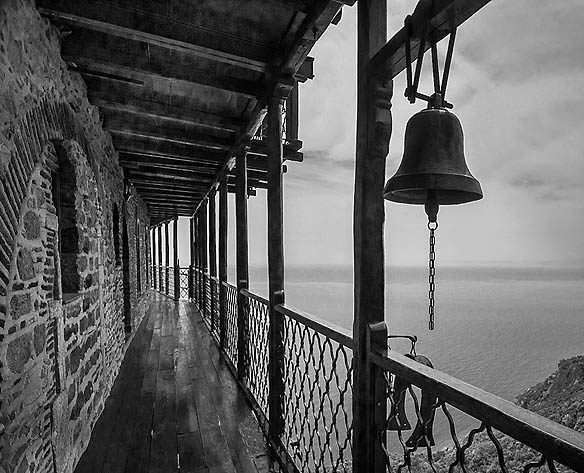 It is like a rock which problems like changing political influences, the immoderate use of technology, tourism, parochial views, inter-monastic feuds, rivalries and even hatred, and all kinds of hostile forces only succeed in briefly washing over or moistening the surface of, without in the least disturbing its inner core.
There is something that does indeed protect it. Perhaps it is its monastic diversity, perhaps it is its enduring quality, perhaps the naturalness of its monastic expression, perhaps its treasures, relics and splendour, perhaps the abaton1 and its administrative autonomy, perhaps its ecumenical character, perhaps the care and protection of the Mother of God, perhaps its special grace. Despite its theocratic character, after eleven centuries of glorious existence Byzantium fell. Athos, on the other hand, is now in its fourteenth century of life but it moves at the pace of the world to come and gives you the impression that it is a place which is ‘not of this world’ (John 18: 36), one whose relationship with time is like that of its surface with the air and whose ‘citizens dwell in heaven’ (Philippians 3: 20).
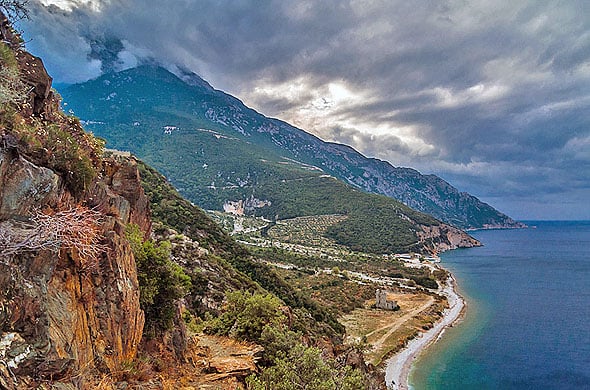
‘A rich mountain, a firm mountain’ (Psalms 68: 15)
With its slender connection with ephemeral and worldly things and its attention constantly focused on lofty matters of the soul, the Holy Mountain seems to embrace the whole of mankind and to possess a gaze that can see beyond the limits of time and reason. In geographical terms, the Mountain is situated in Greece but it does not belong to her.
Perhaps it is that part of Orthodox life which best emphasises the catholicity and universality of the Church. Its monasteries include a Russian, a Serbian and a Bulgarian foundation. There are two Romanian sketes2 and monks from distant countries and civilisations, such as Peru and Colombia. Within its geographical borders God is worshipped in numerous languages and a wide variety of cultures and traditions find expression here: there is a marvellous, well-balanced diversity. Nothing in all this obstructs the unity of faith, the catholicity of the Orthodox spirit, the universality of the Church’s witness.
On the contrary, all of this proves that the Word of God is not restricted by language or confined within borders, and is not stifled by different forms of cultural expression or perhaps even different religions. It is an interesting fact that only a third of the members of the ‘Friends of Mount Athos’ society in England are Orthodox. The number of non-Orthodox writers recording their admiration of Athos and their sense of its mystical power is increasing all the time. The Mountain moves all people.
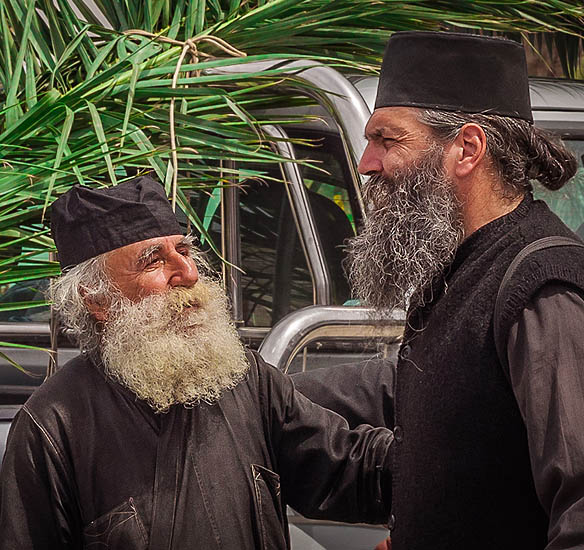
Here space and time acquire another dimension and perspective. One’s relationship with earthly, ephemeral and perishable things is an entirely perfunctory one. Concepts like ‘money’, ‘property’, ‘wealth’, ‘investment’, ‘entertainment’, ‘competition’ and ‘interest’ completely lose their importance. Here only the most essential worldly concerns are allowed to occupy one’s thoughts. The soul opens itself up to heavenly things. Here the main focus of interest is eternity and God’s kingdom. The purpose of history is not to serve as an object of worship but to build the foundations of the present. The future is not seen as a way of relieving suppressed emotions but as a way of transforming the present. The whole of time is held within its embrace. Athos follows the Old Style Calendar knowing that it is wrong but without being bothered by the fact, believing that it is a system that works well for it. Even the Byzantine cycle of daily time, which is so cumbersome in practice, seems to have a good reason for existing here. The Mountain lives in its own time. It has escaped the most pressing demands and defeated the most powerful oppressors.
Time is not binding. Tradition is not restrictive. The liturgical rite is not a shackle. National identity and language do not count for everything. Education is not a privilege. There is no discrimination. Comparisons are avoided. The most important thing is being constantly in God’s presence and embracing the whole world.
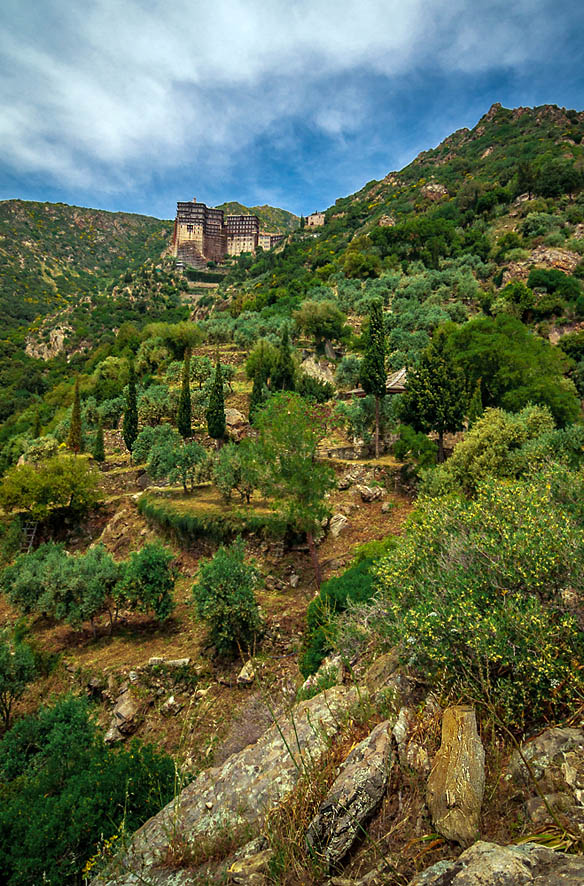
‘I lift up my eyes to the hills – where does my help come from?’ (Psalm 121: 1)
The first thing that can be said about Athos is that it is a mountain, and in a notional sense at that. It is a high point. It represents a life that consists of an uphill struggle, that can be enjoyed ‘in a state of spiritual exaltation’, that involves a ‘heart which contemplates the heavens’ and seeks the ‘one who dwells on high’, the Almighty. It is an interesting fact that in the Orthodox tradition there are four hagiographical allusions to mountains on which revelations took place.
On Mount Sinai Moses received the Ten Commandments, the expression of God’s will. Moses spoke with Him, heard His voice and saw Him from behind (Exodus, chapters 19 and 20).
On Mount Carmel the Prophet Elijah prayed and God heard his prayer and answered it. Elijah felt God’s presence and experienced the manifestations of His power (I Kings, chapters 18-20).
The Mount of Olives was the scene of the Lord’s ascension into heaven. Christ deified human flesh and ‘took sinful human nature upon himself and offered it up to God the Father’, thus revealing a glimpse of the glory and honour of human nature (Acts 1: 12).
Finally, on Mount Tabor the Lord revealed as much of His glory as could be borne by human nature and emanated His divine light (Matthew 17: 1-8).
The Mountain is a place where God reveals His commandments; it is a place for a practical way of life, a place where patience, humility and love prevail, a place where man can clothe himself in divine raiment. It is a place where ‘nature is constantly constrained and the senses ceaselessly imprisoned’, a place of extreme, unceasing and persistent askesis3 and submission.
It is a place of prayer and signs. Prayer is unceasing, and in the cases of many monks extensive and long-lasting. At sundown the ascetics begin their all-night vigil, the coenobites take over with nocturns, in the morning the Divine Liturgy is celebrated, and during the day the Hours are performed by the monks in the course of their duties or while in their cells; during the times of quiet and pious chatter the repetition of the divine meanings of the Jesus Prayer can be constantly heard on numerous lips. Tongues pray; the architecture of the churches underscores the intensity of the prayers; the daily routine, the long services, the hearts of the monks are all imbued with the sweet melody of prayer.
The Mountain reveals the extremity of human situations. It is moderate in its discreet character but also displays a divine extremeness – though without foolish extremes – in its absolute and uncompromising lifestyle and philosophy. The daily vigils, the absence of a comforting female presence (even in pictorial form), the customary obedience, the life devoid of personal choices emphasises the naturalness of the ‘supernatural’ state. The Mountain is a place where the majesty of human nature is displayed. It functions as a kind of training ground for achieving deification. ‘The angels’ ranks were awed by thy life in the flesh’, chants the Athonite world, in honour of its father, St. Athanasios of Athos. Human limits are pushed to their utmost. Here saints like Gregory Palamas become beholders of divinity. Saints like Maximos the Kafsokalyvitan cast off their earthly gravity and appear to fly. Saints like Nikodemos Hagioreites express their intelligence as light, while their knowledge assumes the character of revelation. Saints like our modern-day saints Païssios, Ephraim and Elder Joseph the Hesychast combine rigorous discipline in their lives with grace, like the old elders in our ascetic literature. Saints like Kosmas the Aetolian or Fathers Sophronios and Porphyrios, also from our own time, draw strength from Athos’s springs for a few years and then become lifelong reformers, preachers and theologians of worldwide renown.
But the Mountain is not only a place for man’s spiritual glory. On all of the four mountains mentioned earlier God’s presence is marked by the appearance of a cloud. On Mt. Sinai as a ‘dense cloud’ which Moses enters, sensing but not actually seeing the Lord (Exodus, chapters 16, 19 and 24). On Mt. Carmel the ‘cloud’ breaks the silence of the heavens and brings forth rain in a miraculous manner (I Kings 18: 44). On the Mount of Olives, the Mount of the Ascension, the Lord ‘was taken up into a cloud’ and carried off to Heaven (Acts 1: 9). Finally, on Mt. Tabor ‘a bright cloud overshadowed’ the disciples and the voice from the cloud saying ‘This is my beloved Son, with whom I am well pleased: listen to Him’ shows that God the Father was present there with them (Matthew 17: 5).
The Mountain lives within a cloud of God’s graces. Sacred relics emit a sweet fragrance, holy icons exude myrrh, events take an unexpected turn, expectations are exceeded, rare surprises occur, God works with a power greater than the force of natural laws and logic. You enter the cloud of Athos as a visitor and, like Moses, you discover the tablets with God’s commandments in your hands. You find it easier to observe them. You are surprised by the presence of the cloud and are startled by the ‘sign’ of God’s grace flowing down like rain. You are struck by the cloud’s mystical character and ‘fall on your face in great fear’, like the disciples on Mt. Tabor. You behold the cloud and hear the voice of God the Father within you. You sense its intangible divine majesty and ‘gaze up at heaven’ like the Apostles on the Mount of Olives and you ‘return’ with great mystical ‘joy’.
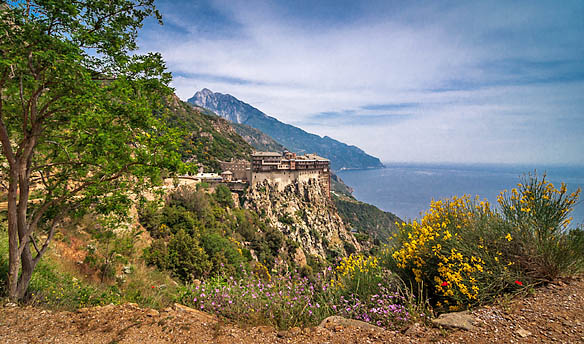
If the Mountain of God’s presence illuminates with its apocalyptic visions, the cloud of the divine mystery fills the heart with the humility of uncreated grace. On the Holy Mountain you experience miracles, you perceive holiness, you are illuminated by whatever you can see, you are nourished by whatever lies within your reach, you have the ‘same mind that was in Christ Jesus’ (Philippians 2: 5).
A long time ago I was approached by a young student. Very hesitantly, but with the intensity of someone who is determined to find out something, he declared that, although he was an atheist and found it hard to believe, he very much wanted to find faith. He had tried and searched for years but all to no avail. He had talked with professors and educated people but his thirst for something serious was not satisfied. He heard about me and decided to share his existential need with me. He asked me for a scientific proof of God’s existence.
‘Do you know anything about integrals or differential equations?’ I asked him.
‘Unfortunately not,’ he replied, ‘I’m an Arts student.’
‘What a shame! I knew a proof like that,’ I said in a deliberate attempt to be funny.
He felt awkward and fell silent for a while.
‘Look,’ I said, ‘I’m sorry I teased you like that but God is not an equation or a mathematical proof. If He was, then all educated people would believe in Him. You know, there is a different way of approaching God. Have you ever been to Mount Athos? Have you ever met any ascetics?’
‘No, father, but I’m thinking of going. I’ve heard so much about it. If you tell me to, I’ll even go tomorrow. Do you know any well-educated person I could meet?’
‘Which would you prefer: a well-educated person who would confuse you, or a saint who might wake you up?’
‘I’d prefer a well-educated person. I’m afraid of saints.’
‘Faith is a matter of the heart. Try talking to a saint. What’s your name?’ I asked him.
‘Gabriel’, he replied.
I sent him to an ascetic. I told him how to get there and gave him the necessary instructions. We even drew a sketch-map.
‘You must go and ask the same thing,’ I said. ‘“I’m an atheist”, you must say, “and I want to believe. I want some proof of God’s existence”.’
‘I’m afraid, I’m too shy,’ he replied.
‘Why are you afraid and shy of the saint when you’re not afraid or shy of me?’ I asked him. ‘Just go and ask him the same thing.’
A few days later he went, and he found the ascetic talking with a young man in the yard of his cell. Opposite, four other young men sat waiting on some logs. Gabriel gingerly took his place amongst them. About ten minutes later the elder finished his discussion with the young man.
‘How are you, boys?’ he asked. ‘Have you had a loukoumi?4 Have you had a drop of water to drink?’
‘Yes, thank you, father,’ they replied with conventional worldly politeness.
‘Come here,’ he said to Gabriel, picking him out from the others. I’ll get some water and you take this box with the loukoumia. And come closer so that I can tell you a secret: it’s okay being an atheist, but to be an atheist and have an angel’s name, well… It’s the first time I’ve ever come across anything like that.’
Our friend almost fainted with shock at this sudden revelation. How did he know his name? Who had told him about his problem? And what did the elder want to say to him?
‘Father, can I have a brief word with you?’ he uttered in a faint voice.
‘Look, my son, the sun is going down: take the loukoumi, have a drink of water and go to the nearest monastery for the night.’
‘Father, I’d like to speak to you, if that’s possible.’
‘What is there for us to say, my child? Why have you come?’
‘On hearing this question I immediately felt a huge weight off my chest,’ he told me later. ‘My heart began to overflow with faith. My inner world began to glow. My questions began to be solved without any logical arguments, without any discussion, without any clear answers. All the “ifs”, “whys” and “maybes” were banished at a stroke, leaving only the “hows” and “whats”.’
What the knowledge of educated men was unable to give him he gained from the kind allusion of a saint, who had completed only four years at junior school. Saints are very discreet. They operate on you without an anaesthetic and there is no pain. They perform a transplant without cutting you open. They raise you to lofty heights without using the steps of earthly logic to get there. They plant faith in your heart without tiring your mind.

‘Inviolate and God-trodden mountain’
The Holy Mountain is a training school of the heart, a place of healing for the inner man. It raises you up to spiritual heights which cannot be reached even by the most modern balloon of worldly reasoning. Here Grace expresses truth in unexpected ways.
The basic question on the Mountain is not whether God exists. This question seems to have been decisively resolved a long time ago. Neither is it whether our God is better than other people’s gods. Here ‘our’ does not have a possessive sense – as in the phrase ‘God is mine’ – but the sense of a child selflessly wishing to join its father – ‘I am striving to become His’. All efforts are directed at partaking of God’s divine nature (2 Peter 1: 4), at making the most of our kinship with Him, at gaining a sense of His presence, of learning the benefits and ways of experiencing Him.
The Mountain’s value does not lie in its individual charismatic monks, however many or great they may be. Its majesty is concealed in the fact that it is a resting-place for God. Just as, for reasons that remain unknown to us, in some icons that depict exactly the same figure as others God works in different ways, and imparts a special grace to some that He does not give to others; just as amongst His twelve beloved disciples the Lord had a favourite; just as from amongst all His peoples he selected His ‘chosen people’; just as He performed the miracles that revealed His glory only in certain places like the Pools of Bethsaida and Siloam, so too does He select certain places in His creation to be special expressions of His grace. The Holy Mountain is the Mountain of God.
Paper presented at the Inter-Orthodox Theological Conference ‘Russia and Athos: A Thousand Years of Spiritual Unity’ held in Moscow, 1-4 October 2006.
All photographies: Copyright Fr. Constantine Prodan
(http://sfantulmunte.wordpress.com/)
Translator’s notes:
1 The regulation forbidding the entry of women to Mount Athos.
2 Skete (plural sketes): a small monastery.
3 Spiritual exercise or training.
4 A piece of Turkish delight, a traditional hospitality offering on Athos.
Of all the holy sites in the Orthodox world, Mount Athos is the place where for over a thousand years the monastic life has been lived in its most absolute form.
http://pemptousia.com/

You have heard the words of the Apostle, in which he addresses the Thessalonians, prescribing rules of conduct for every kind of person. His teaching, to be sure, was directed towards particular audiences; but the benefit to be derived therefrom is relevant to every generation of mankind. Rejoice evermore, he says; Pray without ceasing. In everything give thanks (I Thessalonians 5:16-18). Now, we shall explain a little later on, as far as we are able, what it means to rejoice, what benefit we receive from it, and how it is possible to achieve unceasing prayer and give thanks to God in all things.
However, it is necessary to anticipate the objections that we encounter from our adversaries, who criticize the Apostles injunctions as unattainable. For what is the virtue, they say, in passing ones life in gladness of soul, in joy and good cheer night and day? And how is it possible to achieve this, when we are beset by countless unexpected evils, which create unavoidable dejection in the soul, on account of which it is no more feasible for us to rejoice and be of good cheer than for one who is being roasted on a gridiron not to feel agony or for one who is being goaded not to suffer pain?
And perhaps there is someone among those who are standing among us here who is ailing with this sickness of the mind and makes excuses in sins (Psalm 140:4, Septuaginta), and who, through his own negligence in observing the commandments, attempts to transfer the blame to the law-giver for laying down things that are unattainable. How is it possible for me always to rejoice, he may ask, when I have no grounds for being joyous? For the factors that cause rejoicing are external and do not reside within us: the arrival of a friend, long-term contact with parents, finding money, honors bestowed on us by other people, restoration to health after a serious illness, and everything else that makes for a prosperous life: a house replete with goods of all kinds, an abundant table, close friends to share ones gladness, pleasant sounds and sights, the good health of our nearest and dearest, and whatever else gives them happiness in life. For it is not only the pains that befall us which cause us distress, but also those that afflict our friends and relatives. It is from all of these sources, therefore, that we must garner joy and cheerfulness of soul.
In addition to these things, when we have occasion to see the downfall of our enemies, wounds inflicted on those who plot against us, recompense for our benefactors, and, in general, if no unpleasant circumstance whatsoever that would disturb our life is either at hand or expected, only then is it possible for joy to exist in our souls. How is it, therefore, that a commandment has been given to us that cannot be accomplished by our own choice, but depends on other antecedent factors? How am I to pray without ceasing, when the needs of the body necessarily attract the attention of the soul to themselves, given that the mind cannot attend to two concerns at the same time?
And yet, I have been commanded to give thanks in everything. Am I to give thanks when I am strapped to a rack, tortured, stretched out on a wheel, and having my eyes gouged out? Am I to give thanks when I am beaten with humiliating blows by one who hates me? When I am stiff from the cold, perishing from hunger, tied to a tree, suddenly bereft of my children, or deprived even of my very wife? If I lose my wealth as a result of a sudden shipwreck? If I run into pirates on the sea, or brigands on the mainland? If I am wounded, slandered, wander around, or dwell in a dungeon?
Raising these objections, and more besides, our adversaries find fault with the lawgiver, thinking that, by slandering the precepts that we have been given as impossible to fulfill, they furnish themselves with a defense for their own sins. What, therefore, shall we say in response to them?
That, while the Apostle is looking elsewhere and attempting to elevate our souls from the earth to the heights and to transport us to a heavenly way of life, they, unable to attain to the loftiness of the lawgivers mind, and preoccupied with the earth and the flesh, crawl around in the passions of the body like worms in a swamp and demand that the Apostle issue precepts which are capable of being fulfilled. For his part, the Apostle summons not just anyone, but one who is as he was to rejoice always, no longer living in the flesh, but having Christ living in himself, since union with the highest good does not in any way allow sympathy for the demands of the flesh (cf. Galatians 2:20). And even if an incision is made in the flesh, the disintegration occasioned by its continued presence remains in the part of the body that suffers it, since the pain is unable to spread to the noetic part of the soul. For, if, in accordance with the Apostles precept, we have mortified our members which are upon the earth (Colossians 3:5) and we bear in the body the dying of the Lord Jesus (II Corinthians 4:10), necessarily the injury suffered by the mortified body will not reach the soul which has been freed from contact with the body. Dishonor, losses, and deaths of our nearest and dearest will not rise up to the mind, nor will they incline the sublimity of the mind to sympathy with things below. For, if those who fall into difficulties have the same attitude as the virtuous man, they will not cause annoyance to anyone, seeing that not even they themselves endure sorrowfully what befalls them; but if they live according to the flesh (Romans 8:13), not even in this way will they annoy anyone, but will be reckoned pitiable, not so much because of their circumstances, as because they do not choose to react properly.
In short, a soul which has once and for all been held fast by the desire for its Creator and is accustomed to delighting in the beauties of the heavenly realm will not alter its great joy and cheerfulness under the influence of carnal feelings, which are varying and unstable; but things which distress other people it will regard as increasing its own gladness. Such was the Apostle, who took pleasure in infirmities, in afflictions, in persecutions, and in necessities, counting his needs an occasion for glorying (II Corinthians 12:9-10); in hunger and thirst, in cold and nakedness, in persecutions and distresses (II Corinthians 12:10; 11:27), conditions in which others endure only with difficulty, bidding farewell to life: in these he rejoiced. Therefore, those who are ignorant of what the Apostle has in mind, and do not understand that he is calling us to the evangelical way of life, dare to accuse St. Paul of laying down things that are impossible for us. Well then, let them learn how many legitimate occasions for rejoicing are made available to us through Gods munificence. We were brought from non-being into being; we were made in the image of the Creator (Genesis 1:27); we have the mind and reason to perfect our nature, and through them we have knowledge of God. And perceiving the beauties of nature carefully, we thereby recognize, as if through letters, God's great providence and wisdom concerning all things. We are capable of discerning good and evil; we are taught by nature itself to choose what is beneficial and to avoid what is harmful. Having been estranged from God through sin, we have been called back to kinship with Him, being released from ignominious slavery by the blood of His Only-begotten Son. We have the hope of resurrection, the enjoyment of Angelic goods, the Kingdom of Heaven, and promised goods, which transcend the grasp of mind and reason.
How is it not proper to think that these things are sufficient reasons for unending joy and unceasing gladness? How is it proper to suppose that one who is a glutton, who delights in hearing flute-playing, and who lies on a soft bed and snores, is living a life worthy of joy? I would say that such people are worthy of lamentation on the part of those who are endowed with intelligence, whereas we should call blessed those who endure the present life in the hope of the age to come and who exchange present joys for eternal joys. Whether they stand amid flames, as did the three Youths in Babylon, who were united with God (Daniel 3:21), or are shut up with lions (Daniel 6:16-23), or swallowed by a whale (Jonah 2:1), we should call them blessed, and they should pass their lives in joy, not being distressed over present sufferings, but rejoicing in the hope of what is in store for us in the next life. For, in my opinion, a good athlete, once he has stripped down for the arena of piety, should valiantly endure the blows of his adversaries in hope of the glory that comes from crowns of victory. Indeed, in gymnastic contests, those who have become inured to pain in wrestling schools are not depressed at the prospect of suffering pain from blows, but advance to close quarters with their foes, disdaining momentary pains in their desire to be publicly proclaimed victors. Thus, even if some misfortune befalls a virtuous man, it will not cast a shadow over his joy. For tribulation worketh patience, and patience, experience, and experience, hope; and hope maketh not ashamed (Romans 5:3-5). Hence, in another place, Saint Paul enjoins us to be patient in tribulation and to rejoice in hope (Romans 12:12). It is hope, therefore, that makes joy to dwell within the soul of a virtuous man. But the same Apostle bids us weep with those who weep (Romans 12:15); and, writing to the Galatians, he wept over the enemies of the Cross of Christ (Philippians 3:18). And what need have I to speak of the tears of Jeremiah (Lamentations), of Ezekiel writing lamentations over the rulers of Israel, at Gods command (Ezekiel 2:9), or of many other Saints who mourned? Alas, my mother, that thou hast borne me (Jeremiah 15:10); Woe is me, for the godly man hath perished from the earth, and there is none among men that ordereth his way aright (Micah 7:2); Woe is me, for I am become as one gathering straw in the harvest (Micah 7:1).
So, in a word, scrutinize the sayings of the righteous, and when anywhere you find one of them emitting a rather doleful expression, you will be convinced that all who are of this world bemoan the misery of the life that is led therein. Woe is me, for my sojourning is prolonged (Psalm 119:5, Septuaginta). For the Apostle has a desire to depart, and to be with Christ (Philippians 1:23). He is, therefore, vexed at the prolongation of this earthly sojourn as an impediment to his joy. David, too, bequeathed to us a lamentation in song for his friend Jonathan, in which he also mourned for his enemy: I am grieved for thee, my brother Jonathan (II Kings 1:26); and: O daughters of Israel, weep for Saul (II Kings 1:24). He mourns for Saul, as one who died in sin, but for Jonathan, as one who shared his life in every respect. Why should I speak of the other examples? And yet, the Lord wept over Lazarus (St. John 11:35) and He wept over Jerusalem (St. Luke 19:41), and He calls blessed those who mourn (St. Matthew 5:4) and likewise those who weep (St. Luke 6:21).
But how, you say, are these things to be reconciled with the words: Rejoice always? For weeping and joy do not derive from the same source. Weeping, for example, is naturally engendered as a result of some blow, in which the involuntary impact strikes and constricts the soul, while the spirit surrounding the heart is depressed; but joy is like a leap of the soul, as it were, which rejoices at things that are under its control. Hence, the physical symptoms are different. For, in the case of those who are distressed, their bodies are sallow, livid, and cold, whereas in the case of those who feel joyous, the condition of their bodies is efflorescent and reddish, while their souls all but leap outwards, propelled by delight.
To this we will say that the Saints lamented and wept on account of their love for God. And so, ever beholding Him Whom they loved and increasing the gladness that they themselves derived from Him, they provided for the needs of their fellow-servants, mourning for those who sinned and correcting them through their tears. Just as people who stand on the shore and feel sympathy for those who are drowning in the sea do not jettison their own security in their concern for those in peril, so also, those who are distressed at the sins of their neighbors do not efface their own gladness; on the contrary, they increase it, being vouchsafed the joy of the Lord by virtue of the tears that they shed for their brothers. This is why those who weep and those who mourn are blessed, for they themselves will be comforted and they themselves will laugh. By laughter, one means not the sound which is emitted through the cheeks when the blood boils, but the cheerfulness which is pure and unmixed with any sadness. Therefore, the Apostle allows us to weep with those who weep, because tears of this kind are like the seed and pledge of eternal joy. Ascend with me in mind, please, and behold the Angelic estate and consider whether any other condition befits them than that of rejoicing and gladness; for they are vouchsafed to stand before God and enjoy the ineffable beauty of the glory of Him Who created us. And so, it is to that life that the Apostle urges us on, bidding us always to rejoice.
Now, as for the fact that the Lord wept over Lazarus and the city, we have this to say: He ate and drank, not because He needed these things Himself, but so as to leave you with measures and limits by which to control the unavoidable emotions of the soul. Thus, He wept in order to correct the propensity to excessive emotion and dejection among those given to mourning and lamentation. For if there is anything that needs to be moderated by reason, it is weeping: that is, over what things, to what extent, when, and how it is proper to weep. For that the Lord's weeping was not emotional, but didactic, is clear from this verse: Our friend Lazarus sleepeth; but I go, that I may awake him out of sleep (St. John 11:11). Who among us mourns for a sleeping friend, whom he expects to awake after a short while? Lazarus, come forth (St. John 11:43). And the dead man was brought back to life; he who was bound walked. This is a miracle within a miracle: that his feet were bound with grave-clothes and yet were not prevented from moving. That which strengthened him was greater than that which impeded him.
Why, therefore, did the Lord, Who was about to accomplish such things, judge the incident worthy of tears? Is it not clear that, disregarding our infirmity in every way, He contained the necessary emotions within certain measures and limits, avoiding a lack of sympathy, on the one hand, as something appropriate to wild beasts, and, on the other hand, refusing to give way to excessive grief and lamentation as something ignoble? Hence, in weeping over His friend, He both displayed that He Himself shared in our human nature, and freed us from either kind of extreme, allowing us neither to indulge our emotions nor to be unfeeling in the face of sorrows.
Therefore, just as the Lord accepted hunger, after digesting solid food, submitted to thirst, after the moisture in His body was consumed, and felt weary, when His muscles and nerves were strained from travel-ling—although it was not that His Divinity succumbed to weariness, but that His body accepted its natural attributes; so also, He accepted weeping, permitting a natural property of the flesh to supervene. This occurs when the hollow parts of the brain, filled with vapors arising from grief, discharge the burden of moisture through the opening of the eyes as through some kind of duct. Hence, one experiences a certain ringing in the ears, dizziness, and darkening of the eyes when he hears about unexpected sorrows, and ones head is set in a whirl by vapors which are emitted by compressed heat deep inside him. Then, in my opinion, just as a cloud dissolves into raindrops, so also the thickness of vapors dissolves into tears. Hence, those who grieve feel a certain pleasure when they lament, because the burden that weighs on them is secretly evacuated through weeping. Experience of events proves the truth of this account. For we know many people who, in desperate straits, forcibly restrain themselves from weeping; then, in some cases, they fall into incurable sufferings, either apoplexy or paralysis, while in other cases, they completely faint, their strength having been broken down, like a weak support, by the weight of sorrow. For, what is observable in the case of fire, that it is stifled by its own smoke if it does not escape, but rolls around it—this, it is said, occurs also in the case of the faculty that governs a living creature; that is, it wastes away and is extinguished if there is no way for it to ex-hale.
Therefore, let those who are given to mourning not adduce the Lords tears in support of their own weakness. For, just as the food which the Lord ate is not an occasion of pleasure for us, but, on the contrary, the highest criterion of restraint and sufficiency, so also, His weeping is not an ordinance prescribing lamentation, but is a most fitting measure and an exact standard whereby we may, with proper dignity and decorum, endure sorrows while remaining within the limits of our nature. Thus, neither women nor men are permitted to indulge in mourning and excessive weeping, but only to the extent that it is fitting to grieve over sorrows; they are permitted to shed a few tears, but this must be done calmly, without bellowing or wailing, without rending ones tunic or sprinkling oneself with dust, or committing any of the other improprieties that are typical of those who are ignorant of heavenly things. For one who has been purified by Divine doctrine must be fenced around by right reason, as by a strong wall, and must manfully and strenuously ward off the onslaughts of such emotions; he must not accept any crowd of emotions that flows in, as it were, to some low-lying place, with a submissive and compliant soul.
It is the mark of a craven soul, and one that is lacking in the vigor that comes from hope in God, that it utterly collapses and succumbs to adversities. For, just as worms are particularly inclined to breed on more tender pieces of wood, so also sorrows grow in men of lesser moral fiber. Was not Job adamantine in heart? Were his inward parts not made of stone? His ten children fell dead in one brief moment of time, overwhelmed by a calamity in the house of their gladness at a time of enjoyment, when the Devil brought down their dwelling upon them. He saw the table drenched with blood; he saw his children, who had been born at different times, but who had ended their lives together. He did not wail aloud; he did not pluck his hair out; he did not let out a degenerate cry; but he uttered that thanksgiving which is renowned and acclaimed by all: the Lord gave, the Lord hath taken away; as it seemed good to the Lord, so hath it come to pass; blessed be the name of the Lord (Job 1:21). Was this man not lacking in sympathy? How could this be so? For about himself, at any rate, he says: I wept over every man who was afflicted (Job 30:25). But was he not lying when he said this? But here, too, the truth bears witness to him that, in addition to his other virtues, he was also truthful: ...That man was blameless, righteous, godly, and truthful (Job 1:1).
Yet many of you keep on wailing in dirges that are designed to express dejection, and you deliberately waste away your soul with mournful melodies; and, just like the make-believe and paraphernalia with which they adorn theatres to typify tragedies, so, also, you suppose that the proper outfit for a mourner consists of black clothing, squalid hair, dirt, and dust, complete with a darkened house and lugubrious chanting, which preserves the wound of grief ever fresh in the soul. Let those who have no hope do these things. You, however, have been taught, concerning those who repose in Christ, that it [the body] is sown in corruption; it is raised in incorruption; it is sown in dishonor; it is raised in glory; it is sown in weakness; it is raised in power; it is sown a natural body; it is raised a spiritual body (I Corinthians 15:42-44). Why, then, do you weep for one who has gone to change his vesture? Neither mourn for yourself, as one who has been deprived of a helper in this life; for it is better to trust in the Lord than to trust in man (Psalm 117:8-9, Septuaginta). Nor lament for this helper, as one who has suffered a terrible calamity. For, a little later, the trumpet sounding from Heaven will awaken him, and you will see him standing before the judgment-seat of Christ. So, dismiss these dejected and ignorant cries: Alas, these unexpected woes! Who would have thought that this would happen? Could I have ever anticipated that I would cover this dearest friend of mine with earth? If we should hear someone else saying such things, it behooves us to blush, since we have been taught from both past memories and present experience that these natural occurrences are inevitable.
Therefore, neither untimely deaths nor other misfortunes that unexpectedly befall us will ever cause consternation in us who have been educated by the doctrine of piety. For example, let us say that I had a son who was a young man—the sole heir of my estate, the comfort of my old age, the adornment of his family, the flower of his peers, the support of his household, and at that time of life which is most charming—, this lad having been carried off by death, he becoming earth and dust who, a short while ago, uttered sweet sounds and was a most pleasing sight in the eyes of his father. What, then, am I to do? Shall I rend my clothing? Shall I consent to roll around on the ground, scream in vexation, and act in front of those present like a child crying out in pain and having convulsions? Rather, paying heed to the inevitability of events, that the law of death is inexorable and affects every age-group alike, dissolving all compound things in order, surely I should not be surprised at what has happened. Surely I should not be upset in my mind, as if I had been devastated by some unexpected blow, since I have been taught beforehand that, being mortal, I had a mortal son, that there is no constancy in human affairs, and that nothing wholly abides for those who possess it.
Why, even great cities, which were renowned for the elegance of their buildings and the abilities of their inhabitants, and conspicuous for their prosperity both in the countryside and in the marketplace, now display tokens of their erstwhile dignity only in ruins. A ship which has frequently been preserved from the sea, and which has made countless speedy voyages and conveyed innumerable amounts of merchandise for traders, vanishes with a single gust of wind. Armies which have many times defeated their foes in battle have, on suffering a reversal of fortune, become a pitiful sight and one pitiful to relate. Entire nations and islands, which have attained great power, and have raised many trophies both by land and by sea, and have gathered much wealth from booty, have either been consumed by the passage of time or been taken captive and exchanged their liberty for enslavement. Indeed, in short, whatever great and unbearable evil you care to mention, life already has prior examples of it.
Therefore, just as we determine weights by a turn of the scale and assay gold by rubbing it with a touchstone, so also, if we were to remember the limits revealed to us by the Lord, we would never exceed the bounds of prudence. Whenever, therefore, any involuntary adversity befalls you, by virtue of being mentally prepared, you will avoid confusion, and you will make light of present afflictions by your hope for the future. For, just as those whose eyes are weak divert their gaze from things that are excessively bright and give them rest by looking at flowers and grass, so, also, the soul must not constantly behold that which causes grief or be fixated on present sorrows, but must direct its gaze towards what is truly good. In this way will it be feasible for you always to rejoice, if your life always looks towards God and if hope of recompense alleviates life's colors.
Have you been dishonored? Then have regard for the glory which is laid up in Heaven through patient endurance. Have you suffered a loss? Then contemplate the heavenly wealth and treasure which you have laid up for yourself through your good deeds. Have you been expelled from your homeland? Then you have Jerusalem as your heavenly homeland. Have you lost a child? Then you have Angels, with whom you will dance around the Throne of God, rejoicing eternally. By thus opposing anticipated good things to present sorrows, you will keep your soul in the cheerfulness and tranquillity to which the Apostles precept summons us. Neither let the joys of human affairs create immoderate and excessive gladness in your soul, nor let sorrows diminish its exultation and sublimity by feelings of dejection and abasement. Unless you have previously trained yourself in this way regarding the eventualities of life, you will never have a calm and tranquil life. But you will easily achieve this if you have dwelling within you the commandment which advises you always to rejoice, dismissing the vexations of the flesh and gathering that which gladdens the soul, transcending the sensation of present realities and extending your mind to the hope of eternal realities, the mere thought of which is sufficient to fill the soul with rejoicing and to make Angelic exultation reside in our hearts; in Christ Jesus our Lord, to Whom be the glory and the dominion, unto the ages. Amen.
St. Basil the Great

Μακαριστός Γέρων Φιλόθεος Ζερβάκος
… Η παράλυσις του σώματος εξασθενεί τας σωματικάς δυνάμεις και τας καθιστά ακινήτους προς εργασίαν σωματικήν, και η παράλυσις της ψυχής καθιστά τας πνευματικάς και ψυχικάς δυνάμεις ακινήτους προς εργασίαν πνευματικήν. Και την μεν παράλυσιν τους σώματος ευκόλως οι άνθρωποι την αισθάνονται, ενώ την ψυχικήν ελάχιστοι την εννοούν.
Όταν εις τις πνευματικές εργασίες είναι κανείς ακίνητος και αναίσθητος, όταν η ψυχή του δεν αγαπά τον Θεόν, δεν αισθάνεται έφεσιν ολόψυχον, όταν δεν αγαπά τον πλησίον, όταν βλέπει πάσχοντα πτωχόν, πεινώντα, διψώντα, γυμνόν, κινδυνεύοντα και η ψυχή του δεν αισθάνεται πόνον, συμπάθειαν, ευσπλαχνίαν τότε πάσχει από παράλυσιν.
Όταν προσεύχεται και ο νους του αεροβατεί, όταν ευρίσκεται εις τον ναόν του Θεού και δεν αισθάνεται που ευρίσκεται, όταν έχει υπερηφάνειαν, φθόνον, μνησικακίαν, όταν κατακρίνει ή κακολογεί από φθόνον και κακίαν τους συνανθρώπους του, όταν ψεύδεται, συκοφαντεί, θυμώνει, βλασφημεί, όταν είναι έκδοτος εις ασωτείας και αισχρουργίας τότε η ψυχή του πάσχει από παράλυσιν. Έχει ανάγκην θεραπείας, και ο μοναδικός ιατρός της ψυχή μας είναι ο Ιησούς Χριστός, χθες και σήμερον ο αυτός εις τους αιώνας…
ΠΗΓΗ : ΧΑΡΙΤΩΜΕΝΕΣ ΔΙΔΑΧΕΣ ΑΝΘΡΩΠΩΝ ΤΟΥ ΘΕΟΥ ΠΑΛΑΙΟΤΕΡΩΝ ΚΑΙ ΣΥΓΧΡΟΝΩΝ, εκδ. «ΟΡΘΟΔΟΞΟΣ ΚΥΨΕΛΗ»
http://agiameteora.net/
One must behave affectionately toward one’s neighbors, not showing even a hint of offense. When we turn away from a person or offend him, it is as if a rock settles on our heart. One must try to cheer the spirit of an embarrassed or dejected person with words of love.
St. Seraphim of Sarov


