The political prisoners were all too well aware that each day that passed brought them closer to the inevitable end of their earthly lives. As if by some spontaneous reaction, they struggled desperately to keep their spirits alive, to combat the melancholy and depression, to avoid going mad…
Piotr Andreyevich, later Father Arseny, was born in Moscow in 1894 and graduated from a practical high school in 1911 and the Moscow Imperial University in 1917. It was then that he wrote the first art critical studies on early Russian architecture. From 1917 until 1919 he lived as a monk in the Optina Desert and was ordained as a priest. From 1919 onwards he served as a priest in various churches in Moscow. In 1921 he was placed in charge of a parish church, while in 1927 he was arrested and exiled to northern Russia. In 1942 he found himself in a ‘special camp’.
The following extract has been taken from the book O Pater Arsenios (Father Arseny):
The political prisoners were all too well aware that each day that passed brought them closer to the inevitable end of their earthly lives. As if by some spontaneous reaction, they struggled desperately to keep their spirits alive, to combat the melancholy and depression, to avoid going mad…
So it was that in the evenings, after mess and the evening inspection, they would form small groups in their barrack-rooms and strike up conversation on a wide variety of different topics – social, religious, philosophical, technical and historical subjects, etc… Sometimes they would organise impromptu lectures on the theatre, art or literature; they would hold forth on scientific subjects, or read poetry or short stories… All of this was truly impressive in the general climate of rough camp life, with its gloomy prospect of a quick death and the constant tyrannical presence of criminals. Yet on the other hand these were their sole pleasures, the crutches that helped them to bear the unbearable misery of life in ‘the Special’, a life that on average lasted no more than two years!
The waves of arrests had filled the camp huts with men from all walks of life and all kinds of educational background – army officers, clerics, scientists, actors, writers, farmers…
In each barrack room informal ‘professional unions’ had been formed, based on the common interests of their ‘members’.
Although they were all cut off from the rest of the world and forgotten by mankind, they obstinately strove to preserve the memory of their past, their families and their occupations.
In their discussions they would often disagree and clash with each other. They would lose their tempers over the slightest things, argue passionately and defend their views uncompromisingly, as if the solution to every problem depended on their opinion being accepted. Father Arseny took no part in the disputes. He had not joined any of the ‘factions’, anyway. He was on good terms with everyone. As soon as a quarrel broke out, he would quietly withdraw to his bunk and devote himself to inner prayer.
The intellectuals in his barrack room treated him with arrogant condescension. ‘The worthless little priest’, they called him, ‘a grey, pale man, good-hearted and helpful but without an ounce of culture. That’s why he’s so obsessed with God. There’s nothing else to him.’ This is how he was once described by a highbrow political prisoner, echoing the thoughts of most of the others.
Once a group of ten or twelve men got together, consisting of art critics, painters, writers and actors. They began discussing early Russian art. A very tall prisoner, a professor of art criticism, who, despite all the rigours of camp life, had managed to preserve something of his old noble and imposing demeanour, almost monopolised the discussion. He spoke in a lively and grandiloquent manner and the others listened to him with great interest. He seemed to know the subject well and so was convincing.
At one point Father Arseny passed by them, silent as always. The ‘tall one’ stopped speaking and asked him with a sarcastic grin: ‘What about you, Father, since you’re such a faithful and spiritual man, perhaps you could tell us what relationship there is between Orthodoxy and early Russian painting and architecture, if indeed there is a relationship between them?’
The others laughed shamelessly, so much so that Avsenkov, who was listening to what they were saying some distance away, inadvertently smiled to himself. The professor’s question had struck them all as being rather inappropriate but it was simply meant as a taunt. How could that simple and uneducated little priest possibly answer?
Father Arseny stopped in his stride. He saw the grins and realised what they meant. ‘Just a minute… I’ll be back in a minute. Just let me finish this job I’m doing’, he said and he hurried off.
‘Our little priest isn’t so daft, you know. He managed to escape being humiliated,’ someone remarked.
‘It’s a fact that Russian priests have always been coarse and uneducated,’ somebody else said dogmatically.
The ‘tall one’ continued to expound effusively on his subject.
Ten minutes later Father Arseny returned and interrupted him: ‘I’ve finished the job that I had to do, would you mind repeating your question?’
The professor looked at him in a pitiful and scornful way, just as he might have looked at his dimmest student. ‘The question, batushka1, is a simple but interesting one. As a representative of the Russian clergy, what could you tell us about the influence of Orthodoxy on the visual arts of early Russia? You may have heard of the treasures of Suzdal, Rostov, Pereyaslavl and the Therapontov Monastery… and perhaps the icons of Our Lady of Vladimir and the Holy Trinity by Rubliov. You may even know of them from copies. Well, then, tell us your thoughts on all these…’
The simple and good-natured little priest now became a different person. He cast a confident glance at the professor and began to speak in a low but clear and steady voice: ‘There are many different opinions about the influence of Orthodoxy on Russia’s visual arts. Various theories have been expressed on this subject, which is one that you yourself, professor, have written and taught about a great deal. However, permit me to say that I find some of your conclusions wrong, hasty or even contradictory. What you said just now was much closer to the truth than what you have at times published in your books and articles. You believe that the development of our visual arts is almost exclusively due to the folk economic factor. In other words, you claim that artistic creation, like every other expression of human life, be it social, political, cultural or spiritual, is determined by material, and indeed economic, conditions. I disagree with you. I believe that Christianity, Orthodoxy, has not only had a decisive and creative influence on Russian painting and architecture but also played a decisive role in the formation of our folk culture as a whole between the tenth and eighteenth centuries.
‘From the late tenth century onwards, our clergy and monks were taught Orthodox Byzantine culture, and they in turn transmitted it to the people. Culture in Russia essentially begins with Christianity, which we received from Byzantium. The earliest form of Russian literature was based on Byzantine sources, and indeed the writings of the Eastern Church Fathers, which were translated into our language and proved to be the foundation of all subsequent cultural activity in Russia. As for the works of art, architecture and painting, who can doubt their absolute dependence on Orthodox Greek-Byzantine models up until the seventeenth century? The strict, though of course not slavish, conformity of Russian artists to these models – I call to mind Our Lady of Vladimir which you mentioned – produced superb works of chromatic brilliance, linear harmony and spiritual depth, such as Rubliov’s masterpiece, the icon of the Holy Trinity.
‘Each iconographical work is inseparably bound up with the Orthodox soul of its creator, with the soul of a faithful believer who gives artistic expression not only to physical reality, as a naturalist painter would do, but also to his spiritual experience, which is precisely that experienced and handed down to us by the saints of the Orthodox Church.
‘In Orthodox icons everything – the figures, the animals, the landscapes, the buildings – have an outwardly strange appearance, something that you perhaps would call unnatural. This is due neither to a desire to make an impact on the viewer, nor – more importantly – to a lack of skill on the part of the painter. It is a challenge to the orderless order and wisdomless wisdom of this world, a challenge similar to that of the preaching of the Gospel. The Gospel of Christ is foolishness according to the wisdom of this world. For “since in the wisdom of God the world through its wisdom did not know him, God was pleased through the foolishness of what was preached to save those who believe” (I Corinthians 1: 21). The “foolishness” of the Gospel is similar to the “foolishness” in the icon, which shocks our normal vision precisely because the state of the world around us – the world of the Fall, apostasy and decay – is what it normally sees. Orthodox icons express the transcendent truth, the Divine Revelation, embodied in the depicted figures, which constitute models of holiness and exemplary introductions to the transformation of the world, figures that introduce us to the mystery of the “age to come” and guide us towards a state in which we can share in invisible and eternal things…
‘In the creation of an icon nothing can replace the personal and specific experience of grace. Whoever has not had this personal experience can paint an icon only by conveying the experience of those who have had it – by painting, that is, in the style of the old holy iconographers. Hence most Russian iconographers carried out their work with devotion, fear of God, prayer and fasting. And our people, who turn prayerfully to the holy icons in both their joys and sorrows, have associated them with magnificent and wondrous traditions. They say, and they deeply believe, that in many cases the painter’s hand was guided by an angel of the Lord. In fact, the old Russian iconographers never put their signatures on the icons they painted because they regarded them not as their own handiwork but as creations pervaded by God’s blessing and grace. Look at any Orthodox icon of the Most Holy Mother of God and compare it with a Western Madonna. In the former you will behold spiritual depth, the miracle of faith and the truth of Orthodoxy. In the latter you will see a sovereign lady, full of worldly beauty and attractiveness, but lacking divine grace and power – just a woman. Observe the gaze of Our Lady of Vladimir and you will agree that it radiates a spirituality of the highest order, God’s infinite benevolence, the hope of salvation…’
Father Arseny spoke with his head held high, transformed and moved by his own words. His speech was clear, expressive and captivating…
After mentioning a number of historic Russian icons and making a superb exposition and analysis of the essence and spirit of early Russian painting, he did the same for architecture, referring to the monuments at Rostov Veliki, Suzdal, Vladimir, Uglitch and Moscow. And he rounded off with these words:
‘In building his churches, the Orthodox Russian made the stones sing out to God and tell man of God and sing His praises!’
For an hour and a half the ‘highbrows’ of the barrack-room had hung on his every word, amazed, perplexed and dumbfounded…
The professor was crestfallen and lost for words. Where was his boasting, arrogance and sarcasm now?
‘Forgive me,’ he muttered after a short silence, ‘but how do you know of my writings and my views? Where did you study early Russian painting and architecture? You’re only a priest…’
‘We must love our homeland and know everything about its history and culture. And a “worthless little priest”, as you described me, should enter the “soul” of Russian art in order to be able to show the human souls in his flock the reality and the truth, the pure and unmolested truth. For many people – unfortunately including yourself, my dear professor – smother whatever is most sacred in man with fabrications and lies. And this is done to serve ephemeral interests, philosophical theories that are exposed as false, social systems that are collapsing and political regimes that are being overthrown…’
The professor had turned pale.
‘Who are you?’ he grunted. ‘What’s your real name?’
‘My secular name, you mean… Piotr Andreyevich Streltsov. Now I’m just Father Arseny, a prisoner, like yourself, in the “Special”.’
The professor gave a start and took a step forward.
‘Piotr Andreyevich!… Forgive me… Forgive me… How could I have imagined, how could I have supposed that the famous art critic, the author of so many studies and treatises on the history of Russian art, the teacher of so many people, would be with me here in this camp, and as a priest at that!… We hadn’t heard anything about you for quite some time. Only your articles and books were being circulated by hand. I didn’t know you personally but I argued hard against your views… But how did you, an illustrious scholar, come to be a priest?’
‘Because in all things I can see and feel God’s presence. That’s why I became “Father Arseny”. That’s why I became a “worthless little priest”. But if you really want to know the truth, I must tell you that, in the fourteenth and fifteenth centuries, it was the Russian clergy who saved our homeland by uniting the people and helping them to throw off the Tartar yoke. It is true, of course, that in the sixteenth and seventeenth centuries there was a moral decline amongst the clergy, although this does not mean that during this period there were no great spiritual figures in our Church. Up until that time, however, they had been the most substantial force in Russia.’
With these words Father Arseny turned round and walked away. His listeners remained rooted to the spot, stunned and defeated, amongst them Avsenkov.
‘Well, then, comrades, there’s our good-natured little priest for you!’ someone exclaimed.
The group quietly broke up.
Avsenkov observed that from that day onwards the ‘intelligentsia’ in the barrack-room, and in the camp as a whole, began to treat Father Arseny in a completely different way. Many discovered for the first time that not only was there no clash between faith in God and scientific knowledge but that in fact the two went hand in hand.
Avsenkov was a communist idealist, who had once been a fanatical Marxist. During his first year in the ‘Special’ he had cut himself off from the others. He had been silent and uncommunicative. Then he had approached some of his fellow inmates, long-standing communists like himself. Soon, however, he broke off all contact with them as he realised that all they thought about and longed for was to regain the posts they had lost, to go back to their old conformist lives and not to struggle against Stalin’s authoritarianism, for justice and for freedom.
He would look back on the past… Without realising how, he had lost touch with ideas, or rather had replaced them with curt orders, formal circulars and bureaucratic procedures… He had become cut off from the broad masses and their real problems. Statements made by ‘witnesses’, confessions extracted from ‘guilty’ individuals and articles for party newspapers – these were the things that had taken the place of living men.
The camp had dispelled his illusions. Here he saw life in all its harsh reality. Gradually he had built up a warm human relationship with all his fellow inmates, no matter who they were. With warmth and kindness he would willingly help anyone in need.
Father Arseny exerted an irresistible attraction on him. Initially he had been put off by the old priest’s boundless faith and habit of praying constantly. At the same time, however, something inexplicable had attracted him to him. In Father Arseny’s presence he felt relaxed, calm and safe. This man had a secret way of ridding him of the sadness and melancholy that the difficulties and oppression of camp life caused him. Why? He couldn’t understand it.
Ivan Alexandrovich Sazikov, on the other hand, never changed: he was always brutal, ruthless and domineering. Once he got back on his feet again he organised all the criminal convicts in the camp into a ‘criminal fraternity’ again under his inconspicuous leadership. His word was law, his authority indisputable and his power absolute; he was, you see, the most experienced and hardened criminal of them all…
After his recovery he paid no attention at all to Father Arseny. A few months later, however, he hurt his leg badly. He was relieved of work duties for five days. But his wound festered and he had to stay in bed longer. Father Arseny looked after him again with boundless love.
One day Sazikov tried to give him a tip. Father Arseny smiled and gently pushed his hand away. ‘I’m not doing it for a reward but for you yourself, as a human being.’
The stiff-necked Sazikov had by now softened, but only towards Father Arseny. He began to talk now and then about his life, something which he had never done before with anybody, even his closest comrades.
‘I don’t trust men, much less priests. But you, PiotrAndreyevich, I do trust. You would never betray anyone. You live close to God… You are kind to others not in order to gain anything for yourself but because you love your fellow men… My mother was just like that!…’
The temperature dropped well below freezing. The prisoners, working all day in the bitter cold, were frozen stiff. Many of them died… almost every evening fewer returned to the barrack-room, although others soon took their place.
Things were harder for the political prisoners. After work, when they returned worn out and numb with cold, their only comfort, and their only hope of staying alive, was their meagre rations.
So it was that on one occasion the criminal convicts seized all their bread by force. When the same thing happened the next day as well, things came to a head.
After the evening meal, when everyone had gathered in the hut and the doors had been shut, a deadly quarrel broke out between the political prisoners and the criminals.
The political prisoners were led by Avsenkov, two or three former army officers and five intellectuals, while the convicts were headed by Ivan ‘the Brown’, a notorious criminal, troublemaker and murderer. He had ‘done away with’ many men in the camp as well. An invincible card-player, he had the macabre hobby of playing cards with human lives as stakes!
The political prisoners shouted angrily, ‘That’s enough! We demand justice and order!’
‘We’ve always taken what we wanted and that’s just how we mean to carry on!’ the convicts sneered in reply.
They knew, you see, that the camp officials would never defend the political prisoners.
The first blows began to fall and then soon afterwards they started fighting with logs. A few of the criminals even drew knives (in the camp it was strictly forbidden to keep a knife: the superintendents often searched for them but hardly ever found any). They knived one of the army officers and split open the heads of a few of the others. The convicts worked methodically and with professional ease. All most of the political prisoners could do, on the other hand, was yell. Fear held them back from helping their own.
The criminals struck mercilessly. They were in total control and their victory was assured. The floor of the barrack-room ran red with blood,,,
Father Arseny rushed over and fell at Sazikov’s feet. ‘Ivan Alexandrovich,’ he begged, ‘please help! Please! They’re cutting the men to pieces, can’t you see? There’s blood everywhere! In God’s name, please stop them! They’ll listen to you!’
Sazikov laughed. ‘You think they’ll listen to me, do you? Why don’t you and your God help them? Aha! Just look at that! Ivan the Brown is about to butcher your friend Avsenkov! He’s already floored the other two… How far away your God is now, priest!’
Blood, screams, oaths and groans… the eternal human drama. His soul full of pain, Father Arseny suddenly sprang into the middle of the brawl. Raising his hands, he cried out in a loud clear voice, ‘In Christ’s name, I order you to stop!’
After making the sign of the cross over them, he said in a quieter voice, ‘Now take care of these wounded men.’
He went and stood in front of his bunk. It was as if he was in a different world. He was praying so intensely that he did not see or hear what was happening around him – he did not notice how they had all fallen immediately silent and were now dragging the dead bodies towards the door and taking care of the wounded…
Soon the only thing that could be heard in the barrack-room was the creaking of bunks and the groans of a badly wounded inmate.
‘Forgive me, Father Arseny…’
Sazikov’s trembling voice brought Father Arseny back to reality and he opened his eyes.
‘Forgive me… I didn’t use to believe in God but now I’ve begun to believe! I don’t know what to think! Faith is a very powerful thing. Forgive me for making fun of you…’
Two days later, on his return from work, Avsenkov also approached Father Arseny. He wore a thoughtful and grateful expression on his face.
‘Thank you! You saved me… You saved me… Your faith in God knows no bounds. You know, watching you, I’ve begun to realise that He exists!’
In the hut life went on as normal, or rather both life and death. Some of the inmates died while others took their place, until it was their turn…
There was no more stealing of bread. One or two attempts were made by some who would not learn but they were given such a thrashing by the other criminals for their impudence that nobody ever tried to steal somebody else’s rations again.
Father Arseny continued his ministry in the barrack-room, although he felt weaker by the day. Living amongst men of the most different kinds – different in character, education, breeding and experience – through his love and kindness, through his warm and tender words, he bound everyone together – believers, communists and criminals. With his deep insight into men’s souls he knew what each man needed and gave it to him. He won men’s hearts, softened their pain, gave them hope and taught them what was right.
Sazikov and Avsenkov, without understanding how, became friends. But what could a criminal and a former Party member possible have in common?…
It was Father Arseny who united them!
TRANSLATOR’S NOTES
1 Batushka is the diminutive form of an obsolete Russian word meaning ‘father’ and is usually applied to village priests.
CAPTIONS TO PHOTOGRAPHS
p. 61:
The interior of a ruined church in Russia. The desecration that places of worship have suffered is truly disheartening, particularly if one considers their liturgical and artistic value.
p. 62:
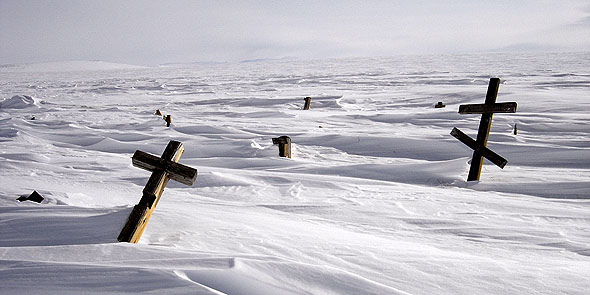
The biting cold of northern Russia was another foe that the prisoners had to face, a foe that, combined with the other hardships, wiped many of them out.
p. 63:
‘Most Russian iconographers carried out their work with devotion, fear of God, prayer and fasting.’
p. 64:
Despite the hardships and persecutions, the Russians continue to be a deeply devout people, and their devotion is being passed on to the next generation. The flame of faith in God that for years flickered in the hearts of ordinary people has not gone out because their experience was genuine.
p. 65:
‘The strict, though of course not slavish, conformity of Russian artists to these models (e.g. the icon of Our Lady of Vladimir: see icon below) produced superb works of chromatic brilliance, linear harmony and spiritual depth, such as Rubliov’s masterpiece, the icon of the Holy Trinity (see icon above).’
p. 66:
The famous 15th-century Lavra of the Holy Trinity at Zagorsk
p. 67:
Father Arseny’s biographer, author of ‘Father Arseny’, talking with one of the protagonist’s spiritual children about the book, which has been published in Greece by the Parakletos Monastery at Oropos, which kindly provided us with excerpts from the book and the photographic material.
http://pemptousia.com/2014/06/father-arseny-1894-1975-the-testimony-of-a-russian-confessor/