Ακούμε συχνά κάποιον να λέει. Έκανα αυτό το άσχημο πράγμα και η Παναγιά με τιμώρησε. Άλλος πάλι λέει. Διέπραξα αυτό το κακό και ο Χριστός με τιμώρησε. Η ο Άγιος με τιμώρησε.
Πόσο λάθος κάνουμε παιδιά μου. Πόσο μεγάλο λάθος.
Ούτε η Παναγιά τιμωρεί κανέναν, ούτε ο Χριστός μας, ούτε φυσικά και κανένας Άγιος.
Αλήθεια λέω. Γιατί; Γιατί απλούστατα δεν μπορούν να τιμωρήσουν κανέναν παιδιά μου.
Η ενέργεια τους αποτελείται από αγνή και καθαρή αγάπη. Και η αγάπη δεν μπορεί να κάνει κακό. Γιατί; Γιατί απλούστατα δεν μπορεί. Αν κάνει κακό, τότε δεν θα είναι αγάπη.
Και αφού είναι αγνή και καθαρή αγάπη και τίποτα άλλο, δεν μπορεί να κάνει κακό.
Τι συμβαίνει τότε και όταν διαπράξουμε κάτι κακό, μας έρχεται καρπαζιά ένα δυσάρεστο γεγονός, που εμείς μεταφράζουμε σαν τιμωρία από τον Χριστό ή την Παναγία;
Έχετε ακούσει την έκφραση, αυτόν τον πήρε ο διάολος και τον σήκωσε.;
Ε κάτι τέτοιο συμβαίνει. Όσο είμαστε σε αρμονία με την αγάπη του Κυρίου μας, έχουμε σαν ασπίδα αυτή την αγάπη και ο πονηρός δεν μπορεί να μας πειράξει. Εκτός από κάτι μικρές φωνούλες που εμφανίζονται που και που ,δεν μπορεί να μας κάνει κακό. Και καμιά φορά ακόμα και αυτές οι μικρές φωνούλες είναι παιχνίδια του μυαλού μας και δεν έχουν σχέση με τον πονηρό.
Όταν όμως διαπράξουμε ένα σοβαρό αμάρτημα και ειδικά όταν αυτό το αμάρτημα έχει καταστροφικές συνέπειες για κάποιον άλλο, ή έχουμε προσβάλει ή βρίσει τον Θεό και την Παναγία μας, τότε αυτομάτως χάνουμε την αρμονία της αγάπης του Χριστού μας, η ασπίδα προστασίας μας φεύγει από τα χέρια μας και απροστάτευτοι πλέον γινόμαστε έρμαιο στα χέρια του πονηρού, που με μεγάλη του χαρά θα μας περιλάβει για να εκτελέσει αυτό που του δίνει μεγάλη χαρά. Να μας πονέσει .Και εμείς αντί να καταλάβουμε τι συμβαίνει και να τρέξουμε με δάκρυα στα μάτια να επανορθώσουμε ότι μπορούμε και να ξανά βρούμε την προστασία μας στην αγάπη του Κυρίου μας, λέμε με τιμώρησε η Παναγιά η ο Χριστός.
Και ξεκαρδίζεται στα γέλια ο πονηρός.
Όχι παιδιά μου. Ο Χριστός, η Παναγία και οι Άγιοι του Κυρίου δεν τιμωρούν. Αγαπούν.
Και πονούν να μας βλέπουν να υποφέρουμε. Εμείς ανοίγουμε την πόρτα και βγαίνουμε από την περιοχή προστασίας του Κυρίου.
Με εξομολόγηση, ειλικρινή μεταμέλεια και την ευλογία του ιερέα ,μπορούμε να ξαναβρεθούμε σύντομα σε αρμονία πάλι με την αγάπη του Κυρίου μας. Και να είμαστε προστατευμένοι..
Ο καλός θεός και η Παναγιά μας να σας προστατεύουν από κάθε κακό.
Πατήρ Ιωάννης
http://lllazaros.blogspot.ca/

Η ταπείνωση έχει μεγάλη δύναμη και διαλύει τον διάβολο. Είναι το πιο δυνατό σόκ για τον διάβολο.
Όπου υπάρχει ταπείνωση, δεν έχει θέση ο διάβολος. Και όπου δεν υπάρχει διάβολος, επόμενο είναι να μην υπάρχουν πειρασμοί.
Μια φορά ένας ασκητής ζόρισε ένα ταγκαλάκι να πή το "Αγιος ο Θεός ...;";
Είπε το ταγκαλάκι "Αγιος ο Θεός, άγιος ισχυρός, άγιος αθάνατος";, "ελέησον ημάς" δεν έλεγε.
Πές: "ελέησον ημάς"! Τίποτε! Αν το έλεγε, θα γινόταν Άγγελος. Όλα τα λέει το ταγκαλάκι, το ''ελέησόν με" δεν το λέει, γιατί χρειάζεται ταπείνωση. Το "ελέησον με" έχει ταπείνωση, και δέχεται η ψυχή το μεγάλο έλεος του Θεού που ζητάει.
Ό,τι και να κάνουμε, ταπείνωση-αγάπη-αρχοντιά χρειάζεται. Τα πράγματα είναι απλά. Εμείς τα κάνουμε δύσκολα. Όσο μπορούμε, να κάνουμε ό,τι είναι δύσκολο στον διάβολο και εύκολο στον άνθρωπο.
Η αγάπη και η ταπείνωση είναι δύσκολες στον διάβολο και εύκολες στον άνθρωπο. Και ένας φιλάσθενος που δεν μπορεί να κάνει άσκηση, μπορεί να νικήση τον διάβολο με την ταπείνωση. Σε ένα λεπτό μέσα μπορεί ο άνθρωπος να γίνη Άγγελος ή ταγκαλάκι. Πώς; Με την ταπείνωση ή την υπερηφάνεια.
Τι, μήπως χρειάσθηκαν ώρες για να γίνη ο Εωσφόρος από Άγγελος διάβολος; Μέσα σε δευτερόλεπτα έγινε. Ο ευκολώτερος τρόπος για να σωθούμε, είναι η αγάπη και η ταπείνωση. Γι΄αυτό από την αγάπη και την ταπείνωση να αρχίσουμε και μετά να προχωρήσουμε στα άλλα.
Να εύχεσθε να δίνουμε συνέχεια χαρά στον Χριστό και στενοχώρια στο ταγκαλάκι, μια που του αρέσει η κόλαση και δεν θέλει να μετανοήση";.
Άγιος Παΐσιος

Commemorated on October 22
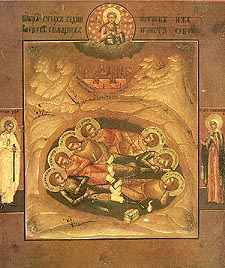
The Seven Youths of Ephesus: Maximilian, Iamblicus, Martinian, John, Dionysius, Exacustodianus (Constantine) and Antoninus, lived in the third century. St Maximilian was the son of the Ephesus city administrator, and the other six youths were sons of illustrious citizens of Ephesus. The youths were friends from childhood, and all were in military service together.
When the emperor Decius (249-251) arrived in Ephesus, he commanded all the citizens to offer sacrifice to the pagan gods. Torture and death awaited anyone who disobeyed. The seven youths were denounced by informants, and were summoned to reply to the charges. Appearing before the emperor, the young men confessed their faith in Christ.
Their military belts and insignia were quickly taken from them. Decius permitted them to go free, however, hoping that they would change their minds while he was off on a military campaign. The youths fled from the city and hid in a cave on Mount Ochlon, where they passed their time in prayer, preparing for martyrdom.
The youngest of them, St Iamblicus, dressed as a beggar and went into the city to buy bread. On one of his excursions into the city, he heard that the emperor had returned and was looking for them. St Maximilian urged his companions to come out of the cave and present themselves for trial.
Learning where the young men were hidden, the emperor ordered that the entrance of the cave be sealed with stones so that the saints would perish from hunger and thirst. Two of the dignitaries at the blocked entrance to the cave were secret Christians. Desiring to preserve the memory of the saints, they placed in the cave a sealed container containing two metal plaques. On them were inscribed the names of the seven youths and the details of their suffering and death.
The Lord placed the youths into a miraculous sleep lasting almost two centuries. In the meantime, the persecutions against Christians had ceased. During the reign of the holy emperor Theodosius the Younger (408-450) there were heretics who denied that there would be a general resurrection of the dead at the Second Coming of our Lord Jesus Christ. Some of them said, “How can there be a resurrection of the dead when there will be neither soul nor body, since they are disintegrated?” Others affirmed, “The souls alone will have a restoration, since it would be impossible for bodies to arise and live after a thousand years, when even their dust would not remain.” Therefore, the Lord revealed the mystery of the Resurrection of the Dead and of the future life through His seven saints.
The owner of the land on which Mount Ochlon was situated, discovered the stone construction, and his workers opened up the entrance to the cave. The Lord had kept the youths alive, and they awoke from their sleep, unaware that almost two hundred years had passed. Their bodies and clothing were completely undecayed.
Preparing to accept torture, the youths once again asked St Iamblicus to buy bread for them in the city. Going toward the city, the youth was astonished to see a cross on the gates. Hearing the name of Jesus Christ freely spoken, he began to doubt that he was approaching his own city.
When he paid for the bread, Iamblicus gave the merchant coins with the image of the emperor Decius on it. He was detained, as someone who might be concealing a horde of old money. They took St Iamblicus to the city administrator, who also happened to be the Bishop of Ephesus. Hearing the bewildering answers of the young man, the bishop perceived that God was revealing some sort of mystery through him, and went with other people to the cave.
At the entrance to the cave the bishop found the sealed container and opened it. He read upon the metal plaques the names of the seven youths and the details of the sealing of the cave on the orders of the emperor Decius. Going into the cave and seeing the saints alive, everyone rejoiced and perceived that the Lord, by waking them from their long sleep, was demonstrating to the Church the mystery of the Resurrection of the Dead.
Soon the emperor himself arrived in Ephesus and spoke with the young men in the cave. Then the holy youths, in sight of everyone, lay their heads upon the ground and fell asleep again, this time until the General Resurrection.
The emperor wanted to place each of the youths into a jeweled coffin, but they appeared to him in a dream and said that their bodies were to be left upon the ground in the cave. In the twelfth century the Russian pilgrim Igumen Daniel saw the holy relics of the seven youths in the cave.
There is a second commemoration of the seven youths on October 22. According to one tradition, which entered into the Russian PROLOGUE (of Saints’ Lives), the youths fell asleep for the second time on this day. The Greek MENAION of 1870 says that they first fell asleep on August 4, and woke up on October 22.
There is a prayer of the Seven Sleepers of Ephesus in the GREAT BOOK OF NEEDS (Trebnik) for those who are ill and cannot sleep. The Seven Sleepers are also mentioned in the service for the Church New Year, September 1.
http://oca.org/saints/lives

“Protestantism? It is the loyal child of Papism. It went from one heresy to another over the centuries because of its rationalistic scholasticism, and it is continually drowning in the various poisons of its heretical errors. In addition, Papal haughtiness and ‘infallible’ foolishness reign absolutely within it, ruining the souls of its faithful. First of all each Protestant is an independent pope when it comes to matters of faith. This always leads from one spiritual death to another; and there is no end to this ‘dying’ since a person can suffer countless spiritual deaths (in a lifetime).
Since this is the way things are, there is no way out of this impasse for the Papist-Protestantic Ecumenism with its pseudo-Church and its pseudo-Christianity without wholehearted repentance before the God-man Christ and His Orthodox Catholic Church. Repentance is the remedy for every sin, the medicine given to man by the only Friend of man (Christ).”
St. Justin Popovich, Orthodox Faith & Life in Christ , “Humanistic Ecumenism”
Οι γονείς μας, ο πατέρας μας και η μητέρα μας, είναι ιερά πρόσωπα για μας. Έχουν από το Θεό μεγάλη χάρη και ευλογία. Μα πιο μεγάλη από αυτούς χάρη και ευλογία έχουν οι ιερείς μας.
Η διαφορά ανάμεσα στους ιερείς και στους γονείς μας είναι πολύ μεγάλη. Είναι τόσο μεγάλη, όσο μεγάλη είναι η διαφορά ανάμεσα στην παρούσα ζωή και στην αιώνια.
Οι γονείς, γεννούν παιδιά, για την παρούσα ζωή· οι ιερείς, για την άλλη.Οι γονείς, δεν μπορούν, ούτε να σώσουν τα παιδιά τους, ούτε να τα προφυλάξουν· ούτε από αρρώστειες· ούτε από τον θάνατο!
Οι ιερείς, μπορούν. Και σώζουν. Ψυχές άρρωστες. Από το χείλος της απωλείας! Κάνουν και σταματάει το κατρακύλισμα: με τα λόγια τους· με τις συμβουλές τους· και με τις ευχές τους.
Οι γονείς, αν τα παιδιά τους πρόσβαλαν κανέναν μεγάλον, δεν μπορούν να τα προστατεύσουν!
Οι ιερείς, μας βγάζουν ασπροπρόσωπους, ακόμη και αν εναντίον μας έχει οργισθή ο ίδιος ο Θεός. Γιατί ο Θεός έχει δεσμευθή να τους ακούει.
Άγιος Ιωάννης Χρυσόστομος

I received your letter, my child, and I saw your anxiety. But don’t be sad, my child. Don’t worry so much. Even though you have fallen again, get up again. You have been called to a heavenly road. It is not surprising for someone running to stumble. It just takes patience and repentance at every moment.
Therefore, always do a metanoia when you are wrong and don’t lose time, because the longer you wait to seek forgiveness, the more you allow the evil one to spread his roots within you. Don’t let him make roots to your detriment.
Therefore, don’t despair when you fall, but get up eagerly and do a metanoia saying, “Forgive me, my dear Christ. I am human and weak.” The Lord has not abandoned you. But since you still have a great deal of worldly pride, a great deal of vainglory, our Christ lets you make mistakes and fall, so that you perceive and come to know your weakness every day, so that you become patient with others who make mistakes, and so that you do not judge the brethren when they make mistakes, but rather put up with them.
So every time you fall, get up again and at once seek forgiveness. Don’t hide sorrow in your heart, because sorrow and despondency are the joy of the evil one. They fill one’s soul with bitterness and give birth to many evils. Whereas the frame of mind of someone who repents says, “I have sinned! Forgive me Father!” and he expels the sorrow. He says, “Am I not a weak human? So what do I expect?” Truly, my child this is how it is. So take courage.
Only when the grace of God comes does a person stand on his feet. Otherwise, without grace, he always changes and always falls. So be a man and don’t be afraid at all.
Do you see how that brother you wrote about endured the temptation? You, too, should do likewise. Acquire a brave spirit against the temptations that come. In any case, they will come. Forget about what your despondency and indolence tell you. Don’t be afraid of them. Just as the previous temptations passed by the grace of God, these, too, will pass once they do their job.
Temptations are medicines and healing herbs that heal our visible passions and our invisible wounds. So have patience in order to profit every day, to store up wages, rest, and joy in the heavenly kingdom. For the night of death is coming when no one will be able to work anymore. Therefore, hurry. Time is short.
You should know this too: a victorious life lasting only one day with trophies and crowns is better than a negligent life lasting many years. Because one man’s struggle, with knowledge and spiritual perception that lasts one day, has the same value as another man’s struggle, who struggles negligently without knowledge for fifty years.
Without a struggle and shedding your blood, don’t expect freedom from the passions. Our earth produces thorns and thistles after the Fall. We have been ordered to clean it, but only with much pain, bloody hands, and many sighs are the thorns and thistles uprooted. So weep, shed streams of tears, and soften the earth of your heart. Once the ground is wet, you can easily uproot the thorns.
Elder Joseph the Hesychast
 Τα αγαπημένα παιδιά τρέχουν στα λιβάδια, κόβουν λουλούδια , τραγουδούν και χαίρονται , γιατί τα κάνει και χαίρονται η χάρη του Θεού. Αλλά, να, είδαν τα παιδιά κάποιον μοναχό και του λένε…
-Κοίτα, ο Κύριος στόλισε τον ουρανό με αστέρια και την γη με ποτάμια και κήπους. Οι αετοί πετούν πάνω στα σύννεφα και απολαμβάνουν το κάλλος της φύσεως. Τα πουλιά κελαηδούν εύθυμα στα δάση και στις πεδιάδες και εσύ, μοναχέ, κάθεσαι στο κελλί σου και δεν βλέπεις όλη την ωραιότητα του Θεού. Κάθεσαι και κλαις. Γιατί κλαις στο μικρό κελλί σου, όταν ο ήλιος λάμπει και ο κόσμος όλος στολίζεται με ομορφιά , και όλοι πάνω στη γη χαίρονται;
Έτσι ρωτούσαν τα παιδιά τον μοναχό και αυτός αποκρίθηκε:
-Παιδιά, εσείς δεν καταλαβαίνετε τον θρήνο μου. Η ψυχή μου κλαίει για εσάς, γιατί δεν γνωρίζετε τον Θεό , που δημιούργησε αυτή την ωραιότητα. Η ψυχή μου τον γνωρίζει και ποθώ αυτή την γνώση για όλους σας, και γι΄αυτό θλίβομαι και παρακαλώ τον Θεό για εσάς ώστε και εσείς να γνωρίσετε τον Κύριο εν Πνεύματι Αγίω.
-Τι σημαίνει να γνωρίσουμε τον Κύριο εν Πνεύματι Αγίω;
-Με τον νου, παιδιά, είναι αδύνατο να γνωρίσετε τον Κύριο, αλλά διαβάστε την θεία Γραφή. Σε αυτή ζει η χάρη που θα σας γλυκάνει και έτσι θα γνωρίσετε τον Κύριο και με χαρά θα Τον υπηρετείτε ημέρα και νύχτα. Και όταν γνωρίσετε τον Κύριο, τότε θα σας φύγει η επιθυμία να βλέπετε αυτόν τον
κόσμο , αλλά η ψυχή σας θα ορμά να βλέπει την δόξα του Κυρίου στους ουρανούς.
-Μας αρέσουν, όμως, τα λουλούδια, μας αρέσει να περπατούμε και να χαιρόμαστε.
-Σας αρέσει να περπατάτε στους αγρούς και να μαζεύετε λουλούδια, σας αρέσει να τραγουδάτε και να ακούτε το κελάηδημα των πουλιών, αλλά υπάρχει στον ουρανό κάτι πιο ευχάριστο απ΄αυτά, ο Παράδεισος, όπου ζει ο Κύριος με τους Αγγέλους και τους Αγίους. Εκεί υπάρχει αγαλλίαση και ψάλλουν ύμνους, αλλά άλλους καλύτερους. Και όταν η ψυχή ακούει τους ύμνους αυτούς, δεν μπορεί ποτέ να τους ξεχάσει, και οι ύμνοι της γης δεν την ελκύουν πλέον.
-Αλλά μας αρέσει να τραγουδάμε.
-Ψάλλατε, παιδιά, στον Κύριο με το Άγιο Πνεύμα, ψάλτε με ταπείνωση και αγάπη.
-Εσύ, όμως, γιατί θρηνείς; Δεν καταλαβαίνουμε.
–Θρηνώ, για εσάς, μικρά παιδιά. Σας βλέπω, σας αγαπώ και προσεύχομαι στον Κύριο να σας φυλάξει, ώστε να γνωρίσετε τον Δημιουργό και Κύριό σας. Σας βλέπω και, να, είστε όμοιοι με το Παιδί Ιησού, και θέλω, να μην χάσετε την χάρη του Θεού και γίνετε, όταν μεγαλώσετε στην ηλικία, σαν τον εχθρό εξαιτίας των κακών λογισμών. Θέλω πάντα να μοιάζετε με τον Υιό της Πανάγνου Θεομήτορος. Αυτό εύχεται η ψυχή μου για εσάς. Γι΄αυτό προσεύχομαι. Λυπάμαι όλα τα παιδιά της γης και γι΄αυτό θρηνώ για όλα τα αθώα παιδιά και τα ορφανά. Πενθώ, παιδιά, για τον κόσμο, και θρηνώ για όλο τον λαό του Θεού.
“Κύριε, εξαπόστειλε το έλεός Σου στα παιδιά της γης , που εσύ αγαπάς, και ΄δώσε σε αυτά να Σε γνωρίσουν με το Άγιο Πνεύμα,και δίδαξέ τα να σε δοξάζουν.Με δάκρυα σε ικετεύω, άκουσε την προσευχή μου και δώσε σε όλα αυτά να γνωρίσουν την δόξα Σου με το Άγιο Πνεύμα.
-Παιδιά, αγαπάτε τον Θεό, όπως Τον αγαπούν οι Άγγελοι στον ουρανό.
-Ποτέ δεν είδαμε τον Θεό. Πώς μπορούμε να Τον αγαπάμε;
-Αγαπημένα μου παιδιά, να σκέφτεστε για τον Θεό πάντα ότι Αυτός σας αγαπά και έδωσε σε σας ζωή, ώστε να ζείτε αιώνια μαζί Του και να ευφραίνεσθε με την αγάπη Του.
-Πώς μπορούμε να γνωρίσουμε ότι μας αγαπά ο Θεός;
-Από τους καρπούς, παιδιά, γνωρίζετε την αγάπη.Όταν μένουμε στην αγάπη του Θεού, τότε φοβόμαστε την αμαρτία και έχουμε στην ψυχή χαρά και ειρήνη, και θέλουμε συνέχεια να θυμόμαστε τον Θεό και να προσευχόμαστε αδιάλειπτα, και τότε στην ψυχή θα υπάρχουν αγαθοί λογισμοί.
-Πώς θα γνωρίσουμε ποιοι λογισμοί ζουν μέσα μας και ποιοι απ΄αυτούς είναι καλοί και κακοί;
– Για να διακρίνετε τους καλούς λογισμούς από τους κακούς, πρέπει να διατηρείτε το νου σας καθαρό εν τω Θεώ.
-Δεν καταλαβαίνουμε με ποιο τρόπο μπορούμε να κρατούμε το νου σπο Θεό, αφού δεν είδαμε τον Θεό και δεν Τον γνωρίσαμε. Και τι σημαίνει “καθαρός νους”;
-Παιδιά, να σκέφτεστε ότι ο Θεός σας βλέπει, παρ΄όλο που εσείς δεν Τον βλέπετε. Έτσι πάντοτε θα βαδίζετε ενώπιον του προσώπου του Κυρίου. Αν και αυτό είναι μικρή αγάπη, εν τούτοις, αν ακούσετε το λόγο μου, τότε αυτός θα σας οδηγήσει σε μεγαλύτερη αγάπη, και τότε με το Άγιο Πνεύμα θα γνωρίσετε όλα όσα σας είπα, και που τώρα ακόμα δεν καταλαβαίνετε.
Σημείωση: ο άγιος διηγούνταν τις πολύ ενδιαφέρουσες παρατηρήσεις του από τις συνομιλίες και την συναναστροφή του με τα
παιδιά, όταν κατά την διάρκεια του Ρωσοϊαπωνικού πολέμου, κλήθηκε να υπηρετήσει στην οπισθοφυλακή και έζησε για κάποιο διάστημα στο χωριό του. Έλεγε ότι η ψυχή του ανθρώπου, από την παιδική ηλικία, μπορεί να προσδιορισθεί στην σχέση της με τον θεό.
Οι συνομιλίες που αναφέρονται εδώ, αποτελούν επεξεργασία εκείνων, που είχε αυτός με τα παιδιά. Ενδέχεται στις αγνές ψυχές των παιδιών να αντικατοπρίζεται η φωτεινή εικόνα του “αγαπώντος” μοναχού, αλλά είναι αδύνατον να μην παρατηρήσουμε ότι ,κατά το περιεχόμενό τους, οι λόγοι του Γέροντα είναι προσιτοί μόνο σε ενήλικες.
Πηγή: ο Άγιος Σιλουανός ο Αθωνίτης, αρχ. Σωφρονίου Σαχάρωφ, εκδόσεις Ι. Μονής Τιμίου Προδρόμου, Έσσεξ Αγγλίας, σ. 575-577 – εικόνες από: Διακόνημα και Συναξαριστή
http://orthodoxigynaika.blogspot.gr/2015/10/blog-post_13.html

Πρώτον: Γιατί η πίστη μας είναι φως. Ο Χριστός είπε: «Εγώ ειμί το φως
του κόσμου». Το φως της κανδήλας μας θυμίζει το φως, με το οποίο ο
Χριστός καταυγάζει τις ψυχές μας.
Δεύτερον: Για να μας
θυμίζει, ότι και η ζωή μας πρέπει να είναι φωτεινή σαν των αγίων, δηλαδή
των ανθρώπων, που ο Απόστολος Παύλος τους ονομάζει «τέκνα φωτός».
Τρίτον: Για να είναι έλεγχος στα σκοτεινά μας έργα και στις κακές μας
ενθυμήσεις και επιθυμίες. Και έτσι να τα επαναφέρει όλα στο δρόμο του
φωτός του αγίου Ευαγγελίου. Για να λάμψει «το φως ημών έμπροσθεν των
ανθρώπων, όπως είδωσιν ημών τα καλά έργα και δοξάσωσι τον Πατέρα ημών
τον εν τοις ουρανοίς».
Τέταρτον: Είναι μια μικρή δική μας
θυσία, σημείο και δείγμα της ευγνωμοσύνης και της αγάπης, που οφείλουμε
στο Θεό για τη μεγάλη θυσία που έκαμε για μας. Με αυτήν και με την
προσευχή μας, τον ευχαριστούμε για τη ζωή, για τη σωτηρία και για όλα
όσα μας χαρίζει η θεϊκή και άπειρη αγάπη του.
Πέμπτον: Για να
είναι φόβητρο στις δυνάμεις του σκότους, που μας επιτίθενται με
ιδιαίτερη πονηρία πριν και κατά την ώρα της προσευχής και θέλουν να
απομακρύνουν τη σκέψη μας από το Θεό. Οι δαίμονες αγαπούν το σκοτάδι και
τρέμουν το φως: Και του Χριστού κι εκείνων που αγαπούν τον Χριστό.
Έκτον: Για να μας παρακινεί σε αυτοθυσία. Όπως δηλαδή με το λάδι
καίγεται στο καντήλι το φυτίλι, έτσι και το δικό μας θέλημα να καίγεται
με τη φλόγα της αγάπης για τον Χριστό και να υποτάσσεται πάντοτε στο
θέλημα του Θεού.
Έβδομον: Για να μάθωμε ότι: Όπως δεν ανάβει
το καντήλι χωρίς τα δικά μας χέρια, έτσι και το εσωτερικό καντήλι της
καρδιάς μας δεν ανάβει χωρίς τα χέρια του Θεού. Οι κόποι των αρετών μας
είναι η καύσιμη ύλη (το φυτίλι και το λάδι), που για να ανάψουν και να
φωτίσουν χρειάζονται το «πυρ» του Αγίου Πνεύματος.

There is no question that only Christ is able to save us from sin. So, how can saints aid us? When we honor saints and ask them to pray for us we are not putting them in the place of Christ. They are close to God, so when they pray for us they seek our salvation from Christ.
Elder Cleopa puts it this way,
When the saints pray for us, it is precisely our salvation that they seek from Christ. They interceded with Him for our salvation. From Christ they entreat our salvation. This is what we mean when we say they intercede for us. By their prayers the saints petition for our salvation -- not, however, as if they themselves have the power to save, for the only one who saves is Christ. Thus we do not venerate saints and angels as we do God. (That which we render the saints and angels is solely a veneration of honor and reverence, while God we adore and worship with perfect adoration which is thus properly called worship)
The apostle Paul reminds us that the saints are our fellow citizens who can help us. "Now therefore ye are no more strangers and foreigners, but fellow citizens with the saints, and of the household of God" (Eph 2:19).
How is we know that the saints have the ability to pray to God on our behalf? We know this from Scripture. "And when he had taken the book, the four beasts and the four and twenty elders fell down before the Lamb, having everyone of them harps, and golden vials full of orders, which are the prayers of the saints" (Rev 5:8)
Some are concerned that the veneration of saints eclipse the glory and honor that belongs to God alone. But God himself glorified His saints. "And the glory which thou gravest me I have given them; that they may be one, even as we are one" (Jn 17:22).
Elder Cleopa says,
No eclipse or depreciation of the glory of God results from the reverence and veneration of His angels. This is so, first of all, because the veneration that we offer God is one thing and the veneration we render to the angels and saints is another. The same Holy Spirit exhorts us to glorify God with His saints saying, "Praise ye God in His saints." Thus we glorify God likewise when we seek in prayer the help and mediation of the angels and saints, since the saints in their succession convey our supplications and requests together with their own prayers to God.
The saints are given special powers by God to work miracles. It says in Scripture, "In the saints that are in His earth hath the Lord been wondrous; He hath wrought all His desires in them" (Ps 15:3). Elder Cleopa lists many examples from the Old Testament of people who were given such powers and then points out the powers of the Holy Apostles, including the seventy, who are able to render all sorts of things.
He writes,
God himself glorified His saints and robed them with His glory: "And the glory which thou gravest me I have given them; that they may be one, even as we are one" (Jn 17:22). Elsewhere He says, "He that receiveth you receiveth me; and he that receiveth me receiveth him who sent me. He that receiveth a prophet in the name of a prophet shall receive a prophets reward; and he that receiveth a righteous man in the name of a righteous man shall receive a righteous man's reward" (Mat 11:40-41). These statements prove sufficiently enough the delusion of those who repudiate the honor shown toward the saints and angels, -- those beloved servants of God -- not realizing that in practice they turn their back on God himself, the Creator and Fashioner of saints.
Reference: The Truth of Our Faith, 67-77

Kontakion 1
Chosen passion-bearer of Christ and gracious healer, who freely grantest healing unto the sick, we praise thee in songs as our protector. Since thou hast boldness with the Lord, free us from all harm and sickness who cry with love unto thee:
Rejoice, Saint Panteleimon, Great Martyr and Healer.
Ikos 1
We know thee, glorious Panteleimon, as an earthly angel and heavenly man. Adorned with angelic purity and martyrdom, thou hast passed from earth to Heaven. Standing before the Throne of the Lord of Glory with the angels and all the saints, thou prayest for all of us on earth who venerate thee with these invocations:
Rejoice, torch of piety.
Rejoice, most glorious lamp of the Church.
Rejoice, adornment of venerable martyrs.
Rejoice, support of the faithful in unflinching endurance.
Rejoice, outstanding boast of youth.
Rejoice, thou who having grown up in the world, wast not of the world.
Rejoice, angel in the flesh, surpassing mortals.
Rejoice, warrior of Christ of invincible courage.
Rejoice, witness of heavenly mercy.
Rejoice, vessel of divine knowledge.
Rejoice, thou by whom faith hath been exalted.
Rejoice, thou by whom delusion hath been dethroned.
Rejoice, Saint Panteleimon, Great Martyr and Healer.
Kontakion 2
Seeing thee to be a chosen vessel, the Lord loved the beauty of thy soul. Despising all earthly glory and pleasure, thou didst long to adorn thyself with the crown of martyrdom. Hence, wounded with divine love, thou didst jubilantly sing: Alleluia.
Ikos 2
Possessing divinely inspired knowledge, O valiant warrior Panteleimon, thou didst astound the Emperor Maximian by the courage of thy soul and by the words with which thou didst fearlessly preach Christ. Wherefore praising thy boldness, we cry unto thee:
Rejoice, thou who didst despise Maximian’s threats.
Rejoice, thou who didst not follow the advice of the godless.
Rejoice, propagator of true adoration.
Rejoice, uprooter of demon worship.
Rejoice, accuser of the fury of torturers.
Rejoice, overthrower of the delusion of idolatry.
Rejoice, thou who didst disperse the assembly of the godless.
Rejoice, thou who didst exchange the corruptible for heavenly joy.
Rejoice, converser with immaterial angels.
Rejoice, fellow chorister of longsuffering saints.
Rejoice, thou by whom Satan was put to shame.
Rejoice, thou by whom Christ is glorified.
Rejoice, Saint Panteleimon, Great Martyr and Healer.
Kontakion 3
By the power of the Most High given unto thee and by thy strong patience thou didst render powerless the torturer’s insolence, O valiant victor who wast undaunted by fire, wild beasts, and the wheel. When beheaded with the sword, thou didst receive the crown of martyrdom, wounded with divine love and singing: Alleluia.
Ikos 3
The monastery which hath thy precious head as a great treasure, O divinely wise martyr, is filled with joy over it. Praising the grace of healing given unto thee by God, the monks thankfully cry unto thee:
Rejoice, all-radiant lamp of Nicomedia.
Rejoice, vigilant guardian of the monastery that honoureth thee.
Rejoice, thou through whom godlessness grew cold.
Rejoice, thou through whom the knowledge of God hath increased.
Rejoice, bright glory of the passion-bearers.
Rejoice, joyous report of the Orthodox.
Rejoice, gracious source of healings.
Rejoice, worthy container of great gifts.
Rejoice, fragrant myrrh who dost sweeten souls.
Rejoice, ready helper of those who call upon thee.
Rejoice, thou who didst give sight unto the blind.
Rejoice, thou who didst cause the lame to walk.
Rejoice, Saint Panteleimon, Great Martyr and Healer.
Kontakion 4
Possessed by a storm of polytheistic thoughts, the impious Emperor was confused upon learning from the doctors, who were jealous of thee, that thou healest all kinds of hopeless illnesses by the Name of Christ. We therefore glorify with gladness our wonderful God in thee, and we cry unto Him: Alleluia.
Ikos 4
When the people of Nicomedia heard of thy great compassion for the suffering and of thy free healing of all illnesses, everyone rushed to thee with faith in the healing grace in thee. Receiving swift healing of all their diseases, they glorified God and magnified thee, Saint Panteleimon, their most gracious healer, crying unto thee:
Rejoice, thou who art anointed with the myrrh of grace.
Rejoice, thou who sanctifiest the Temple of God.
Rejoice, great glory of the pious.
Rejoice, firm wall of the oppressed.
Rejoice, thou who surpassest the wise in knowledge.
Rejoice, thou who enlightenest the thoughts of the faithful.
Rejoice, recipient of divine gifts and source of many of the Lord’s mercies for us.
Rejoice, speedy helper of the suffering.
Rejoice, harbor of the storm-tossed.
Rejoice, instructor for those gone astray.
Rejoice, thou who dost heal the sick freely.
Rejoice, thou who dost work miracles abundantly.
Rejoice, Saint Panteleimon, Great Martyr and Healer.
Kontakion 5
The Lord worked a glorious miracle through thee when through His servant Hermolaus, He called thee into His marvelous light. After thy prayer to Christ, a child who had died from snakebite at once revived and stood up healed. Thenceforth, recognizing the Giver of Life as the True God of all, with firm faith thou didst cry unto Him: Alleluia.
Ikos 5
The blind man whom thou didst touch with prayer in the Name of Christ recovered his sight, O glorious martyr. Renouncing thy father’s polytheism, thou wast baptized by the priest Hermolaus and didst embrace thy mother’s religion with which thou didst also enlighten thy father. We therefore cry aloud unto thee, Saint Panteleimon, as unto a glorious servant of God and wonderful healer:
Rejoice, thou who hast great devotion for God.
Rejoice, thou who art ever aflame with the fire of divine love.
Rejoice, thou who didst listen to the teachings of the priest Hermolaus.
Rejoice, thou who didst follow the advice of thy mother Eubule.
Rejoice, thou who didst give away everything to obtain Christ.
Rejoice, thou who didst vanquish love for the world by love for God.
Rejoice, thou who didst renounce worldly pleasures and didst accept for Christ cruel sufferings.
.
Rejoice, thou who didst become a partaker of Christ’s Passion.
Rejoice, thou who didst overcome all the passions.
Rejoice, thou who through grace wast adorned with dispassion.
Rejoice, thou who dost fill with joy those who hasten to thee.
Rejoice, thou who dost heal all freely by the grace of Christ.
Rejoice, Saint Panteleimon, Great Martyr and Healer.
Kontakion 6
The blind man enlightened by thee in body and soul became a preacher of the truth. Like the blind man of the Gospel, he boldly preached Christ unto all as the True Light that enlighteneth every man. Because he reproached the impious Emperor and the pagan gods, he was beheaded and rose to the never-waning light in Heaven to sing unto God: Alleluia.
Ikos 6
Standing before the Emperor’s tribunal with a radiant face, thou didst boldly declare in the hearing of all, O thrice-blessed Martyr Panteleimon: Mine all-healing power and glory is Christ, the True God, the Lord of all, Who raiseth the dead and healeth all infirmities. For this confession we bless thee and say:
Rejoice, thundering mouth of the deity of Christ.
Rejoice, mellifluous tongue that declareth His plan of salvation.
Rejoice, orator of sublime theology.
Rejoice, wise sower of piety.
Rejoice, sweet-sounding flute of faith.
Rejoice, glorious preacher of Orthodoxy.
Rejoice, faithful follower in Christ’s footsteps.
Rejoice, joyful seer of Christ’s glory.
Rejoice, comfort of those reproached by unbelievers.
Rejoice, support of those who confess the Faith.
Rejoice, giver of help unto those who need it.
Rejoice, obtainer of blessings for those who honour thy memory.
Rejoice, Saint Panteleimon, Great Martyr and Healer.
Kontakion 7
Myrrh was poured out upon thy soul, O divinely wise healer Panteleimon, from the Comforter Spirit. Hence, after thy death, thy venerable relics by their fragrance banish the stench of the passions and give healing unto those who with faith cry unto God: Alleluia.
Ikos 7
When the worshippers of idols beheld the paralyzed man raised and walking through thy prayer, Saint Panteleimon, many believed in Christ. However, the demon’s priests, consumed with jealousy, incited the vain Emperor to anger. For this reason, unto thee who wast mercilessly tortured and burnt for Christ, we cry with compunction:
Rejoice, thou who didst despise earthly pleasures.
Rejoice, thou who wast above material comforts.
Rejoice, thou who didst regard as nothing all the beautiful things in this world.
Rejoice, thou who didst shake thyself free of fleeting glory.
Rejoice, thou who didst remain free from the nets of the devil.
Rejoice, thou who didst vanquish the wiles of the torturers.
Rejoice, thou who didst not spare thy life for Christ.
Rejoice, thou who wast shewn to be an enemy of hostile flesh.
Rejoice, thou who didst impede the spread of polytheism.
Rejoice, thou who by the power of God didst defeat the idols.
Rejoice, sharp arrow by whom enemies are wounded.
Rejoice, mediator who defendest the faithful.
Rejoice, Saint Panteleimon, Great Martyr and Healer.
Kontakion 8
The Lord appeared unto thee in a wonderful way, encouraging and upholding thee in the tortures for His Name. In the person of the priest Hermolaus, the Lord cooled the boiling lead into which thou wast thrown, and in the sea He untied the great stone from thy neck and brought thee unharmed onto land. Whereafter having been brought again before the Emperor, thou didst sing triumphantly unto Christ our God: Alleluia.
Ikos 8
While dwelling noetically wholly in Heaven, thou leavest not those below on earth but remainest with us through the relics of thy holy skull, O great passion-bearer of Christ. Receiving from the Lord enlightenment and sanctification, thou givest blessings unto those who cry unto thee thus:
Rejoice, thou who art filled with divine wisdom.
Rejoice, discerner of God’s providence.
Rejoice, delight of minds made wise by God.
Rejoice, gladness of souls who love God.
Rejoice, bright pearl of Christ.
Rejoice, glorious sanctification in soul and body.
Rejoice, dweller in the courts of the firstborn in Heaven.
Rejoice, inhabitant of the ever-blessed bridal halls.
Rejoice, beholder of the light of the Trinity.
Rejoice, fervent mediator in thy prayers to God for us.
Rejoice, thou who grantest illumination unto souls.
Rejoice, thou who givest comfort unto the afflicted.
Rejoice, Saint Panteleimon, Great Martyr and Healer.
Kontakion 9
All nature marveled, Great Martyr, at the radiance of grace and the wealth of virtues in thee. Thou art a model of angelic purity, great courage in cruel sufferings, strong love for Christ, and great compassion for the people for whom thou doest glorious things that they may sing: Alleluia.
Ikos 9
Eloquent orators cannot worthily praise thy struggles, O glorious victor Panteleimon. By the invincible power of God, though young in years, thou didst conquer the ancient, primordial enemy and didst put to shame the deluded idolaters. Full of wonder at thy faith and purity, we truly cry unto thee:
Rejoice, joyful sight of angels.
Rejoice, worthy wonder of men.
Rejoice, thou who didst shed thy blood for Christ, and in death didst shed milk.
Rejoice, thou who didst give up thy body to a martyr’s death for His sake.
Rejoice, splendid model of confession.
Rejoice, valiant warrior of the King of kings.
Rejoice, thou who didst conquer the ruler of darkness.
Rejoice, thou who by thy victory didst gladden Heaven and earth.
Rejoice, blessed inhabitant of the world above.
Rejoice, wise pilgrim of the world below.
Rejoice, tree adorned with the fruits of the gifts of grace.
Rejoice, thou who carriest palms of victory.
Rejoice, Saint Panteleimon, Great Martyr and Healer.
Kontakion 10
Full of compassion as a true imitator of Christ the Giver of Mercy, thou wast renamed by Him Panteleimon — that is, all-merciful — for thou pourest mercy upon all who hasten to thine aid. Pour it also abundantly upon us who cry unto God concerning thee: Alleluia.
Ikos 10
Finding thee a strong wall resistant to all kinds of torture, the torturer tried to break thy spirit by the teeth of wild beasts and the spikes of the torture wheel, but all to no effect. The power of Christ restrained the fierceness of the beasts, and the frightful wheel on which thy body was turned immediately broke to pieces. Wherefore unto thee, invincible passion-bearer Panteleimon, we cry:
Rejoice, precious chosen-one of Christ.
Rejoice, exquisite fragrance of God.
Rejoice, firm diamond of the Church.
Rejoice, unshakable tower reaching unto Heaven.
Rejoice, tamer of visible beasts.
Rejoice, crusher of invisible dragons.
Rejoice, thou who wast stained with thy blood shed for Christ, mixed with milk.
Rejoice, thou who hast received glorious crowns.
Rejoice, thou who bringest joy unto angels and men.
Rejoice, thou who hast been glorified by God in Heaven and on earth.
Rejoice, celestial one who singest in the choirs of the martyrs.
Rejoice, holy one who delightest in the sweet vision of Christ.
Rejoice, Saint Panteleimon, Great Martyr and Healer.
Kontakion 11
A funeral song do we offer unto thy sacred immolation for Christ, in which milk instead of blood flowed from thee, Great Martyr, and the olive tree under which thou wast beheaded was all covered with healing fruit. It is fitting that we cry fervently unto Christ Who wonderfully glorifieth those who glorify Him: Alleluia.
Ikos 11
A luminous ray wast thou, divinely wise Panteleimon, unto those sitting in the darkness of polytheism, leading them unto the Sun of Righteousness, Christ God. Him do thou entreat that we who offer unto thee glad praises may ever live in the light of His Commandments:
Rejoice, bright star, shining in the noetical firmament.
Rejoice, ray of light, shining for Christian people.
Rejoice, thou who wast mystically illumined by the Sun, Christ.
Rejoice, thou who in spirit roamest the earth.
Rejoice, beautiful tabernacle of the Holy Ghost.
Rejoice, honourable vessel who pourest out healing.
Rejoice, treasury of purity.
Rejoice, namesake of mercy.
Rejoice, heir of the Kingdom of Heaven.
Rejoice, partaker of eternal glory.
Rejoice, patron of those in distress upon the sea of life.
Rejoice, unmercenary healer who helpest those who invoke thee with faith.
Rejoice, Saint Panteleimon, Great Martyr and Healer.
Kontakion 12
Thou didst receive an abundance of grace, O thrice-blessed one, according to the greatness of thy love for Christ God, Who also shewed thee to be a source of healing. Thou curest free of charge the sicknesses of soul and body of those who approach thee with faith and cry unto God: Alleluia.
Ikos 12
Chanting of thy longsuffering labors for Christ, O our defender and healer Panteleimon, we praise thy great patience, we bless thy martyr’s death, we honour thy holy memory, and in praise we cry unto thee:
Rejoice, sweet-sounding trumpet of piety.
Rejoice, sword who didst cut down impiety.
Rejoice, thou who wast struck at the olive tree for Him Who didst stretch out His hands on the Tree of the Cross.
Rejoice, by being burnt for Him, thou didst extinguish the furnace of delusion.
Rejoice, by thy wounds, thou didst wound the opponents of Christ.
Rejoice, by thy blood, thou didst dry the streams of idolatrous blood.
Rejoice, thou who wast thrown into boiling lead for Christ.
Rejoice, thou who wast sunk into the sea for His Name.
Rejoice, thou who didst remain unharmed therein by the providence of God.
Rejoice, thou who didst pass through tortures of fire and water into the peace of Heaven.
Rejoice, thou who didst pour unfailing streams of mercy upon the faithful.
Rejoice, gracious and compassionate physician who grantest healing through grace.
Rejoice, Saint Panteleimon, Great Martyr and Healer.
Kontakion 13
Since you are a longsuffering passion-bearer of Christ and a healer, Saint Panteleimon, graciously accept from us this small offering. Heal us of our many and various ailments, and through thine intercession protect us from enemies visible and invisible. Pray to the Lord that we may be delivered from eternal torment, and that we may continually sing in His Kingdom: Alleluia. Alleluia. Alleluia.
(Repeat Kontakion 13 three times.)
Kontakion 1 (repeated)
Chosen passion-bearer of Christ and gracious healer, who freely grantest healing unto the sick, we praise thee in songs as our protector. Since thou hast boldness with the Lord, free us from all harm and sickness who cry with love unto thee:
Rejoice, Saint Panteleimon, Great Martyr and Healer.
Ikos 1 (repeated)
We know thee, glorious Panteleimon, as an earthly angel and heavenly man. Adorned with angelic purity and martyrdom, thou hast passed from earth to Heaven. Standing before the Throne of the Lord of Glory with the angels and all the saints, thou prayest for all of us on earth who venerate thee with these invocations:
Rejoice, torch of piety.
Rejoice, most glorious lamp of the Church.
Rejoice, adornment of venerable martyrs.
Rejoice, support of the faithful in unflinching endurance.
Rejoice, outstanding boast of youth.
.Rejoice, thou who having grown up in the world, wast not of the world.
Rejoice, angel in the flesh, surpassing mortals.
Rejoice, warrior of Christ of invincible courage.
Rejoice, witness of heavenly mercy.
Rejoice, vessel of divine knowledge.
Rejoice, thou by whom faith hath been exalted.
Rejoice, thou by whom delusion hath been dethroned.
Rejoice, Saint Panteleimon, Great Martyr and Healer.

In this portion of a letter, Elder Sophrony writes regarding holy oil and how to use it. Specifically, he refers to Holy Unction, but this could apply to all holy oil as well:
"I am glad that your cheek is better. You should anoint it with the oil that you have now. And you should do so in the following way:
You should take some oil on the tip of your finger, and make the sign of the Cross on the sick body part and say:
'In the name of the Father and the Son and the Holy Spirit…O Lord, heal my spiritual and bodily afflictions, and save me, in the manner that You know.'
Then, you should rub it into the sick body part. This you should do to every bodily member that is suffering. Regardless of whether you are healed or not, you should do this to be sanctified.
I have experienced, however, a multitude of cases of astonishing healing. This holy oil [i.e. the Sacrament of Holy Unction] is especially sanctified. It is sanctified on Wednesday or Thursday of Holy Week…"
From the book: Letters from Russia, by Archimandrite Sophrony Sacharov, published by the Holy Monastery of the Precious Forerunner, Essex, England.
Through the prayers of our Holy Fathers, Lord Jesus Christ our God, have mercy on us and save us! Amen!
http://full-of-grace-and-truth.blogspot.ca/2015/07/elder-sophrony-on-holy-oil.html

Κυριακή.Δ.Λουκα 15.10.2006
Βρισκόμαστε αδελφοί μου στα σκληρά χρόνια της Σταλινικής δικτατορίας, όπου οι διωγμοί εναντίον των χριστιανών και η αθεΐα έπαιρνε τρομακτικές διαστάσεις με συνέπεια, να καταστρέφονται και να κολάζονται εκατομμύρια ψυχές.
Ο Πατήρ Δημήτριος Ντούτκο, ιερεύς και πρωτοπρεσβύτερος της εποχής εκείνης, ο οποίος ήτο απτόητος μπροστά σε όλους αυτούς τους διωγμούς, όπου συνεχώς εδιώκετο και προπηλακίζετο ποικιλοτρόπως, κάποτε στο πολυπληθές εν κρυπτώ ακροατήριό του, διηγήθηκε την εξής ιστορία.
Είναι μεσάνυκτα, περιγράφει, κάποιος κτυπάει την πόρτα μιας εκκλησίας, από τις λίγες που είχαν απομείνει από την μανία της Γκα-Κε-Πέ. Ύστερα από λίγο, ανοίγει ο ιερεύς την πόρτα και βλέπει μπροστά του μια γριούλα, η οποία του ζήτησε να πάει να κοινωνήσει έναν άρρωστο. Χωρίς δισταγμό, ο παππούλης εκείνος ετοιμάστηκε, και βγήκε μαζί της. Εκείνη μπροστά και αυτός από πίσω με τα Τίμια Δώρα στα χέρια, με κάθε δυνατή προφύλαξη διότι ο κίνδυνος ήτο μεγάλος. Έτσι πλησίασαν σε ένα φτωχικό σπιτάκι, η γριούλα ανοίγει την πόρτα και από τον διάδρομο μπάζει τον ιερέα σε ένα δωμάτιο. Και ξαφνικά ο παππούλης βρίσκεται μόνος, με μόνον τον άρρωστο. Ο άρρωστος τον βλέπει και αμέσως με χειρονομίες και φωνές, άρχισε να βρίζει και να τον διώχνει.
«Φύγε από δω ρε τράγο, ποιος σε κάλεσε, ποιος σε φώναξε, εγώ είμαι άθεος, δεν πιστεύω σε τίποτα, και άθεος θέλω να πεθάνω».
Ο καημένος ο παππούλης τά ’χασε.
«Μα δεν ήρθα μόνος μου», του είπε.
«Μια γριούλα με εκάλεσε, και με έφερε μέχρι εδώ, μέχρι εδώ σε σένα».
«Ποια γριά», του λέει, «εγώ δεν ξέρω καμιά γριά».
Εκείνη τη στιγμή πέφτουν τα μάτια του ιερέως πάνω από το κρεβάτι του αρρώστου σε μια κορνίζα όπου υπήρχε μια φωτογραφία. Η φωτογραφία της γυναίκας, της γριούλας που τον κάλεσε, αλλά σε μια λίγο νεώτερη ηλικία.
«Να αυτή», του λέει, «αυτή με κάλεσε».
«Ποια αυτή», του λέει, «ξέρεις τι λες μωρέ παπά; Αυτή έχει πεθάνει εδώ και χρόνια και είναι η μάνα μου».
Για μια στιγμή πάγωσαν και οι δύο, και τους κατέλαβε δέος. Και αμέσως μετά ο άρρωστος άρχισε να κλαίει με λυγμούς. Και αφού έκλαψε, έκλαψε, έκλαψε για πολλή ώρα, μέσα του γέμισε φως, φως μετάνοιας και φως ελπίδος και σωτηρίας.
Και φώναξε:
«Πιστεύω, πιστεύω τώρα και θέλω να εξομολογηθώ, όλα τα κρίματά μου, τα εγκλήματά μου, τους φόνους μου, τις ιεροσυλίες μου, τις βρωμιές μου, τις ανηθικότητές μου, τα πάντα. Και έτσι μέσα στο κρεβάτι, εκεί της βαρειάς του αρρώστιας και μέσα από λυγμούς και κλάματα πολλά, εξομολογήθηκε όλα τα κρίματά του.
Και ύστερα από λίγο αφού του διάβασε ο ιερεύς την συγχωρητική ευχή κοινώνησε και των Αχράντων Μυστηρίων.
Την άλλη μέρα πέθανε.
Η μητέρα του όμως, η μάνα του, φρόντισε και απ’ τον ουρανό να του δείξει τον δρόμον της σωτηρίας. Τον σπόρο του λόγου του Θεού, που τον είχε σπείρει στην παιδική του ψυχούλα, τότε που ήταν μικρό παιδάκι. Η ευλογημένη αυτή μάνα, με την ουράνια αυτή παρουσία της, αυτόν τον λόγον, στην παιδική ψυχούλα, τον έκανε ετούτη τη στιγμή δένδρο σωτηρίας.
Αυτό μας είπε και σήμερα ο λόγος του Θεού. Ό,τι σπέρνουμε, αυτό και θερίζουμε. Και Ό,τι σπέρνουμε στις παιδικές ψυχούλες των παιδιών μας, αλλά και σε κάθε ψυχή, αυτό και θα θερίσουμε. Ύστερα από πέντε μέρες, από δέκα, από ένα μήνα, από ένα χρόνο, από πέντε, από δέκα, από πενήντα, δεν ξέρω, κάποτε αυτός ο σπόρος θα πιάσει τόπο. Έστω και αν παρουσιάζεται προσωρινά κάποια σκληρότητα και από γρανίτη γη, στην καρδιά των ανθρώπων.
Ποιος ξέρει πότε μπορεί να γίνει αυτός ο σεισμός, και να ανοίξει μια χαραμάδα για να μπει ο σπόρος του Θεού μέσα στις ψυχές μας;
Αλλά ο λόγος όμως του Θεού, ο αγνός και καθαρός σπέρνεται από το αγιασμένο παράδειγμά μας, γιατί λόγια λέμε πολλά, και μείς οι παπάδες λέμε λόγια πολλά και κάνομε και ωραιότατα κηρύγματα, και σκλαβώνουμε και το πλήθος, και κρέμονται από τα χείλη μας, και μας λένε «ν’ αγιάσει το στοματάκι μας». Αλλά το είπε και το σημερινό Ευαγγελικό Ανάγνωσμα, η παραβολή, ότι ύστερα από λίγο μη έχοντες ικμάδα θα φύγει ο λόγος, και θα μείνει άχρηστος, άσπορος, άδενδρος, άκαρπος, τίποτα δεν θα ’χει μέσα.
Πιθανόν βέβαια τα παιδιά μας να κάμουν την επανάστασή τους, και την κάνουν. Θα λοξοδρομήσουν, θα λιποτακτήσουν, ακόμα και θα μας απαρνηθούν, και από ηλικία τριών ετών, μη σας φαίνεται παράξενο. Παρά ταύτα θα ’ρθει καιρός που κάποιο γεγονός, θα τα συγκλονίσει αυτά τα παιδιά, θα προκαλέσει μέσα αναστάσιμο σεισμό, και θα γεννήσει τη μετάνοια, και η μετάνοια με τη σειρά της θα γεννήσει τη σωτηρία.
Έσπειρε ο Κύριος τον λόγον του Θεού, και μετεβλήθησαν οι ψαράδες σε αλιείς ανθρώπων, σε κήρυκας του Ευαγγελίου, σε αποστόλους, μαθητεύοντες πάντα τα έθνη, και βαπτίζοντες όσους πίστευαν στο όνομα του Πατρός και του Υιού και του Αγίου Πνεύματος. Σπείρεται ο Ευαγγελικός λόγος και αναδεικνύονται μεγάλοι ιεράρχες της Εκκλησίας μας, οι Άγιοι θεοφόροι και Πατέρες ημών που συγκρότησαν όχι μόνον την Εβδόμη Οικουμενική Σύνοδο, τους οποίους σήμερα εορτάζομε, αλλά και όλας τας Συνόδους, και τας τοπικάς που έχουν κύρος Οικουμενικό, όπως είναι οι δύο του Αγίου Γρηγορίου του Παλαμά.
Σπείρεται ο λόγος του Θεού και γεμίζει η έρημος, και γεμίζουν οι τρύπες της γης, τα βουνά και τα δάση, και οι σπηλιές της γης από χιλιάδες χιλιάδων οσίων Πατέρων, που με νηστεία, αγρυπνία, προσευχή, εγκράτεια, και σκληρή άσκηση, έλαβαν ουράνια χαρίσματα και έλαμψαν ως ο Άλλος Ήλιος, στο πνευματικό στερέωμα της Εκκλησίας μας.
Σπείρεται ο λόγος του Θεού και γεννά εκατομμύρια από μάρτυρες, μεγαλομάρτυρες, ομολογητές και νεομάρτυρες. Και το απίστευτο. Γέννησε και παιδομάρτυρες.
Θ’ αφήσουμε τους παιδομάρτυρες των πρώτων αιώνων, αρχίζοντες από
τον Άγιο Κήρυκο που ήταν τριών ετών,
τον Άγιο Ταρσήλιο που ήταν δώδεκα,
την Αγία Μαρίνα που ήταν δεκατέσσερα και πολλούς άλλους,
και θα πάμε σε κείνους, σε κείνα τα παιδιά μάλλον που μαρτύρησαν από την θηριωδία των Τούρκων. Σ’ αυτά τα παιδιά ο λόγος του Θεού και Ορθόδοξης πίστης είχε πιάσει μέσα τόσο βαθιές ρίζες, ώστε αυτά τα παιδιά από δέκα ετών και πάνω μέχρι δεκαοκτώ, έδωσαν και το αίμα τους για την πίστη του Χριστού την Αγία.
Θα σας αναφέρω δεκαπέντε – δεκαέξι.
Η Αγία Ειρήνη απ’ τη Μυτιλήνη μαρτύρησε δώδεκα ετών το χίλια τετρακόσια εξήντα τρία.
Ο Άγιος Γεώργιος στην Κωνσταντινούπολη δεκαπέντε ετών, το χίλια πεντακόσια δεκαπέντε,
ο Άγιος Μακάριος απ’ τη Χίο αποκεφαλίστηκε, δεκαοκτώ ετών το χίλια πεντακόσια ενενήντα,
ο Άγιος Θεόφιλος από την Ζάκυνθο, δεκαοχτώ ετών τον έκαψαν ζωντανό,
ο Άγιος Μάρκος από την Κρήτη, δεκαπέντε ετών απεκεφαλίστηκε,
ο Άγιος Ιωάννης απ’ τη Θάσο, και αυτός απεκεφαλίστηκε, δεκατεσσάρων ετών,
ο Άγιος Δημήτριος απ’ τη Φιλαδέλφεια, λιθοβολήθηκε και τον σκότωσαν με τις πέτρες δεκατριών ετών παιδάκι, επειδή φώναζε «δε θέλω να γίνω Τούρκος, θέλω να μείνω χριστιανός, όπως ο μπαμπάς μου και η μαμά μου»,
ο Άγιος Νικόλαος από το Καρπενήσι, του ’κόψαν το κεφάλι και αυτουνού, δεκαπέντε ετών,
ο Άγιος Νικήτας από την Ρόδο, βασανίστηκε και πέθανε δεκαέξι ετών,
η Αγία Κυράνα από την Θεσσαλονίκη, βασανίστηκε δεκαπέντε ετών,
η Αγία Ακυλίνη από Ζαγκλιβέρι, μαστιγώθηκε μέχρι θανάτου δεκαοχτώ ετών, το χίλια επτακόσια εξήντα τέσσερα,
ο Άγιος Μιχαήλ απ’ τα Βουρλά, τον αποκεφάλισαν δεκαοχτώ ετών,
τον Άγιο Ιωάννη από την Μονεμβασία, τον σφάξανε δεκαπέντε ετών,
τον Άγιο Πολύδωρο απ’ την Κύπρο, τον κρέμασαν δεκαπέντε ετών,
τον Άγιο Ιωάννη απ’ την Θεσσαλονίκη, τον έσφαξαν δεκαπέντε ετών, το χίλια εφτακόσια ενενήντα πέντε,
όλοι έχουν ημερομηνίες και ακρίβεια, ημερομηνίες δεν τις αναφέρουμε χάριν συντομίας του λόγου,
ο Άγιος Κωνσταντίνος από την Ύδρα βασανίστηκε δεκαοκτώ ετών,
ο Άγιος Χριστόδουλος απ’ τη Μακεδονία, τον αποκεφάλισαν δεκατεσσάρων ετών το χίλια οκτακόσια εξήντα,
η Αγία Αναστασία απεκεφαλίσθη δεκαπέντε ετών το χίλια οκτακόσια δέκα,
και για να τελειώνουμε να πούμε να πούμε και τον Άγιο Παναγιώτη που τον απεκεφάλισαν δεκαοκτώ ετών στο Βόλο.
Και ασφαλώς και όλα εκείνα τα παιδιά που σφαγιάστηκαν μαζί με τους γονείς τους στην παραλία της Χίου το χίλια οκτακόσια είκοσι ένα, όταν αρνήθηκαν να πατήσουν τον Σταυρό που ’χαν χαράξει οι Τούρκοι κάτω στη γη. Γονείς και παιδιά ακόμα και μωρά, όλα μαζί και όλοι μαζί που ήσαν περισσότεροι από τρείς χιλιάδες σφαγιάστηκαν στην παραλία της Χίου. Τα μαρτυρικά τους λείψανα και οστά βρίσκονται σε ένα μοναστήρι έτοιμα προς προσκύνηση για κάθε χριστιανό προσκυνητή.
Σπείρεται ο λόγος του Θεού και μέσα στον κόσμο. Και σε μας σπέρνεται ο λόγος του Θεού, πλούσια, αλλού υπάρχει λιμός, λιμός του ακούσαι λόγον Θεού, -επισκέφθηκα νησιά και το διαπίστωσα,- λιμός, δεν ακούνε λόγον Θεού, και μείς που ακούμε δεν παράγουμε καρπόν.
Έχουμε λοιπόν και μέσα στον κόσμο, ακόμα και στην εποχή μας, κάθε κοινωνικής τάξεως και επαγγέλματος, πάσης ηλικίας και μορφώσεως, άντρες γυναίκες και παιδιά, που δίνουν τον καλό τους τον αγώνα και αγιάζουν μέσα απ’ αυτόν.
Ναι αδελφοί μου, πλήθος αγίων γεννά κάθε μέρα ο λόγος του Θεού.
Κατ’ εξοχήν όμως ο Ευαγγελικός λόγος, ανέδειξε αγίους μοναχούς, ασκητάς, ησυχαστάς, ερημίτας, κελιώτας ακόμα και κοινοβιάτας.
Πάντοτε όμως ο λόγος του Θεού, θα γεννά και αγίους κληρικούς παντός βαθμού, διακόνους, πρεσβυτέρους, απλούς λεβήτας ενοριών, χωριών, πρεσβυτέρους, και νήσων, όπως και επισκόπους.
Γεννά ο λόγος του Θεού και μέσα από τους κεκοιμημένους, τους πεθαμένους, γονείς ή και παιδιά, που συνταράσσουν τις κοιμισμένες συνειδήσεις μας από τις σωτήριες ουράνιες επεμβάσεις τους, όπου προσφέρουν ζωντανά και παραστατικά, ή την φρίκη της κολάσεως ή την ωραιότητα και το κάλος του Παραδείσου και της Βασιλείας των Ουρανών.
Τα παραδείγματα δε λείπουν και μάλιστα είναι πολλά, ένα μας ανέφερε προηγουμένως ο πατήρ Δημήτριος Ντούτκο, αλλά θα πούμε και κάνα δυό εμείς.
Για τις παραβολές και τον σωτήριον λόγον του Θεού, θα ακούσετε πολλά και ωφέλιμα, στα βραδινά μας κηρύγματα, που εύχομαι να έρχεστε όλοι σας, από τον πατέρα Δημήτριο. Πάντως προσωπική μου διαπίστωσις είναι και το είδα με τα μάτια μου, ότι το Ευαγγέλιο τον μέθυσο τον κάνει νηστευτή, τον τσιγκούνη τον κάνει ελεήμονα, τον χαρτοπαίκτη τον κάνει νοικοκύρη, τον λύκο τον κάνει αρνάκι, τον θυμώδη και τον όργιλο τον μεταβάλλει σε πραότατον, τους φθονερούς τους γεμίζει από αγάπη και τους εγωιστάς και τους υπερηφάνους τους μεταμορφώνει με την ταπείνωση. Και τους απελπισμένους το Ευαγγέλιο τους γεμίζει από ουράνια ελπίδα.
Εμφανίζεται ένα πεθαμένο δωδεκάχρονο παιδάκι στους γονείς του γεμάτο φως, και με τις Ευαγγελικές του συμβουλές τους λυτρώνει από τον φόβο του θανάτου και της κολάσεως.
Εξομολογούνται, κοινωνούν, διάγουν αγία ζωή ύστερα από αυτή την ουράνια επέμβαση.
Εικοσάχρονος νέος ομολογεί απ’ τον ουρανόν, ότι είναι πρίγκιπας τώρα στην Βασιλεία των Ουρανών γεμάτος παράσημα, γεμίζοντας την τραγική χήρα μάνα, από την ομορφιά του Παραδείσου και την χαρά, της βεβαιωμένης ελπίδος και της προσωπικής της ακόμα σωτηρίας. Σήμερα χαίρεται γιατί έχει έναν εικοσάχρονο γιο, πρίγκιπα στην Βασιλεία των Ουρανών. Πόσοι άραγε από μας έχουν αυτή τη χαρά;
Τα παραδείγματα που είδα και άκουσα, στα σαρανταεφτάμιση χρόνια της ιερατικής μου ζωής, είναι πάμπολλα αλλά αρκούμαι σε αυτά που ανέφερα.
Χριστιανοί μου,
ένα είναι το συμπέρασμα, το Ευαγγέλιο, ο λόγος του Θεού, η Καινή Διαθήκη, η Αγία Γραφή, η Ορθόδοξος πίστις με την Ιερά Παράδοσή της, την Εκκλησία και τα μυστήριά της, μας οδηγεί στη μετάνοια, στην προσωπική μας μεταμόρφωση, στο φωτισμό μας, στη λύτρωσή μας, στη σωτηρία μας.
Γι’ αυτό σας παρακαλώ όλους, όλους μηδενός εξαιρουμένου, να προσεύχεστε, να χουμε μετάνοια, τα χρόνια, οι μέρες, οι μήνες, οι βδομάδες, δε ξέρω, ώρες, δεν ξέρω πόσες θα ’ναι για μένα.
Θέλω λοιπόν να παρακαλάτε τον Θεόν, να καλλιεργηθεί μέσα μου η αληθινή μετάνοια,
η αληθινή μετάνοια σε όλους τους Ορθοδόξους κληρικούς, εν Ελλάδι και απανταχού της γης, και σε μας, που σας υπηρετούμε εδώ και διακονούμε τα μυστήρια, χάριν της σωτηρίας σας, αλλά και σεις όλοι όμως, να καλλιεργήσετε αυτήν την σωτήρια μετάνοια, για να πάμε όλοι μαζί στον Παράδεισο,
Αμήν.
π. Στεφάνου Αναγνωστοπούλου

Στην Λίμνη της Ευβοίας ζούσε και εργαζόταν ένας γιατρός που ονομαζόταν Μαντζώρος. Σαν γιατρός ήταν πολύ καλός, αλλά δεν πίστευε στο Χριστό και μάλιστα δεν ήθελε να ακούει συζητήσεις σχετικές με την θρησκεία και την ψυχή. Καταφερόταν εναντίον της θρησκείας και οι απόψεις του ήταν σκληροπυρηνικές στο θέμα του Χριστιανισμού.
Αρρώστησε λοιπόν και μάλιστα πολύ σοβαρά. Η επάρατος νόσος είχε πλησιάσει τον άπιστο γιατρό που με φρικτούς πόνους κατάλαβε την έλευσή του. Μέσα σε αφόρητους πόνους μεταφέρθηκε στο Νοσοκομείο της Χαλκίδας. Εκεί, λόγω της σοβαρότητας της ασθένειάς του, δεν μπορούσαν να τον νοσηλεύσουν. Τον έστειλαν λοιπόν στην Αθήνα στη κλινική «Παντοκράτωρ», που βρίσκεται στην οδό Γ΄ Σεπτεμβρίου.
Εκεί υποβλήθηκε σε ακτινολογικές και χημικές εξετάσεις, οι οποίες έδειξαν ότι η επάρατος νόσος είχε προσβάλει το παχύ έντερο του γιατρού.
Όταν όλη η ζωή του γιατρού ήταν στρωμένη κοινωνικά και μπορούσε να λέει και να κάνει με ευκολία ότι ήθελε ο γιατρός ήταν απόλυτος στον λόγο του για τον Χριστό και τους Αγίους. Όλα ήταν ένα καλοστημένο ψέμα για τον άπιστο γιατρό. Η μόνη αλήθεια ήταν η αμαρτία και η ασωτεία.
Εκεί κατέφευγε όταν εμφανίζονταν στη ζωή του μαύρα μικρά συννεφάκια. Αλλά τώρα, τα πράγματα ήταν διαφορετικά. Τα μαύρα σύννεφα που είχαν επισκιάσει για καιρό τώρα τη ζωή του δεν μπορούσε να τα διώξει με την προσφιλή του μέθοδο που δεν ήταν άλλη από την αμαρτία.
«Στο παντοδύναμο Θεό, να ελπίζεις μόνο συνάδελφε»
Αυτή ήταν η διάγνωση-έκκληση των συναδέλφων του, που του εξηγούσαν, με αυτό τον σκληρό λόγω επαγγέλματος λόγο. Και ο ίδιος όμως, λόγω του επαγγέλματός του είχε αντιληφθεί, ότι η φλόγα της ελπίδας κόντευε να σβήσει. Οι γιατροί λοιπόν του Νοσοκομείου του είπαν ότι αν συμφωνούσε και ο ίδιος θα μπορούσε να εγχειρισθεί την επόμενη μέρα. Συμφώνησε λοιπόν με γνώμονα την ιατρική γνώση που και ο ίδιος είχε.
Αλλά τα λόγια των συναδέλφων του: «Στον παντοδύναμο να ελπίζεις, συνάδελφε», τον οδήγησαν παραμονή της εγχείρησης, σε μια αυθόρμητη προσευχή, που έβγαινε μέσα από την ψυχή του. Παρακαλούσε τον Θεό, όχι μόνον να τον κάνει καλά, αλλά να τον συγχωρέσει κιόλας για την απιστία που είχε δείξει τόσα χρόνια.
Την ώρα της προσευχής κάποιος χτύπησε την πόρτα κι τον διέκοψε. Ήταν ένας όμορφος νεαρός, ο οποίος σπρώχνοντας με τα χέρια του την πόρτα μπήκε μέσα στο δωμάτιο του γιατρού και ακολούθησε ο πιο κάτω διάλογος:
- Τι έχεις;
- Είμαι πολύ άρρωστος.
- Δεν έχεις τίποτε.
- Μα τι λες, Χριστιανέ μου. Έχω καρκίνο στο έντερο στο τελευταίο στάδιο και αύριο εγχειρίζομαι. Καταλαβαίνεις τι μου συμβαίνει;
- Δεν έχεις τίποτα πια. Σ’ έκανα καλά.
- Μα καλά δεν ντρέπεσαι έναν άρρωστο; Με ειρωνεύεσαι κιόλας;
- Είμαι ο Άγιος Ιωάννης ο Ρώσος. Αφού, επιμένεις, κάνε αύριο την εγχείρηση και θα πειστείς ότι δεν έχεις τίποτε.
Ο νεαρός εξαφανίστηκε. Ο γιατρός όμως γεμάτος αγωνία χτυπούσε το κουδούνι για να ρωτήσει τις νοσοκόμες μήπως και είδαν το νεαρό αυτό, που είχε βγει από το δωμάτιό του. Μάταια όμως γιατί καμία από τις νοσοκόμες δεν είδε τίποτα. Την επόμενη μέρα ο άρρωστος γιατρός εισήχθη στο χειρουργείο για την επέμβαση. Οι γιατροί έτοιμοι για την εγχείρηση ακούνε ξαφνικά τον γιατρό να τους λέει ότι δεν χρειάζεται εγχείριση και ότι είναι καλά στην υγεία του.
- Με θεράπευσε ο Άγιος Ιωάννης ο Ρώσος.
- Μα τι είναι αυτά που μας λες; Στον 20ο αιώνα είμαστε συνάδελφε τι είναι αυτά που λες;
Τα έχει χαμένα ο συνάδελφος μονολογούσαν οι γιατροί του Νοσοκομείου, ενώ επέμειναν να γίνει η εγχείριση, λόγω μειωμένου καταλογισμού του ασθενούς. Τον νάρκωσαν λοιπόν για την επέμβαση και όταν τον άνοιξαν ο όγκος δεν υπήρχε. Είχε κάνει το θαύμα του ο Άγιος και οι γιατροί απορούσαν, κοιτάζοντας ο ένας τον άλλον. Ο γιατρός ήταν τελείως καλά. Αυτά τα διηγείται ο ίδιος ο γιατρός παντού, όπου κι αν βρίσκεται.

Στο βιβλίο του αγίου Ιωάννου Μαξίμοβιτς υπάρχει ένας διάλογος ενός ζητιάνου με ένα διάσημο θεολόγο. Ο θεολόγος επί οκτώ έτη ακατάπαυστα παρακαλούσε το Θεό να τού φανερώσει κάποιον άνθρωπο, πού θα μπορούσε να του δείξει τον πιο σίγουρο δρόμο για τη Βασιλεία των Ουρανών. Κάποια μέρα πού έφθασε στο αποκορύφωμα τής προσευχής άκουσε μια φωνή «Πήγαινε και στην έξοδο τής Εκκλησίας θα βρεις τον άνθρωπο πού ζητάς». Πηγαίνει βιαστικά στην Εκκλησία, όπου βρίσκει ένα γέρο ζητιάνο με κουρελιασμένα ρούχα και πληγωμένα γόνατα και τον χαιρετά:
- «Καλό και ευτυχισμένο πρωινό, γέροντα».
- «Ποτέ δεν είχα κακό και δυστυχισμένο πρωινό». (ο άλλος εν αμηχανία διορθώνει)
- «Είθε να σού στείλει ο Θεός κάθε αγαθό»!
- «Ουδέποτε μου εστάλη κάτι μη αγαθό»! (ο θεολόγος παραξενεύεται και τού λέει)
- «Τι συμβαίνει με σένα, γέροντα; Εγώ σού εύχομαι κάθε ευτυχία».
- «Μα ποτέ δεν είμαι δυστυχής. Ζω σύμφωνα με το θέλημα τού Θεού. Για το ζυγό πού μου έδωσε ο Θεός ποτέ δεν δυσανασχέτησα και είμαι πάντοτε ευχαριστημένος».
- «Από πού ήλθες εσύ, γέροντα, εδώ»;
- «Από τον Θεό».
- «Και πού Τον βρήκες»;
- «Εκεί πού Τον άφησα στην αγαθή θέληση».
- «Ποιος είσαι, γέροντα, και σε ποια τάξη ανήκεις»;
- «Όποιος κι αν είμαι, είμαι ικανοποιημένος με την κατάστασή μου, γιατί βασιλεύς είναι αυτός πού κυβερνά και διευθύνει τον εαυτό του».
Ο θεολόγος αποδέχθηκε τελικά πώς ο δρόμος τού ζητιάνου ήταν ο μόνος σίγουρος για τον Ουρανό, δηλαδή η τελεία παράδοση στο θέλημα τού Θεού»
Αγίου Ιωάννη Μαξίμοβιτς
http://lllazaros.blogspot.ca/

You write that all your worldly goods were sold off to a third party. When you found yourself out on the street with nothing and nobody, you headed to the cemetery, bent on killing yourself. You had no doubts or second thoughts about this. Exhausted by the vexations, you lay down on your parents’ grave and fell asleep. Your mother appeared to you in your sleep and berated you, saying that in the Kingdom of God there were plenty of people who had been beggars, but not a single one of those who had done away with themselves. That dream saved you from suicide. Your beloved mother really did save you, by God’s providence. You began to beg and to live off begging. And you’re asking if, by doing so, you’re transgressing God’s law.
Take courage. God gave the commandment: ‘Don’t steal’. He didn’t give any commandment ‘Don’t beg’. Begging without any real need is stealing, but in your case it isn’t. The general and emperor Justinian was left blind in his old age, with no possessions or friends. He would sit, blind, outside the courtyard of the throne and beg for a little bread. As a Christian, he didn’t permit himself to consider suicide. Because, just as life’s better than death, so it’s better to be a beggar than a suicide. [Saint Nikolaj seems to be confusing two people here. There was a medieval Latin legend that Belisarius, Justinian’s great general, had his eyes put out and ended his days as a beggar, but this is generally, though not universally, held to be spurious. WJL]
You say that you’re overcome with shame and that your sorrow’s deep. You stand at night outside the coffee-shop that used to be yours and ask for money from those who go in and out. You remember that, until recently, you were the owner of the coffee-shop and now you don’t dare go in even as a customer. Your eyes are red from weeping and lamentation. Comfort yourself. God’s angels aren’t far from you. Why are you crying about the coffee-shop? Haven’t you heard of the coffee-shop at the other end of Belgrade where it says: ‘Someone’s it wasn’t; someone’s it won’t be’? Whoever wrote those words was a true philosopher. Because that’s true of all the coffee-shops, all houses all the castles and all the palaces in the world.
What have you lost? Something that you didn’t have when you were born and which isn’t yours now. You were the boss, now you’re poor. That’s not loss. Loss is when a person becomes a beast. But you were a person and have remained so. You signed some papers for certain of your prominent customers and now your coffee-shop’s in the hands of a stranger. Now you look through the window and see everybody laughing, just the way they used to, and you’re wandering the streets with tears in your eyes and covered in shame. Never fear, God’s just. They’ll all have to answer for their misdeeds. But when they attempt to commit suicide, who’s to say whether the merciful Lord will allow their mothers to appear to them from the other world in order to keep them from the crime? Don’t consider them successful even for a moment. Because you don’t know how they’ll end up. A wise man in ancient Greece said: ‘Never call anybody happy before the end’. It’s difficult to be a beggar? But aren’t we all? Don’t we all depend, every hour of every day, on the mercy of Him Who gives us a life to lead? Now you’ve got an important mission in the world: to engage people’s attention so that they remember God and their soul and to be charitable. Since you’re forced to live in silence, delve into your soul and talk to God through prayer. The life of a beggar’s more heroic than that of a boss. ‘For gold is tested in the fire and accepted people in the furnace of humility’ (Sir. 2, 5). But you’ve already demonstrated heroism by rejecting the black thought of suicide. This is a victory over the spirit of despondency. After this victory, all the others will be easy for you. The Lord will be at your side.
Peace and comfort from the Lord!
Source: Δρόμος χωρίς Θεό δεν αντέχεται…, Ιεραποστολικές επιστολές Α, En Plo Publications, pp. 121-3.
Pemptousia.com
http://tokandylaki.blogspot.ca/

Just as the Lord is solicitous about our salvation, so too the murder of men, the devil, strives to lead a man into despair.
A lofty and sound soul does not despair over misfortunes, of whatever sort they may be. Our life is as it were a house of temptations and trials; but we will not renounce the Lord for as long as He allows the tempter to remain with us and for as long as we must wait to be revived through patience and secure passionless!
Judas the betrayer was fainthearted and unskilled in battle, and so the enemy, seeing his despair, attacked him and forced him to hang himself, but Peter, a firm rock, when he fell into great sin, like one skilled in battle did not despair nor lose heart, but shed bitter tears from a burning heart, and the enemy, seeing these tears, his eyes scorched as by fire, fled far form him wailing in pain. And so brothers, St. Antioch teaches, when despair attacks us let us not yield to it, but being strengthened and protected by the light of faith, with great courage let us say to the evil spirit: “What are you to us, estranged from God, a fugitive from heaven and evil servant? You dare do nothing to us.
Christ, the Son of God, has authority both over us and over everything. It is against Him that we have sinned, and before Him that we will be justified. And you, destroyer, leave us. Strengthen by His venerable Cross, we trample under foot your serpent’s head”
St. Seraphim of Sarov

Zοῦμε στή γῆ καί δέν βλέπουμε τό Θεό, δέν μποροῦμε νά Tόν δοῦμε. Ἀλλά σάν ἔρθει τό Ἅγιο Πνεῦμα στήν ψυχή, τότε θά δοῦμε τό Θεό, ὅπως Tόν εἶδε ὁ ἅγιος Στέφανος (Πράξ. 7:55-56).
Ἡψυχή καί ὁνοῦς ἀναγνωρίζουν ἀμέσως μέ τό Ἅγιο Πνεῦμα ὅτι Aὐτός εἶναι ὁ Κύριος. Ἔτσι ὁ ἅγιος Συμεών ὁ Θεοδόχος, μέ τό Ἅγιο Πνεῦμα, ἀναγνώρισε στό μικρό βρέφος τόν Κύριο (Λουκ. 2:25-32). Ἔτσι καί ὁ ἅγιος Ἰωάννης ὁ Bαπτιστής, μέ τό Ἅγιο Πνεῦμα ἐπίσης, ἀναγνώρισε τόν Κύριο καί Tόν ὑπέδειξε στούς ἀνθρώπους.
Καί στόν οὐρανό καί στή γῆ ὁ Θεός γνωρίζεται μόνο μέ τό Ἅγιο Πνεῦμα, ὄχι μέ τήν ἐπιστήμη. Καί τά παιδιά πού δέν σπούδασαν καθόλου, γνωρίζουν τόν Κύριο μέ τό Ἅγιο Πνεῦμα. Xωρίς τό Ἅγιο Πνεῦμα κανείς δέν μπορεῖ νά γνωρίσει τό Θεό καί πόσο πολύ μᾶς ἀγαπάει.
Ἀκόμα κι ἄν διαβάζουμε ὅτι μᾶς ἀγάπησε καί ἔπαθε ἀπό ἀγάπη γιά μᾶς, σκεφτόμαστε γι' αὐτά μόνο μέ τό νοῦ, ἀλλά δέν καταλαβαίνουμε ὅπως πρέπει, μέ τήν ψυχή, τήν ἀγάπη τοῦ Xριστοῦ. Ὅταν ὅμως μᾶς διδάξει, τότε γνωρίζουμε μέ ἐνάργεια καί αἰσθητά τήν ἀγάπη· τότε γινόμαστε ὅμοιοι μέ τόν Κύριο.
Καθένας μας μπορεῖ νά κρίνει γιά τό Θεό κατά τό μέτρο τῆς χάριτος τοῦ Ἁγίου Πνεύματος πού γνώρισε. Γιατί πῶς εἶναι δυνατό νά σκεφτόμαστε καί νά κρίνουμε γιά πράγματα πού δέν εἴδαμε ἤ δέν ἀκούσαμε καί δέν ξέρουμε; Oἱ ἅγιοι λένε πώς εἶδαν τό Θεό. Ἀλλά ὑπάρχουν καί ἄνθρωποι πού λένε ὅτι δέν ὑπάρχει Θεός. Eἶναι φανερό πώς μιλοῦν ἔτσι, γιατί δέν Τόν γνώρισαν· αὐτό ὅμως δέν σημαίνει καθόλου πώς ὁ Θεός δέν ὑπάρχει.
Oἱ ἅγιοι μιλοῦν γιά πράγματα πού πραγματικά εἶδαν καί γνωρίζουν. Δέν λένε, γιά παράδειγμα, πώς εἶδαν ἕνα ἄλογο μήκους ἑνός χιλιομέτρου ἤ ἕνα πλοῖο δέκα χιλιομέτρων, πού δέν ὑπάρχουν. Κι ἐγώ νομίζω, πώς, ἄν δέν ὑπῆρχε Θεός, δέν θά μιλοῦσαν κάν γι' Aὐτόν στή γῆ. Oἱ ἄνθρωποι ὅμως θέλουν νά ζοῦν σύμφωνα μέ τό δικό τους θέλημα καί γι' αὐτό λένε πώς δέν ὑπάρχει Θεός, βεβαιώνοντας ἔτσι μᾶλλον πώς ὑπάρχει.
Ὅποιος δέν γνωρίζει τή χάρη, δέν τήν ἐπιζητεῖ. Oἱ ἄνθρωποι προσκολλήθηκαν στή γῆ, γι' αὐτό οἱ πιό πολλοί δέν ξέρουν πώς τίποτα τό γήινο δέν μπορεῖνά συγκριθεῖμέ τή γλυκύτητα τοῦἉγίου Πνεύματος.
Tά ἐπίγεια μαθαίνονται μέ τήν ἐπίγεια διάνοια, ἐνῶ ὁΘεός καί ὅλα τά ἐπουράνια γνωρίζονται μόνο μέ τό Ἅγιο Πνεῦμα. Γι' αὐτό παραμένουν ἀπρόσιτα στό νοῦ πού δέν ἀναγεννήθηκε. Ἡ ἀπιστία προέρχεται ἀπό τήν ὑπερηφάνεια.
Ὁ ὑπερήφανος ἰσχυρίζεται πώς θά γνωρίσει τά πάντα μέ τό νοῦ του καί τήν ἐπιστήμη, ἀλλά ἡ γνώση τοῦ Θεοῦ παραμένει ἀνέφικτη γι' αὐτόν, γιατί ὁ Θεός γνωρίζεται μόνο μέ ἀποκάλυψη τοῦ Ἁγίου Πνεύματος.Ὁ Κύριος ἀποκαλύπτεται στίς ταπεινές ψυχές. Σ' αὐτές δείχνει τά ἔργα Tου, πού εἶναι ἀκατάληπτα γιά τό νοῦ μας. Mέ τόν φυσικό μας νοῦ μποροῦμε νά γνωρίσουμε μόνο τά γήινα πράγματα, κι αὐτά μερικῶς, ἐνῶὁ Θεός καί ὅλα τά οὐράνια γνωρίζονται μέ τό Ἅγιο Πνεῦμα.
Πολλοί ἄνθρωποι λένε σήμερα πώς δέν ὑπάρχει Θεός. Mιλοῦν ἔτσι γιατί στήν καρδιά τους ζεῖ ὑπερήφανο πνεῦμα, πού τούς ὑποβάλλει ψέματα ἐναντίον τῆς Ἀλήθειας καί τῆς Ἐκκλησίας τοῦ Θεοῦ. Nομίζουν πώς εἶναι σοφοί, ἐνῶστήν πραγματικότητα δέν ἀντιλαμβάνονται κάν ὅτι τέτοιοι λογισμοί δέν εἶναι δικοί τους, ἀλλά προέρχονται ἀπό τόν ἐχθρό. Ἄν ὅμως κανείς τούς δεχθεῖ στήν καρδιά του καί τούς ἀγαπήσει, τότε γίνεται συγγενής μέ τό πονηρό πνεῦμα. Καί εἴθε νά μή δώσει ὁ Θεός σέ κανένα νά πεθάνει σέ τέτοια κατάσταση.
Ἡ ὑπερηφάνεια ἐμποδίζει τήν ψυχή νά μπεῖ στό δρόμο τῆς πίστεως. Στόν ἄπιστο δίνω μιά συμβουλή. Ἄς πεῖ: “Κύριε, ἄν ὑπάρχεις, φώτισέ με, καί θά Σέ ὑπηρετήσω μ' ὅλη μου τήν καρδιά καί μ' ὅλη μου τήν ψυχή”. Καί ὁ Κύριος θά φωτίσει ὁπωσδήποτε μιά τέτοια ταπεινή σκέψη…
Γιά νά σωθεῖς, εἶναι ἀνάγκη νά ταπεινωθεῖς. Γιατί τόν ὑπερήφανο, καί μέ τή βία νά τόν βάλεις στόν παράδεισο, κι ἐκεῖ δέν θά βρεῖ ἀνάπαυση. Κι ἐκεῖδέν θά εἶναι ἱκανοποιημένος καί θά λέει: “Γιατί δέν εἶμαι ἐγώ στήν πρώτη θέση;”. Ἀντίθετα, ἡ ταπεινή ψυχή εἶναι γεμάτη ἀγάπη καί δέν ἐπιδιώκει πρωτεῖα, ἀλλά ἐπιθυμεῖ γιά ὅλους τό καλό καί εὐχαριστιέται μέ ὅλα.
"Γνωριμία με τον Θεό"
Άγιος Σιλουανός Αθωνίτης

SOUROTI, Greece—Legend has it that nearly three decades ago, a bearded Orthodox Christian mystic visiting here made an unsettling prediction: Greece in the future would experience a "great disruption and confusion," followed by hunger and political turmoil.
Believers say this grim vision of Elder Paisios, an ascetic monk who died in 1994, was actually a prescient glimpse of the upheaval now gripping this debt-racked country—helping fuel a surge of interest in the Orthodox holy man by Greeks struggling to make sense of a brutal financial crisis.
Elder Paisios, who spent much of his adult life as a hermit on the monastic peninsula of Mount Athos in northeastern Greece, has become a popular sensation—with tales of his prognostications and miracles he is said to have performed posted online and recounted in popular books.

A book on Elder Paisios on display at an Athens bookstore. ALKIS KONSTANTINIDIS FOR THE WALL STREET JOURNAL
On Saturdays, hundreds of pilgrims line up at Elder Paisios's gravesite here, waiting their turn to kneel, pray and kiss the wooden cross that marks his final resting place. They ask for help finding jobs, paying bills and surviving a downturn that has upended their lives.
"Paisios predicted many things, and his prophecies are now coming true," said Costas Katsaounis, a 41-year-old military officer on a visit to the shrine. "He foresaw the crisis. But he also said it would get better, that we will overcome and prosperity will return. He's helped a lot of people."
Elder Paisios's fame in some ways echoes that of Michel de Notredame, better known asNostradamus, a 16th-century French apothecary who believers say foretold everything from the rise of Hitler to the terror attacks of Sept. 11.
"Figures like Paisios represent the shaman, the magician of the tribe," said Alexandra Koronaiou, a sociologist at Panteion University of Social and Political Sciences in Athens. "They are the incarnation of a transcendental, invisible power."
With Greece's economy in the fifth year of a grinding recession that is expected to deepen further in 2013, unemployment above 25% and even middle-class families struggling to feed their children, many Greeks feel like their society is teetering on the brink of collapse, and they are seeking solace.
"When there is an event that brings an entire country to its knees, people look for a religious explanation," said Vasilios Makrides, a religious-studies professor and specialist on Orthodox Christianity at the University of Erfurt in Germany. "They are seeking support from the supernatural."
That is driving a fresh boom in all things Paisios. The elder's wizened and bearded face, peering out from below a black cap, adorns devotional banners and cards inscribed with inspirational messages.
Bookstores stock dozens of Paisios-related titles, from books detailing his spiritual teachings to volumes filled with his commentary on everything from the coming of the apocalypse to Greece's retaking of Constantinople, once the seat of Byzantine emperors and now Istanbul.

A woman prayed at the mystic's grave in Souroti. GORDON FAIRCLOUGH/THE WALL STREET JOURNAL
"They sell like crazy," said Ionnis Aivaliotis, who works at the Zoe religious bookstore in downtown Athens. "Even nonbelievers are starting to read them. It gives people courage to withstand what's coming."
There is a Paisios diet guide—he was very thin—and a kids' book, "Once Upon a Time, Children, There Was Elder Paisios."
Over the past two years, conservative newspaper Dimokratia has sold 350,000 copies of Paisios-related titles—from compilations of his prophecies to his views on education. Other newspapers carry accounts of his reputed miracles.
Elder Paisios, born Arsenios Eznepedis in central Anatolia in 1924, is part of a long tradition of monastic spirituality that believers say confers a power of divination—to see things others cannot, to interpret signs and predict the course of events.
Even before his death in 1994, he was well known in religious circles, drawing the faithful to Mount Athos for spiritual guidance and advice. Many expect that he will eventually be canonized. (A church spokesman declined to comment.)
But the recent increase in attention has prompted a backlash from skeptics and drawn cautions from some in the Greek Orthodox Church hierarchy.
"People are looking for somewhere to turn," said the Rev. Vasilios Havatzas, head of the church's charitable operations in Athens. "But some are overreacting. They are making him into some kind of prophet," he said, adding: "That doesn't mean everything he said is right."
But in a sign of the broad support for Elder Paisios, Greek police arrested 27-year-old Phillipos Loizos for creating a Facebook page that poked fun at Greeks' belief in the miracles and prognostications of the late monk. He was charged with blasphemy and insulting religion. The blasphemy charge was later withdrawn.
Police received thousands of complaints about the page on the social-networking site for Elder Pastitsios, a play on the monk's name. Pastitsio is a traditional baked pasta dish similar to lasagna. An ultranationalist lawmaker condemned the page in Parliament.
Mr. Loizos said he was using satire to criticize the commercialization of the monk and his message.
Many of Elder Paisios's purported prophecies resonate. "The people will be so disappointed by the politicians of the two big parties, that they will get sick of them," is one that rings true in an era when voter support for the country's two mainstream parties, blamed for the crisis, has dropped sharply.

Elder Paisios
Some of the elder's reported remarks hint at dark conspiracies—among them that the world is ruled secretly by a cabal of five people. He also predicted national triumphs for Greece, saying that Greeks would defeat Turkey, rule Constantinople and take part of Albania.
"Holy people like Elder Paisios are born once in a thousand years," said Nikolaos Zournatzoglou, who has compiled three books of the elder's pronouncements. "He was a gift from God and the Virgin Mary for humanity."
In Souroti, about 20 miles from the northeastern Greek city of Thessaloniki, busloads of pilgrims arrived one Saturday recently to see the elder's grave. Young and old, they prayed and took pictures. Some plucked a leaf of basil from a plant growing near the simple cross at his head.
Afterward in a gift shop in the basement of the rough-hewn stone church, visitors bought postcards, plaques with images of Elder Paisios and books by and about him, along with icons, crosses and other religious paraphernalia.
"There's a lot of uncertainty now. We don't know what is going to happen," said Anastasia Constantinou, a waitress visiting the shrine who said her family has had to cut back on meat, on driving their car and on other normal activities as their income has fallen amid the downturn.
"People find consolation in faith," Ms. Constantinou, 32, said. "Even though everyday life is difficult, Paisios gives strength to people. He helps them hold on."
http://www.wsj.com/articles

Οταν ὁ ἅγιος ἤθελε νά κοιμηθεῖ λίγο, ἔστρωνε κοφτερές πέτρες στή γῆ καί πάνω τους ἔριχνε ἕνα σάγισμα. Ὕστερα ἔψαλλε νεκρώσιμα τροπάρια, σά νά ἑτοίμαζε τόν ἑαυτό του γιά ταφή, κι ἔλεγε τέσσερα ἀποστολικά καί τέσσερα εὐαγγελικά ἀναγνώσματα, ὅλα ἀπ’ ἔξω. Ἔτσι ἔπεφτε νά κοιμηθεῖ, βάζοντας ἕνα λιθάρι γιά προσκεφάλι καί σταυρώνοντας τρεῖς φορές τό στρωσίδι του.
Συχνά τή νύχτα τοῦ ἔκαναν ἐπίθεση οἱ δαίμονες καί δέν τόν ἄφηναν νά κοιμηθεῖ. Ἐκεῖνος τότε, μέ δύναμη θεϊκή, ἅρπαζε τό ραβδί του καί τούς χτυποῦσε ἄγρια, βρίζοντάς τους καί χλευάζοντας τήν ἀδυναμία τους.
Οἱ δαίμονες εἶχαν ἀπελπιστεῖ μαζί του.
-Τί θά κάνουμε μ’ αὐτόν τόν σκληροτράχηλο, ἔλεγαν μεταξύ τους, πού μᾶς χτυπάει καί μᾶς βρίζει καί ρεζιλεύει τό σόι μας;
Μιά νύχτα εἶχε πάρει λιγάκι ὁ ὕπνος τόν δοῦλο τοῦ Θεοῦ . Ξαφνικά φάνηκε ὁ διάβολος κρατώντας μιάν ἀξίνα! Τή σήκωσε ψηλά γιά νά τόν χτυπήσει, μά, πρίν προλάβει νά τήν κατεβάσει, κυριεύτηκε ἀπό φρίκη καί τρόμο, τραβήχτηκε πίσω καί χάθηκε σάν καπνός, ξεφωνίζοντας καί κάνοντας μεγάλο θόρυβο, ἐνῶ ὁ Νήφων, ξύπνος πιά, τόν ἄκουσε νά τρίζει τά δόντια καί νά λέει:
-Ἄχ, Μαρία! Ἐσύ, ὅπως πάντα, μέ καῖς!
Ἐσύ, πού προστατεύεις αὐτό τό ἀγύριστο κεφάλι!
Ἀπο τά θυμωμένα ἐκεῖνα λόγια τοῦ σατανᾶ, ὁ δίκαιος κατάλαβε ὅτι ἡ Παναγία τόν ὑπερασπιζόταν καί τόν σκέπαζε μέ τή χάρη της, ἐπειδή κάθε βράδυ, πρίν κοιμηθεῖ συνήθιζε νά παίρνει λάδι ἀπ’ τό καντήλι της καί ν’ ἀλείφεται μέ πολλή εὐλάβεια στό μέτωπο, στόν αὐχένα, στήν καρδιά καί σ’ ὅλα του τά αἰσθητήρια.
Ἡ μυστική δύναμη, πού εἶχε τό ἅγιο ἐκεῖνο λάδι, ἔτρεψε τό διάβολο σέ φυγή.
Ἀπό τότε, διαπιστώνοντας τή δύναμη πού ἔχει τό λάδι ἀπό τό καντήλι τῆς Θεοτόκου καί τῶν ἁγίων, συμβούλευε τούς γνωστούς του νά παίρνουν κάθε βράδυ ἀπ’ αὐτό, ν’ ἀλείφονται μέ πίστη καί μετά νά κοιμοῦνται.
Ἕνας Ἀσκητής Ἐπίσκοπος
Ὅσιος Νήφων Ἐπίσκοπος Κωνσταντιανῆς
(σελ.80-82)
Ἱερὰ Μονή Παρακλήτου
Ὠρωπος Ἀττικῆς 2004