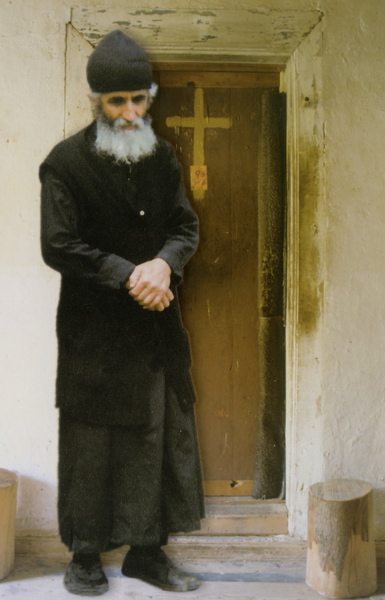
The more a person progresses in the spiritual life attending to himself, the wider the eyes of the soul open and the more clearly he discerns his mistakes and the many benefactions of God. Thus man is humbled and inwardly crushed, and then the Grace of God — divine enlightenment — comes naturally and he becomes more discerning.
St. Paisios
The more a person progresses in the spiritual life attending to himself, the wider the eyes of the soul open and the more clearly he discerns his mistakes and the many benefactions of God. Thus man is humbled and inwardly crushed, and then the Grace of God — divine enlightenment — comes naturally and he becomes more discerning.
Elder Paisios

Elder Paisios said: As a person becomes more spiritual, so much fewer rights does he has in this life. It is obligatory to be patient, to accept injustice, to accept evil words from others. A crooked stick (perverted person) who is distant from God has many rights: to strike and shout and act unrighteously. Our rights God keeps for the other life. Out of ignorance however we often seek our rights here. Let us not damage things at all. If they say anything to us, immediately we give them the right. And later we think we trust in God. That is a big joke. Human justice doesn't mean anything to a spiritual person. But it is a great concern for the perverted person.
The elder said: I often see a strange thing that occurs with religious people, reminding one of a vegetable market. There everybody shouts. One says, take oranges; another says take beets, and so forth, each in order to sell their own stuff. Something similar happens with Christians. Some say if you enter this association you'll be saved. If you go there you'll be saved. However, many people are not for here or there but for somewhere else., . A man of God can help. Help but not strangle. Now, let's imagine, I go to some army base to tell them various things about monasticism. I won't tell them lies. I'll tell them as it is. So what happens? Are all to become monks. That way naturally I cause trouble, because perhaps some of them will undertake monasticism and later will suffer and fail. I have to find the pure one to help him choose.
The elder spoke again on the same theme: Someone want to paint icons, has decide to become an icon painter, to make icons which will perform miracles; may it be. Another wants to become a married priest; it is my joy. One wants to be unmarried; let him be unmarried. One wants to be a monk? He should be helped accordingly. All do not fit in one basket. Some set the people to do things contrary to whatever they can do.
The elder said: It is not good for one to change spiritual fathers. Imagine a building which continually changes engineer and builder. It's not likely to turn out right.
The elder said: The spiritual father should be free and act accordingly. He should not follow somebody else's party line. (follow some line placed by others)
Father Paisios said: I don't give prescriptions at a distance. There is no long distance doctor. Only I give prayers.
The elder said: So much higher you throw a thing, with analogous power it will fall down and break in pieces. Often we see someone with a great fantasy of himself, but outwardly he doesn't suffer anything to be humbled. This is dangerous. He has arrived at interior pride and gives grades. May God protect him, he's one with Satan.
They asked the elder if there exist on the Holy Mountain those who have arrive at the love that sees all people as brothers, and he answered: There would have been many. Unfortunately there are few, few souls. We Athonites have suffered a great evil with the Calendar. This will destroy the Holy Mountain. It has destroyed the whole world. It has created the whole situation.
The elder said again: The world now is concerned with all the other matters except itself. I think that if one is concerned with oneself everything will fall in its canonical rhythm. And this we must do. The devil, you see, opens work, gives handiwork to each.
The elder said: When I put myself in order, I put in order a bit of the Church, whenever we can be of one mind. The Holy Spirit is One. Now people make many spirits. I can not understand.
The elder said: A person give flesh to his child. God gives the soul. When the child grows the parents cease to have authority. God gives to each person the guardian angel. He helps him throughout his whole life. Shouldn't we trust ourselves to God?
Someone asked if the elder all the people who came everyday with questions tired him. He answered: I'll tell you. When the discussion is spiritual it doesn't weary. It's bad when people ask altogether unreasonable questions. If they are illiterate and ask such things it will be alright. But there are "smart" people, students, and they ask you what relation the time has with the conscience of the person. In such cases I say, 'Here I have coffee and one or two aspirins. Sit a little and little by little we'll clear up your theme.
Elder Paisios

For most of us who are serious about our spiritual life, we feel we have a good degree of self-control. We are able to follow the regular fasts and other Traditions of the Church. We don't seem to have any major sins. This is a good condition, but also one where we need to be especially vigilant. The passions that do remain can become seen as frivolous or insignificant. But these are like the glowing embers of a fire that is about to go out. At any time a wind can come along and restart an immense blase and even start a whole forest on fire. Each glowing ember needs to be attended to to prevent the danger of a major forest fire. Every passion, no matter how slight, needs to be attacked.
Saint Theophan advises us in this way,
No matter how small or weak a passion appears, it is necessary to regard it as if it were the largest and most powerful.How do we respond then to the passions that we seem to regard lightly as we become more spiritually mature? One thing we cannot do is ignore them and surely if we do they will eventually flame up and possibly destroy us.
Saint Theophan says that we have to get very angry at them and treat them with hostility.
Try to stir up anger within yourself against it as quickly as possible. This anger is a firm rejection of the passion. The passionate cannot be sustained unless there is sympathy for it, but any sympathy is destroyed by anger, and the passionate will leave or fall away at the first manifestation of it. Here is the only case where anger is permissible and useful.The Prophet David told us, "Be angry, and sin not (Psalm 4:5).
Saint Paul says, "Be angry and sin not" (Ephesians 4:26).
It s important to always be on the lookout for the work of our passions. It is as if there are terrorists lurking about who want to destroy us. They may be silent and not too visible but we must always be on the lookout and ready to act with quick and firm action against them. Do not delay in action against them when you see even the slightest action of a passion. Your sympathy towards it will only lead to its growth and the potential of a raging fire that you cannot put out.
Saint Theophan says,
Self-indulgence still lives concealed within even long after we have obviously renounced and devoted ourselves to God... Thus, it is necessary to reject this sympathy and stir up anger... As son as you realize a passion's belligerence, get angry at it in a very obvious way.
Reference: The Spiritual Life, pp 233-236

Even though we’re in the season of winter, we had a fine day yesterday, with lots of sunshine. We felt the weather had taken a turn for the better, and then today it changed again and we’ve got turbulence. We can’t get out to do our work. We have to dig in until this situation passes, since we all know it’s temporary. This phenomenon of variations in the weather also occurs in our spiritual life. Changes and variations are a postlapsarian phenomenon. After the fall, people unfortunately lost their personality and are now subject to alterations. Before the fall, they had the Grace of the Holy Spirit living with them. They lived in accordance with nature, they lived without needs and “being lords of all”, held sway over time, manner, place and means and were not subject to variations of any kind, since they had a comprehensive personality. But, as the late Justin Popović observes, when they wanted to become God, through the devil, not only did they not do so, but became a particular kind of devil themselves. Something happened which cannot be rooted out and they now had no authority over anything in their personality. And they waited to see what they would find. All that was left to them was the power of reason and with this they thought up ways of freeing themselves from dangers, which had arisen because of the changes they had undergone. This is an important piece of thinking which will especially help us monks to succeed, since our life is the exact study of the conscience. We don’t monitor only the results of an action, in order to refrain from it; we also monitor the causes which gave rise to it.
In the period of Grace, Jesus has taught us to root out evil. In the period of the Law of Moses, the result, the fruit, the action had been punished. We live in the period of Grace. We don’t wait for the time for evil to happen in order to stop it or to pray not to implement it. We monks are on the watch from the conception of the thought, the “provocation” in the language of the Fathers, so that we can pull up by the roots the very plants that bear evil fruit, which is sin in action. To succeed in this we have to have great finesse in the handling of the variations. As we’ve already said, these variations are like weather conditions. They’re not permanent, but passing. They shouldn’t frighten people into changing the pattern of their lives. We have sailors as examples. They don’t renounce the call of the sea just because it becomes like hell when there’s a storm. What do they do? They tie up in a harbour and wait it out. Then they get back on course and the matter of the storm doesn’t concern them any more. So we aren’t frightened either, when we have the skill of dealing with variations. Through the variations, Satan tries to scare us, to block our path. But since we know in advance that the variations are intrusive and transient features, then we’re not bothered by them. Like the sailors, we tie up the ship and wait, knowing that the tempest will pass and we’ll continue. You see in the readings we listen to in the refectory that the Fathers place little store by the matter of troubling thoughts, or provocations, as they’re called, particularly that great teacher of discrimination Abba Pimin, who interprets precisely this detail for us. For us who are a long way from the causes, the variations really are laughable, because they achieve nothing. In practice, we’re living in reality. What reality? When we heard the call. Jesus called us with the prophetic words of Isaiah: “Therefore come out from them and be separate. Touch no unclean thing, and I will receive you. I will be a Father to you,
and you will be my sons and daughters”. And we heard the call; each one at the age and in the circumstances decided by the dispensation of divine grace, we “came out from them”. What? The causes, not people. Never let it be said. With people we’re brothers. People don’t harm us. We have relations with people. We came out, to be exact, from the root cause of mammon, in the language of Jesus, by which He meant the law of abnormality, the law of desire. We came out from there, and now don’t touch such kinds of “unclean things”, which make up the body of mammon… Anything to do with abuse and desire is no concern of ours. And we didn’t wait for a moment at a distance from the causes of evil, but built a dwelling and a hut in the deserts, like wild goats, and here we persevere, awaiting God’s mercy, convinced that He Who called us is faithful to His promises. So there’s not much the devil can get out of us, if we’re just a little bit careful. Because in the language of the Fathers, who interpret in detail the practical facet of our lives, most of the bad that we can suffer is due to the root causes of evil. Our backsliding starts where the senses and the natural resources and laws, with unspeakable pretexts, are all jumbled up by Satan. Now that we’re out of all that, Satan’s been stripped of his power. Divine Grace, with the Cross of Christ, has denuded him, because “the swords of the enemy have failed utterly”. And Jesus tells us that “the Lord of world is coming and in me he will find nothing” and “take courage, I have defeated the world”, including, naturally the devil himself. Not being able any longer to provoke us directly from the essence of things, which are the root causes and which excite us us, he tries through the variations to bring back old memories, in order to trouble us, to spoil our peace and take our minds off our aim. Which is what? To forget the past and concentrate on the future. To forget the old life, the old person of sin and abuse and to embrace the “new life”. To imitate Jesus and our Holy Fathers, whose followers we are.
The crown of the monastic hypostasis is virginity. We had virginity and purity as our goal, which is why we fled the root causes that provoked us. Intertwined with virginity are obedience and the renunciation of our own will, which is subordination, and then there follow physical service, humility, sobriety, silence, prayer and everything else the Fathers gave us and with which we occupy ourselves. By the Grace of Christ, each of us observes all these, more or less, with the strength he possesses and abstains in practice from the root causes. This is as far as human strength and effort will take us, there’s nothing we can do. Whether the roots of evil will be pulled up from within us and in their place the roots of good will strike, bringing as their fruit good memories and virtues, doesn’t depend on us. We long for it, we await it, we hope for it, we believe in it, but it’s not ours to hold. Only divine Grace will give it, and that’s what we wait for. It’s out of our control. All that’s within our control is to abstain, in practice, from anything which is called- and really is- sin. And, with as much strength as we have, to remain within the margins of the good and of virtue.
By the Grace of Christ, this is what we do, more or less. It’s as far as our strength will take us. The rest we await with faith, and if Grace comes, it grants it. So the devil can’t do us down, unless he troubles the waters and draws the monk away from his standards. What are these standards? Purity, subordination and obedience. Now if the monk hangs on to these unswervingly, the devil can’t do him any harm.
He can’t harm him in purity, because there aren’t any root causes. A monk would have to be really stupid to be deceived into entering into evil tastes you have to acquire and to think up ways of finding pleasure in that sort of filth and compliance, which are too disgusting even to think about. One of the most significant causes that blocks the road for us who want to observe virginity precisely, is the opposite sex. Because, in the presence of this cause, our purity is impugned. Anything at all that moves us to the remembrance of this kind of pleasure is entirely alien to us. In a real monk, the effect of Grace is so great that thoughts like that just make him laugh. If ever God allows a war to burst upon us, there must be some reason. Either because we’ve abandoned our duty and have resigned ourselves to negligence and sloth, and so are asking Grace to give us a wake-up call, or because it’s the time for it to give us the crown of purity, the comprehensive seal of virginity, which is why it allows Satan to trouble us: so that we can prove, in practice, our real appetite for purity. And in this battle, God will give us the appropriate strength. “And God is faithful; he will not let you be tempted beyond what you can bear. But when you are tempted, he will also provide a way out so that you can stand up under it”.
Now we come to our second duty, subordination and obedience. As you know, the fall of logical beings, both angels and people, occurred through rebellion. When Christ came to bring back into balance that which had fallen, he did not deign, nor provide nor attempt nor decide to make that return by any other gate but that of obedience. Because if He chosen any other way, He would have given the impression that He had made a mistake at the creation. But God made everything “very good”. In one of his discourses, Saint Neofytos the Enclosed interprets “very good” by saying: “And how was it possible, Our Good Lord, for You to make something wrong, something not “very good”. Since You’re the centre of all kindness. You’re the supreme good, so was it possible for You to make a mistake and make something that wasn’t good like You?”.
So what was made “very good” by God can’t be altered by the devil, by people or by any other factor. When Christ came, He had the power, as Lord of all to alter even the law of creation, because “He spoke and they were born, He commanded and they were made”. He is the craftsman. And yet, to prove the perfection of His Godly magnificence, He indicated that there should be a return to where the fall occurred. He was forced, therefore, to take on our own nature, to undergo a kind of selflessness that’s inconceivable for the thought process of logical beings and to persuade us, in practice, that our restitution could only succeed in this way. We monks, who keep the Gospel perfection in its highest form, are total imitators of Christ. This is why, after purity, we promised subservience and obedience. So long as a monk remains subservient and obedient, the devil can’t ever do him any harm, neither with variations, nor illnesses, nor dangers nor fears nor any logical or absurd pretext. Precisely because the obedient monk doesn’t accept his own thinking. Satan can never appear directly and speak face to face nor even make shapes for us that will deceive us. He certainly does something, but in what way? Deviously, through thoughts. From where the faculty of direct knowledge casts up its own thoughts and projects them onto the screen of the intellect and chooses them and decides, that’s where Satan goes and, through the same projector, beams the evil thought onto the same screen. This faculty of direct knowledge is guileless and doesn’t understand; it sees the image and doesn’t realize who put it there. It takes it for its own thought. Because the thought’s deceitful when it comes. It doesn’t say: “Eat, sleep, be idle, steal, lie, laugh”. If it did, people wouldn’t heed it. By nature, people are good and don’t go directly towards evil; unless they’re depraved. Then the thought comes with the reasonable pretext and says: “I don’t feel too good, I’ll just have sleep”, and many other unspeakable pretexts. Now when these come, the real person who’s really under obedience immediately thinks: “Any thought that comes to me, good or bad, I’ll tell the Elder about it”. Then they’re within the framework of subordination and obedience. Once the devil sees that the disciple behaves like that, he loses all his power. Try it and see. If there’s a subtle thought that won’t go away, say “I’ll go to the Elder and he’ll tell me what to do” and it’ll disappear straight away.
Unfortunately, variations exist and alter our disposition. People can be cheerful, enterprising, “fervent in the spirit”, and all of a sudden they’re arid, listless and lose all their vigour. Then comes the perfectly reasonable thought that they should be accommodating. If they’re not feeling well, they can eat a little more, maybe something better, go and have a rest before the usual time, not bother with their rule. But a monk says: “That’s not for me. And if necessary, I’ll ask the Elder”. So he’s in no danger. Because, if you allow yourself dispensations, they’re followed by a host of temptations and you’ll never hear the end of it. You’re seized with despair, discouragement, your conscience bothers you and doesn’t leave you in peace, so that you’re encouraged bodily to abandon your rule and spiritually to stop remembering God. This will shake up your whole world, body and soul. But if you’re careful, you’ll take whatever’s bothering you, whatever’s pressing upon you, to the Elder. Then you’re sheltered by the grace of obedience and dependence and, because of that, you’re not held in thrall to the various traps that Satan’s laid. Wherever Satan can’t get in, everything’s normal and peaceful, because we Christians have the peace of Jesus as a possession: “Peace I leave with you, my peace I give you” (Jn. 14, 27) and “Behold, I am with you always” (Matth. 28, 20). These are positions; they’re not just words.
By staying within the bounds of obedience and duty, we enjoy the continuation of the presence of the Grace of Jesus and we become peaceful. All of this increases within us the experience of how we should fight. Once we learn that, the problem’s solved. Nobody can do anything to us, because we’ve continued along our chosen path intelligently and wisely, because, to put it simply they don’t have the right to, because “the one who is within you is greater than the one who is in the world” (1 Jn. 4, 4).
Question: Elder, apart from what you’ve told us, what else should we do when these variations come?
Answer: As I said before, people have to learn the art of war. Central to this, as Jesus told us, is patience. “Who shows patience to the end will be saved” and “in your patience you will possess your souls. Since it’s patience that’ll show reality. Because the variations, which are up and down states, are not real. Neither the state of being up is real not that of being down. The wave of Grace which sweeps people, cools them and gives them comfort isn’t permanent, but then neither are despair and dryness. What they really are we’ll discover only with patient endurance. If you’re in the habit of being patient, you await the mercy of God, which will come and satisfy you.
The variations are caused by lots of reasons. Whether they’re from the right or the left the underlying causes have one aim. Whatever is in the interest, for the benefit of people. If the Lord of life and death allows anything to happen to people, He must have weighed it with His own Godly justice, which is certainly for people’s benefit. The matter of the great goodness and providence of God is Godly and perfect- as are all the divine perfections. God doesn’t change, so that evil can come out of one of His decisions. Only kindness, only love, only goodness, only caring, only charity- that’s what God is. So those whom He loves and those whom He chastises, He does so in accordance with His attributes- with love.
If God allows a variation, a temptation- especially to people, whom He loved so much that “He did not spare His own Son”- it means that He does so out of love, in our interest.
Source: Elder Iosif, Διδαχές από τον Άθωνα, Ψυχωφελή Βατοπαιδινά 8, 3rd ed. Publications of the Holy Great Monastery of Vatopaidi, Holy Mountain, 1999.

Force yourself to get up early and on a set schedule. As soon as you wake up, turn your mind to God: make the Sign of the Cross, and thank Him for the night that has passed and for all His mercies towards you. Ask Him to guide all your thoughts, feelings and desires, so that everything you say or do will be pleasing to Him.
After washing yourself, get down to morning prayers. Pray kneeling, with concentration, and with reverence. Ask Him to give you faith, hope, and charity, as well as calm strength to accept all that the coming day may bring to you - its hardships and troubles. Ask Him to bless your labors. Ask for help: to accomplish some particular task that you face; to steer clear of some particular sin.
If you can, read something from the Bible, especially from the New Testament and the Psalms. Read with intent to receive some spiritual enlightenment, inclining your heart to compunction.
Try to devote at least fifteen minutes to spiritually contemplate the teachings of the Faith and the profit to your soul in what you have read.
Start every morning as if you had just decided to become a Christian and to live according to God's commandments.
As you enter upon your duties, strive to do everything towards the glory of God. Start nothing without prayer, because whatever we do without prayer later turns out to be futile or harmful. The words of the Lord are true: "Without me, you can do nothing."
If your labors are successful, give thanks to the Lord; If not accept all hardships as a penance for your sins - in the spirit of obedience and humility.
Before every meal, pray that God will bless the food and drink; and after the meal give thanks to Him and ask Him not to deprive you of spiritual blessings. In everything, avoid excess. Following the example of Christians of old, fast on Wednesdays and Fridays.
Do not be greedy. Be content having food and clothing, imitating Christ Who became impoverished for our sake.
Strive to please the Lord in everything, so that you will not be reproached by your own conscience. Remember God always sees you, and so be carefully vigilant concerning the feelings, thoughts and desires of your heart.
Never argue or make excuses. Be gentle, quiet and humble; endure everything, according to the example of Jesus. He will not burden you with a cross that exceeds your strength. He will also help you carry the Cross that you have.
Having done a good deed, do not expect gratitude, but temptation: for love towards God is tested by obstacles. Do not hope to acquire any virtues without suffering sorrows. In the midst of temptations do not despair, but address God with short prayers: "Lord, help... Teach me to... Do not leave... Protect me... " The Lord allows temptations and trials; He also gives the strength to overcome them.
Ask God to take away from you every thing that feeds your pride, even if it will be bitter. Avoid being harsh, gloomy, nagging, mistrustful, suspicious or hypocritical, and avoid rivalry. Be sincere and simple in your attitude. Humbly accept the admonitions of others, even if you are more wise and experienced.
When you feel slack, or a certain coolness, do not leave off the usual order of prayer and pious practices which you have established. Everything that you do in the name of the Lord Jesus, even the small and imperfect things, becomes an act of piety.
If you desire to find peace, commit yourself completely onto God. You will find no peace until you calm down in God, loving Him alone.
From time to time seclude yourself, following the example of Jesus, for prayer and contemplation of God. Contemplate the infinite love of our Lord Jesus Christ, His sufferings and death, His Resurrection, His Second Coming and the Last Judgment.
Visit the church as often as possible. Confess more often and receive the Holy Mysteries. Doing so you will abide in God, and this is the highest blessing. During Confession, repent and confess frankly and with contrition all your sins; for the unrepented sin leads to death.
Devote Sundays to works of charity and mercy; for example, visit someone who is sick, console someone who is in sorrow, save one who is lost. If anyone will help the lost one turn towards God he will receive a great reward in this life and in the age to come. Encourage your friends to read Christian spiritual literature and to participate in discussing spiritual matters.
Let the Lord Jesus Christ be your teacher in everything. Constantly address Him by turning your mind to Him; ask yourself: what would He do in similar circumstances?
Before you go to sleep, pray frankly and with all your heart, look searchingly at your sins during the past day. You should always compel yourself to repent with a contrite heart, with suffering and tears, lest you repeat past sins. As you go to bed, make the Sign of the Cross, kiss the cross, and entrust yourself to the Lord God, who is your Good Shepherd. Consider that perhaps this night you will have to appear before Him.
Remember the Lord's love towards you and love Him with all your heart, your soul and your mind.
Acting in this way, you will reach the blessed life in the Kingdom of Eternal Light.
The grace of our Lord Jesus Christ be with you. Amen.
Bishop Platon of Kostroma

Schema-Archimandrite Gabriel (Bunge)
You’ve asked me to speak to you about prayer. It’s doubtlessly one of the most important subjects in a Christian’s life, because when one scrutinizes the Holy Fathers’ doctrine on prayer, one notes very quickly that the human person is only himself in the act of prayer. I shall return to this aspect.
Like everything else in life, prayer is a process that grows and evolves according to the rhythm of our human life. Therefore, I’d first like to speak to you about the ages of the spiritual life. I’ll base myself essentially on the teaching of Evagrius of Pontus, because I know him the best and also because he was one the first Desert Fathers to synthesize and put into writing the doctrine of the first monastic Fathers about prayer.
You might know that Evagrius was the disciple par excellence of Macarius the Great, who was himself the disciple of Anthony the Great. Therefore we are at the third generation of monasticism, which had already accumulated a rich experience. Thanks to his exceptional philosophical, theological, and spiritual culture, Evagrius was able to present the process of the spiritual life in a coherent manner. Evagrius had first been a disciple of Basil the Great, and then of Gregory the Theologian, and later in the desert – as I’ve already said – of Macarius the Great, as well as of other Fathers of this era. Thus, one simultaneously finds in him the stamp of the theology of the Cappadocian Fathers and the spiritual, and even mystical, experience of the Desert Fathers.
In a manner that might at first glance appear a bit unsophisticated, Evagrius defines Christianity as the doctrine of Christ our Savior that is divided into praktike [ascetic discipline], physike [natural contemplation], and theologike [theology].
Praktike is the practice of the Evangelical commandments. Physike – physis is “nature” – is the indirect contemplation of God by means of His works, of His creatures. Finally, theologike – theology – is the immediate knowledge of God Himself and coincides with what we today call, using a modern term, “mysticism.”
In modern terms, we can speak of three different ages because, as in normal physical life, we pass from one phase to another. Man progresses slowly but, contrary to normal physical life, there is nothing automatic between the various stages of the spiritual life. That is to say, many people remain their entire lives at the level of the practice of the Evangelical commandments.
The goal of this first stage or age – which is that of infancy or childhood – is to attain, with God’s grace, purity of heart. Therefore, this is a very important aspect, because one cannot speak of the spiritual life and of the following stages – contemplation of God, first indirect and then immediate – without purity of heart.
Thus, with the grace of God, man can arrive at purity of heart (this is also referred to using a term from ancient philosophy: apatheia), which itself has Christian charity as its daughter. Thus, freedom from the passions (apatheia) is the fruit of praktike, but also has a daughter: Christian charity (agape), which is the Christian virtue par excellence. This charity, Evagrius says, is the door to natural contemplation, that is, to the contemplation of God’s works.
But the next step or age – that of seniority or wisdom, of the contemplation of God’s works – is not arrived at automatically, because for man to be able to know God immediately, God must reveal Himself to him; He is free, He is a Person. He does so only when He judges man to be worthy of such a revelation.
All of this might seem a bit abstract to you, and you might pose some questions about it. But I think that it’s important in the spiritual life to know the road; not to believe, for example, that one can satisfy oneself for one’s entire life only reciting or listening to the Psalms or to conventional prayers.
You can also easily imagine that corresponding to these three ages of the spiritual life are three manners of praying. At first, man recites the Psalms and conventional prayers – which is, of course, excellent. But when he is called to ascend higher, when he contemplates the works of God, then his prayer, which had previously been supplication (as it is in the Psalms), becomes a prayer of praise. Man sings the praises of God for all that He has done. Then at the summit of this height something very mysterious takes place, about which one can no longer speak with the usual words and concepts. Evagrius does not do this; he speaks in Biblical images. This is a highly symbolic language, which one needs to known how to decode. And even if you have decoded it, ultimately you can understand exactly what it means only if you’ve had this experience.
But one can say – and Evagrius does say – that this is a dialogue or conversation with God without any intermediaries. What are these intermediaries? Above all, the creatures that speak about God, but aren’t God. These are the concepts that our spirit forges through its contact with reality. These are concepts or ideas about God, but which aren’t God.
I will stop here, but something very mysterious then happens, something in which God completely takes the initiative. Evagrius’ language on this subject is very significant: he speaks of manifestation, apparition, visit, et cetera, on God’s part. All this language indicates that there’s someone, the supreme Person of God, Who reveals Himself to His creature and makes Himself known and understood by him. But the curious thing – which is where I’ll stop – is that the man who has reached this stage is not conscious. The contemplative – the one who sees God – is, as it were, in a state of sleep. When we sleep, we do not know that we’re asleep. Thus, curiously, the contemplative doesn’t know; he finds himself in an entirely peculiar state; he is here and is not here. He isn’t conscious. It’s not ecstasy, in which man goes out of himself or where he loses his consciousness. It’s nothing like that.
I will conclude this short exposition with a word from the Curé d’Ars, whom you might not know. He was a French priest of the nineteenth century, a saint of the Catholic Church. One day he found an old man, an old peasant, in his church, sitting on a bench and not appearing to be doing anything; he wasn’t even praying the rosary. He asked him: “What are you doing here?” In his old French, he said: “I’m looking at Him; and He’s looking at me.” That is the mystery.
"You must know that only passions and sins are ours. Whatever good we do is from God, whatever foolish things we do come from us. When God's Grace abandons us for just a little while, we become unable to do anything. As in natural life, when God removes oxygen from us we die immediately. The same is true for spiritual life: If God removes His Grace, we are lost."
Elder Paisios

There are two basic phases in our path of spiritual growth described by Fr. Dimitru Staniloae.
The first is the practical phase of doing things.
The practicle phase, that of doing things, is intended to raise the beiever's nature from the state subject to the passions and to elevate it to and by, the steps of virtues, until it reaches love.... The purpose of this phase is the liberation of man from the passions.The scond is the contemplative phase.
The contemplative pahase represents it reintegration, unity and simplicity, and its exclusive focus on God, the One and Infinite. ...
Only he who has cleansed the mind through dispassion can go on to knowledge or contemplation.... Only a clean soul is a shinny mirror, unspotted by passionate attachment to the things of the world, capable of receiving divine knowledge. We can identify a third phase of mystical knowledge.
The holy Fathers strictly distinguish this gnosis or contemplation, from the spiritual knowledge of the world aided by divine grace, which itself is distinguished from profane knowledge.Saint Maximus the Confessor described these phases in this way:
Of the three steps, the first is that of beginners, who must strive to become proficient in the virtues. The virtues are seven in number*. At the beginning stands faith; at the end love, immediately preceded by dispassion. Love concentrates all the virtues in it and carries man to the knowledge or contemplation. The final step is mystical knowledge, no longer concerned with the reasons of things but with God Himself... this knowledge of God is an ecstasy of love, which persists unmoved in a concentration on God. It is reached in the state of the deification of man, or of his union with God.
Dionysius the Areopagite described the phases as Purification, Illumination and Perfection. For most of us we are most concerned about the first stage of purification. It's important to recognize our level in our spiritual development. Many writings are aimed at aspirants at the highest levels of spirtual development. Following advice intended for one at a higher level can be detrimental to your progress. It is essential to have a spiritual Father to guide you.
* Faith, fear of God, self-restraint, patience, hope, dispassion, and love.
Reference: Orthodox Spirituality pp 69 - 73.
Fr. Dimitru Staniloae