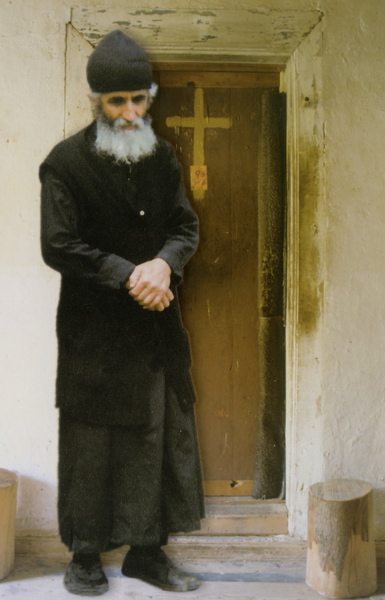
The Elder advised one visitor to go to confession. He objected:
— Gheronta, what sense is there in confessing, and then sinning again?
Then the Elder explained him:
— Look, during war, when someone is wounded, say, with a bullet in his leg, should he not first of all see the doctor to get his wound dressed? If he says: "Why should I get the wound dressed, if I shall be wounded again anyway?" Then he will die prematurely from bleeding or blood poisoning, which he could have avoided. The same thing happens with sins. That is why you go and confess, and if you fall again, confess again. And let it be so until you stop falling.
St. Paisios
"Today I observe that even with great matters, when someone asks, before he has even had the time to complete his question, we interrupt him and answer him. This shows that not only do we not seek enlightenment from the Grace of God, but we do not even judge with the reason God gave us. On the contrary, whatever our thoughts suggest to us, immediately, without hesitation, we trust it and consent to it, often with disastrous results
St. Paisios
In order for you to have time for prayer you must not concern yourself with things that other people can do. Let's take an example. A doctor should not be concerned with gauzes and bandages. A nurse can do that. The doctor will take care of the serious matters. He'll do the examinations and operations, etc. If he sit to put gauze he won't get to the serious work and then many who have need won't benefit. The same with you. Pray for your suffering parishioners (applied to the correspondent and two other priests) remember their names and note those who have greater need. It's better for you to know what pains each one. That way the prayer is better.
St. Paisios

SOUROTI, Greece—Legend has it that nearly three decades ago, a bearded Orthodox Christian mystic visiting here made an unsettling prediction: Greece in the future would experience a "great disruption and confusion," followed by hunger and political turmoil.
Believers say this grim vision of Elder Paisios, an ascetic monk who died in 1994, was actually a prescient glimpse of the upheaval now gripping this debt-racked country—helping fuel a surge of interest in the Orthodox holy man by Greeks struggling to make sense of a brutal financial crisis.
Elder Paisios, who spent much of his adult life as a hermit on the monastic peninsula of Mount Athos in northeastern Greece, has become a popular sensation—with tales of his prognostications and miracles he is said to have performed posted online and recounted in popular books.

A book on Elder Paisios on display at an Athens bookstore. ALKIS KONSTANTINIDIS FOR THE WALL STREET JOURNAL
On Saturdays, hundreds of pilgrims line up at Elder Paisios's gravesite here, waiting their turn to kneel, pray and kiss the wooden cross that marks his final resting place. They ask for help finding jobs, paying bills and surviving a downturn that has upended their lives.
"Paisios predicted many things, and his prophecies are now coming true," said Costas Katsaounis, a 41-year-old military officer on a visit to the shrine. "He foresaw the crisis. But he also said it would get better, that we will overcome and prosperity will return. He's helped a lot of people."
Elder Paisios's fame in some ways echoes that of Michel de Notredame, better known asNostradamus, a 16th-century French apothecary who believers say foretold everything from the rise of Hitler to the terror attacks of Sept. 11.
"Figures like Paisios represent the shaman, the magician of the tribe," said Alexandra Koronaiou, a sociologist at Panteion University of Social and Political Sciences in Athens. "They are the incarnation of a transcendental, invisible power."
With Greece's economy in the fifth year of a grinding recession that is expected to deepen further in 2013, unemployment above 25% and even middle-class families struggling to feed their children, many Greeks feel like their society is teetering on the brink of collapse, and they are seeking solace.
"When there is an event that brings an entire country to its knees, people look for a religious explanation," said Vasilios Makrides, a religious-studies professor and specialist on Orthodox Christianity at the University of Erfurt in Germany. "They are seeking support from the supernatural."
That is driving a fresh boom in all things Paisios. The elder's wizened and bearded face, peering out from below a black cap, adorns devotional banners and cards inscribed with inspirational messages.
Bookstores stock dozens of Paisios-related titles, from books detailing his spiritual teachings to volumes filled with his commentary on everything from the coming of the apocalypse to Greece's retaking of Constantinople, once the seat of Byzantine emperors and now Istanbul.

A woman prayed at the mystic's grave in Souroti. GORDON FAIRCLOUGH/THE WALL STREET JOURNAL
"They sell like crazy," said Ionnis Aivaliotis, who works at the Zoe religious bookstore in downtown Athens. "Even nonbelievers are starting to read them. It gives people courage to withstand what's coming."
There is a Paisios diet guide—he was very thin—and a kids' book, "Once Upon a Time, Children, There Was Elder Paisios."
Over the past two years, conservative newspaper Dimokratia has sold 350,000 copies of Paisios-related titles—from compilations of his prophecies to his views on education. Other newspapers carry accounts of his reputed miracles.
Elder Paisios, born Arsenios Eznepedis in central Anatolia in 1924, is part of a long tradition of monastic spirituality that believers say confers a power of divination—to see things others cannot, to interpret signs and predict the course of events.
Even before his death in 1994, he was well known in religious circles, drawing the faithful to Mount Athos for spiritual guidance and advice. Many expect that he will eventually be canonized. (A church spokesman declined to comment.)
But the recent increase in attention has prompted a backlash from skeptics and drawn cautions from some in the Greek Orthodox Church hierarchy.
"People are looking for somewhere to turn," said the Rev. Vasilios Havatzas, head of the church's charitable operations in Athens. "But some are overreacting. They are making him into some kind of prophet," he said, adding: "That doesn't mean everything he said is right."
But in a sign of the broad support for Elder Paisios, Greek police arrested 27-year-old Phillipos Loizos for creating a Facebook page that poked fun at Greeks' belief in the miracles and prognostications of the late monk. He was charged with blasphemy and insulting religion. The blasphemy charge was later withdrawn.
Police received thousands of complaints about the page on the social-networking site for Elder Pastitsios, a play on the monk's name. Pastitsio is a traditional baked pasta dish similar to lasagna. An ultranationalist lawmaker condemned the page in Parliament.
Mr. Loizos said he was using satire to criticize the commercialization of the monk and his message.
Many of Elder Paisios's purported prophecies resonate. "The people will be so disappointed by the politicians of the two big parties, that they will get sick of them," is one that rings true in an era when voter support for the country's two mainstream parties, blamed for the crisis, has dropped sharply.

Elder Paisios
Some of the elder's reported remarks hint at dark conspiracies—among them that the world is ruled secretly by a cabal of five people. He also predicted national triumphs for Greece, saying that Greeks would defeat Turkey, rule Constantinople and take part of Albania.
"Holy people like Elder Paisios are born once in a thousand years," said Nikolaos Zournatzoglou, who has compiled three books of the elder's pronouncements. "He was a gift from God and the Virgin Mary for humanity."
In Souroti, about 20 miles from the northeastern Greek city of Thessaloniki, busloads of pilgrims arrived one Saturday recently to see the elder's grave. Young and old, they prayed and took pictures. Some plucked a leaf of basil from a plant growing near the simple cross at his head.
Afterward in a gift shop in the basement of the rough-hewn stone church, visitors bought postcards, plaques with images of Elder Paisios and books by and about him, along with icons, crosses and other religious paraphernalia.
"There's a lot of uncertainty now. We don't know what is going to happen," said Anastasia Constantinou, a waitress visiting the shrine who said her family has had to cut back on meat, on driving their car and on other normal activities as their income has fallen amid the downturn.
"People find consolation in faith," Ms. Constantinou, 32, said. "Even though everyday life is difficult, Paisios gives strength to people. He helps them hold on."
http://www.wsj.com/articles

God is very near us, but also very high. In order for someone to have God bend to descend and remain with him, he must be humbled and repent. Then, the greatly-compassionate God, beholding his humility, lifts him up to the Heavens and loves him greatly. There is joy in heaven over the repentance of a sinner, says the Gospel.
God granted man a mind to contemplate his fault, to repent and to seek forgiveness. The unrepenting man is a hard thing. He is very senseless, because he does not wish to repent, in order to eliminate the small hell that he is experiencing, which leads him to something worse, eternity. Thus, he is barren of the heavenly joys on earth, which continue in Paradise, near God, with the much greater joys, eternal ones.
As long as man is far from God, he is outside of himself. Do you see, that the Gospel writes that the Prodigal Son "came to himself", saying: "I will go to my Father." In other words, when he came to his senses, when he repented, he said: "I will return to my Father." As long as he was living in sin, he was outside of himself, he was not in his right mind, because sin is irrational.
-Elder, Abba Alonios says: "If a man wishes, he can reach a divine measure from morning until the evening." What does he mean?
The spiritual life does not desire time. In one second, one can be found in Paradise from hell, if he repents. Man is responsible. He can become an angel, he can become a devil. My, my, my, what power repentance has! It attracts divine Grace. A humble thought that a man brings to mind can save him.
A prideful thought can come to his mind, and if he does not repent, death will find him, he is gone, he is lost. Of course, the humble thought must be followed by internal groaning, by internal contrition. Because the thought is a thought, but there is also the heart. The hymn says: "With all my soul and mind and heart...", I think, however, that the Abba here is thinking here of a more permenant state. It requires some time, in order for one to reach a good state.
I err, I repent, and I am forgiven that instant. If I have a struggling spirit, slowly I will achieve a more stable situation, but until then, I can be swayed.
-Elder, can an older person help himself spiritually?
Yes, barely, for when someone gets old, he is granted the strength to repent, because all illusions flee. Formerly, because he had bodily strength and nothing was difficult for him, he did not understand his weaknesses and he thought that he was in a good state. Now that he has difficulties and grumbles, he is helped to understand that he is not well, that he is limping, that he must repent. If he spiritually utilizes the little remaining years of his life, and if he uses his experience that shows that most of the years of his life have passed him by, [he learns that] Christ will not leave him, He will have mercy on him.
Through the prayers of our Holy Fathers, Lord Jesus Christ our God, have mercy on us and save us! Amen!
http://full-of-grace-and-truth.blogspot.ca/
http://tokandylaki.blogspot.ca/

In the future Judgment, the condition of each person will be revealed in an instant, and each person on his own will proceed to where he belongs. Each person will recognize, as if on a television screen, his own wretchedness, as well as the spiritual condition of others. He will reflect himself upon the other, and he will bow his head, and proceed to the place where he belongs. For example, a daughter-in-law who sat comfortably with her legs crossed in front of her mother-in-law, who with a broken leg took care of the grandchild, will not be able to say, “My Christ, why are you putting my mother-in-law into Paradise without including me?” because that scene will come before her to condemn her. She will remember her mother-in-law who stood with her broken leg in order to take care of her grandchild and she will be too ashamed to go into Paradise — but there will be not place for her there, anyway.
Or, to cite another example, monastics will see the difficulties, the tribulations of the people in the world and how they faced them; and if they have not lived appropriately as monastics, they will lower their heads and proceed on their own to the place where they belong. There, nuns who did not please God will see heroic mothers who neither took vows nor had the blessings and opportunities that they, the nuns, had. They will see how those mothers struggled, as well as the spiritual heights they attained, while they, the nuns, who with petty things preoccupied and tormented themselves, will be ashamed! These are my thoughts about the manner of the Final Judgement. In other words, Christ will not say, “You come here; what did you do?” Nor will He say, “You go to Hell; you go to Paradise.” Rather, each person will compare himself with the others and proceed to his appropriate place.
St. Paisios of Mt. Athos
It is better for someone to eat a little twice a day and have more humility and a lighter stomach, than to eat once a day, have a full stomach and a head full of pride.
St. Paisios
Those who wish others to provide for them but offer nothing in return, are constantly asking things from God without giving anything to Him, not even their sins (by repentance). Such people are completely estranged from God and deliver themselves of their own accord into the hands of the manslayer (the devil). Because they have only cultivated love for their own selves, it follows that great anguish will then develop in them and that they will suffer hell, in part, already in this life.
St. Paisios
The devil does not hunt after those who are lost; he hunts after those who are aware, those who are close to God. He takes from them trust in God and begins to afflict them with self-assurance, logic, thinking, criticism. Therefore we should not trust our logical minds. Never believe your thoughts.
St. Paisios
Those who withdraw themselves from Christ are deprived of divine enlightenment, for like fools they forsake sun-drenched places so as to retire to the shade. Hence, it is natural for them to be cold and fall spiritually ill. God has endowed us all with gifts, but not all of us utilize them for the salvation of our souls and the salvation of our fellow men. Instead, most of us, most of the time, use them to the detriment of others and ourselves.
St. Paisios
"The ancient fathers did not trust their thoughts at all, but even in the smallest things, when they had to give an answer, they addressed the matter in their prayer, joining to it fasting, in order in some way to ‘force’ Divine Grace to inform them what was the right answer according to God. And when they received the ‘information,’ they gave the answer.
St. Paisios

"To some people your love will be expressed with joy and to others it will be expressed with your pain. You will consider everyone your brother or your sister, for we are all children of Eve (of the large family of Adam, of God).
Then, in your prayer you will say: ‘My God, help those first who are in greater need, whether they are alive or reposed brothers in the Lord.’
At that point, you will share your heart with the whole world and you will have nothing but immense love, which is Christ".
Elder Paisios of Mount Athos, Epistles, p. 50
Those who suffer deeply for the salvation of the whole world and help in their own way (as strugglers) and humbly entrust themselves to the hands of God, feel the greatest joy in the world. Their life is a constant doxology, for they flutter about internally like angels, glorifying God day and night.
Those, however, who neglect the salvation of their souls and try to find joy and rest in this vain life, are continually tortured and entangled in endless worldly machinery and live in hell in this life.
St. Paisios

An icon depicting St. Paisios receiving pilgrims, taking up their burdens and preaching to them the Word of God. His scroll reads: "We must struggle with philotimo, that we may be saved, and so that we not sadden Christ..."
Those who suffer deeply for the salvation of the whole world and help in their own way (as strugglers) and humbly entrust themselves to the hands of God, feel the greatest joy in the world. Their life is a constant doxology, for they flutter about internally like angels, glorifying God day and night. Those, however, who neglect the salvation of their souls and try to find joy and rest in this vain life, are continually tortured and entangled in endless worldly machinery and live in hell in this life...Those who have philotimo, because they move within the heavenly sphere of doxology, joyfully accept their trials as well as their blessings, and glorify God for them. Thus, they are continuously receiving God’s blessing from everything and are melting internally out of gratitude towards God, which they express in every spiritual way possible, like children of God.
St. Paisios of Mount Athos
source

"To some people your love will be expressed with joy and to others it will be expressed with your pain. You will consider everyone your brother or your sister, for we are all children of Eve (of the large family of Adam, of God).
Then, in your prayer you will say: ‘My God, help those first who are in greater need, whether they are alive or reposed brothers in the Lord.’ At that point, you will share your heart with the whole world and you will have nothing but immense love, which is Christ."
(Elder Paisios of Mount Athos, Epistles, p. 50).
The more a person progresses in the spiritual life attending to himself, the wider the eyes of the soul open and the more clearly he discerns his mistakes and the many benefactions of God. Thus man is humbled and inwardly crushed, and then the Grace of God — divine enlightenment — comes naturally and he becomes more discerning.
St. Paisios

From the age of eleven [says Elder Paisios], I would read the lives of the Saints, I would fast and keep vigil. My older brother would take the books and hide them, but that didn’t stop me. I would just go into the forest and keep reading there.
Later, when I was fifteen, a friend of my brother named Costas told my brother, “I’ll make him willingly give up all this nonesense.” He came and explained to me Darwin’s theory of evolution. I was shaken by this, and I said, “I’ll go and pray, and, if Christ is God, He’ll appear to me so that I’ll believe. I’ll see a shadow, hear a voice—He will show me a sign.” That’s all I could come up with at the time.
So, I went and began to pray and make prostrations for hours; but nothing happened. Eventually I stopped in a state of exhaustion. Then something Costas had said came to mind: “I accept that Christ is an important man,” he had told me, “righteous and virtuous, Who was hated out of envy for His virtue and condemned by His countrymen.” I thought to myself, “since that’s how Christ was, even if He was only a man, He deserves my love, obedience, and self-sacrifice. I don’t want paradise; I don’t want anything. It is worth making every sacrifice for the sake of His holiness and kindness.”
God was waiting to see how I would deal with this temptation. After this, Christ Himself appeared to me in a great light. He was visible from the waist up. He looked at me with tremendous love and said, “I am the resurrection, and the life; he that believeth in Me, even if he dies, he shall live” (Jn. 11:25). He was holding the Gospel in His left hand, open to the page where the same words were written.
With this event, the uncertainties that had troubled my soul were overcome, and in divine grace I came to know Christ as true God and Savior of the world. I was convinced of the truth of the God-man, not by men or books, but by the very Lord Himself, who revealed Himself to me even at this young age. Firmly established in faith, I thought to myself, “Come back now, Costas, if you want, and we’ll have a talk.”
EVOLUTION IS A THEORY; JESUS CHRIST IS GOD
from the book Elder Paisios of Mount Athos
Through the prayers of our Holy Fathers, Lord Jesus Christ our God, have mercy on us and save us! Amen!
source

Jesus Christ, the Son of God, the Savior of the World Below is a beautiful prayer, written by St. Paisios the Athonite (+1994), for monastics to pray every evening on behalf of the world. This is meaningful because it underlines that the purpose of monasticism is not for monks or nuns to solely pray for themselves, but demonstrates to laypeople that their goal is to pray for and support the whole world. This also illustrates the great love that the Elder had and continues to have for all those who suffer from any trial or temptation throughout the world. He helped many multitudes of people on a daily basis through his prayer and instructions, and helps even more after his repose. Finally, as mentioned in the short introduction that I have also translated below, this could definitely be a suitable prayer for laypeople to say on a daily basis, helping us to entreat Christ on behalf of the whole world.
The love of Elder Paisios for the whole world is well-known. The Elder has helped a multitude of people, both before and after his repose.
From where did he receive the power to strengthen people, and to work miracles? From his fervent prayer to God.
The following prayer was given to a women's monastery which had asked him for some "typikon" for their vigils in their cells. This is from one of the last years of his life. In this can chiefly found his love for the whole world.
This can be used by each of the faithful, as it covers all cases of people who have need of prayer. Even children can understand it, and it is written in simple words, and thus can be read during the family's evening prayer.
Our Lord Jesus Christ,
Do not abandon Your servants who live far away from the Church. May Your love work to bring everyone near You.
Remember, O Lord, Your servants who are suffering from cancer,
Your servants who are suffering from small or great afflictions,
Your servants who are suffering from bodily disabilities,
Your servants who are suffering from spiritual disabilities.
Remember our rulers, and help them to govern in a Christian manner.
Remember, O Lord, the children who come from troubled families,
Troubled families and divorced couples.
Remember, O Lord, the orphans of the whole world, all those who are pained and unjustly treated in this life, and all those who have lost their spouses.
Remember, O Lord, all those in prison, anarchists, drug addicts, murders, evil-doers, thieves, and enlighten them and help them to be corrected.
Remember all immigrants,
All those who travel by sea, land, and air, and protect them.
Remember our Church, the Fathers (Clerics) of the Church and the Faithful.
Remember, O Lord, all Monastic Brotherhoods, men and women, Elders and Eldresses, and all brotherhoods and Athonite Fathers.
Remember, O Lord, Your servants who are in time of war,
All those who flee to the mountains and to the plains,
All those who are like endangered little birds.
Remember Your servants who have left their homes and their work and are suffering.
Remember, O Lord, the poor, the homeless, and refugees.
Remember, O Lord, all nations, and have them in Your arms, protecting them with Your Holy Protection, and keeping them from every evil and from war. And our beloved Greece***, keep in Your arms day and night, and protect it with Your Protection, keeping it from every evil and from war.
Remember, O Lord, the suffering, abandoned, wronged, and tested families, and richly give them Your mercy.
Remember Your servants who are suffering from spiritual and bodily problems of all nature.
Remember all those who are in despair, and help and give peace to them.
Remember, O Lord, Your servants who have asked of our prayers.
Remember, O Lord, all those who have reposed from all ages, and grant them repose.
From the book, "God is with us, are we with Him", by Orthodox Kypseli.
***I do not believe it would be impious to also include a special prayer for your country or place of origin.

Icon of St. Paisios the Athonite
Through the prayers of our Holy Fathers, Lord Jesus Christ our God, have mercy on us and save us! Amen!
source

A simple way for ceaseless prayer, if you want to you can use it too, which probably helps simple people who cannot get the true meaning of the neptic Holy Fathers, and run the risk of delusion.
Some (unfortunately) do not set the goal of putting off the old man (repentance, humility, and asceticism as a way of helping the sanctification of the soul) with a deep sense of their sinfulness. Then, they would naturally feel the need for God's mercy, saying "Lord Jesus Christ, Son of God, have mercy on me," often. This with pain in their heart and then the feeling of the sweetness of divine comfort of the most Sweet Christ within their heart.
But unfortunately some people (as I mentioned) start off with a dry ascetic practice and seek after divine pleasure and lights and continually multiply their prayer-ropes and are sanctified by their calculation, reaching that conclusion (about their sanctity) from the mathematical reckoning of the greater amount of prayer-ropes they say.
They also (naturally) make footstools to the exact inch and all the other things, the bending of the head towards the heart. They regulate their breath and whatever else the watchful Saint Kallistuses and Gregorys of the Philokalia say. Then they create the false sensation that they are somewhere near the measure of those Saints.
From the moment they believe that thought, the tangalaki (the demon) immediately appears and sets up a television for them (with their fantasies) and devilish prophecies etc. of delusion follow.
For this reason, only certainty is repentance and let every spiritual edifice be built upon it and let us continually seek repentance from God and nothing else except that.
We should not ask for lights or miracles, or prophecies, or gifts of the Spirit, only for repentance. Repentance brings humility; humility will bring grace from God, because grace always goes to the humble, of necessity. Therefore, repentance is necessary for our salvation and when we have it, the grace of God will come and it will teach us what we need to do for salvation even of our fellows too, if it is necessary.
In this way, which I mentioned (feeling the great need for God's mercy), we will say the Jesus Prayer many times with our whole heart and we will feel, as I mentioned, the sweetness of divine comfort of the most sweet Jesus within our heart. The heart will (then) have our nous in tight embrace, as well as our whole being.
Then, and only then, will prayer not be tiring, but rather it will give rest, because we have grasped the true meaning of it. Only then do we pray without putting pressure on ourselves, but we are pressurised by our sense of honour and dignity (philotimo) , which gives rise to all our spiritual upstanding generosity (leventia) . This produces the fluttering of the heart. Then the heart (however stony it may be) breaks and tears burst forth from their ducts (without an effort being made to weep during the time of prayer).
You feel the need for this prayer like a hungry baby who opens its little mouth and runs into the arms of its mother to be suckled and at the same time feels very secure in its mother's loving care.
Nobody doubts that the enemy will try to war against us and to disperse our thoughts. However, when preceded by a little bit of Patristic study (e.g. The Sayings of the Fathers) a lid is put on all our cares, great and small, and on the day's temptations. So, it is transformed into another atmosphere, a spiritual one and you pray with concentration.
If the enemy wages war with blasphemous thoughts (from his usual wickedness and envy) do not get upset. Instead, use the demon as your worker in the following way, by not getting upset, but by saying to the enemy: "It's a good thing that you brought me those thoughts so that I can say the Jesus Prayer, because otherwise I forget to pray without ceasing." The enemy will then depart immediately, because he is only used to doing evil. I mentioned that because the enemy brings blasphemous thoughts to sensitive people (usually) to make them even more sensitive, to upset them and to cut them down.
The same applies to some that struggle in vigil over and above their strength, and with pride. When they slacken, and they do not have the strength to banish the thoughts of the enemy. They think that those blasphemous thoughts are their own, and so they suffer without reason, while the thoughts are not their own, but those of the enemy.
That is why young people should struggle in the matter of prayer with humility and discernment. They should prepare for the night. This, by not being distracted, by study and through moderate and simple food, which helps. As far as possible it should not be savoury, to avoid drinking plenty of water, because that, too, is an obstacle, with the bloating that it causes. In this way, the person is helped with prayer.
It helps a great deal if the light evening meal, however light it may be, takes place at around 4 o'clock (European time), after study, fathers and so on, or else 3 hours after the main meal. Small and great prostrations beforehand, and in between each prayer-rope, help a great deal, unfreezing the machine's oil. Later, after getting quite tired, he should sit down and say the Jesus Prayer, since he brings to mind his wretchedness and the great favours of God that our good God has done for him.
Then the nous is collected (as I mentioned, in the heart, on its own) and seeks God's mercy with all his heart, with all his soul and with all his mind, without making a great effort.
The three hours after sunset help a lot (having read patristic books before sunset), as well as after midnight until sunrise. For young people it is good for them to sleep one hour after sunset, with less prayer, and to get up after midnight, in order to avoid scandalous sleep of the morning.
Naturally, discernment is required and guidance from their spiritual father, who is a requirement."
St. Paisios