Showing posts with label Miracles. Show all posts

Tuesday, February 3, 2015

Two additional recent miracles by St. Paisios

1. "I, six years ago", a young man confessed to many, "was an anarchist. I wore earrings and took drugs. One of my friends had a book on Elder Paisios.

In December of 1996, this friend of mine was found at the bookstore of Souroti Monastery, where there was a couple with their little girl, and their father, two middle-aged women, and a young man. Straightaway, there was heard a loud cry. One of the middle-aged women, who was a large woman, collapsed to the floor and began to hit and cry out wildly. She swung her head here and there. The sight was truly terrible. The woman with the little child went out, while the rest approached her to try to help her. The woman bellowed and said with a wild, unbelievable and male voice: "I will take care of you guys who don't believe, I will show you...Now, a short time more and I will put the 666 on all your hands...You will all worship me...You losers and idiots..." and other insults.

Then she began to sputter and appeared afraid. "Paisios, don't burn me, don't burn me. You want to send me back to Tartarus...And this loser brings me to all these monasteries...why are you helping her? You're burning me, you're burning me." And she squealed even louder. She was hitting herself so strongly that we were afraid that she would break her skull. It was clear that she was being troubled by a demon.

"A...aaah" she cried again, "Now Maria has come too...you're burning me, Paisios." She let out a loud cry and became motionless, as if she fainted.

Those standing around approached tentatively to help her, while the women covered her with their clothes. As soon as she was settled, they lifted her up from the floor. She had opened her eyes and cried calmly and silently. She gave thanks from the depth of her heart. "I thank you, Elder...I thank you, my God. She said this over and over again with great gratitude.

She got up and went before an icon of Christ and Panagia and let out loud cried: "My God...My God. How did you accept me, who am unworthy...I thank you, my God. I thank you, O Elder...I am not worthy, my God, of this help."

The scene was very moving. Later she greeted my friend with gratitude and left. The woman had a demon. As she left, she mentioned that the previous night she saw Elder Paisios in a dream tell her: "Come to my grave, and I will make you well." She came to the Monastery and asked where was the grave of the Elder, she venerated the grave, and then went to the bookstore, where the above event occurred...

2. The following is from Ms. L.N.M., a Russian Physician from Moscow: "I suffered an accident, with the result being that my left eye became blind. They brought me to the General Hospital of Moscow. The rooms were full, so they put me in the hallway. That night, I did not sleep at all. I prayed and was very worried. Towards morning, as I was in a state between sleep and awake, Elder Paisios came. I saw him clearly and I recognized him, because I had read a book on his life. He covered my head with a handkerchief and disappeared. At that same instant, I understood that I was seeing from my blind eye. The doctors did not have to do anything. I was kept in the clinic from February 4th to the 11th, 2002...

I thank God for His mercy to me, and Elder Paisios for his help."


http://full-of-grace-and-truth.blogspot.ca/search/label/Miracles

Friday, July 11, 2014

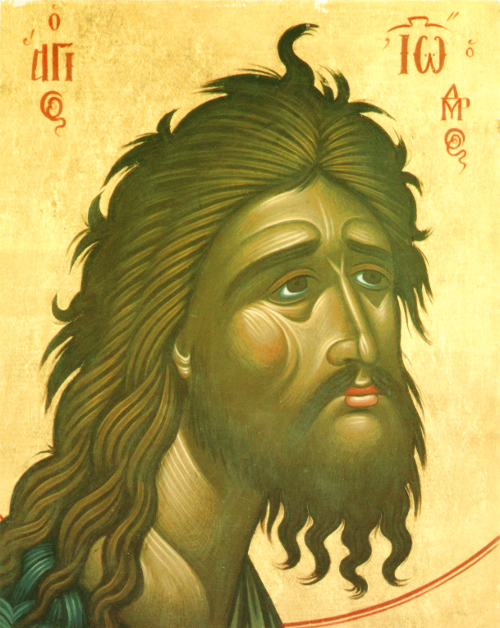
St. John the Forerunner performs miracles ( part 3 )


I have never told you, my brother Lazarus, [says monk Leontios] what happened to me several years ago, when I was young and had just been newly tonsured, which has to do with the subject of obedience.


I do not remember exactly, but it was either during 1916 or 1917 when my Elder of blessed memory advised me to make a prostration and to go serve at the mill located at Mariana as an attendant. Unfortunately, because I did not particularly like this dependency, I foolishly started to make excuses, arguing that I could not go because, supposedly, it was too cold, I did not have enough
clothing, perhaps I would get sick, and other such reasons. Additionally, there were many thieves wandering in that region, and I was afraid. 


My Elder of blessed memory made the same recommendation to me again and again, assuring me that he would provide me with the all the necessary clothing and provisions. I distinctly remember him saying to me,
"Go ahead, my child. May you have the blessing of the Honorable Forerunner. Do obedience and go, because the manager is there all alone and needs help. Go my child..." I, however,
continued to retort with my usual obstinacy. 


Finally, my Elder got fed up and tired with me, and vexed he left the matter in St. John's hands. This is how I left from the Elder's quarters and went to my room to retire for the evening.
But alas! Every time I think about what followed, my brother, I am always overcome with trembling with fear. About 8 or 9 o'clock that same evening, I saw a fearsome, towering man appear in my bedroom with a whip in his hand.


 As I  was lying down, I jumped out of bed horrified. No sooner had I stood on my feet when he started to lash me. "What type of a monk are you? Why don't you do obedience?" he remarked, and simultaneously he whacked from one direction ... he whacked me from the direction. I started to cry and begged him to stop hitting me, promising that I would henceforth be obedient. 


Immediately, he vanished from sight. I was a nervous wreck as I ran that very moment to the Abbot's quarters. I woke up the Elder, and with tears and lamentation I fell at his feet and asked him to read me a prayer of absolution, I related to him what had taken place, and promised to never again disobey any of his orders. Thus my Elder
was appeased, he read me the prayer of absolution, I took courage, and I returned to my cell and rested peacefully. The next morning, as soon as I woke up, I packed my bags and set out for Mariana. 


from the book
Narrations from Dionysiou Monastery

Sunday, July 6, 2014

St. John the Forerunner performs miracles ( part 2 )


I heard the following account that took place in 1937 [says monk Lazaros] to my amazement and surprise from monk Chrysanthos:
"As you are aware, Father Lazarus, for many years now I have repeatedly attempted to become a
director and member the monastery’s Council of Elders. 


After trying at length, pleading with various fathers, and oftentimes bringing this matter up
with the Abbot without success, I became
extremely distraught and upset.Through the
synergy of the devil, I became despondent and my mind was darkened to such an extent that I decided to put an end to my life. "Can you believe it?" I would ask myself.


"They appoint so many other younger monks to
this position! But they disregard me, even though I have grown old in this monastery working at so many different assignments! I will not tolerate this any longer. I'll go down to the shore, and jump in the ocean then it will be on their conscience."


I pondered on these thoughts for a several days, until I firmly decided to go through with it. However, our merciful Lord, through the intercessions of our holy patron Saint John the Honorable Forerunner, gave me the thought to fast for three days prior to executing my plan.


I thus isolated myself in my room for three days.
I shut my door and window shutters, and, within the darkness of my cell, I prayed continuously for two days and nights without eating or drinking anything, without even lying down on my bed. I prayed standing, then seated, and when I sensed sleep coming on, I would again arise to pray. On the third day, around 10 o'clock in the evening, suddenly a brilliant light appeared that lit up my entire room.


Simultaneously, I heard a loud voice saying to me: "Why aren't you at peace? Why are you distraught
and planning to go down to the shore to drown in t
he sea?" As soon as I saw the light and heard this voice, the sadness and dejection that had been plaguing me altogether disappeared, and I began
crying, wailing, and shedding tears, asking for forgiveness, and confessing that I had sinned and been deceived by the evil one: "Forgive me, Saint John..." He then responded, "Why have you stopped chanting? 


Why haven't you approached the chanter's stand this past week, but instead you wander about here and there asking to become a director? Don't I know who should become a director? If I don't want you to become a director, how can you become one? Don't I know who should become a director?" In the meantime, I had fallen to the ground and was weeping ceaselessly,
begging for forgiveness, and promising that henceforth I would be at peace, I would return to the chanter's stand, and never again seek to become a director.


After I said these things,the brilliant light vanished. I no longer felt uneasy, I immediately felt peace, and when the bell rang for the beginning of the service, I went to church and
followed the entire service."
 

Monk Chrysanthos [notes monk Lazaros] was very guileless, and for twenty-five years he had
chanted in the right choir with much zeal and reverence.


This is why he received divine mercy and
special intervention from the Honorable Forerunner. 


from the book
Narrations from Dionysiou Monastery

Sunday, June 29, 2014

St. John the Forerunner performs miracles


Monk Bisarion of Dionysiou Monastery was appointed by the monastery in 1916 to work outside Mount Athos for a period of time, at one of the monastery's dependencies where he was in charge of the flourmill. 

This monk related the following account that took place during his time there:
One day two villagers went to the fair, and one of them bought a horse from the other. The villager who bought the horse came to the chapel and venerated the icons. 


He left a certain amount of money in front of the Honorable Forerunner's icon and asked me to light a candle for him. I lit a candle for him. I saw the money, which was a sizeable amount, but I did not take it; I left it there in front of the icon. Later that
evening, as I went to light the vigil lamps in the chapel, I noticed that the money was gone. 


You can't imagine how sad I became. The evil one took advantage of this opportunity and made me
indignant. I walked to the icon of St. John the Forerunner, and, as I stood before it, I said to the
saint: "Holy Forerunner, aren't you here? Why do
you allow people to steal money right in front of your icon? I'm not going to light your vigil lamp!" 


So I only lit the vigil lamp of the Mother of God, and I left somewhat nervous. I went to the mill, I walked up to the house, I ate a little, but I was
still apprehensive. I was feeling guilty for having left the vigil lamp of the saint unlit; nonetheless, the evil demon incited me to remain stubborn. I was thinking to myself:
"Let's see what will happen... I'm not lighting his vigil lamp tonight."


Hence, as I lay down to sleep with uneasiness,
I still insisted on my course of action. As I was sleeping in the house all alone (because at that time I did not have any other helpers with me), around midnight, I felt someone nudging me. I woke up, and I saw standing before me a towering figure whose hair was falling freely over his
shoulders. I started to shake fearfully, and I was just barely able to utter: "How did you come here?" The person responded in a serious tone: "Don't you worry how I came here, but tell me why don't you light my vigil lamp?" With utter fear, with a shaky voice, and with tears in my eyes, I said: "Please forgive me, Saint John. I am at fault." I then prostrated myself three times before his feet, crying and asking him to forgive me. 


I then heard the Honorable Forerunner address me with a calm and sweet voice: "My child, Bisarion, why did you say that I am not here? If I am not here present, then who has been guarding you all
this time you are here in this wilderness from thieves and other harmful criminals?" "Please, my saint," I replied. "Please forgive me. I won't do it
again." "Go, light the vigil lamp hanging before my icon, and preach to others as well that the icons perform miracles. Because many people in this area have started to say that the icons do not perform miracles." This is what the Honorable Forerunner said to me, and then he disappeared. 


That very same moment, I went to the chapel, where I witnessed another miracle! I saw that all the money had been returned to the exact some spot in front of the icon of St. John, where it had been originally placed before it disappeared.


The thief must have experienced a good scare, enough to make him return the money that same evening to the icon. 

from the book Narrations from Dionysiou Monastery

Monday, November 25, 2013

Some Recent Miracles of St. John Maximovich


Archbishop John's abundant miracles both before and after his death testify to his love for the people. People in America, Europe, and the other places of his pastoral labors have long known of the power of his heavenly intercessions. And now, with the publication of Blessed John the Wonderworker and other books and articles about him in the Russian language, the people of Russia are beginning to know, too, and have already experienced healings through his prayers, as the following accounts testify.

1) Valentina A. is a member of our parish which is dedicated to the Reigning Icon of the Mother of God. Having read the book on the healings and life of St. John of San Francisco (Blessed John the Wonderworker), she came to me after church services and asked for oil from the lampada in the sepulchre of Archbishop John, as her daughter was seriously sick. Valentina A. recounted that her daughter, an architect by profession, had a swelling in her breast. It grew and the daughter turned to a doctor for help. The diagnosis was a frightful one, cancer of the breast. I had Unction served over the daughter and later gave her cotton saturated with oil from Archbishop John’s lampada. She anointed the ailing spot several times by making the Sign of the Cross. The doctors insisted on surgery, but when she came to the hospital for observation, the doctors and the sick woman herself were amazed: the swelling had disappeared and there remained only a scar. (1994)

2) Our altar boy, Oleg S., asked me after church services to anoint his hand. There was a swelling on it the size of a chicken egg. I anointed him with the oil of Archbishop John in a cross-like form in the Name of the Father, Son and Holy Spirit, and the acolyte left for home. After a week, I asked Oleg about his hand. He said he himself did not even notice when that swelling had disappeared. (1995)

3) Some time later, after Divine Liturgy, a Moleben was served with a Blessing of the Water. At the end of the Moleben, I anointed all communicants with the oil of St. John Maximovitch. I also anointed Olga. After a week, she was again at services and stood weeping. I asked her why she was weeping and all she could say was that everything was fine. Her husband, a military man, later came to me and told me that her leg had developed some infected growths. These growths had rapidly become ulcerous and had begun to multiply. The sight was awful. She turned to doctors but they simply shrugged their shoulders and could say nothing concrete. They gave her various creams but these did not help her.

Alter Holy Communion, Alga had been anointed with the oil of St. John. At home she sprinkled her legs with holy water and went to bed. In the morning, she saw no ulcers at all on her legs. Therefore, at the next church service, Olga wept from gratitude and was too emotional to tell us by herself. June, 1995)

4) Another parishioner of mine, Nadezhda, told me that her son Michael caught a severe cold and had a convulsive cough which only grew worse. She began to treat him with various medications. In the evening he would begin to fall asleep but the cough continued to torment him. Each minute he would be racked by this cough. His mother, a professional medical worker, was very frightened because at one time he had been rushed to the hospital by ambulance with these same symptoms. At this time, Nadezhda was reading the book on St. John Maximovitch and his miraculous healings. The mother began to pray, asking help from St. John, that he would heal her son. Having prayed, she came over to her sleeping son, crossed him and turned him on the other side. Some time later, the cough stopped and the boy quietly slept until morning. She no longer gave him any medication, only some holy water. For several days, her son would occasionally cough, but the convulsive fits did not return, and he became quite well. The mother was very thankful to Archbishop John for the healing of her son and continues to pray to him with gratitude. (April, 1995)

Hieromonk Cyril Osipov

Astrakhan, Russia

Saturday, October 5, 2013

Miracles ( Anthony Bloom (Metropolitan of Sourozh )


In the name of the Father, the Son and the Holy Ghost.

Time and again we read of miracles in the Gospel and in the Old Testament and indeed, we observe them in the life of the Church through the centuries; miracles of healing, miracles of the renewal of a human life by the power of God. And at times people - we all - ask ourselves, What is a miracle? Is it a moment when God overpowers His own creation, breaks its own laws, destroys something which He has willed Himself? That would be an act of magic, an act of overpowering whatever is unwilling to obey, of overpowering what is weak in comparison to Him Who is strong.

A miracle is something completely different, a miracle is a moment when harmony destroyed by human sin is restored. It may be a moment, it may be the beginning of a whole life: a harmony between God and man, a harmony between the created world and its Creator. It is a restoration of what should always be; not a miracle in the sense of something unheard of, unnatural, perhaps contrary to the nature of things, but rather a moment when God enters into His creation and is received. And because He is received, He can act freely.

We have an example of such a miracle in the story of the marriage at Cana of Galilee, when the Mother of God turned to Christ and said to Him at this poor, peasant feast, "They have no wine". Their hearts were still hungry for human happiness, for human joy; and yet, the material support of such joy had gone. And Christ says to Her, "What have I to do with Thee, why are you asking Me this question?" And She does not answer Him directly; She turns to the servants and says, "Whatever He may say to you - do it". She offers Him a perfect act of faith; unreservedly She trusts His wisdom, His love and His Divinity. And at that moment, because a door has been opened by the faith of one person who has drawn into this faith all those who will do what they are told, the Kingdom of God is established, a new dimension of eternity, of infinite depth enters into the world and what is otherwise impossible becomes reality.

And here we are confronted with several things which are necessary for this harmony to be re-established. On the one hand, - a need; a need which is real; it may not be great, but it must be true; and joy and sorrow, illness and un-happiness are equally in need of being absorbed into something greater than the earth, something as vast and deep as the Divine Love and the Divine Harmony.

And then there is the Divine compassion that we have heard of so many times, and the word is repeated here again in today's Gospel - the feeding of the five thousand: Christ had compassion, compassion which means that He looked at these people who were in need, who could do nothing to alleviate it, and He felt a pain in His Divine Heart, that these people, whose life should be fulfilment, abundance, a glorious joy - that these people should be in obvious need. This time it was hunger, another time it is illness, another time it is sin, another time it is death - it may be anything. But God's love may be either joy, exulting, glorious joy or crucified, sacrificial pain. And when all this meets then a mysterious harmony is established between the Divine sorrow and the human need, between human helplessness and the power of God, the love of God that expresses itself in all ways, great and small.

Let us therefore learn to be pure enough in heart, pure enough in mind to be able to turn to God with our need without hiding our face; or if we feel unworthy of coming up to Him, let us kneel at His feet and say, Lord - I am unworthy! Unworthy to be in Thy presence, unworthy of being loved, unworthy of Thy compassion, and yet I believe in Thy love more than I am sure of my unworthiness, and I come, because Thou art love and victory; because I have evidence in the life and in the death of Thine Only Begotten Son of what I mean to Thee: the life, the passion, the death, the descent into hell, the horror of it, to save me.

Let us learn this creative helplessness that consists in surrendering all hope of human victory for the sake of the certainty that God can do what we cannot. Let us be helpless in the sense of being transparent, and supple, and listening with all our being, and presenting our need to God - our need of eternal life, but also our needs that are human and frail: the need of support, the need of consolation, the need for mercy. And the response of God will always be the same: If you can believe, however little - everything is possible. Amen.

Tuesday, September 3, 2013

Some miracles performed by the right hand of Saint John the Baptist in Mount Athos


Just as we are referring to the wonders performed by Saint John, The Baptist, in the present times, we are not departing from our purpose if we also refer to some miracles performed in the past, which have so far been unknown to most of our brothers, through which it is brilliantly manifested how he protects and helps the monastery and its monks…
We will omit the totally unexpected and paradoxical appearance of this protection by the Saint, because its detailed description is read during the joint feast on the day of its commemoration, the Fourth Sunday of Lent.

Let’s talk about some events which took place in the island of Poros, and refer to the dangers which those who were at sea have avoided from the day of their departure. In order to avoid talking about these things ourselves, let’s us present the account given by the Abbot Stephanos, who refers to the reasons for this sea voyage and to some historical facts. (These accounts are found in Code 627 of the monastery, 1733-1833).

He writes: “Kassandra has fallen, everyone have been taken captives by the agarinous(Turks) who have even been threatening to capture Ayio Oros. When the monks saw the Turks advancing, they picked up their holy relics and left towards romeiko. I also left among them, with my holy relics. Taking those of the monks who wanted to leave, we deserted the monastery on the 23 of February 1821. That night, there was a storm and high seas, but nevertheless, were embarked and let the waves take us whenever they wanted. During the night we arrived at Amouliani and moored. All the ships belonging to the kleftes also anchored there, but God did not give them permission to touch us.

We got up in the morning, the weather was better. We sailed towards the monastery again, so that we could take some of the things which we had left behind together with the other seven monks. However, a boat from Psara hunted us down; they fired four shots with their guns but we managed to escape towards the port of Sikia and they couldn’t reach us.

While at sea, we met with a lot of dangerous people, who had the same faith as us, but the Lord freed us from all evil. Finally we reached the island of Poros. There, our Christian brothers helped us, despite the presence of some evil people who wanted at first to harm us. Saint John, however, protected us. One such person, a marauder, who wanted us to hand over some silver to decorate his guns, threatened to visit us during the night and do us a lot of harm. Therefore, seeing that I had no choice, I gave him a silver lantern, weighing 80 ounces, and left it to Saint John to judge.

A few days later, the poor guy who got the silver died from dysentery. Then I related everything to his brother, who was a very good man. He was saddened and said to me: “St John certainly killed him”. Then, he run to his brother’s house; he was looking to verify the matter and when he found all the silver he brought it straight back to us, crying bitterly all the way…

Another one, who was the first captain in Poros, took the oars from our boat, bowing to his own wishes and while he was on his boat on the way towards Piada, he had a fight with others. When they shot at each other, one bullet went through one of our oars and hit him on the thigh. Afterwards, he returned to Poros and gave the oars back to us. He even carried out twice, a blessing of water in front of St John’s holy relic but he was not cured. He later died even though his wound was not fatal.

All these have been made known to everyone and the whole world. What happened next? Those villains, who intended to come during the night and steal all our belongings later, became our protectors. Even the Greek parliament sent a boat and a letter to the provosts of the island to send us on our way to Korinthos, which was free from the Turks at the time, but the people of Poros would in no way let us go. This was a miracle performed by Saint John because had we gone, we would have surely lost the treasures of the monastery, since Korinthos’ castle fell once again to the Turks after a little while. The people of Poros did this good deed to us and Saint John benefited them a lot in return. From these I will tell you one:

For seven years they had been suffering from the presence of locusts and they have been losing all they had. Not only the locusts would not leave even a single green leaf but they would eat away even the peels from the lemon trees. As soon as a procession was launched with the relic of the holy, right hand of Saint John leading the way, all the locusts disappeared and the people were consoled because they had started reaping the fruits of their efforts. Indicatively, those days we never needed a doctor, because of the presence of Saint John. They had so benefited from all the miracles that were happening that they wanted us to live at the monastery of Zoodohou Pigis. We did, and we no longer had any material needs. Until the Turks torched Psara from one end to the other and we got scared and left for Eptanisa, the island of Zakinthos. There, the Christians welcomed us and we lived peacefully for four years, truly contended.

When the governor, John Kapodistrias, arrived in Greece, we left Zakinthos and returned to Greece, to the island of Skopelos, at our metohi of Faneromeni, where we stayed for one and a half years. Then, we eventually returned to our own holy monastery with our entire collection of holy relics. Glory be to the Lord, to His Holy Mother, our benefactor, and to our protector, Saint John, for everything. We returned to our monastery on the 5th June 1830. I beg the readers to pray for me, the humble abbot Stephanos, so that my soul finds mercy in the Lord, because of your holy prayers. Amen.


2. A miracle performed by the holy right hand of Saint John.

On Monday, the 16th of May 1961, during the Holy liturgy in honor of the Holy Spirit, ieromonahos Paul, described to me the miracle performed by the right hand of Saint John:

“Did you realize what has happened to me during the liturgy, father Lazaros?”

“What? Please explain to me better”.

“Of course you must have heard me how difficult it was for me to chant because my throat was closed up as a result of the long standing laryngitis”.

“Yes, I did realize this. I was even asking myself how you were going to offer the prayers during the liturgy, especially today when there is a sillitourgo”.

“Listen then. When the priests gathered in the church to take “kero” seeing that I was in such a state, I asked the abbot to bless me with the Saint’s holy hand and to cross me with it. The abbot agreed and crossed me on the head with the hand and offered the specific prayer. I also worshipped the hand, praying with fervor and adoration to the saint to cure me from this illness so that I could offer glory to the Lord, chant the proper hymns and read the Gospel clearly and loudly as I should on such a holy day. This is what I more or less said to the saint. And lo! and behold! The great Saint rushed to give me a fast and wonderful response! I immediately felt the presence of Grace, my throat softened up, my voice could now be heard, and in complete comfort, I gave the responses and I read the Gospel. I then offered sincere and heartfelt thanks from the bottom of my heart to our glorious protector, our Lord’s Baptist, with whose intervention we hope to have a blessed end to our lives, and be received in the k. Let it be done, father! Let it be done!”

Thursday, July 11, 2013

The Grave of Elder Cleopa: Miracles that happened


The tomb of Father Cleopa Ilie, who rests at the Sihăstria Monastery, has become a pilgrimage site. Those who met Father Cleopa during the 64 years he spent only at Sihăstria come and worship at his resting place and say that they feel the blessing and the help of the holy man in achieving their requests, just as when he was alive.

Very many ill people have been miraculously cured after having taken earth or flowers from Father Cleopa’s tomb (which they carefully preserved at home) or even oil from the icon lamp at his tomb cross, which they applied on the suffering parts of their body. The miracle of the healings has spread out fast throughout the country and the monks at Sihăstria have to permanently add a layer of earth on the tomb, to replace the amount that is taken for healing.

"Several buses of pilgrims stop over at Father Cleopa’s tomb and ask for permission to take a handful of earth. Some sprinkle it in their gardens, others keep it as a sample of the Elder’s grace to be protected from all evil, while others add just a little bit in their food," a monk told us, adding that several times so far he has had to carry two or three wheelbarrells of earth to Fr. Cleopa’s grave, to fill in the hollows left by the faithful.

A young woman from Cluj, who knew Father Cleopa while he was alive (he had been her spiritual Father), was suffering from a terrible heart disease. She couldn’t manage to get to Sihăstria until after the Elder’s repose. She went to the cemetery and prayed near his grave; when she left, she took a little bit of earth and swallowed it, being certain that the Father’s grace will work upon her. The young woman was healed and the news about the miracle spread throughout the villages around Cluj, the monk added. The Father’s cell has been turned into a museum ever since and has been visited by thousands of pilgrims from inside and outside Romania.


Elder Cleopa

Friday, June 21, 2013

The Five Miracles of Saint Gerasimos of Kefallonia


St. Gerasimos of Kefallonia (Feast Day - August 16 and October 20)


1. A Young Atheist Woman From Australia Converts To Orthodoxy and Becomes A Nun After Seeing the Incorrupt Relics of Saint Gerasimos

The powerful effect the incorrupt relics of Saint Gerasimos the New had a particular effect on a young Australian nun, Anna, who lives at St. Stephen's Monastery on Meteora. She related the following:

I came to Greece in 1988, hoping to get work as an English teacher. I wasn't of Greek parentage, nor did I have any particular interest in classical culture or the arts, but came because Greece sounded interesting. I had not been raised with any religion nor was I looking for one, but soon after I arrived I met some people who were planning to go to Kefallonia, to St. Gerasimos, and invited me along. It seemed a good way to begin seeing the country, and I agreed. When I entered the church and stood before the saint's coffin, I was stunned by what I saw - the incorrupt relics were so obviously a miracle that I knew in myself that there must be a God, and that Orthodoxy was how you worshipped Him. I was baptized and a year later I came to the monastery.

2. The Cave of Saint Gerasimos and Unbelievers

The older church containing the relics of St. Gerasimos is built directly over his cave and pilgrims are welcome to descend the ladder and squeeze through the tiny floor-level entrance that leads into the cave. Local Christians say that only believers can wriggle through the narrow passageway. The wife of an Argostoli priest has informed that, wanting a blessing for her unborn child, she had squeezed through with no trouble when she was fully nine months pregnant, but the thin, lithe young woman whom she brought with her - an unbeliever - couldn't do so.

3. The Epidemic of Cholera in 1760

In 1760, when an epidemic of cholera struck the island, a nun named Akakia had a vision of the saint, praying in front of an icon of the Mother of God, beseeching her to halt the epidemic. The Mother of God spoke from the icon and said, "I have asked my Son, and He will grant you this." Then the saint caught hold of a roll of a cotton-like material wrapped around his staff, and began plucking off many small pieces, scattering them into the air. That night he also appeared to another woman on the island, telling her to go quickly to her father's house - that the infection would not spread to the countryside.

The stories of these visions quickly made the rounds of the villages. One local woman, however, refused to believe the accounts, and scoffed at them saying, "These are stories for children." That night the saint appeared to her in a dream and struck her with his staff, saying, "By this children's story, through the blessing of Panagia, I dispel the sickness from this island." The next morning the woman went straight to the monastery to venerate the saint's relics, telling the nuns of her dream and showing them the bruise on her side where the saint had struck her. They all gave thanks to God.


4. Healing of a Mentally Ill Woman in 1785

In 1785, a mentally ill woman named Susannah came to the monastery and lived there for many months. She never spoke to anyone and ate only if she was given food; otherwise, she went hungry.

One day, after she had been there almost a year she began shrieking loudly during Vespers. The priest came out of the altar and tried to calm her but she screamed all the more until the unnerved cleric finally slapped her, and she was forcibly carried out of church.

That night the priest had a dream that the saint's larnaca (coffin) opened by itself and that St. Gerasimos climbed out. He was holding a book in his hands and motioned the priest over. When the priest came up to him, he hit him hard over the head with the book and asked him, "Did that hurt?" The priest said, "Yes," and the saint responded, "And that hurt me tonight when you slapped that poor woman. Get up now, it's time to go to Matins, and don't ever do it again."

The priest awoke terrified, and ran to the church where he begged the saint's forgiveness. That morning, Susannah was again in church, but this time, she suddenly called out coherently, "Let the priest who hit me yesterday, come and give me something to eat." To the amazement of everyone who knew her, she had been healed.

5. Saint Gerasimos Saves Sailors At Sea From Death

In November 1807, a shipping merchant by the name of Manuel was passing the island on his way to the Peloponnese. When he was in sight of Kefallonia a huge storm blew up. The sailors did all they could to keep the ship afloat, but the intensity of the storm continued to build until they were near despair. On board was a Kefallonian sailor named Ioannis, who had a small icon of St. Gerasimos with him. Shouting to the crew, "St. Gerasimos will save us!" he threw the icon into the sea. When the icon touched the surface of the sea the waves were immediately calmed. The grateful captain ordered the crew to dock in Kefallonia, to pay homage to the saint.


Apolytikion in the First Tone
O believers, let us praise the protector of the Orthodox, the God-bearing miracle-worker lately appearing to us, the incarnate angel, divine Gerasimos. For he has rightly received from God the ever-flowing grace of performing healing. He strengthens those with diseases and he heals those with demons. And therefore he pours out healings to those who honor him.


Saint Gerasimos of Kefallonia

Thursday, April 11, 2013

When does God Perform Miracles?


Here is a story about Father Paisios where he taught the nature of miracles.

"A group of young men, of no religious background, visited the Elder. They had heard of Father Paisios and were curious to meet him. After giving them the typical Mount Athos treat (loukoumi and water), he sat next to them to listen to what they had to say. The told him:
- Father, we want you to work a miracle in our presence, so we can believe in God.
- Wait a second, he replied.
He went inside and brought a knife and said jokingly:
- Stand up in line! I will cut your heads off and then I will miraculously glue them back to their place. But please, don't stand next to each other, in case I mix them up.
The young men reacted at once"
- No!! We want to see a different kind of miracle.
then, the Elder sat by their side and told them the following:
- It would be very easy, if God wished so, to make people believe in Him by working miracles; with His supernatural power, visible to all of us, He would make everyone believe. However, God does not want people to believe in Him out of admiration for His supernatural power; on the contrary, He wants us to believe in Him and love Him because He is extremely kind.


God will never work a miracle in order to demonstrate His power, and thus acquire more believers. He works miracles to cover up human weaknesses. ..."


We cannot put the burden on God to make us have faith in Him. This is a matter for our own free-will. The Elder is beautifully telling us that it is only through a relationship of love that we embody faith and know God's power. Miracles can happen to those of faith when they are in need due to their human weaknesses. They come when we seek with humility and faith based on a love of Him.

Tuesday, March 19, 2013

THE BENEFITS OF ALMSGIVING - AN AMAZING MIRACLE!


  Once there lived in the city an officer of the palace court. One day he was sent by the king to someone as a messenger. On the road, he found a dead person, who was naked. The officer was saddened with this lamentable image of misfortune and said to his servant, ‘take my horse and go on a bit’. The officer dismounted and approached the dead man. Taking off some of his clothing, he covered the dead man with them.


A few days after this incident, the officer was once again dispatched in the service of the king. But as soon as he left the city, he fell from his horse and broke his leg. He was immediately taken to his house, where he was beset by horrendous pain. The doctors looked after the ill man, but without result. After five days, his leg turned to black. When the doctors saw this symptom they became very concerned and, so that the rest of his body would not become infected, decided to amputate his leg.


On hearing this decision of the doctors the officer became very upset, wept over his misfortune, and, because of his sadness, could not even sleep. The night after he learnt this terrible news he remained completely sleepless. The lamps in his room thus being lighted, around midnight there came to the attic window an unknown man who approached him. ‘Why are you crying and why are you sad?’ The officer answered him, ‘Sir how could I not cry? For no good reason I broke my leg, and tomorrow the doctors are going to amputate it.’ This unknown man then said to the suffering officer, ‘show me your leg.’ He began forthwith to anoint the leg of the sick man and to massage it. After a short time, he said to the ill man, ‘Get up and walk.’ ‘I cannot, Sir, because it is broken.’ ‘Do not be afraid,’ the man told him, ‘lean on me.’ In fact, the officer of the palace guard rose up from his bed and walked; he had become perfectly well.


After this strange miracle, the unknown man said to the healed officer; ‘See, you have become perfectly well. Lie down and rest from your night time vigil and your sufferings and do not worry.’ Continuing he spoke a few words about the value of charity, based on the words of Holy Scripture: ‘Blessed are the meek (poor): for they shall inherit the earth’ (Matt. 5:5) and ‘For He shall have judgment without mercy, that hath showed no mercy’ (James 2:13).


Following this short dissertation, the unknown man bid farewell to the healed officer: ‘Good bye and be always healthy!’ Saddened by the impending departure of his benefactor, the officer asked him: ‘Are you leaving?’ ‘What else do you want?’ he said. ‘You are now completely well.’ The officer said back to him: ‘In the name of God, who sent you? Tell me who you are.’ ‘Look at me carefully’ – the unknown man said – ‘and see if you recognise what I am wearing.’ ‘Yes’ the officer said, ‘Those are my own clothes.’ ‘Well, then,’ said the unknown man, ‘I am the same one whose body was tossed aside naked on the street and which you – with succour and mercy – covered with your clothes. It is thus that God sent me to cure you. For this you should always thank him.’


Having finished his words, he climbed up again, through the attic window from which he had come, and became invisible. From that time forward, the healed man never ceased to thank God and to distribute alms to the poor.
Gerontikon

Wednesday, December 12, 2012

When does God Perform Miracles? ( Elder Paisios )


Here is a story about Father Paisios where he taught the nature of miracles.


"A group of young men, of no religious background, visited the Elder.  They had heard of Father Paisios and were curious to meet him.  After giving them the typical Mount Athos treat (loukoumi and water), he sat next to them to listen to what they had to say.  The told him:
   - Father, we want you to work a miracle in our presence, so we can believe in God.
   - Wait a second, he replied.
He went inside and brought a knife and said jokingly:
   - Stand up in line! I will cut your heads off and then I will miraculously glue them back to their place.  But please, don't stand next to each other, in case I mix them up.
The young men reacted at once"
   - No!! We want to see a different kind of miracle.
then, the Elder sat by their side and told them the following:
   - It would be very easy, if God wished so, to make people believe in Him by working miracles; with His supernatural power, visible to all of us, He would make everyone believe.  However, God does not want people to believe in Him out of admiration for His supernatural power; on the contrary, He wants us to believe in Him and love Him because He is extremely kind.


God will never work a miracle in order to demonstrate His power, and thus acquire more believers.  He works miracles to cover up human weaknesses. ..."


We cannot put the burden on God to make us have faith in Him.  This is a matter for our own free-will. The Elder is beautifully telling us that it is only through a relationship of love that we embody faith and know God's power. Miracles can  happen to those of faith when they are in need due to their human weaknesses. They come when we seek with humility and faith based on a love of Him.

Friday, November 23, 2012

Three moving miracles of St. John the Russian

                                                                
St. John the Russian

An unbelieving physician is miraculously healed

At Limne of Evia lived and worked a physician named Mantzoros. As a physician he was very good, but he did not believe in Christ, and of course did not wish to hear questions about religion and the soul. He was against religion, and his opinions were harsh on the subject of Christianity.

One day, he however became very sick. This illness had struck this unbelieving doctor with terrible pains as soon as it arrived. Amidst unbearable pains, he was taken to the Hospital of Chalkida. There, due to his illness, they were unable to help him, so they sent him to the Athens clinic “Pantocrator”, which is on September 3rd road. There they took x-rays and and ran blood tests, which showed that he had a problem with his large intestine...The physicians of the Hospital, therefore, said that if he agreed, he would be operated on the next day. He agreed, based on the medical knowledge that he had. But the words of his brethren: “Take hope in the Almighty, O brother”, led him to a spontaneous prayer from his soul the night before his surgery. He entreated God, not only to make him well, but to forgive him for the disbelief which he had shown for so many years.

During his prayer, someone knocked on his door and entered. It was a beautiful young man, who opened his door and entered the doctor's room.

“What do you have?” he asked.

“I am very sick” the doctor answered.

“But you don't have anything wrong with you” he replied.

“What are you saying, my Christian? I have colon cancer of the final stage, and tomorrow I am going to surgery. Do you understand what is going on?”

The young man replied “You don't have anything wrong with you anymore. I made you well.”

“Don't you have any shame talking like this to a sick man?” the doctor said, “Are you just trying to calm me down?”

“I am Saint John the Russian. If you insist, have the surgery tomorrow, and you will be convinced that nothing is wrong with you.” The young man disappeared.

The doctor was full of agony, and he rang the bell in his room to ask the nurses who the young man was who came to his room. However, not one of the nurses had seen anything. The next day, the sick physician went to the operating room for the surgery. The doctors were ready for the operation when they heard the doctor tell them that he didn't need the surgery, and that his health was good: “Saint John the Russian healed me”.

“What are you talking about?” they asked him, “We're in the 20th century, what are you talking about brother? Our brother must be out of it.”

Though the sick man had improved, they continued with the surgery. He went under anesthesia, and when they opened him up, they did not find any cancer. The Saint had done his miracle, and the doctors were astonished, and were looking at each other. The doctor was totally well. He relates this himself, wherever he goes.
(from the book: “Lives of Orthodox Saints 9: Saint John the Russian”, published by Entheos Vios
"The Saint Was Helping Me To Pray"
Aikaterina M. from Athens related the following miracle of St. John the Russian in 1995, about her first visit to the Church of Saint John the Russian in Evia:
The first time I came here with my friends, I barely knew who St. John was, nor did I know what to expect, as I had never seen incorrupt relics before. At first I was shocked - the saint's body was certainly there, as it should not have been if it had been subject to the normal processes of nature, but his skin looked dark and a little withered, and I was fearful of coming any closer to the glass coffin. I finally gathered my courage and went up to look. His face was covered with a gold cloth, out of reverence, but I could clearly see his hands and wrists. I knelt down beside the coffin to pray, feeling that even if it seemed strange to me, I should still try to be respectful. I asked the saint to help me understand what I was seeing, and to know him. When I finished praying, I went to sit in a chair off to the side while I waited for my friends. I thought that I should pray some more, but I didn't know any prayers to St. John so I took out my Akathist Hymn to the Panagia, which I always carry with me, and told St. John that it was for him also. I begged him to forgive me for not having a special prayer for him alone.

Probably like most people, I often don't pray very deeply unless someone I love is ill or in danger, and this time I began read the Akathist to the Panagia in my usual way, although I tried hard to concentrate on the words. Suddenly, I felt that someone had come up and was standing next to me. I looked around quickly, but the nearest person was kneeling at the relics with his back to me, about a dozen meters away. I went back to my prayers, and although I didn't actually hear anything spoken aloud, I had the distinct impression that someone was praying to the Panagia with me, with great strength and love. I suddenly found myself praying with a depth I have never felt before or since - as if I was somehow in the middle of the prayer, and it was alive. I could feel the prayer moving up to heaven, and I knew in my soul that it was St. John himself, praying with me.

I was filled with such awe and joy at the nearness of the saint who was helping me to pray even though I had been afraid of him. It felt like Pascha, and as if I had just received the Holy Mysteries. I come to him now as often as I can.

The Cane
For many years, pilgrims to the shrine of St. John the Russian saw a simple cane standing before the glass-enclosed sepulchre. It belonged to an old woman, Maria Spaik, who was bent over from osteoporosis and had been unable to stand upright for eighteen years. In August 1978, he relatives brought her to the Church of St. John and lifted her in their arms so that she could venerate the relics. When Maria saw the incorrupt body of the Saint, she began to cry, asking St. John to help her. As she prayed over the relics, she felt an invisible hand touch her back. The old woman drew herself up erect. Tears appeared in the eyes of all the onlookers. The bells were rung, and a Supplication Service was sung in thanksgiving. The cane was left at the shrine as a memorial of the miracle.

Wednesday, October 24, 2012

The Church is an endless source of miracles…


Despite appearances and the unworthiness of the monks and clergy, the Church is an endless source of miracles.


 It takes water and makes it Holy Water; it takes bread and wine and makes the Holy Eucharist; it takes man made of dirt and makes him a god!


But many people do not see the miracles. Because if they saw them they would not despise or hate the Church of Christ, but they would love and honor Her and would not be talking about Her with contempt as they do.


- Elder Paisios of Mount Athos

Miracles happen… - Elder Paisios of Mt. Athos


Miracles happen through the prayers of small children. Whatever they ask of God He gives them because they are guileless and He hears their pure prayer.


I remember one time our parents had gone out into the field and had left me in the house with my two younger siblings. The sky suddenly darkened and a torrential rainstorm began.


“What will our parents do now?,” we said. “How will they get back home?” The two little ones began crying. “Come here,” I told them, “we will ask Christ to stop the rain.” The three of us knelt down before the family’s icons and prayed. In just a few minutes the rain stopped.


- Elder Paisios of Mt. Athos


Related Posts Plugin for WordPress, Blogger...