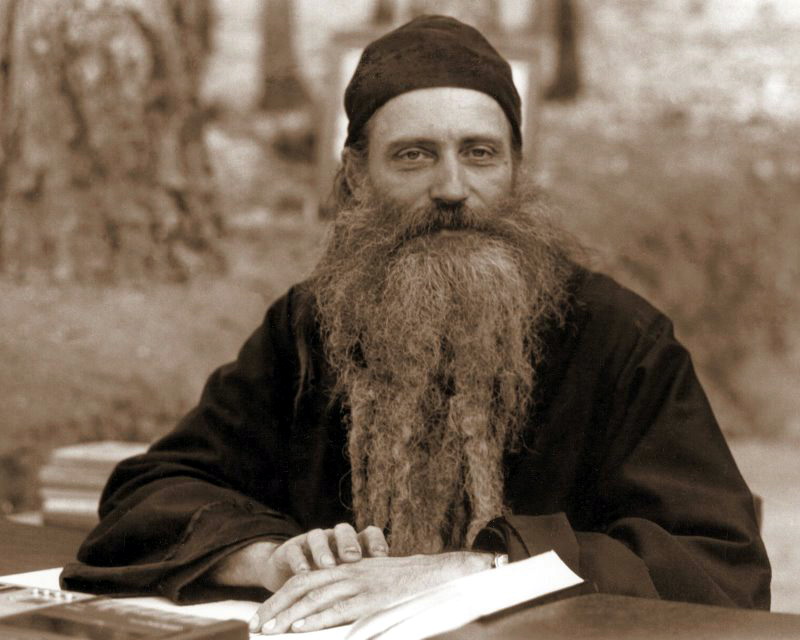
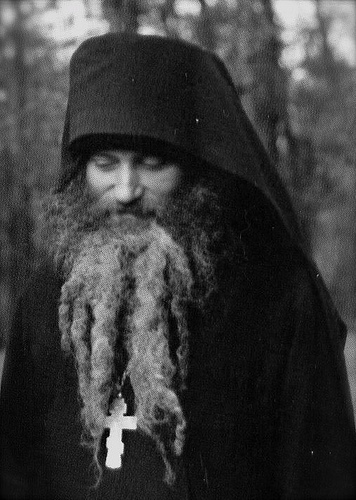
In the coming years, the devil will use every opportunity to pit the true Orthodox Christians against each other, sometimes with issues great and other times (more commonly) small. We must try with steadfastness to not get caught by the bait.
Fr. Seraphim Rose

Every Orthodox Christian is placed between two worlds: this fallen world where we try to work out our salvation, and the other world, heaven, the homeland towards which we are striving and which, if we are leading a true Christian life, gives us the inspiration to live from day to day in Christian virtue and love.
But the world is too much with us. We often, and in fact nowadays we usually forget the heavenly world. The pressure of worldliness is so strong today that we often lose track of what our life as a Christian is all about.
Even if we may be attending church services frequently and consider ourselves “active” church members, how often our churchliness is only something external, bound up with beautiful services and the whole richness of our Orthodox tradition of worship, but lacking in real inner conviction that Orthodoxy is the faith that can save our soul for eternity, lacking in real love for and commitment to Christ, the incarnate God and Founder of our faith.
How often our church life is just a matter of habit, something we go through outwardly but which does not change us inwardly, does not make us grow spiritually and lead us to eternal life in God.
Fr. Seraphim Rose
“Why do men learn through pain and suffering, and not through pleasure and happiness? Very simply, because pleasure and happiness accustom one to satisfaction with the things given in this world, whereas pain and suffering drive one to seek a more profound happiness beyond the limitations of this world. I am at this moment in some pain, and I call on the Name of Jesus—not necessarily to relieve the pain, but that Jesus, in Whom alone we may transcend this world, may be with me during it, and His will be done in me. But in pleasure I do not call on Him; I am content then with what I have, and I think I need no more. And why is a philosophy of pleasure untenable?—because pleasure is impermanent and unreliable, and pain is inevitable. In pain and suffering Christ speaks to us, and thus God is kind to give them to us, yes, and evil too—for in all of these we glimpse something of what must lie beyond, if there really exists what our hearts most deeply desire.”
Fr. Seraphim Rose

So, to repeat the first point: we watch the signs of the times in order to recognize Christ when He comes, because there have been many false Christs, many more false Christs will come, and at the very end of the world there will finally come one who is called Antichrist. The Antichrist will unite all those who are deceived into thinking he is Christ, and this will include all those whose interpretation of Christianity has gone off. Often you can look at some people who confess Christianity, and it seems that many of their ideas are correct—they go according to the Bible. Then you look here and there, and you see that here’s a mistake, there’s a mistake.
Just recently Fr. Dimitry Dudko, in the little newspaper he puts out, said there came t him someone who claimed to be Christian. As he began to talk to him, he began to feel that this person wasn’t Orthodox, and he said, “What confession are you?” “Oh, that’s not important. We’re all Christians. The only important thing is that we be Christians.” He said, “Well, no, no, we have to be more precise than than that. For example, if you’re a Baptist and I’m an Orthodox, I believe that we have the Lord’s Body and Blood, and you don’t.” We must be precise because there are many differences. It’s good to have the attitude: I have respect for you, and I won’t interfere with your faith, but nonetheless there’s a true way of believing and there are ways which go away from the truth. I must be according to the truth.
In the same way we can see that many people who ae not Orthodox have many good things about them, and then they go off in some respect. In the end it’s up to God to judge, not to us. But we can see what will happen if all these little ways people go off now are projected into the last times, if people still believe that way when the last times come. These mistakes cause people, when they see Antichrist, to think that he is Christ. There are very many sects now which believe that Christ is coming to rule for a thousand years form the Temple in Jerusalem. Therefore, when the Jews start building the Temple, these sects will only rejoice because, to them, this is the sign of Christ’s coming. On the contrary, we know that this isn’t he sign of the Antichrist coming, because Christ will no more come ot the Temple. The Temple has been destroyed. Christ comes only at the end of the world to begin the eternal kingdom of heaven. The only one who will come to the Temple is Antichrist.
So, this is why the correct Orthodox Christian understanding and preparation based upon this understanding are absolutely necessary. The closer we get to the very last times, the more indispensable this understanding and preparation are.
Fr. Seraphim Rose

The first thing we must have if we are going to have the true interpretation of the signs of the times is something we can call basic Orthodox knowledge. That is, knowledge of the Holy Scripture, both the Old and New Testaments (and not just according to the way it seems, but according to the way the Church has interpreted it); knowledge of the writings of Holy Fathers; knowledge of Church history; and awareness of the different kind of heresies and errors which have attacked the Church’s true understanding of dogma and especially of the last times. If we do not have a grounding in sources such as these, we will find ourselves confused and unprepared. That is precisely what our Lord tells us: to be ready, to be prepared. Unless we have this basic knowledge, we will not be prepared and we will misinterpret the signs of the times.
A few years ago a book was printed in English which has become a fantastic bestseller for a religious book. It has sold over ten million copies in America. It’s called The Late Great Planet Earth by Hal Lindsey, a Protestant Evangelical in Texas. In a rather superficial style he gives his interpretation of the signs of the times. He believes it’s the last times we are living in now. He believes that everywhere around us there are being fulfilled these signs which our Lord talked about. If you read this book, you find that sometimes he gets something more or less correct according to our Orthodox understanding, sometimes he is totally off, and sometimes he is partly wrong, partly right. It’s as though he’s just guessing, because he reads the Scripture according to his own understanding. He has no basic Orthodox Christian knowledge, no background in the true knowledge of the Scriptures and the Holy Fathers. Therefore, if you read this book seriously, you will find that you become very confused. You don’t know what to believe any more. He talks, for example, about a millennium which is supposed to come before the end of the world. He talks about the rapture, when Christians are supposedly gathered up into the heavens before the end of the world, and then watch how the people suffer down below. He talks about the building of the Temple in Jerusalem as though this is a good thing, as thought this is preparing for Christ’s coming.
If you read such books as this (there are many other books like it; this one happens to be a bestseller because the author caught the imagination of people just at one particular time), and if you take them all as truth, you will find that instead of recognizing Christ—which is the whole reason for our understanding about the signs of the times—you will be accepting Antichrist.
Take, for example, the very question of the Temple in Jerusalem. It is true, according to Orthodox prophecies, that the Temple will be rebuilt in Jerusalem. If you look at people like Hal Lindsey, or even the Fundamentalist Carl McIntire, they are also talking about the building of the Temple, but they’re talking about it as though we are building it in order for Christ to come back and reign over the world for a thousand years. What they are talking about is the coming of Antichrist. The millennium, according to the Protestant interpretation, as being a special thousand-year reign at the end of the world, is actually the reign of Antichrist. In fact, there have already been people who have arisen and proclaimed their thousand-year kingdom which is going to last until the end of the world. The last one was Adolf Hitler. This is based upon the same kind of chiliastic idea: that is, interpreting the millennium in a worldly sense. The actual thousand years of the Apocalypse is the life in the Church which is now, that is, the life of Grace; and anyone who lives it sees that, compared to the people outside, it is indeed heaven on earth. But this is not the end. This is our preparation for the true kingdom of God which has no end.
There are many books of basic Orthodox knowledge now available. Those who are seriously concerned about studying the signs of the times should first be very well versed in some of these books, and they should be reading them, seriously studying them, and having them as daily food. The best books to read are not someone’s interpretation of Revelation (the Book of Apocalypse), because right now there’s not really any Orthodox interpretation of this in English.2
The best books are the basic spiritual textbooks. First of all there are basic texts of Orthodox dogmas, the various catechisms. One of the best is the eighth-century work of St. John Damascene, On the Orthodox Faith, which goes through the whole of the catechism. An even earlier one is St. Cyril of Jerusalem’s Catechetical Lectures, that is, lectures prepared for people about to be baptized, which goes through the whole Creed and tells what the Church believes. There are many similar books of catechism, both in ancient times and in more modern times. More recently we have the catechisms in Russian of Metropolitan Platon and Metropolitan Philaret, which are a little shorter and simpler.
Then there is a different kind of book: commentaries on Holy Scriptures. There are not too many of these in English,3 but we do have some of the commentaries of St. John Chrysostom. This area is a little bit weak in English, because there are many good books in Russian which are not in English yet, including more recent books of commentaries on the Scriptures, even on the Apocalypse. Archbishop Averky’s books are very good, but they’re just being put into English now. God willing, before too long, they will be out.4
Then, besides these two kinds of books—basic catechism and commentaries on Scripture—there are all the books on Orthodox spiritual life. These include the Lausiac History (which tells about how the monks lived in Egypt, and how they fought spiritually), the Dialogues of St. Gregory of Rome, the Lives of Saints, The Ladder of St. John, the Homilies of St. Macarius the Great, the books of St. John Cassian, the Philokalia, Unseen Warfare and St. John of Kronstadt’s My Life in Christ. These books deal with basic Orthodox spiritual life, spiritual struggle, how to discern the wiles of the demons, how not to fall into deception. All of them give a basic foundation by which to understand the signs of the times.
Then there are the works of more recent writers who are in the same patristic spirit as the ancient Holy Fathers. The main examples are the two great writers of 19th-century Russia, Bishop Theophan the Recluse and Bishop Ignatius Brianchaninov,5 whose works are now coming out gradually in English. Bishop Ignatius’ book The Arena and various articles by Bishop Theophan are in English.6 These two writers are very important because they transmit the patristic teaching down to our times. They have already explained many questions which arise concerning how to understand the Holy Fathers. For example, the new Orthodox Word has a whole text of Bishop Ignatius on the toll-houses which the soul meets after death. Sometimes, in reading the Holy Fathers, one has questions on such subjects and doesn’t quite know how to understand what the ancient Fathers say, and these more recent Father explain these texts.
There are the histories of the Church, which tell of God’s revelation to men and how God acts with regard to men. It is very instructive to read the stories of the Old Testament, because exactly the same things repeat themselves in the New Testament. Then one should read, along with he New Testament, the histories of the New Testament Church. For example, there’s a pocketbook of Eusebius’ History of the Church, which traces the history of the Church down through the first three centuries, written from an Orthodox Christian point of view.7 It’s very important to see what early Church writers saw was important in the history of the Church: the martyrs, the apostles, and so forth.
So all these different kinds of writings help to prepare us with basic Christian knowledge, that is, catechisms, commentaries on Scripture, books on spiritual life, more recent patristic books in this same spirit, and histories of the Church. Before we do too much reading about what specifically the signs of the times mean, we should have a basic background in all of these categories of books. All of them prepare one to understand something about the signs of the times. Once one has begun to prepare oneself like this, it is not merely a matter of adding knowledge up in one’s head and being able to repeat by heart certain phrases, to have exactly the right interpretation of a Bible verse, or anything of the sort.
Fr. Seraphim Rose
Count it all joy, my brethren, when ye fall into manifold temptations, knowing that the testing of your faith produces patience. And let patience have its perfect work, that ye may be perfect and entire, lacking nothing. (James 1:2-4)
"By taking one small step at a time, and nobody not thinking that in one big step we are going to get any place, we can walk straight to the Kingdom of Heaven––and there is no reason for any of us to fall away from that ."
Fr. Seraphim Rose

We have one particular idea right now that’s taking possession of people: the so-called idea of women’s liberation. This takes the form of women priestesses in the Anglican Church, and also in the Catholic Church, which is preparing for it now.
Of course, if you look at this seriously, sit down and think about it, and you read what St. Paul says about women and so forth, you have no problems. It’s all very clear that this is some kind of crazy new idea. But it is also very interesting to look at this more deeply and see where it comes from—why is there such an idea, what is it, what’s behind it?—because if you understand the strategy of the devil, you’re a little better equipped to fight against it.
This particular idea of women’s liberation can be traced back at least two hundred years. Of course, you can go back even before that, but its present from goes back at least two hundred years, to the forerunners of Karl Marx, the early Socialists. These Socialists were talking about a great new utopian age which is going to come when all the distinctions of class and race and religion and so forth are abolished. There will be a great new society, they said, when everybody is equal. This idea, of course, was based originally upon Christianity, but it distorted Christianity, and amounted to its opposite.
There was a particular philosopher in China in the late nineteenth century who brought this philosophy to its logical conclusion, as far as it could go. His name is K’ang Yu-Wei (1858-1927). He’s not particularly interesting except as he incarnates this philosophy of the age, this spirit of the times. He was actually one of the forerunners of Mao Tse-Tung and the takeover of China by the communists. He based his ideas not only on distorted Christianity, which he took from the liberals and Protestants in the West, but also on Buddhist ideas. He came up with the idea of a utopia which was to come into being, I think, in the 21st century according to his prophecies. In this utopia, all ranks of society, all religious differences, and all other kinds of differences which affect social intercourse will be abolished. Everyone will sleep in dormitories and eat in common halls. And then with his Buddhist ideas he began to go beyond this. He said that all distinctions between the sexes would be abolished. Once mankind is united, there’s not reason to halt there—this movement must go on further. There must be an abolition between man and animals. Animals also will come into this kingdom, and once you have animals… The Buddhists are also very respectful to vegetables and plants; therefore, the whole vegetable kingdom has to come into this paradise, and in the end the inanimate world, also. So, at the very end of t he world, where will be an absolute utopia of all kinds of beings who have somehow become intermingled with each other, and everybody’s absolutely equal.
Of course, you read about this and you say the man must be crazy. But if you look deeply, you see that this is coming from a deep desire to have some kind of happiness on earth. No pagan philosophy, however, gives happiness; no man-made philosophy gives happiness. Only Christianity gives hope for a kingdom which is not of this world. The idea to have a perfect kingdom comes from Christianity, but since the early Socialists did not believe in the other world or in God, they dreamed of making this kingdom in this world. That is what communism is all about.
We see what happens, of course, when this idea is put into practice. You have the experiment of the French Revolution, which had apparently good ideas—liberty, equality, fraternity—or the Bolshevik Revolution, or in more recent times the various other communist revolutions. Last of all you have Cambodia, a poor little country which for three years suffered absolute communism and found that at least one-fourth of its population was exterminated because it didn’t fit. Everyone who had more than a high-school education had to be eliminated, everyone who thought for himself, and so forth. Now the regime has been overthrown by people who are a little less ruthless, but there’s nothing much to cheer about.
This shows that once you try to put these ideas into operation, you get, not paradise on earth, but more like hell on earth. In fact, the whole experiment in Russia for the last sixty years has been a proof of this, that there is no paradise on earth, except in the Church of Christ, with sufferings.8 Our Lord prophesied that already in this life we would receive back a hundredfold what we give, but it must be with persecutions and sufferings. Those who wish to have this happiness on earth without suffering and persecutions, and without even believing in God, make hell on earth.
Fr. Seraphim Rose

A second example of a new phenomenon, which at first sight one doesn’t know what to make of, is the now very common phenomenon of UFOs, flying saucers.
There is a particular Protestant evangelist, the above-mentioned Carl McIntire, who is extremely strict and righteous and very Bible-believing. He has a radio program, the Twentieth-Century Reformation, and a newspaper. He is absolutely upright—you have to separate from all people who are in apostasy—and his ideas are very nice. He’s anti-communist. He calls Billy Graham an apostate, together with everyone who deviates from the strict line of what he thinks is right. From this point of view he’s very strict, and yet you see the strangest things i his philosophy. For example, he’s building himself the Temple of Jerusalem, in Florida. He has a model of the Temple, and he wants to build it so as to make it compete with Disneyworld. People will come and pay to see the great Temple which is soon going to be built for Christ to come to earth. This is supposed to provide a good opportunity to witness Christianity.
He goes in for the flying saucers, also. In every issue of his newspaper there’s a little column called “UFO Column,” and there they talk, to one’s great astonishment, about all the wonderful, positive things which these flying saucers are doing. The give conferences and make movies about them.
Just recently there have been several Protestant books about UFOs, showing quite clearly that they’re demons. The person who writes the column in this newspaper got upset about this, and said that some people say that these beings are demons, but we can prove they aren’t. He says that maybe a couple of them are demons, but most of them aren’t. He cites a recent case in which some family in the Midwest saw a flying saucer. The flying saucer came down, landed, and the family saw inside little men—they’re usually four and half feet tall or so—and they sang “Hallelujah.” They stopped and looked and then they flew away; I guess they didn’t talk to them any more. And that set the family to thinking; they began to think “Hallelujah”; they began to think about Christianity; they looked in their Bibles, and they finally ended up going to a Fundamentalist church and being converted to Christianity. Therefore, he says, these beings must be some kind of people who are helping God’s plan to make the world Christian because they said “Hallelujah.”
Of course, if you read Bishop Ignatius Brianchaninov, you will know about all the deceptions which the demons perpetrate: the demons “pray” for you, the demons make miracles, they produce the most wonderful phenomena, they bring people to church, they do anything you want, as long as they keep you in this deception. And when the time comes, they will suddenly pull their tricks on you. So these people, who have been converted to some kind of Christianity by these so-called outer-space beings, are waiting for the next time they will come; and the next time their message may have to do with Christ coming to earth again soon, or something of the sort. It’s obvious that this is all the work of demons. That is, where it’s real. Sometimes it’s just imagination, but when it’s real this kind of thing obviously comes form demons.
This is very elementary. If you read any text of the early Fathers, any of the early Lives of Saints or the Lausiac History, you find many cases where beings suddenly appear. Nowadays they appear in spaceships because that’s how the demons have adapted themselves to the people of the times; but if you understand how spiritual deception works and what kind of wiles the devil has, then you have no problems in understanding what’s going on with these flying saucers. And yet this person who writes the UFO column is an absolutely strict Fundamentalist Christian. He is looking, actually for new revelations to come from beings from outer space.
Fr. Seraphim Rose

In the following talk, Fr. Seraphim speaks to us from almost twenty years ago, and yet his words are quite relevant to our times as we approach the end of the second millennium. Although some of the individual examples he gives are now dated, there are now even more extreme examples of the same phenomena of which he speaks. As always, he humbles his understanding before the holy Scriptures and their interpretation by the Orthodox Holy Fathers, and thus his teaching about the times remains timeless, free of the intellectual fashions and prejudices of this world. As time goes on, the Orthodox world-view from which he received his wisdom will become ever more necessary for the spiritual survival of true Christians.
THE SUBJECT of this talk is watching for the signs of the times. First of all, we have to know what it is meant by the phrase “signs of the times.” This expression comes straight from the Gospel, from the words of our Saviour in Matthew 16:3. Christ tells the Pharisees and Sadducees who came to Him, “Ye can discern the face of the sky,” that is, tell what the weather will be; “but can ye not discern the signs of the times?” In other words, He’s telling them that this has nothing to do with science, or with knowing our place in the world, or anything of the sort. It’s a religious question. We study the signs of the times in order to be able to recognize Christ.
During the time of Christ, the Pharisees and Sadducees did not study the signs of the times in order to see that Christ had come, that the Son of God was already on earth. There were already signs that they should have recognized. For example, in the book of Daniel in the Old Testament, there is a prophecy concerning the seventy weeks of years, which means that the Messiah was to come about 490 years from the time of Daniel. Those Jews who read their books very carefully knew exactly what this was all about, and at about the time that Christ came they knew that it was time for the messiah.
But this is an outward sign. More importantly, the Pharisees and Sadducees should have been watching for the inward signs. If their hearts had been right with God, and if they had not been merely trying to fulfill the outward commandment of the law, their hearts would have responded and recognized God in the flesh when He came. And many of the Jews did—the apostles, the disciples, and many others.
This same passage in the 16th chapter of St. Matthew speaks further about signs. Our Lord told the Jews, “An evil and adulterous generation seeketh after a sign, and there shall no sign be given unto it, but the sign of the prophet Jonah.” The events of the Old Testament contain prefigurations of events in the New Testament. When Jonah was three days in the belly of the whale, this was a prefiguation of our Lord’s being three days in the tomb. And this sign—the sign of Jonah-was given to the people of Christ’s time.
Our Lord was telling the Pharisees and Sadducees that an evil and adulterous generation seeks for spectacular events, that is, fire coming down from heaven, or the Romans being chased away, angels manifesting themselves and banishing the foreign government of the Romans, and things of that sort. Christ told them this kind of sign would not be given. An evil and adulterous generation seeks after this, but those who are pure of heart seek rather something more spiritual. And the one sign that is given to them is the sign of Jonah. Of course, it is a great thing that a man should be three days in the grave and the rise up, being God.
Thus, from our Savior’s words, we know that we are not to watch for spectacular signs, but we are rather to look inwardly for spiritual signs. Also, we are to watch for those things which according to Scripture must come to pass.
Fr. Seraphim Rose

The first thing we must have if we are going to have the true interpretation of the signs of the times is something we can call basic Orthodox knowledge. That is, knowledge of the Holy Scripture, both the Old and New Testaments (and not just according to the way it seems, but according to the way the Church has interpreted it); knowledge of the writings of Holy Fathers; knowledge of Church history; and awareness of the different kind of heresies and errors which have attacked the Church’s true understanding of dogma and especially of the last times. If we do not have a grounding in sources such as these, we will find ourselves confused and unprepared. That is precisely what our Lord tells us: to be ready, to be prepared. Unless we have this basic knowledge, we will not be prepared and we will misinterpret the signs of the times.
A few years ago a book was printed in English which has become a fantastic bestseller for a religious book. It has sold over ten million copies in America. It’s called The Late Great Planet Earth by Hal Lindsey, a Protestant Evangelical in Texas. In a rather superficial style he gives his interpretation of the signs of the times. He believes it’s the last times we are living in now. He believes that everywhere around us there are being fulfilled these signs which our Lord talked about. If you read this book, you find that sometimes he gets something more or less correct according to our Orthodox understanding, sometimes he is totally off, and sometimes he is partly wrong, partly right. It’s as though he’s just guessing, because he reads the Scripture according to his own understanding. He has no basic Orthodox Christian knowledge, no background in the true knowledge of the Scriptures and the Holy Fathers. Therefore, if you read this book seriously, you will find that you become very confused. You don’t know what to believe any more. He talks, for example, about a millennium which is supposed to come before the end of the world. He talks about the rapture, when Christians are supposedly gathered up into the heavens before the end of the world, and then watch how the people suffer down below. He talks about the building of the Temple in Jerusalem as though this is a good thing, as thought this is preparing for Christ’s coming.
If you read such books as this (there are many other books like it; this one happens to be a bestseller because the author caught the imagination of people just at one particular time), and if you take them all as truth, you will find that instead of recognizing Christ—which is the whole reason for our understanding about the signs of the times—you will be accepting Antichrist.
Take, for example, the very question of the Temple in Jerusalem. It is true, according to Orthodox prophecies, that the Temple will be rebuilt in Jerusalem. If you look at people like Hal Lindsey, or even the Fundamentalist Carl McIntire, they are also talking about the building of the Temple, but they’re talking about it as though we are building it in order for Christ to come back and reign over the world for a thousand years. What they are talking about is the coming of Antichrist. The millennium, according to the Protestant interpretation, as being a special thousand-year reign at the end of the world, is actually the reign of Antichrist. In fact, there have already been people who have arisen and proclaimed their thousand-year kingdom which is going to last until the end of the world. The last one was Adolf Hitler. This is based upon the same kind of chiliastic idea: that is, interpreting the millennium in a worldly sense. The actual thousand years of the Apocalypse is the life in the Church which is now, that is, the life of Grace; and anyone who lives it sees that, compared to the people outside, it is indeed heaven on earth. But this is not the end. This is our preparation for the true kingdom of God which has no end.
There are many books of basic Orthodox knowledge now available. Those who are seriously concerned about studying the signs of the times should first be very well versed in some of these books, and they should be reading them, seriously studying them, and having them as daily food. The best books to read are not someone’s interpretation of Revelation (the Book of Apocalypse), because right now there’s not really any Orthodox interpretation of this in English.2
The best books are the basic spiritual textbooks. First of all there are basic texts of Orthodox dogmas, the various catechisms. One of the best is the eighth-century work of St. John Damascene, On the Orthodox Faith, which goes through the whole of the catechism. An even earlier one is St. Cyril of Jerusalem’s Catechetical Lectures, that is, lectures prepared for people about to be baptized, which goes through the whole Creed and tells what the Church believes. There are many similar books of catechism, both in ancient times and in more modern times. More recently we have the catechisms in Russian of Metropolitan Platon and Metropolitan Philaret, which are a little shorter and simpler.
Then there is a different kind of book: commentaries on Holy Scriptures. There are not too many of these in English,3 but we do have some of the commentaries of St. John Chrysostom. This area is a little bit weak in English, because there are many good books in Russian which are not in English yet, including more recent books of commentaries on the Scriptures, even on the Apocalypse. Archbishop Averky’s books are very good, but they’re just being put into English now. God willing, before too long, they will be out.4
Then, besides these two kinds of books—basic catechism and commentaries on Scripture—there are all the books on Orthodox spiritual life. These include the Lausiac History (which tells about how the monks lived in Egypt, and how they fought spiritually), the Dialogues of St. Gregory of Rome, the Lives of Saints, The Ladder of St. John, the Homilies of St. Macarius the Great, the books of St. John Cassian, the Philokalia, Unseen Warfare and St. John of Kronstadt’s My Life in Christ. These books deal with basic Orthodox spiritual life, spiritual struggle, how to discern the wiles of the demons, how not to fall into deception. All of them give a basic foundation by which to understand the signs of the times.
Then there are the works of more recent writers who are in the same patristic spirit as the ancient Holy Fathers. The main examples are the two great writers of 19th-century Russia, Bishop Theophan the Recluse and Bishop Ignatius Brianchaninov,5 whose works are now coming out gradually in English. Bishop Ignatius’ book The Arena and various articles by Bishop Theophan are in English.6 These two writers are very important because they transmit the patristic teaching down to our times. They have already explained many questions which arise concerning how to understand the Holy Fathers. For example, the new Orthodox Word has a whole text of Bishop Ignatius on the toll-houses which the soul meets after death. Sometimes, in reading the Holy Fathers, one has questions on such subjects and doesn’t quite know how to understand what the ancient Fathers say, and these more recent Father explain these texts.
There are the histories of the Church, which tell of God’s revelation to men and how God acts with regard to men. It is very instructive to read the stories of the Old Testament, because exactly the same things repeat themselves in the New Testament. Then one should read, along with he New Testament, the histories of the New Testament Church. For example, there’s a pocketbook of Eusebius’ History of the Church, which traces the history of the Church down through the first three centuries, written from an Orthodox Christian point of view.7 It’s very important to see what early Church writers saw was important in the history of the Church: the martyrs, the apostles, and so forth.
So all these different kinds of writings help to prepare us with basic Christian knowledge, that is, catechisms, commentaries on Scripture, books on spiritual life, more recent patristic books in this same spirit, and histories of the Church. Before we do too much reading about what specifically the signs of the times mean, we should have a basic background in all of these categories of books. All of them prepare one to understand something about the signs of the times. Once one has begun to prepare oneself like this, it is not merely a matter of adding knowledge up in one’s head and being able to repeat by heart certain phrases, to have exactly the right interpretation of a Bible verse, or anything of the sort.
Fr. Seraphim Rose

So, to repeat the first point: we watch the signs of the times in order to recognize Christ when He comes, because there have been many false Christs, many more false Christs will come, and at the very end of the world there will finally come one who is called Antichrist. The Antichrist will unite all those who are deceived into thinking he is Christ, and this will include all those whose interpretation of Christianity has gone off. Often you can look at some people who confess Christianity, and it seems that many of their ideas are correct—they go according to the Bible. Then you look here and there, and you see that here’s a mistake, there’s a mistake.
Just recently Fr. Dimitry Dudko, in the little newspaper he puts out, said there came t him someone who claimed to be Christian. As he began to talk to him, he began to feel that this person wasn’t Orthodox, and he said, “What confession are you?” “Oh, that’s not important. We’re all Christians. The only important thing is that we be Christians.” He said, “Well, no, no, we have to be more precise than than that. For example, if you’re a Baptist and I’m an Orthodox, I believe that we have the Lord’s Body and Blood, and you don’t.” We must be precise because there are many differences. It’s good to have the attitude: I have respect for you, and I won’t interfere with your faith, but nonetheless there’s a true way of believing and there are ways which go away from the truth. I must be according to the truth.
In the same way we can see that many people who ae not Orthodox have many good things about them, and then they go off in some respect. In the end it’s up to God to judge, not to us. But we can see what will happen if all these little ways people go off now are projected into the last times, if people still believe that way when the last times come. These mistakes cause people, when they see Antichrist, to think that he is Christ. There are very many sects now which believe that Christ is coming to rule for a thousand years form the Temple in Jerusalem. Therefore, when the Jews start building the Temple, these sects will only rejoice because, to them, this is the sign of Christ’s coming. On the contrary, we know that this isn’t he sign of the Antichrist coming, because Christ will no more come ot the Temple. The Temple has been destroyed. Christ comes only at the end of the world to begin the eternal kingdom of heaven. The only one who will come to the Temple is Antichrist.
So, this is why the correct Orthodox Christian understanding and preparation based upon this understanding are absolutely necessary. The closer we get to the very last times, the more indispensable this understanding and preparation are.
Fr. Seraphim Rose
Count it all joy, my brethren, when ye fall into manifold temptations, knowing that the testing of your faith produces patience. And let patience have its perfect work, that ye may be perfect and entire, lacking nothing. (James 1:2-4)
"By taking one small step at a time, and nobody not thinking that in one big step we are going to get any place, we can walk straight to the Kingdom of Heaven––and there is no reason for any of us to fall away from that ."
Fr. Seraphim Rose