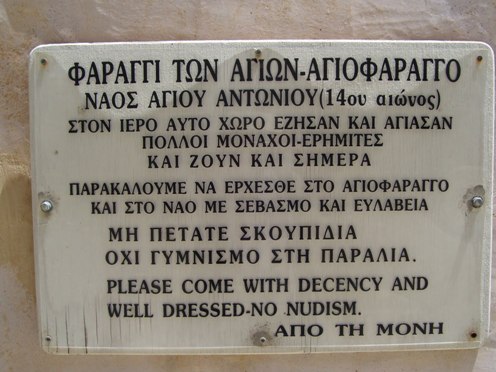
Το «Άγιον Όρος» της Κρήτης
Όταν αναπτύχθηκε και στην Κρήτη ο αναχωρητισμός- ερημητισμός, επέλεξε να απλωθεί στην ευρύτερη περιοχή των Καλών Λιμένων (περιοχή στην οποία προσάραξε και παρέμεινε ο Απόστολος Παύλος, μεταφερόμενος στην Ρώμη), κι από εκεί σε όλα τα κεντρικά και νότια Αστερούσια όρη με τελικό επίκεντρο το Αγιοφάραγγο. Δικαίως ονομάστηκαν τα Αστερούσια «Άγιον Όρος της Κρήτης». Ο ερημητισμός αυτός έφθασε σε πολύ μεγάλη ακμή όχι μόνο σε αριθμό αλλά και σε ποιότητα. Απόδειξη το γεγονός ότι ο Άγιος Γρηγόριος ο Σιναϊτης διδάχθηκε εκεί την νοερά προσευχή από τον ασκητή Αρσένιο, την οποία δίδαξε και ο ίδιος στην συνέχεια στο Άγιον Όρος.
Ορατές μαρτυρίες του ερημητισμού των Αστερουσίων είναι τα μέχρι σήμερα σωζόμενα ασκητήρια, τα οποία είναι παντού εγκατεσπαρμένα.
Οι ερημίτες υπήρχαν ως τα μέσα του 20ου αιώνα και μάλιστα σε απόλυτη απομόνωση. Μέχρι σήμερα ακούγονται παραδόσεις για αόρατους ασκητές, ασκητές δηλαδή που με την χάρη του Θεού έχουν φτάσει σε πολύ μεγάλα μέτρα αγιότητας και έχουν το χάρισμα να γίνονται αόρατοι από τους ανθρώπους. Και αυτό όχι γιατί τους φοβούνται, αλλά κυρίως για να μην αποσπώνται από τον σκοπό που πήγαν εκεί, να ενωθούν με τον Θεό.

Μαρτυρίες πολλές, διηγήσεις άπειρες …;. Αλλά πως μπορούμε εμείς να αναφέρουμε μόνο σε λίγες γραμμές το τι θαυμαστά γίνονται εκεί στην περιοχή των Αστερουσίων. Δυστυχώς ή ευτυχώς δεν θα αναφέρουμε τις πηγές από τις οποίες αντλήσαμε τα παρακάτω στοιχεία και αυτό για ευνόητους λόγους.
Υπάρχουν λοιπόν αρκετές μαρτυρίες για την εμφάνιση αόρατων αλλά και ορατών ασκητών στην περιοχή του Αγιοφάραγγου ακόμη και σήμερα. Σύμφωνα με μαρτυρίες ιερέων που κοινωνούν κάποιους από αυτούς, υπάρχουν δυο ασκητές οι οποίοι είναι ορατοί στους ανθρώπους. Μας διηγείται ο ιερεύς, ότι για να πάει να κοινωνήσει τον ασκητή Θεοδόσιο κάνει πορεία δυο με τρεις ώρες πάνω στα βουνά, πάνω σε μέρη δύσβατα και απρόσιτα. Όταν όμως φτάνει στο μέρος όπου ασκητεύει ο πατήρ Θεοδόσιος, μια ευωδία απλώνεται στην περιοχή.
Το ασκητήριο, δυο επί δυο. Ίσα- ίσα χωράει μέσα ο γέροντας Θεοδόσιος. Αλλά η καρδιά του χωράει όλη την κτίση, όλο τον κόσμο. Γιατί κοινωνεί και επικοινωνεί με τον κόσμο. Πως ; όταν ο ιερεύς πάει να κοινωνήσει τον γέροντα του δίνει χαρτιά με τα ονόματα ορισμένων ανθρώπων που χρήζουν βοηθείας. Έτσι ο γέροντας προσεύχεται διακαώς για αυτούς. Μας εξομολογείτε ο ιερεύς ότι το σώμα του γέροντα είναι γερασμένο αλλά το πρόσωπό του λάμπει σαν τον ήλιο. Σημαντικό δε είναι το γεγονός ότι, και άλλοι άνθρωποι έχουν συναντήσει τον γέροντα Θεοδόσιο, συζητώντας μαζί του ποικίλα θέματα.
Συγκλονιστική δε είναι η μαρτυρία τους ιερέως που επικοινωνεί με τον γέροντα Θεοδόσιο, όταν τον ρώτησε : Γέροντα πόσοι ασκητές είστε εδώ; Ο γέροντας χαμογέλασε, και με γλυκιά φωνή του απαντά, πολλοί.
Αυτό μπορούν να μας το διαβεβαιώσουν πολλοί από τα πλησιέστερα εκεί χωριά. Και αυτό γιατί υπάρχει η μαρτυρία ότι όταν είναι καιρός να κουρευτούν τα πρόβατα, τότε όλα τα ζώα και περισσότερο τα άγρια κατσίκια που ζουν στα αστερούσια είναι κουρεμένα. Και αυτό είναι δείγμα ότι υπάρχουν και άλλοι πολλοί ασκητές στην εκεί περιοχή, που ακόμη και τα άγρια ζώα υπακούουν σε αυτούς, όπως τόσοι άγιοι έγιναν προσιτοί στα άγρια ζώα και θηρία …;
Σύμφωνα με διάφορες μαρτυρίες έμπιστων ανθρώπων οι ασκητές οι οποίοι ζουν στα Αστερούσια είναι περίπου 20, και αυτό το λέμε και πάλι με επιφύλαξη. Ίσως είναι λιγότεροι ίσως περισσότεροι. Εμείς όμως πρέπει να σεβαστούμε την απόφασή τους αυτή, δηλ. την απομόνωσή τους από τον κόσμο και την απόλυτη αφοσίωσή τους προς Τον Θεό. Δια τούτο και όλοι οι Κρητικοί γνωρίζουμε αλλά δεν αποκαλύπτουμε.
Μπορούμε όμως να αναφέρουμε άλλα δυο θαυμαστά γεγονότα τα οποία πραγματοποιηθήκαν στην εκεί περιοχή.
Ήταν κάποτε μια ομάδα νέων ανθρώπων και ήθελε να περιηγηθεί στα δύσβατα μονοπάτια των Αστερουσίων. Όταν σκοτείνιαζε, αποφάσισαν να φύγουν. Τότε ένας από την ομάδα είπε : είδατε προλαβαίναμε να κάνουμε την παράκληση του Αγίου Αντωνίου που μας είπε εκείνος ο καλόγερος πάνω στο βουνό. Τότε οι άλλοι ξαφνιάστηκαν και του είπαν ότι δεν συνάντησαν κανένα καλόγερο καθ’ όλη την διάρκεια του περιπάτου. Εκείνος δε , επέμενε ότι τον συνάντησαν και τους είπε να ψάλλουν την παράκληση … Βλέπουμε λοιπόν ότι οι «αόρατοι ασκητές» εμφανίζονται μόνο σε αυτούς οι οποίοι έχουν καθαρή καρδιά και αγνό λογισμό.
Θαυμαστό είναι και το εξής γεγονός : όταν ένας περιηγητής τραβούσε με την βιντεοκάμερά του το καταπληκτικό τοπίο στο Αγιοφάραγγο, η κάμερά του συνέλαβε ένα καλόγερο. Και με την περιέργεια που διακρίνει την ανθρώπινη φύση, πήγαινε από πίσω του και τον βιντεοσκοπούσε. Όταν λοιπόν έβαλε την κάμερα να παίξει αυτά που έγραψε, είδε ότι τράβηξε, όλα τα τοπία, τα βουνά, τα νερά … αλλά ο μοναχός έλλειπε από την λήψη. Τότε ξαφνιάστηκε και κατάλαβε ότι επιτελούνται θαυμαστά έργα εκεί, και οι μοναχοί θέλουν την απόλυτη ησυχία και γαλήνη. Δια τούτο και εξαφανίστηκε ο μοναχός δια θαύματος από την λήψη της βιντεοκάμερας.
πηγή

Στο Αγιοφάραγγο, νότια του νομού Ηρκαλείου Κρήτης (Αστερούσια Όρη) υπάρχουν πολλά παλαιά ερημητήρια σε σπηλιές. Εκεί λένε πως ζουν και σήμερα ακόμη αόρατοι ασκητές, που έχουν το χάρισμα να παραμένουν αθέατοι, αν θέλουν, ακόμη κι αν κάποιος περάσει δίπλα τους.
Σύμφωνα με παράδοση, που μας είχε αφηγηθεί η γερόντισσα Συγκλητική, μεγαλόσχημη μοναχή στο Ρέθυμνο (ηγουμένη στο μικροσκοπικό μοναστήρι της Αγίας Τριάδας, στο λόφο του Τιμίου Σταυρού, εντός της πόλης του Ρεθύμνου), οι ασκητές αυτοί είναι υπεραιωνόβιοι, αφού παίρνουν παράταση από το Θεό να ζήσουν όσα χρόνια θέλουν. Η ίδια γερόντισσα μας είπε ότι με μια αόρατη ασκήτρια από το Αγιοφάραγγο είχε επικοινωνία ο άγιος γέροντας Κύριλλος Παναγιωτάκης από τα Ακούμια Ρεθύμνης (κοιμήθηκε 1986), εφημέριος της ίδιας μονής.
Θρύλους γι’ αυτούς αναφέρει ο Νίκος Ψιλάκης στο βιβλίο του Μοναστήρια και ερημητήρια της Κρήτης, Ηράκλειο 1994, τόμ. Α΄, σελ. 236.
Παραθέτουμε τρεις: Στο Γουμενόσπηλιο έρχονταν μια φορά το χρόνο οι ασκητές, από τον Πρέβελη ώς τον Κουδουμά [μοναστήρια, το ένα νότια Ρεθύμνου, το άλλο νότια Ηρακλείου]. Είχε 300 πέτρες γύρω γύρω και καθένας καθόταν στη δική του. Μετρούσανε κεφαλές και, αν έλειπε κανείς, ελέγανε: «Ο Θεός να τόνε συχωρέσει». Μόνο τότε, κάθε Λαμπρή, εθωρούσε ο ένας τον άλλο.
Σ’ ένα σπήλιο στο Μάρτσαλο εζούσε ένας ασκητής. Πηγαίνανε και του ζητούσαν ευλογία οι ανθρώποι, αλλά αυτός δεν εμφανιζότανε ποτέ. Έβγαζε μόνο το δαχτυλάκι του από μια τρύπα και σταύρωνε. Άνθρωπος δεν είδε ποτέ το πρόσωπό του.
Στον Άγιο Αντώνιο στο Αγιοφάραγγο μαζώνονται κάθε νύχτα οι ασκητές και λειτουργούνε. Τυχερός όποιος τους δει. Ένας παλιός ηγούμενος της Οδηγήτριας σηκωνότανε τα μεσάνυχτα, πήγαινε και λέγανε πως πολλές φορές έπαιρνε κι αντίδωρο.
πηγη

I would like to share with you some meaningful stories from my childhood years. I grew up with my older sister in the poor neighborhoods of Sykies[1]. My father's wages were not enough, and, sometimes even nonexistent. Our meals were very frugal, but blessed. We were forced to work from an early age because of our poverty. We never had our own home, and we were forced to move many times, like gypsies.
Every Sunday morning my sister and I would wait on the balcony for the koulouri [a bagel like or ring-shaped bread roll covered with sesame seeds, often sold in the street] man to pass by. We were so eager to get our beloved koulouri, which would quickly disappear in a glass of hot milk. It was such a great joy knowing I had a koulouri and not just stale bread. I wouldn’t even allow a sesame seed to go to waste.
From a young age, my mother would send me by bus to the village market to pick up a few last minute necessities. As an avid shopper, I always managed to have some spare change left, so that I could treat myself to marbles and soccer cards[2]. While returning, a little before reaching the bus terminal, I would encounter beggars on the street. There was a blind man who would play the accordion. A few meters further down, there was a little old lady in rags, further down a paralytic, and further yet, a lady who was nursing her little infant. I still remember that I would look at her somewhat perplexed. As I was waiting for the bus, I couldn’t help to think about all these poor beggars. I felt much pain and sadness in my childhood soul. Many times I wanted to cry and would tell myself, “Aren’t you ashamed to take the bus while this lady doesn’t even have money to buy milk for her little child?” So, I would go to give this lady a two drachma coin [my bus fair], when no one could see me. This gave me so much joy that the half an hour uphill walk to Sykies, didn’t bother me at all. I had so much joy in me that I would walk, often having to pull my underwear up, because as usual the band was broken, and the underwear would fall below my shorts. This didn’t even faze me because I knew that in my childhood innocence, I did what dear Christ wanted. When I arrived home, I wouldn’t say anything to anyone.
The next time I'd go down to the market, I profited again a two drachma coin from my avid shopping. I remember one day I went to a kiosk. I lifted my little legs on a stool because I couldn’t reach the counter, and I said, “Sir, can you please change this, into four half drachma coins?” After this maneuver, I felt richer because I could distribute all four half drachma coins to the four beggars, and this was a great accomplishment in my childhood soul’s innocence. The joy was fourfold. The band was still broken on my underwear. I did not care, however, as long as the girl I had a crush on would not see me on the way, so I would become the laughing stock of the neighborhood. My joy was so great that I saw the uphill walk as a level road.
I remember wearing the blue and white uniforms[3], during the first grades of elementary school. Every Wednesday morning our whole school would go to church. At the time of the Divine Liturgy, I would lift up my eyes upward to the saints and ask a different favor from each one of them. “You, my saint, go and guard my uncle with the sheep." Another saint I would tell to go to my uncle who was at the fields. Another one, I would ask to go to my grandfather and grandmother, whom I loved very much. I would ask another one to go to the poor beggars at the Sykies bus terminal because I hadn’t gone there in quite a while to leave the two drachma coin. Where wouldn’t I send the saints every Wednesday! I wouldn’t forget anyone. I would lift up my little eyes and pray. Tears would come into my eyes, and I didn’t know why. I would wipe them quickly, so my fellow students wouldn’t see me and make fun of me. Before you know it little Thanasi grew up. He started his own family, changed quite a few jobs, and for many years now, he has been making ends meet driving a taxi [around Thessaloniki as he does to this day].
[1] Sykies is located about twenty miles north of Thessaloniki.
[2] The equivalent of baseball cards in Greece since soccer is the most popular European sport.
[3] Patriotic colors of Greece.

«Μόνο αυτός που ευχαριστεί ζει αληθινά».
π. Αλέξανδρος Σμέμαν.
Όταν διψάσεις, θα ανακαλύψεις τη γεύση του νερού, που αγνοούσες λόγω της συνήθειας. Βάλε το στόμα σου στο τρεχούμενο νερό και γεύσου τις σταγόνες που σου έκαναν τη χάρη να μείνουν για να σε δροσίσουν.
Όταν πεινάσεις, θα ανακαλύψεις τη γεύση του ψωμιού, που αγνοούσες λόγω της συνήθειας. Φάε το ψωμί σου αργά και ταπεινά. Δέξου το με ευγνωμοσύνη ως δώρο και θα σου είναι πιο γλυκό κι από το μέλι.
Με τη νηστεία που μας διατηρεί σε κατάσταση πείνας,ασκούμαστε να λαμβάνουμε την τροφή και τη ζωή ευχαριστιακά. Να τη λαμβάνουμε ως δώρο από τα χέρια του Θεού. Η νηστεία -ως πείνα και δίψα- ανοίγει άλλες προοπτικές, άγνωστες παντελώς στον κορεσμένο άνθρωπο. Το ψωμί, τα φρούτα, το νερό γίνονται ξαφνικά τόσο όμορφα…εμπνέουν τόσο σεβασμό που θέλεις να τα φιλήσεις… Τα απλά ακτινοβολούν μια αγνή ομορφιά που τα κάνει πιο ποθητά από τα πολυποίκιλα και επιτηδευμένα…
Η νηστεία, ως πείνα και δίψα, δίνει στην τροφή και τη ζωή τη γεύση της ευλογίας και της ευχαριστίας. Βλέποντας το ψωμί και το νερό ως δώρο του Θεού, ανακαλύπτεις τελικά παντού γύρω σου τα κρυμμένα Του δώρα… Έχει δίκιο ο π. Αλέξανδρος. "Μόνο αυτός που ευχαριστεί ζει αληθινά"!
Η πείνα και η δίψα της νηστείας είναι στο βάθος της πείνα και δίψα για τον Θεό. Αυτό το ζεις πραγματικά στην εσπερινή λειτουργία των Προηγιασμένων Δώρων, όταν όλη μέρα πεινάς και διψάς τον Άρτο και τον Οίνο της Ευχαριστίας.
πηγη

Saint Seraphim of Sarov says "the true goal of our Christian life consists in the acquisition of the Holy Spirit." He says,
"What God requires is a true faith in Himself and His Only begotten Son. In return He generously bestows the grace of the Holy Spirit. The Lord seeks hearts filled with love for God and for one's neighbor." Saint John Chrysostom reminds us that this is not a task just for monks, but is one for all Christians.
"Those who live in the world, even though married, should resemble the monks in everything else. You are wholly mistaken if you think that there are some things that are required of seculars, and others for monastics... They will have to render the same account... When Christ orders us to follow the narrow path, he is speaking to all men." The level of perfection that we are all called to, does not come without our effort. This effort involves what is commonly termed ascetic practices which include a daily rule for prayer and fasting as well as the study of Holy Scripture and other spiritual writings.
When St. Seraphim says, "to acquire" the Holy Spirit, he uses this idea of acquiring in a similar way to saying we acquire material benefits. Saint Seraphim says,
Surely you understand what it means to acquire money? The acquisition of the Holy Spirit of God is exactly the same. You understand I am sure, O lover of God, the meaning of acquiring in a worldly sense. The primary aim of ordinary people in a worldly sense is to acquire, or to make, money... the acquisition of the Spirit of God is the same as the acquisition of capital with the difference that it is eternal and dispenses grace. Since it is so similar to everyday ordinary money, it is acquired in much the same way. How do we acquire material wealth? We must train ourselves, develop valued skills, and apply them through hard work. For spiritual benefits we also must work and prepare to receive the heavenly benefits.
Saint Seraphim continues,
Our Lord Jesus Christ himself compares our life in this world with a marketplace. He likens our everyday activities to trading, telling, telling us to 'trade till I come, redeeming the time, because the days are evil' (cf. Lk 19:13; Eph 5:16). In other words make the most of your time by obtaining heavenly blessings in exchange for you earthly good. The goods you should be trading in are those very same good works done for Christ's sake that confer upon us all the grace of the Holy Spirit. It is these good works which include not only charitable acts but also our ascetic efforts that are essential to purify our mind and heart from the bodily passions that too frequently take precedence over the desire of the soul.
Ascetic efforts cannot be considered as merits to earn God's grace, but only as means to an end, They prepare us for the acquisition of the Holy Spirit and union with God. With the Holy Spirit moving though us we must align our free will with God's and live the virtues. This is only possible though the work of the Holy Spirit. But, we must always remember that God will not judge us based on our ascetic efforts, but will judge us based on our humility as expressed in our love for others and love for God.
Saint Seraphim says,
Prayer, fasting, vigils and all other Christian practices, however good they may be in and of themselves, do not constitute the true goal of our Christian way of ice. They only serve as the indispensable means of attaining it. The true goal of our Christain life consists in the acquisition of the Holy Spirit of God. Fasting, keeping vigil, prayers, and charity, as well as every other good deed done for the sake of Christ, are but the means through which we may acquire the Holy Spirit of God. The love of God must be the motivation of all our actions. As we learn to love others we will increase our love of God. As our love of God is increased so will our love for others. The ascetic practices cannot interfere with our love for others. If we must take care of the needs of a child or a parent or any other person, we cannot use our ascetic practices to excuse ourselves from our loving care of others. But we also must recognize that this ability to love is increased as we purify our heart and mind and this comes about as a result our ascetic efforts so we can acquire the Holy Spirit.
Reference: The Joy of the Holy by Harry M. Boosalis, pp 35 - 43.

Πολλοί κατά καιρούς καταφέρονται εναντίον του χριστιανισμού και της Εκκλησίας ότι δήθεν δεν έχουν δείξει ή δεν δείχνουν ουσιαστικό ενδιαφέρον για τα παιδιά. Αυτό είναι πέρα για πέρα λάθος γιατί αγνοούν σε βάθος τα πράγματα. Απεναντίας η συμβολή του χριστιανισμού στην εξύψωση και προστασία του παιδιού είναι μοναδική. Και αυτό φαίνεται από τους παρακάτω λόγους:
1. Ο Χριστός γίνεται άνθρωπος -νηπιάζει- και περνάει όλα τα στάδια της ανθρώπινης ζωής. Με τη γέννησή Του εξυψώνει την αξία της παιδικής ηλικίας.
2. Δέχεται ο Κύριος με πολλή αγάπη τα παιδιά, τα ευλογεί και τα εγκωμιάζει: «Αφήστε τα παιδιά και μην τα εμποδίζετε να έλθουν κοντά μου, γιατί σ’ αυτά ανήκει η βασιλεία των ουρανών».
3. Τα παρουσίαζε ως υπόδειγμα στους μεγάλους ανθρώπους για να μπουν στη Βασιλεία των Ουρανών. «Αν δεν γίνεται σαν τα παιδιά, δεν πρόκειται να μπείτε στη Βασιλεία των Ουρανών».
4. Ακόλουθοι του Χριστού, εκτός από τους μαθητές και τις μαθήτριες, ήταν και οι νέοι, που ονομάζονται στα ευαγγέλια «παιδία», «παίδες», «νεανίσκοι», «μικροί».
5. Ο Χριστός συγκινείται από τον θάνατο δύο νέων και τους επαναφέρει στη ζωή. Τον υιό της χήρας της Ναίν και την κόρη του Ιαείρου.
6. Η Εκκλησία εφαρμόζει τον «σαραντισμό» του νηπίου και τον νηπιοβαπτισμό.
7. Αναγνωρίζει την αξία του ανθρώπου από την εμβρυακή ηλικία έως ψυχοσωματικής ύπαρξης. Γι’ αυτό και καταδικάζει τις εκτρώσεις, αφού έκτρωση σημαίνει φόνος.
8. Η Εκκλησία ενδιαφέρεται ανέκαθεν για τα ανάπηρα παιδιά, γι’ αυτό ίδρυσε ιδρύματα για την περίθαλψή τους.
9. Αγαπά το παραστρατημένο και ορφανό παιδί, γι’ αυτό διατηρεί ορφανοτροφεία και επισκέπτεται τα ανήλικα φυλακισμένα παιδιά.
10. Καλλιεργεί, διαμορφώνει και ολοκληρώνει την προσωπικότητα του παιδιού (Κατηχητικά σχολεία, έκδοση παιδικών βιβλίων, περιοδικών κατασκηνώσεις κ. α.).
11. Ο Απ. Παύλος κάνει λόγο για την παιδαγωγία των τέκνων και τις αμοιβαίες υποχρεώσεις γονέων και παιδιών.
12. Οι Πατέρες της Εκκλησίας μίλησαν για την ανεκτίμητη αξία των παιδιών και φρόντισαν γι’ αυτά.
13. Στη Θ. Λειτουργία η Εκκλησία εύχεται για το παιδί: «Τα νήπια έκθρεψον, την νεότητα παιδαγώγησον».
14. Η Εκκλησία έχει ορίσει προστάτη των παιδιών τον Άγιο Στυλιανό.

Ἂν εἶσαι μόνος ἀδελφέ, ἅρπαξε τὴν εὐκαιρία. Ἀνάπεμπε ὕμνους στὸν Τρισάγιο Θεό μας. Δόξαζέ Τον πολλὲς φορὲς στὴν διάρκεια τῆς ἡμέρας, διότι κάποιοι ἄλλοι Τὸν ὑβρίζουν καὶ Τὸν βλασφημοῦν (καθημερινῶς). Ὕμνει τὴν Παναγία μας, λέγε τοὺς Χαιρετισμούς της. Εἶναι ἔργο ἀγγελικό. Τώρα δὲν ἔχεις πλέον ἄλλες μέριμνες καὶ φροντίδες οἰκογενειακές. Ἴσως εἶσαι καὶ συνταξιοῦχος. Ἐκμεταλλεύσου τὴν περίστασι. Ἁγίαζε τὸν χρόνο σου.
Εἴσελθε εἰς τὸ «ταμεῖον» σου [σε ένα ήσυχο σημείο ή "στην καρδιά σου"] καὶ προσεύχου, ἀδελφέ μου, μὴν ἀμελεῖς αὐτὸ τὸ καθῆκον. Ἔχομε εὐθύνη γιὰ τὴν κατάστασι ποὺ ἐπικρατεῖ γύρω μας.
Προσεύχου γιὰ ὅλο τὸν κόσμο, γιὰ τὴν ταλαίπωρη πατρίδα μας ποὺ τὴν συκοφάντησαν, ν᾿ ἀναστηθῇ καὶ πάλι. Γιὰ τὴν μετάνοια καὶ συντριβὴ τῶν ὀρθοδόξων ἑλλήνων.
Γι᾿ αὐτοὺς ποὺ ἀγωνίζονται στὴν πρώτη γραμμὴ —γιὰ νὰ κρατήσουν τὴν ὀρθόδοξη πίστι ἀλώβητη ἀπὸ τοὺς ποικιλώνυμους ἐχθρούς της καὶ ἰδιαιτέρως ἀπὸ τὴν παναίρεσι τοῦ οἰκουμενισμοῦ— καὶ πολεμοῦνται λυσσωδῶς.
Ν᾿ ἀναδειχθοῦν κι ἄλλοι ὁμολογηταὶ τῆς ὀρθοδόξου πίστεως καὶ Ἱεράρχες ἄξιοι «ἑπόμενοι τοῖς ἁγίοις πατράσι».
Κλεῖσε τὴν τηλεόρασι· δὲν σοῦ προσφέρει τίποτε.
Καὶ προσεύχου, ἀδελφέ μου, κάνεις πολὺ σπουδαῖο ἔργο:
Γιὰ τὴν ἑλληνορθόδοξη οἰκογένεια, νὰ μὴ χάσῃ τὴν δομή της· νὰ μὴν σαλευθοῦν τὰ θεμέλιά της.
Γιὰ τοὺς ἀσθενεῖς, γιὰ τοὺς γέροντες καὶ τοὺς διακονητές τους, γιὰ δύναμι καὶ ὑπομονή..
Γιὰ τοὺς νοσηλευομένους στὶς ἐντατικὲς κλινικές, γιὰ ὑπομονή.
Γιὰ τοὺς γιατροὺς καὶ νοσηλευτάς, νὰ τοὺς φωτίζῃ ὁ Θεὸς νὰ δίνουν τὶς κατάλληλες διαγνώσεις, νὰ κάνουν σωστὲς ἐνέργειες.
Προσεύχου γιὰ τοὺς ἐκπαιδευτικούς μας, νὰ μεταφέρουν τὰ ἑλληνοχριστιανικὰ ἰδεώδη, τὰ ἰδανικὰ τῆς φυλῆς, στὰ παιδιά μας. Νὰ μείνουν ὄρθιοι στὶς ἐπάλξεις, στὸ καθῆκον, στὴν ἀποστολή τους.
Γιὰ τοὺς ἐργαζομένους, γιὰ τοὺς πολλοὺς ἀνέργους, γιὰ τοὺς ἀπογοητευμένους, νὰ μὴ χάσουν τὴν ἐλπίδα τους στὸ Θεὸ καὶ ἔλθουν σὲ ἀπόγνωσι.
Γιὰ τοὺς φυλακισμένους, μάλιστα δὲ διὰ τοὺς ἀδίκως φυλακισμένους, γι᾿ αὐτοὺς ποὺ τοὺς συμπαραστέκονται.
Γιὰ τὰ ἐγκαταλελειμμένα, γιὰ τὰ παραβατικὰ παιδιά. Γιὰ τοὺς νέους μας, γιὰ τοὺς ναρκομανεῖς, γιὰ τοὺς πλανεμένους, νὰ βροῦν τὴν ὁδὸ τῆς σωτηρίας.
Γιὰ τοὺς πολυτέκνους, γιὰ τοὺς χρεωμένους.
Προσεύχου γιὰ τὴν ἀφύπνισι καὶ ἑνότητα τοῦ ὀρθοδόξου ἑλληνικοῦ λαοῦ!
Γιὰ τὸ μικρὸ ποίμνιο [δηλ. τους λίγους και απομονωμένους πιστούς].
Γιὰ τὴν προστασία πάντων ἡμῶν ἀπὸ τὰ ἐπερχόμενα δεινά!
Γιὰ τοὺς μοναχικοὺς ἀνθρώπους, ὅπου κι ἂν βρίσκωνται, στὴν Ἑλλάδα ἢ στὸ ἐξωτερικό.
Γιὰ τὸν Ἱερὸ κλῆρο· γιὰ τοὺς ἐργαζομένους ὑπὲρ τῆς δόξης τοῦ Κυρίου ἡμῶν Ἰησοῦ Χριστοῦ.
Κάνεις πολὺ σπουδαῖο ἔργο.
Προσεύχου ἰδιαιτέρως γιὰ τοὺς κεκοιμημένους ἀδελφούς μας, γιὰ τὴν ἀνάπαυσί τους· τὸ περιμένουν. Εἶναι ἡ καλύτερη ἐλεημοσύνη καὶ ἱεραποστολή.
—Μελέτα τὸν λόγο τοῦ Θεοῦ, τὴν ἁγία Γραφή! Ἰδιαιτέρως τὴν Καινὴ Διαθήκη. Ἐμβάθυνε σ᾿ αὐτήν. Θὰ γλυκαίνεται «ὁ λάρυγξ» σου, θὰ φωτίζεται ὁ νοῦς σου, θὰ ἠρεμῇ ἡ ψυχή σου. Καθὼς καὶ τὸ Ψαλτήριο.
Ἂν εἶσαι μόνος, ἀδελφέ, ἂν ἔχῃς αὐλὴ ἢ μπαλκόνι, ρίξε λίγα ψίχουλα σ᾿ ἕνα σκεῦος, γιὰ νά ᾽ρθουν περιστέρια ἢ ἄλλα πετεινὰ τοῦ οὐρανοῦ· θὰ ἔχῃς πολὺ καλὴ συντροφιὰ καὶ θὰ χαίρεσαι. Μίλα μαζί τους.
Φύτεψε καὶ λίγα λουλούδια ἢ δένδρα, ἂν ἔχῃς χῶρο, καὶ δόξαζε τὸν Θεό.
Ἡ ἀγαθή Του Πρόνοια στὴν δυσκολία ἢ ἀρρώστια σου δὲν θὰ σ᾿ ἀφήσῃ. Θὰ προνοήσῃ γιὰ σένα. Πῶς εἶναι δυνατὸν νὰ σ᾿ ἐγκαταλείψῃ; Ἀφοῦ φροντίζει γιὰ τὰ πετεινὰ τοῦ οὐρανοῦ· γιὰ σένα τὸ πλάσμα τῶν χειρῶν του, τὸν λογικὸ ἄνθρωπο, γιὰ τὸν ὁποῖο ἔχυσε τὸ αἷμα του πάνω στὸν σταυρό, θ᾿ ἀδιαφορήσῃ;
Ἐσύ, μόνο, ἔλπιζε εἰς Αὐτόν.
Ἂν εἶσαι μόνος, ἀδελφέ, ἔχεις πολλὰ νὰ κάνῃς.
πηγη

Every Orthodox Christian is placed between two worlds: this fallen world where we try to work out our salvation, and the other world, heaven, the homeland towards which we are striving and which, if we are leading a true Christian life, gives us the inspiration to live from day to day in Christian virtue and love.
But the world is too much with us. We often, and in fact nowadays we usually forget the heavenly world. The pressure of worldliness is so strong today that we often lose track of what our life as a Christian is all about.
Even if we may be attending church services frequently and consider ourselves “active” church members, how often our churchliness is only something external, bound up with beautiful services and the whole richness of our Orthodox tradition of worship, but lacking in real inner conviction that Orthodoxy is the faith that can save our soul for eternity, lacking in real love for and commitment to Christ, the incarnate God and Founder of our faith.
How often our church life is just a matter of habit, something we go through outwardly but which does not change us inwardly, does not make us grow spiritually and lead us to eternal life in God.
Fr. Seraphim Rose
«Αυτά πού θέλετε να πείτε στα παιδιά σας, να τα λέτε με την προσευχή σας. Τα παιδιά δεν ακούν με τα αυτιά• μόνο όταν έρχεται η Θεία Χάρις πού τα φωτίζει, τότε ακούνε αυτά πού θέλουμε να τους πούμε. Όταν θέλετε να πείτε κάτι στα παιδιά σας, πέστε το στην Παναγία κι αυτή θα ενεργήσει. Η προσευχή σας αυτή θα γίνει ζωογόνος πνοή, πνευματικό χάδι, πού χαϊδεύει, αγκαλιάζει, έλκει τα παιδιά»...
Ο π. Πορφύριος πίστευε στην αξία πού έχει η προσευχή για την πνευματική ζωή του ανθρώπου και συμβούλευε τα πνευματικά του παιδιά πώς να προσεύχονται:
«Να εύχεσαι έτσι απλά, απλά και ταπεινά, με πίστη απλή, χωρίς να περιμένεις να σου απαντήσει ο Θεός. Χωρίς να δεις το χέρι Του ή το πρόσωπό Του ή το φωτισμό Του. Τίποτα! Να πιστεύεις! Εφ’ όσον μιλάς με το Θεό, μιλάς πραγματικά με το Θεό».
Αγιος Πορφύριος

"In an acceptable time I have heard thee..." —Isaiah 49:8, 2 Cor 6:2
I ask, dear friends, that you pay close attention to these words. We will spend some time in interpreting them; they are a prophecy by Isaiah and those of you who will comprehend them will become the "lottery's grand prize winners." Otherwise I am left with no alternative and I wash my hands...
What is the meaning of these words? I will start my interpretation from a little further away.
When a person intends to travel internationally, he prepares his passport and arranges for a visa from the intended destination country's embassy accordingly. Generally speaking, all travelers inquire about the departure time of the bus, train, ship or airplane and make every reasonable effort to ensure that they are on time, with their ticket in hand. Similarly, a young man who plans to study at a university ensures that he prepares and submits the necessary application forms, as required by the educational institution of his choice. It is likewise for the businessman who has borrowed fluids for his business and is obliged to submit monthly payments; he makes every effort to be on time and to not cause any issues with his lender. What I am trying to say is that as we always make the necessary time to ensure that we obtain our passport, purchase our ticket, pay our loan, and attend to all of our other duties related to employment, marriage and family, similarly there is adequate time for a different obligation, more important than any which life presents us.
What is this obligation? Well, God did not create us for travel and business, for degrees and titles, for dowries and weddings. These things have nothing to do with our main purpose. What is our true purpose? The above verse says it clearly. As there is always time for all worldly matters, there is likewise plenty of time for this most important matter. However, which one of us truly understands this? One may say that it is necessary for an angel to descend from Heaven and inject within our heart some of the faith and love that our saints possess; only then might it be possible for us to truly feel and comprehend the Apostle's words.
"In an acceptable time I have heard Thee." In other words the time which we spend in this world is truly priceless; it is time for the purpose of salvation. Our life may last 20, 40, 60 or 80 years; what can we do during this time? Why do we ask? Why do we not open the holy scriptures, the synaxarion, or even visit a cemetery where the bodies of many lie buried? Why do we not look in the stars in the sky and then, searching within our heart, ask ourselves: "Why did we come to this world?" What is it that we ought to accomplish within the span of our earthly life? Well, I am about to tell you, just make sure you are paying attention:
You my young lady, that spends so much time in front of the mirror or stay up during all hours of the night entertaining yourself, draw near and listen to me. And you, my young man, who spends your day running around in your car or motorcycle, draw near and listen to me as well. And you, my dear housewife, who spends hours window shopping in the malls, come near me as well. All of you, why are you wasting so much of your time? I do not ask for much; I only ask that you set aside some of your time each day for prayer, to kneel and speak with God.
I am also talking to you, the husband, who spends hours upon hours studying those papers with the fine print. I see you on the train or bus or at home either in front of the TV or staring at magazines and newspapers. What is it that you find in them? Please forgive my language, but have you ever seen a man use a stick to dig up or disturb cow droppings? Not really; because such an act would bring forth offensive odors and stench. Draw near my fellow Christian and if you are a baptized Orthodox man, than open up your Bible each day and spend some time reading it with your wife and children so that all of your eyes may open.
What else? Take a pen and paper and start counting the hours. One entire week comprised of 168 hours. From all these hours, what does God ask of you? Simply just one or two hours to attend the weekly Sunday Liturgy*; to be in church from the moment you hear "Blessed is the Kingdom of the Father and the Son and the Holy Spirit" all the way to "Through the prayers of the Holy Fathers, Lord Jesus Christ have mercy on us and save us, Amen." If the priest asks us to attend an all-night vigil who goes? If, however, the devil calls us to join him in the dark entertainment centers of the evening, then many run to be with him through midnight and beyond. While in church, though, they all ask "How much longer until it's over?"
In the end my fellow Christians, every new year God grants you a new cycle of 365 days. Every year is like a long komboloi (worry beads) with 365 beads. Every day is represented by a golden bead. Yes, my fellow Orthodox Christian, it is truly made of gold since we all know too well that "time is money;" From all these 365 days dedicate at least one day and approach the spiritual clinic through the sacrament of Holy Confession. When you lose your physical health, I see you running to doctors and hospitals. For your soul, however, do you do anything? Thus my child, from all these 365 days, pick a day or two and seek a confessor, go and kneel in front of him and confess your offenses.
So you see my child, it is unfortunate but true. There is such great unwillingness to dedicate five minutes for prayer, a few minutes to study the Holy Bible, an hour or two to attend the weekly Liturgy a day or two for confession. What can we then expect from God?
My brethren, as you can see, I have taken a hold of the valuable coin on which is inscribed "In an acceptable time I have heard Thee..." and I peeled it apart so all of us can comprehend these words. Now that this deed is completed, which one of you will take the time to establish his or her timetable and itinerary. Which one of you will rise in the morning and instead of standing in front of the bathroom mirror will take the time to seek the spiritual mirror contained within our Holy Bible and read it? Which one of you will kneel at home to pray? Which one of you will make it a point to start coming to church every Sunday? Which one of you will make it a point to seek and find a spiritual father for confession?
It is within the time afforded to us by God in this life of ours that these deeds must be completed. You must also take note that time is of the essence, even though it appears that we have plenty of time. Our church reminds us of this every day; "That we complete the remaining time of our lives in peace and repentance, let us ask of the Lord." What is the duration of our life going to be? How much longer will we live? Is it perhaps possible that this current year is the last one of our earthly life? What am I saying? Could this current month be our last one? Perhaps even this next week or next day may end up being our last one... Do you doubt me? Well, just open the newspaper and read the obituary section...
There was a mayor of Athens once who organized a large party to celebrate his birthday, inviting politicians, ministers and many others. They all gathered in happiness. The table was set with the finest foods; flowers were everywhere; the music was playing. In his pocket he even had the papers ready with the speech he would deliver. He was standing by the door having his picture taken as he greeted each of his guests. But before he made it to the table, his call arrived. He could have never expected it to come at that time, but it did come, as lightening from a clear sky! What type of lightening? A heart attack... He fell down, never to get up again; they lifted him and carried him away with their hands... He was truly gone. As far as his guests, none of them sat around to enjoy the meal. They were all beside themselves. Those of you who were raised in small villages may have seen the following, several chickens grazing in the meadow when suddenly a hawk appears out of nowhere and plunges among them, snatches one of them and quickly disappears. The remaining chickens become greatly agitated. This is exactly; my brethren, how death appears—like a hawk that snatches lives away. He snatches you in the store, in the street, in the town square, during a wedding, during a baptism, during elections, wherever he finds you! He snatches the elderly as well as babies from their cribs.
My brethren, how much longer shall we remain senseless? How much longer shall we refuse to consider eternity?
"In an acceptable time, I have heard thee..." In a very old book, I read that there was a king a long time ago who had the following custom. Throughout his entire kingdom and whenever he came near a city with his army, he carried two flags; a white one and a black one. When he approached the city; he raised the white flag which meant that as long as that flag was raised, a soldier did not have permission to disturb anything, not even the hair on a person's head! All of the city's inhabitants had also the ability to request favors from the king, whatever they desired. This, however, was for a short duration only and it had a very definitive time limit. As soon as time was up, the black flag was raised and then mothers would weep for their children; in homes and in fields, to people and to animals alike, fire, murder, blood everywhere...
Do you comprehend what I am telling you? Christ, our good King, raises His white flag over this world through His Holy Cross. Let all the sinful come, all people, all nations, while there is time ("In an acceptable time...")! The time will soon come that the white flag of love and mercy will be lowered and then all gates will be shut. The day will come that you will arrive only to find the Church door closed. You will keep knocking but not even the chanter will be there to answer. The stars and the sun will be extinguished and the rivers will dry up. The moment of judgment and justice will be upon us all!
My brethren, as long as we remain in this vain world, let us repent, let us weep, and let us all beg fee God's mercy; May God deem us worthy to spend the rest of our life "in peace and repentance," through the intercessions of our Holy Theotokos and all the saints. Amen.
Bishop Augoustinos of Florina
source
Να μην κάθεσθε την ώρα της θ. Λειτουργίας. Ο νους σας να μην πετάει εδώ κι εκεί. Όσο θα είσθε στην εκκλησία να το πάρετε απόφαση, να διαθέσετε όλο τον χρόνο στην προσευχή.
Όσιος Γεώργιος Καρσλίδης
Those who come close to people in pain, naturally draw near to God, because God is always by the side of His children who are in pain.
St. Paisios

Όταν πήγαινα με το αεροπλάνο στην Αυστραλία, έρχεται η κοπέλα εκεί και μας πρόσφερε καραμέλες.
Πήρα μία - θενκ γιού (ευχαριστώ) μου λέει. Δηλαδή ευχαριστώ που δέχτηκες την καραμέλα που σου πρόσφερα.
«Βρε, λέω, αυτοί ξεπέρασαν και τον Άγιο Ισαάκ σε ευαισθησία και λεπτότητα!»
Μετά, προχωρούσα μία μέρα στο δρόμο, βλέπω κόσμο μαζεμένο, πάω να δω…τι είχε γίνει- ένα σκυλάκι το καημένο, το είχε χτυπήσει ένα αυτοκίνητο και μάζεύτηκε κόσμος γύρω, να βοηθήσουν, άλλος να πάρει τηλέφωνο, άλλος κάτι άλλο. Πολύ ευαισθησία και ενδιαφέρον, θαύμασα.
Μετά από μερικές μέρες, πάλι περπατούσα στο δρόμο, βλέπω έναν άνθρωπο πεσμένο στο πεζοδρόμιο να βογγάει. Μεροκαματιάρης, δούλευε, έπεσε από τη σκάλα και πρέπει να είχε σπάσει τη μέση του… Κανένας δεν ενδιαφερόταν…
Περαστικοί, ρίχναν μία ματιά αδιάφορα και έφευγαν. Θα έρθει λέει το άμπιουλανς (ασθενοφόρο) να τον πάρει. Σού λέει, δεν είμαι εγώ υπεύθυνος, θα φροντίσει το κράτος… Άσε μην μπλέξω και με τραβάν στα δικαστήρια για μάρτυρα.
Πήγα να σκάσω. Πα, πα…. τέτοια αδιαφορία για το συνάνθρωπο…
Τι πολιτισμό και ευγένειά μου λένε μετά; Βλέπεις οι Ευρωπαίοι έχουν μόνο μία εξωτερική ευγένεια, και αυτή εξ ανάγκης για να μη σκοτώνονται μεταξύ τους… Κρύες καρδιές… ενώ οι Έλληνες έχουν φιλότιμο, και ας μην έχουμε ευγένεια.
Άγιος Παΐσιος
Christ said, 'I came not to send peace, but a sword' and 'division'.
Christ summoned us to war on the plane of the spirit, and our weapon
is 'the sword of the Spirit, which is the word of God.'
Our battle is
waged in extraordinarily unequal conditions. We are tied hand and foot.
We dare not strike with fire or sword: our sole armament is love, even
for enemies. This unique war in which we are engaged is indeed a holy
war.
We wrestle with the last and only enemy of mankind -- death.
Our fight is the fight for universal resurrection.
--
Archimandrite Sophrony, "His Life is Mine"

Κοντάκιον. Ἦχος δ΄. Τῇ Ὑπερμάχῳ.
Τῶν χριστωνύμων ἡ πληθὺς δεῦτε συνέλθετε, χαρμονικοῖς ἐν μελῳδήμασι γεραίροντες, Κωνσταντῖνον καὶ Ἑλένην τοὺς θεοστέπτους, τοὺς τὴν πίστιν τοῦ Χριστοῦ τρανῶς κηρύξαντας, καὶ τὸν Τίμιον Σταυρὸν ἀνακαλύψαντας, τούτοις κράζοντες· Χαίρετε παναοίδιμοι.
Ἄνοιξόν μου τὸ στόμα, Ἰησοῦ ὁ Θεός μου, ὑμνῆσαι Κωνσταντῖνον τὸν μέγαν (γ΄)· χριστωνύμων πάντων τὴν χαράν, καὶ τῆς πίστεως λαμπρότατον κήρυκα, καὶ τράνωσον τὴν γλῶσσάν μου, βοῆσαι πρὸς αὐτὸν τοιαῦτα·
Χαῖρε, Θεῷ ὁ προορισμένος·
χαῖρε, Αὐτῷ καθιερωμένος.
Χαῖρε, βασιλέων φυλῆς καταγόμενος·
χαῖρε, ὁ σοφίαν καὶ σύνεσιν κτώμενος.
Χαῖρε, ὅτι ἔργῳ ἔδειξας τοῦ Θεοῦ προορισμόν·
χαῖρε, ὅτι σὺ ἀπέφυγες ἀπιστίας σκοτασμόν.
Χαῖρε, ὁ οὐρανόθεν προσκληθεὶς ἐν τῇ πίστει·
χαῖρε, ὑπὸ Σιλβέστρου βαπτισθεὶς ἐν τῇ Ῥώμῃ.
Χαῖρε, χαρὰ τῶν πιστῶν καὶ σέμνωμα·
χαῖρε, φθορὰ ἀπίστων καὶ θρήνημα.
Χαῖρε, δι’ οὗ ἱερεῖς ἐγκαυχῶνται·
χαῖρε, δι’ οὗ βασιλεῖς στεφανοῦνται.
Χαῖρε, ἄναξ ἀοίδιμε.
Βλέπων λυμαινομένους, τοῦ Χριστοῦ τὴν ἀγέλην, Μαξέντιόν τε καὶ Μαξιμῖνον. Θαῤῥήσας Κωνσταντῖνε Θεῷ, καὶ Σταυροῦ τῇ πανοπλίᾳ φραξάμενος, τυράννους ἄρδην ὤλεσας, καὶ ἀνεβόας τῷ Κυρίῳ·
Ἀλληλούϊα.
Γνώμην θείαν πλουτούσα, μακαρία Ἑλένη, προσῆλθες ἐν τῇ πίστει Κυρίου. Καὶ σὸν γόνον τὸν σεπτὸν συνεργόν, Κωνσταντῖνον τὸν ἀείμνηστον ἔχουσα, χαρᾶς ἀπείρου ἔπλησας, τὴν οἰκουμένην σοι βοῶσαν·
Χαῖρε, ἡ βάσις τῆς εὐσεβείας·
χαῖρε, ἡ δόξα τῆς Ἐκκλησίας.
Χαῖρε, χριστωνύμων ἁπάντων τὸ καύχημα·
χαῖρε, βασιλίδων πασῶν ἐγκαλλώπισμα.
Χαῖρε, σὺ γὰρ ἡμῖν δέδωκας τοῦ Κυρίου τὸν Σταυρόν·
χαῖρε, σὺ γὰρ ἐκ γῆς ἤστραψας τρόπαιον τὸ θαυμαστόν.
Χαῖρε, τὸν ζωηφόρον Τάφον ἡ ἐφευροῦσα·
χαῖρε, παντὶ τῷ κόσμῳ τοῦτον ἡ φανεροῦσα.
Χαῖρε, χαρὰ τοῦ κόσμου καὶ θρύλημα·
χαῖρε, φθορὰ εἰδώλων καὶ θρήνημα.
Χαῖρε, δι’ ἧς ὁ Χριστὸς ἐδοξάσθη·
χαῖρε, δι’ ἧς πίστις ἡ θεία ὑψώθη.
Χαῖρε, ἄνασσα πάντιμε.
Δύναμις τοῦ Ὑψίστου, κατεπέφθη σοι ὄντως, Ἑλένη μακαρία ἐξ ὕψους, προσκυνούσῃ τοὺς Ἁγίους Τόπους σεπτῶς, διὰ τοῦτο καὶ θεῖον ναὸν ἤγειρας, λίαν περικαλλέστατον, Χριστῷ Σωτῆρι βοῶσα·
Ἀλληλούϊα
Ἔχων ἐν τῇ ψυχῇ σου, τὸν Χριστὸν ἐνοικοῦντα, καὶ θείου φωτισμοῦ σε πληροῦντα, τριακοσίους δέκα καὶ ὀκτώ, θεοφόρους Πατέρας ἡμῶν ἤθροισας, καὶ τοὺς πιστοὺς ἐστήριξας, βοᾷν σοι μετὰ πόθου ταῦτα·
Χαῖρε, ὁ ἄναξ ὁ χριστοφόρος·
χαῖρε, ὁ Μέδων ὁ θεοφόρος.
Χαῖρε, Ἀποστόλων Χριστοῦ ὁ ἰσότιμος·
χαῖρε, τῶν Πατέρων τῶν θείων ἰσάριθμος.
Χαῖρε, ὅτι σὺ ἐκήρυξας τὴν Τριάδα τὴν σεπτήν·
χαῖρε, ὅτι πάσας εἵλκυσας εἰς τὴν πίστιν τὴν ὀρθήν.
Χαῖρε, τῆς ὁμωνύμου πόλεως ὁ δομήτωρ·
χαῖρε, τῆς Ἐκκλησίας τοῦ Χριστοῦ ὁ κοσμήτωρ.
Χαῖρε, σὲ γὰρ ἐθαύμασαν Ἄγγελοι·
χαῖρε, σοὶ γὰρ ᾐδέσθησαν ἄνθρωποι.
Χαῖρε, ναοῦ τοῦ κλεινοῦ σου προστάτα·
χαῖρε, ἡμῶν τῶν τιμώντων σε ῥύστα.
Χαῖρε, ἄναξ ἀοίδιμε.
Ζήλων ἔνδοθεν πνέων, ὑπὲρ Σοῦ Θεοτόκε, ὁ μέγας βασιλεὺς Κωνσταντῖνος. Σοὶ μὲν τὴν πόλιν ἀφιεροῖ, κουροτρόφον καὶ προστάτην ἔχουσαν, ἣν εἰς αἰῶνας φύλαττε, ἀναβοῶσαν τῷ Υἱῷ Σου·
Ἀλληλούϊα.
Ἤκουσαν ἔθνη πάντα, διὰ σοῦ πανολβία, τὸ κήρυγμα τοῦ Εὐαγγελίου, οἵ τε Ἀρμένιοι καὶ Ἰνδοί, Ἴβηρες καὶ πάντες οἱ λοιποὶ δέσποινα, ὅθεν φυλαὶ καὶ γλῶσσαί σε γεραίρουσαι βοῶσι ταῦτα·
Χαῖρε, Θεῷ ἡ προορισμένη·
χαῖρε, Αὐτῷ ἡ ἐκλελεγμένη.
Χαῖρε, Προφητίδων τῶν πάλαι ἰσότιμε·
χαῖρε, Μυροφόρων Χριστοῦ ἰσοστάσιε.
Χαῖρε, ὅτι ἐζήλωσας τὴν Μωσέως Μαριάμ·
χαῖρε, ὅτι ἐχρημάτισας θειοτέρα τῆς Ὁλδᾶς.
Χαῖρε, Χριστοῦ τῷ τάφῳ ἡ κομίσασα μύρα·
χαῖρε, Μαγδαληνή τε ἄλλη καὶ Ἰωάννα.
Χαῖρε, Ἰουδὶθ ἀνδρείαν νικήσασα·
χαῖρε, βασιλίδα Ἐσθὴρ ὑπεράρασα.
Χαῖρε, Χριστὸν ὡς Σαλώμη ποθοῦσα·
χαῖρε, Αὐτὸν ὡς Σωσσάνα φιλοῦσα.
Χαῖρε, ἄνασσα πάντιμε.
Θεοδρόμον πορείαν, ποιουμένη θεόφρον, ὑπέστρεψας εἰς τὴν βασιλίδα, καὶ τὸν Τίμιον Σταυρὸν Χριστοῦ, καὶ τοὺς ἥλους δὲ τῷ σῷ υἱῷ ἤνεγκας, χαρᾶς ἀπείρου ἔμπλεως, ἀναβοῶσα τῷ Κυρίῳ·
Ἀλληλούϊα.
Ἶδον πάντα τὰ ἔθνη, διὰ σοῦ Κωνσταντῖνε, Σταυρὸν τὸν θαυμαστὸν τοῦ Κυρίου, καὶ φωτὶ περιλαμφθέντα τρανῶς, δυσσεβείας πάντα σκοτασμὸν ἔφυγεν, καὶ τῷ Χριστῷ προσέδραμες, διό σοι προσφωνοῦμεν ταῦτα·
Χαῖρε, Ἀπόστολε τοῦ Κυρίου·
χαῖρε, λαμπτὴρ τοῦ Εὐαγγελίου.
Χαῖρε, τοῦ Τιμίου Σταυροῦ ἡ φανέρωσις·
χαῖρε, τοῦ κηρύγματος Χριστοῦ ἡ ἐξάπλωσις.
Χαῖρε, τὰ ἔθνη ἅπαντα προσενήνοχας Χριστῷ·
χαῖρε, ὅτι θεία τεμένη ᾠκοδόμησας Αὐτῷ.
Χαῖρε, τοῦ Παναγίου Τάφου στηλογραφία·
χαῖρε, προσκυνημάτων θείων χορηγία.
Χαῖρε, σὺ γὰρ κοινὸν πόλεις καύχημα·
χαῖρε, τὸ ἡμῶν θεῖον ἐντρύφημα.
Χαῖρε, παρ’ οὗ βασιλέων πλουτοῦμεν·
χαῖρε, δι’ οὗ καὶ τὴν πίστιν τηροῦμεν.
Χαῖρε, ἄναξ ἀοίδιμε.
Κλῆρον θεῖον λαβόντες, παρὰ σοῦ Κωνσταντῖνε, εὐσέβειαν καὶ τὴν βασιλείαν, παῤῥησίαν ἔχων πρὸς Θεόν, ἀμφότερα ἔχειν τοὺς πιστούς, πρέσβευε ὅπως ἐπαγγελλόμενος συμφώνως Χριστῷ ἐκβοῶμεν·
Ἀλληλούϊα.
Λάμψασα ἐν τῇ πίστει, ὡς λαμπὰς φαιδροτάτη, Ἑλένη πανολβία ἐφάνης, θείων δὲ τῶν σῶν ἔργων φωτί, τῶν εἰδώλων τὴν σκοτόμαιναν ἔλυσας, καὶ πάντας κατεφώτισας, βοᾷν σοι μετὰ πόθου ταῦτα·
Χαῖρε, λαμπὰς ἡ φωτεινοτάτη·
χαῖρε, ἀμνὰς Χριστοῦ πραοτάτη.
Χαῖρε, ἀνασσῶν εὐσεβῶν ἀγαλλίαμα·
χαῖρε, γυναικῶν ἁπασῶν σεμνολόγημα.
Χαῖρε, ὅτι παρεστόλισας τοῦ Κυρίου τοὺς ναούς·
χαῖρε, ὅτι ἠφάνισας τῶν εἰδώλων τοὺς βωμούς.
Χαῖρε, τὴν ὀρθὴν πίστιν ἔργοις ἡ βεβαιοῦσα·
χαῖρε, ἀδικουμένων πάντων ὑπερμαχοῦσα.
Χαῖρε, πτωχῶν κοινὸν καταφύγιον· χαῖρε γυμνῶν καὶ ξένων προσφύγιον.
Χαῖρε, δι’ ἧς ἡ εὐσέβεια λάμπει·
χαῖρε, δι’ ἧς ἀρετὴ διαυγάζει.
Χαῖρε, ἄνασσα πάντιμε.
Μεμνημένη θεόφρον, ἐντολῶν τοῦ Κυρίου, ἀγάπην τὴν διπλῆν, ὡς πορφύραν, ἐμπεπορμένη τὸν Θεόν, ὁλοψύχως καὶ τὸ πέλας ἠγάπησας, ὡς ψλαμικὴ βασίλισσα, πεποικιλμένη καὶ βοῶσα·
Ἀλληλούϊα.
Νέος τὴν ἡλικίαν, ὡς ὁ Παῦλος θεόθεν ἐκλήθης, Κωνσταντῖνε θεόφρον, ὅνπερ μιμούμενος προφανῶς ὁλοψύχως τῷ Χριστῷ ἠκολούθησας. Διὸ σὲ μεγαλύνομεν βοῶντες χαρμοσύνως ταῦτα·
Χαῖρε, ἐκλόγιον τοῦ Ὑψίστου·
χαῖρε, ἐκμαγεῖον τοῦ Δεσπότου.
Χαῖρε, ἰχνηλάτης Χριστοῦ ὁ θερμότατος·
χαῖρε, νομοθέτης καλῶν πρακτικώτατος.
Χαῖρε, ὅτι ἐχρημάτισας ἀρετῶν ὑπογραμμός·
χαῖρε, ὅτι σὺ διέλαμψας ὡς πραΰς καὶ ταπεινός.
Χαῖρε, ὅτι ὑπῆρξας στήλη τῆς σωφροσύνης·
χαῖρε, ὅτι ἐδείχθης πύργος δικαιοσύνης.
Χαῖρε, πτωχῶν ἀπόρων βοήθεια·
χαῖρε, νοσούντων πολλῶν προμηθεία.
Χαῖρε, πηγὴ ἀμνησικακίας·
χαῖρε, ἡ κρήνη τῆς συμπαθείας.
Χαῖρε, ἄναξ ἀοίδιμε.
Ξένοις δόγμασι μάκαρ, τῆς Ἁγίας Τριάδος, στοιχῶν διὰ παντός, Κωνσταντῖνε, καταλλήλως ξένην βιοτήν, ἐφηρμόσω ἐν τοῖς ξένοις διδάγμασι, λάμψας ἐν τῇ γῇ ὡς ἥλιος, καὶ ἀναμέλπων τῇ Τριάδι·
Ἀλληλούϊα.
Ὅλον σχοῦσα τὸν πόθον πρὸς Θεὸν μακαρία, καὶ πρὸς τὴν τοῦ πλησίον ἀγάπην, τὸν Θεὸν μὲν ὕμνοις καὶ εὐχαῖς, καὶ τοῖς τῶν ναῶν καλλωπισμοῖς εὔφρανας, πᾶσαν δὲ γῆν ἐπλήρωσας, ἀγαθῶν ἔργων σοι βοῶσαν·
Χαῖρε, θεοῦ ἡ θερμὴ λατρεία·
χαῖρε, τοῦ Κτίστου ἡ θεραπεία.
Χαῖρε, ἀδιάλειπτον εὐχὴν ἡ πλουτήσασα·
χαῖρε, θείοις ὕμνοις ἀεὶ ἡ σχολάζουσα.
Χαῖρε, ὅτι ᾠκοδόμησας τοῦ Κυρίου τοὺς ναούς·
χαῖρε, ὅτι ἀναθήμασι κατεπλούτησας αὐτούς.
Χαῖρε, πάντας ἀνθρώπους ἀεὶ εὐεργετοῦσα·
χαῖρε, τὴν οἰκουμένην εὐποιΐας πληροῦσα.
Χαῖρε, σὲ γὰρ Ἄγγελοι ὕμνησαν·
χαῖρε, σὲ γὰρ οἱ δαίμονες ἔφριξαν.
Χαῖρε, Θεοῦ ἡ τερπνὴ ὑμνωδία·
χαῖρε, βροτῶν ὁδηγὲ σωτηρίας.
Χαῖρε, ἄνασσα πάντιμε.
Πᾶσαν τὴν οἰκουμένην περιέλαβεν ὄντως, τῶν σῶν κατορθωμάτων ὁ φθόγγος. Διὰ τοῦτο παρὰ πάσης πνοῆς, ἀνυμνεῖται Ἑλένη τὸν σὸν ὄνομα, καὶ πᾶσα γλῶσσα μέλπουσα, βοᾷ τῷ Κτίστῃ τῶν ἁπάντων·
Ἀλληλούϊα.
Ῥήτορας πολυφθόγγους, ἐξιστᾷ Κωνσταντῖνε, τῶν σῶν κατορθωμάτων τὸ πλῆθος, εἰς τὴν οἰκουμένην πᾶσαν καὶ γάρ, ὁ σὸς φθόγγος, ὡς ἔφη Δαβὶδ ἔφθασε. Διὸ σὲ μεγαλύνομεν, βοῶντες χαρμοσύνως ταῦτα·
Χαῖρε, τὸ θέαμα τῶν Ἀγγέλων·
χαῖρε, ἡ ἔκπληξις τῶν ἀνθρώπων.
Χαῖρε, οὗ τὸ κλέος ἐν γῇ περιάδεται·
χαῖρε, οὗ τὸ ὄνομα ἀπαύστως θαυμάζεται.
Χαῖρε, γίγας ὁ ὑψίδρομος, ὁ τὸν πόλον ἐκμετρῶν·
χαῖρε, ἄτλας ὁ παγκόσμιος, ὁ τὴν γῆν περιπατῶν.
Χαῖρε, παντὸς τοῦ κόσμου τὸ περίδοξον εὖχος·
χαῖρε, πάντων ἀνάκτων περιλάλητον ἄνθος.
Χαῖρε, ἀστὴρ τοῦ πόλου λαμπρότατε·
χαῖρε, φωστὴρ τοῦ κόσμου φαεινότατε.
Χαῖρε, δι’ οὗ ἐλαμπρύνθη ἡ κτίσις·
χαῖρε, παρ’ οὗ ἐδοξάσθη ὁ Κτίστης.
Χαῖρε, ἄναξ ἀοίδιμε.
Σῶσαι πάντα τὸν κόσμον, τοῦ Σταυροῦ τῇ δυνάμει, ὁ Κύριος τῆς δόξης παμμάκαρ. Τὸν ξύλον τοῦ Σταυροῦ διὰ σοῦ, καὶ τὸν τάφον φανεροῖ τὸν ζωήῤῥυτον, ὃν προσκυνοῦντες ἅπαντες, ἀναβοῶμεν ἀσιγήτως·
Ἀλληλούϊα.
Τάγματα τῶν Ἀγγέλων, Προφητῶν, Ἀποστόλων, Μαρτύρων καὶ Ἁγίων ἁπάντων, ὑπεδέξαντό σε ἐν χαρᾷ, ἀπὸ γῆς πρὸς τὸν οὐρανὸν βαίνουσαν. Μεθ’ ὧν Ἑλένη πρέσβευε, ὅπως σωθῶμεν οἱ βοῶντες·
Χαῖρε, πρὸς Κύριον μεταστᾶσα·
χαῖρε, Αὐτῷ ἀεὶ παρεστῶσα.
Χαῖρε, Προφητῶν ἐν μοναῖς προσφοιτήσασα·
χαῖρε, Ἀποστόλων ἐν σκηναῖς κατοικήσασα.
Χαῖρε, ἐν τῇ κλήρῳ πέλουσα τῶν Ἁγίων ἐν φωτί·
χαῖρε, ἐν χαρᾷ ἡ πρεσβεύουσα, τῇ Τριάδι τῇ σεπτῇ.
Χαῖρε, θαυματουργίας χάριν κοσμησαμένη·
χαῖρε, τοῖς σὲ καλοῦσιν ἅμα παρισταμένη.
Χαῖρε, σὲ γὰρ προστάτην κεκτήμεθα·
χαῖρε, σὲ γὰρ φρουρὸν προβαλλόμεθα.
Χαῖρε, δεινὸν ἐκ θανάτου λυτροῦσα·
χαῖρε, ἡμᾶς ἐν τῇ κτίσει φρουροῦσα.
Χαῖρε, ἄνασσα πάντιμε.
Ὕμνοις ἐξ ὕμνων πάντες, πρὸς τὸν Κτίστην χοροῦσαν, προέπεμπον ἐκ γῆς μακαρία. Πατριάρχαι, Ἱερεῖς, Κριταί, σὺν τῷ θεοστέπτῳ σου βλαστῷ Δέσποινα, ἐν φόβῳ λιτανεύοντες, καὶ μελῳδοῦντες τῷ Κυρίῳ·
Ἀλληλούϊα.
Φωτόδοτον λαμπάδα, οἷα παντὶ τῷ κόσμῳ, τὸ φῶς τῆς εὐσεβείας ἁπλοῦσαν, τὴν ἁγίαν σου μνήμην ἡμεῖς, Κωνσταντῖνε χριστοφόρε γεραίρομεν, ἐν ᾗ ἡμῶν μνημόνευε τῶν σὲ φιλούντων καὶ βοώντων·
Χαῖρε, τοῦ κόσμου τὸ φῶς τὸ θεῖον·
χαῖρε, ἅλας πάντας ἡδύνον.
Χαῖρε, τῷ ἀδύτῳ φωτὶ παριστάμενος·
χαῖρε, τῆς Τριάδος τῇ αἴγλῃ τερπόμενος·
Χαῖρε, ἄπλετον κεκτημένος πρὸς Θεὸν παῤῥησίαν·
χαῖρε, φίλος γνήσιος παρεστὼς πρὸς τὸν Χριστόν.
Χαῖρε, θαυμάτων χάριν ἐκ Θεοῦ ὁ πλουτήσας·
χαῖρε, κρήνην χαρίτων τὴν σὴν λάρνακα δείξας.
Χαῖρε, δι’ οὗ τῷ Θεῷ οἰκειούμεθα·
χαῖρε, παρ’ οὗ δεινῶν ἐκλυτρούμεθα.
Χαῖρε, φρουρῶν καὶ ἐν ὥρᾳ θανάτου·
χαῖρε, λυτρῶν κρίσεως ἀδεκάστου.
Χαῖρε, ἄναξ ἀοίδιμε.
Χαίρων μετέστης μάκαρ, πρὸς Χριστὸν Κωνσταντῖνε, τοῦ βίου ἐκχωρῶν ἐν εἰρήνῃ. Λάρνακι μὲν τὸ σῶμα λιπῶν, ἐν χερσὶ δὲ Θεοῦ τὴν ψυχὴν θέμενος, τὴν θείαν καὶ ὁλόφωτον μετὰ Ἀγγέλων ἀναμέλπων·
Ἀλληλούϊα.
Ψάλλων Δαβὶδ ὁ μέγας, εὐφροσύνην προλέγει, τὴν σὴν ὦ θαυμασία Ἑλένη, μητέρα ἐπὶ τέκνῳ ἀεί, εὐφραινομένην διηνεκῶς ἔφησε. Καὶ νῦν ἡμεῖς οἱ δοῦλοί σου, ἐν εὐφροσύνῃ σοῦ βοῶμεν·
Χαῖρε, Θεῷ ἡ νῦν παρεστῶσα·
χαῖρε, ἡ δόξης Αὐτοῦ τρυφῶσα.
Χαῖρε, τῇ Μητρὶ τοῦ Θεοῦ συνυπάρχουσα·
χαῖρε, τῷ υἱῷ σου ἀεὶ συγχαίρουσα.
Χαῖρε, δόξης ἀπολαύουσα καὶ ἀγάπης τοῦ Χριστοῦ·
χαῖρε, ἡ συμβασιλεύουσα εἰς αἰῶνας μετ’ Αὐτοῦ.
Χαῖρε, παντὸς τοῦ κόσμου ἡ κοινὴ μεσιτεία·
χαῖρε, τῶν σὲ τιμώντων ἡ θερμὴ προστασία.
Χαῖρε, ἐλπὶς καὶ βοήθεια·
χαῖρε, ἰσχὺς ὁμοῦ καὶ κραταίωμα.
Χαῖρε, ναοῦ τοῦ κλεινοῦ σου προστάτις·
χαῖρε, ἡμῶν τῶν τιμώντων σε ῥύστης.
Χαῖρε, ἄνασσα πάντιμε.
Ὢ ξυνωρὶς ἁγία, Κωνσταντῖνε Ἑλένη, ἀνάκτων χριστωνύμων τὸ κλέος (γ΄), δεξαμένη τὸν πόθον ἡμῶν οἰκειωθῆναι ἡμᾶς, Θεῷ πρέσβευε συνωνυμοῦντας φύλαττε καὶ πάντας τοὺς πιστῶς βοῶντας·
Ἀλληλούϊα.

One morning, a lady, who was quite irate got into my taxi. She was mumbling to herself and cursing the previous taxi driver who forced her out of the vehicle. The poor thing was literally trembling, and in her confusion she even forgot to say good morning.
I asked her, “What’s the matter mam?”
“What’s the matter? I just took a cab from Delphi and asked the driver to take me to the AHEPA Hospital. After I sat down, we hardly traveled a block down the road when he suddenly stopped and told me, “I cannot take you; get out and take another taxi.” When I asked him for an explanation, he gave me a thousand excuses.
“Please” I said, “it is hard to find a taxi at this time, and it is very urgent. I have my mother sick at the AHEPA.” “No,” he told me. “I cannot take you. I have my reasons.”
“We argued for a while, and then he forced me to get out, so here I am? He did all he could to stress me out first thing in the morning, but I am not done with him yet! I recorded his license number and he will see me in court. When my attorney is done with him, I promise you that he will never forget me as long as he lives.
“Do whatever God enlightens you to do. After a few minutes and when she seemed to calm down a bit I said, “Now if you don’t mind I would like to take a moment of your time to offer you my humble opinion and I promise to be brief”.
“I will listen to you, as long as you don’t try to justify him.”
“No. But please hear me out, I think it is worth the trouble.”
“I’m still very upset, but I will listen to you."
“One thing I try to do every morning before I venture out in my field of work is that I kneel and ask God to grant me the virtue of patience and forbearance. This is necessary for everyone of course, but especially for cab drivers, since we have to deal with so with so many different types of people. So, in the morning at the start of my day’s work, the first customer who enters the cab typically, makes my life unbearable. He begins grumbling, treating me unjustly, accusing me and insulting me for no reason at all. Instinctively, I soon find myself becoming angry, enraged, and ready to explode. At that very moment however, I hear Christ mystically telling me, “Hey, Thanasi, why are you so upset? Didn’t you ask me this morning to grant you forbearance? So here, I allowed this customer to enter into your taxi to serve as your spiritual mirror. Thanks to him you have a full diagnosis of your inner state, and the type of serpents that reside there, my Thanasi. These creepy things [passions] don’t go away with sweet talk and praises, but by patiently enduring hardships, afflictions and insults.
Based on this, the miserable customer who entered my taxi this morning became my best benefactor. Without realizing it, he did the greatest service to me. He brought my old evil and deeply rooted passions to the surface. For this reason, I must not forget to sincerely thank God during my evening prayer and tell him, “My God, I thank you for this man because without meaning to, he acted as a spiritual mirror to help me see the filth that harbors inside me.
It would be nice if you and I could go the nearest grocery store and order ten pounds of love, fifteen pounds of humility, and forty pounds of patience. Unfortunately, these virtues are not available at stores or on Amazon or e-bay. If they were, I would be the first one to purchase them. All these virtues are fruits of the Holy Spirit. They are gained through experiential knowledge; the more a person humbles himself, the more he or she draws the grace of God. All of us are eager for our prayers to be heard by God, when it comes to the healing and well- being of our relatives. However, we usually forget to pray for the well being of our enemies. How can our prayer ascend to heaven when it is lacking the wings of forgiveness and love?” Suddenly, my friends, I heard a noise in the back seat. The lady had just ripped up the paper with the number of my fellow taxi driver. With lips trembling with emotion and tears on her cheeks she asked me, “Do you know what the strange thing is, Mr. Thanasi?
“What?”
“I am a teacher of theology.”
Throughout my career, I have given thousands of hours of religious lessons, but today, I received the most beautiful lesson ever. This is a lesson that I have never given to my students.[1] What a shame! Thank you.”
“Not me, thank God my dear, but, now that we have arrived, I want to ask you for a small favor.”
“Whatever you want, Mr. Thanasi, whatever you want.”
“Before you go to see your mother, as you enter the hospital, at your left hand you will find the hospital chapel.”
“Yes, I know it, I go frequently.”
“Go, and please light a little candle, not for me, nor for your mother, but for the taxi driver who kicked you out. He was the reason we met today. Furthermore, this is what we should do as Orthodox Christians and no one knows this better than you theologians.” With eyes wet with emotion and a trembling voice she told me, “I will do it, Mr. Thanasi. I promise you that I will do it. I thank you from the bottom of my heart because today turned out to be one of the most beautiful days of my life.” She closed the door and left for the hospital. I also rejoiced because she seemed to be quite comforted. “Do you see, my friends, how beautiful life can be? Whenever people mistreat us, instead of taking them to an attorney, let us take them to Christ!
Translator Father N.P.
Editor CZ
Assistant Editor AK
[1] In the country of Greece, Christian education is part of the public school curriculum up to the High School level, taught by lay academic theologians and occasionally by priests.
Ποια στάση να κρατάμε στην εκκλησία; Πρέπει να στεκόμαστε με ένταση και αυτοσυγκέντρωση. Να έχουμε ένταση, δηλαδή μεγάλη προσοχή, ώστε να μην διαχέεται ο νους μας με επιφανειακά πράγματα και αλλότριες σκέψεις.
Γέροντας Σωφρόνιος Σαχάρωφ

And when the king came in to see the guests, he saw there a man which had not on a wedding garment. (Matt. 22:11)
What is meant, brethren, by this wedding garment? It cannot signify either baptism or faith, because who can enter this marriage feast without baptism or without faith? Because undoubtedly the mere fact of not believing excludes one from the Church. So what can we understand by this wedding garment but charity? We must suppose then, that this man enters without a wedding garment who is a member of our Holy Church by reason of his faith, but who lacks charity. It is so called with good reason because our Maker wore it when He came as a bridegroom to unite Himself to the Church. There was no other means than God's love by which the Only-begotten could unite the souls of the elect with Himself. This is why John tells us: God so loved the world, that He gave His only-begotten Son (John 3:16). He who came to men for love's sake, calls this love the wedding garment. All of you, then, who are members of the Church and believe in God have indeed come to the marriage, but you are without a wedding garment if you discard the cloak of charity. If any of you is invited to an earthly wedding, he changes his dress so that he may show the groom and bride his participation in their joy; he would be ashamed to appear shabbily dressed among the guests and merry-makers. We assist at God's marriage feast and nevertheless, we are loath to undergo a change of heart. The angels rejoice when they see God's chosen ones admitted into heaven. How do we visualize this spiritual banquet, those of us who lack that festive garment which is the only one that gives us beauty in God's sight?
We must remember that, as a cloth is woven between two wooden frames, one above and the other below, thus also charity is founded on two precepts: the love of God and the love of our neighbor. For it is written: Thou shalt love the Lord thy God with thy whole heart and with thy whole soul and with thy whole mind and with thy whole strength ... and thy neighbor as thyself (Mark 12:30). It is worth noting here that a limit and measure is set to the love of our neighbor , as we read: Thou shalt love thy neighbor as thyself. The love of God, however, is marked by no limit, as we are told: Thou shalt love the Lord thy God with thy whole heart, and with thy whole soul and with thy whole mind and with thy whole strength. We are not told, then, how much we must love, but the manner in which we must do so: with everything we have. For only he truly loves God who does not think of himself. It is necessary to observe these two precepts of charity if we desire to be found wearing the wedding garment. This is what the prophet Ezekiel means when he tells us that the front of the gate of the city built on a mountain measures two cubits (Ezek. 40:9); for undoubtedly we cannot enter the heavenly city if in this church, which is called the gate because it is outside that city, we have no love for God or man. As we see also in the book of Exodus that it is prescribed that the curtains destined for the tabernacle should be dyed twice in scarlet coloring (Ex. 26:1). You, my brethren, you are the curtains of the tabernacle, veiling by virtue of your faith the heavenly mysteries in your hearts. But the curtains of the tabernacle must be twice dyed in scarlet. That is a color like fire. And what is charity, if it is not fire? But this charity must be twice dyed, that is, steeped in the love of God and in the love of our neighbor. The man who loves God so that his contemplation leads him to forget his neighbor has indeed the color of scarlet, but not twice dyed. Again, he who loves his neighbor, but whose love leads him to forget God, has the color of scarlet but with a single dye. In order that your charity may be steeped in both, you must be inflamed with love of God and of your neighbor, so that compassion for your fellow-man does not induce you to abandon contemplation of God, nor an excessive desire for that contemplation make you cast aside all pity. So, every man who lives among other men should seek God, the object of his longings, but in such a fashion as not to abandon his neighbor; and he should help his neighbor in such a way that it will never check his progress towards God to Whom he speeds.
We know that the love which we owe to our neighbor is sub-divided into two precepts, as we read in Scripture: See thou never do to another what thou wouldst hate to have done to thee by another (Tob. 4:16), and Christ tells us: As you would that men should do to you, do you also to them (Matt. 7:12). If we act towards our neighbor as we should like him to act towards us, and avoid doing to others what would be displeasing to us ourselves, then we observe the law of charity. But no one should think that he observes this law merely because he loves his neighbor; he must examine first the motive behind his love. For he who loves others, but not for God's sake, has not charity, even though he may think he has. True charity lies in loving our friend with and in God, and our enemy for God's sake. He loves for God's sake, who loves even those by whom he is not loved. Charity is usually proved only by the opposing trial of hatred. So that our Lord says, Love your enemies. Do good to them that hate you (Luke 6:27). The man who loves his avowed enemies is following this command. Great and sublime are these precepts and often hard to obey; nevertheless they constitute the wedding garment. And that man who is without it has good grounds to fear that the king, at his coming, will cast him out. For we are told: The king went in to see the guests; and he saw there a man who had not on a wedding garment. It is we, brethren, who attend the marriage of the Word: who believe in the Church, are nourished by the Scriptures, and rejoice in the union of God with the Church. I would have you consider very carefully whether you attend the feast in the wedding garment. Weigh your actions in your heart one by one: whether you foster hatred of anyone, whether you envy the good fortune of others or through malice seek to injure them.
See the king entering the feast, see how he scrutinizes the disposition of our heart. To that man whom he finds stripped of charity, he says in rapid anger: "Friend, how camest thou in hither not having on a wedding garment?" It is striking, dearly beloved, that he calls this man "friend" at the same time as he reproves him, as if his real meaning were: Friend and no friend; friend by faith and no friend by his actions. But he was silent, since - with what pain we must say it - in that final judgment no word of excuse can help us, for he who accuses us outwardly is also he who accuses the soul's interior depths, who is a witness of our conscience. And yet we cannot forget that, if anyone has this garment of virtue, although not perfectly woven, he should not despair of obtaining the forgiveness of this merciful king when he comes, since he himself gives us this hope when he says through the Psalmist, Thine eyes did see my imperfect being, and in thy book all shall be written (Ps. 138:16). We have said these words for the consolation of those who have charity, although weak. We must speak now of those who lack it altogether. The Gospel continues:
Then the king said to the waiters: Bind him hand and foot ... and cast him into outer darkness; there shall be weeping and gnashing of teeth. That rigorous sentence will bind the hands and feet of those who do not restrain themselves now from wicked actions by amending their life. In other words, suffering will bind hereafter those whom guilt binds here. The feet which refuse to visit the sick, the hands which refuse to help the needy, are now voluntarily unbound to any good works. Therefore the willing slave of vice here upon earth will hereafter be the unwilling prisoner of endless torments. It is apt to say that he is cast into the outer darkness. Interior darkness is the blindness of the heart, while the outer darkness belongs to the everlasting night of damnation. That man is damned, then, who is banished into outer, not interior, darkness for he is expelled against his will into the night of condemnation who, in this life, fell willingly into blindness of heart. It is said that there will be weeping and gnashing of teeth; the teeth of those who satiated themselves in their intemperance on earth will be set on edge in hell; their eyes will weep because in life they satisfied them with the sight of unlawful things In this way, each member will suffer a particular torment as here it was used for the satisfaction of a particular vice.
But now that one man has been expelled, one who represents all the various types of evil, a general warning to all is given: Many are called, but few are chosen. This is indeed a terrible sentence, my dear brethren. Consider that all of us have been called, by faith, to the marriage of the Heavenly King. We all believe and confess the mystery of His Incarnation, sharing in the banquet of the divine Word. But at a future date the King of Judgment is to come. We know that we have been called; we do not know whether we have been chosen. It is all the more necessary, therefore, that we abase ourselves with humility, since we have not this certainty. There are some who never tried to do good; there are others who, although they began once, failed to persevere.We see one man pass nearly all his life in wickedness, but as he nears its end he returns to God by repentance and true penance. Another may seem to live the life of a saint, but end his days by falling into error and malice. One begins well and ends better; another plunges into evil from an early age and goes from bad to worse throughout his days. Each man, then, must live in fear, for he does not know what is to come, since we must never forget, but rather often repeat and meditate on the words: Many are called but few are chosen.
An excerpt from Parables of the Gospel by Saint Gregory the Great, Nora Burke, trans., Scepter Publishers, Dublin, 1960.

Ποτέ ο διάβολος δεν αρχίζει τη μάχη από τα μεγάλα και σοβαρά αμαρτήματα. Προτιμά να αγωνιστεί για να πείσει τον άνθρωπο να κάνει μία μικρή παράβαση σε ένα μικρό σφάλμα. Εδώ έχει περισσότερες πιθανότητες επιτυχίας. Ευκολότερα κανείς προχωρεί σε μία μικρή υποχώρηση. Έτσι αρχίζει το ξήλωμα και ο κατήφορος. Το μικρό οδηγεί στο μεγαλύτερο. Και σιγά-σιγά φθάνει ο άνθρωπος στην έσχατη αθλιότητα. Γιατί; Γιατί δεν πρόσεξε στο πρώτο ολίσθημα.
Ο Ιούδας δεν έγινε μονομιάς προδότης. Άρχισε με την κλοπή ενός μικροποσού. Προχώρησε σε μεγαλύτερο. Έγινε δέσμιος της φυλαργυρίας. Οδηγήθηκε στην προδοσία του Διδασκάλου Του. Πάντοτε η αρχή των πιο μεγάλων κακών γίνεται με τρόπο ανεπαίσθητο. Οι μεγάλοι διαρρήκτες ξεκίνησαν κλέβοντας ένα αυγό. Και οι μεγάλοι απατεώνες άρχισαν τη δράση τους από μερικά αθώα ψέματα.
Πράγματι αυτά που φαίνονται μικρά και ασήμαντα είναι τα πιο επικίνδυνα. Ο Άγιος Ιωάννης ο Χρυσόστομος μιλώντας γι΄αυτό το θέμα έλεγε ότι ακριβώς επειδή οι άνθρωποι νομίζουν μικρό το αμάρτημα για τούτο εκείνος λυπάται και ανησυχούσε περισσότερο.
Τέχνασμα φοβερό και επιτυχημένο του διαβόλου είναι να μας ωθεί σε νομιζόμενα μικροσφάλματα. Μία πρώτη υποχώρηση ζητά. Εάν του την παραχωρήσουμε, τότε εκείνος κάνει ένα είδος κατοχής στην ψυχή μας και υφαίνει τα δίχτυα της αιχμαλωσίας μας.
Μικρή και ασήμαντη λεπτομέρεια στον όλο μηχανισμό του αυτοκινήτου ο πίρος που συγκρατεί τον τροχό. Εάν όμως αυτός λείψει, ο τροχός θα φύγει και το δυστύχημα θα ακολουθήσει.
Από ένα καρφί χάθηκε κάποτε μία μάχη. Έλειπε ένα καρφί από το πέταλο του αλόγου που ίππευε ο στρατηγός. Κατά τη μάχη λόγω χαλαρότητος, έφυγε και το δεύτερο καρφί και το τρίτο. Έπειτα έφυγε όλο το πέταλο. Το άλογο, χωρίς πέταλο σκόνταψε, έπεσε, έριξε καταγής τον αναβάτη, τον σκότωσε. Το ακέφαλο στράτευμα ηττήθηκε.
Από το βιβλίο «Πόλεμος κατά του Σατανά», Μακαριστού Αρχιεπισκόπου κυρού Χριστοδούλου
πηγη

O how great was the fearlessness of the holy men and holy women! When we read about their lives, both shame and pride is awakened in us unwillingly - shame that we have lagged so far behind them and pride that they are of our Christian race. Neither sickness, nor prison, nor exile, nor suffering, nor humiliation, nor the sword, nor the abyss, nor fire, nor the gallows were able to shake the exalted peace of their souls, firmly attached to Christ, the Helmsman of the universe and human history.
When Emperor Julian apostasized from the Faith and began to make waste of Christianity throughout the entire empire, St. Athanasius the Great quietly spoke of him to the faithful: "The cloud will pass!". And indeed, that dark cloud quickly passed and Christianity lowered its roots even deeper and spread its branches all the more throughout the world. The weakened wickedness of Julian against Christ was ended after several passing years with Julian's cry: "O Nazarene, You have conquered!" O sons of God, why then should we be afraid of anything from which God our Father is not afraid?
St. Nikolai Velimirovich
 Ο μικρούλης Ανάστασης γεννήθηκε εξήμισι μηνών! Χατηρικώς τον έβαλαν οι γιατροί σε θερμοκοιτίδα, μιας και ανέπνεε. Κατά τη γνώμη τους ήταν αδύνατο να ζήση. Και έτσι το μικρό πλασματάκι πάλευε μόνο του μεταξύ ζωής και θανάτου, χωρίς να του πολυδίνουν σημασία, μια και δεν υπήρχαν ελπίδες.
Μια ευσπλαγχνική χριστιανή νοσηλεύτρια όμως, το λυπόταν το φτωχό και σκέφθηκε να το βοηθήση με τα όπλα της πίστεως.
Είχε λοιπόν λαδάκι απ’ το καντηλάκι της Παναγιάς μας και πήγαινε και το άλειφε. Έτσι ο Αναστάσης μπήκε κι αυτός κάτω από την προστατευτική Σκέπη της Θεομήτορος και το μισοπεθαμένο αγοράκι σε λίγο καιρό, νικώντας όλες τις προβλέψεις των γιατρών, ζωντάνεψε, δυνάμωσε και πραγματικά αναστήθηκε.
Οι γιατροί απόρησαν. Δεν ήξεραν που να αποδώσουν το γεγονός. Η πιστή όμως και γεμάτη καλωσύνη νοσηλεύτρια ήξερε και μαζί της κι εμείς, που μας το διηγήθηκε με πολύ θαυμασμό για την ιαματική δύναμη που έχει το ευλογημένο λαδάκι της Παναγίας, όταν χρησιμοποιείται με πίστη.
Πηγή: Θεομητορικά θαύματα στην Ι.Μ.Παναγίας Βαρνάκοβας, Ιερά Μητρόπολις Φωκίδος, Ιερά Μονή Παναγίας Βαρνάκοβας, Δωρίδα 2011. Σελ. 86-87

The Church is the Body of Christ, and we are its members. The Apostle Paul teaches that each member must fulfill his duty for the good of all. This means that if we belong to the Church and follow Her statutes, we will continually strengthen our spiritual ties in Christ. This will come about through the Church's prayers, Mysteries, services and mutual fellowship.
Chief meaning in the Church is given to the Mysteries, and for this reason we will examine their effects.
The Mystery of Baptism – Through this Mystery of renewal, the Church unites the infant to a new life in Christ. It would seem that this Mystery has meaning only for the one being baptized, but if we consider the godparents, we will perceive a greater meaning in this sacrament. The godfather and godmother are drawn by the Church to participate in the Christian upbringing of the child, and thereby enter into new ties with the family of the baptized. After this, the Church considers them to be spiritual relatives of the family of the baptized and therefore forbids inter-marriage between them. Thus, with each new baptism, the foundation of the Church, the family, is strengthened. Even if not all godparents fully acknowledge their obligations, yet around every baptismal font new spiritual ties spring up between members of the Church.
The Mystery of Communion – From the very earliest times of Christianity, this Mystery was looked upon as a means of maintaining spiritual ties between members of the Church. The Savior said: "He who eats My flesh and drinks My Blood abides in Me and I in him" (Jn. 6:56). The essence of this mystical unity is difficult to grasp, but leaves no doubt that all the faithful, through Holy Communion, enter into spiritual brotherhood through Jesus Christ. And when we say "brother-in-Christ" or write in a letter "with love in Christ," then we witness thereby to our spiritual kinship with other members of the Church. Such a spiritual tie between us goes far beyond all other human relationships, for it has an eternal, unsurpassable meaning. Therefore, the greater the number of the faithful that receive Holy Communion in a parish, and the more often they approach the Holy Chalice, the more the bonds of Christian love between them will be strengthened thereby.
The Mystery of Marriage – By this Mystery the Church creates a family, a new cell of the faithful. In essence, a sort of spiritual miracle is performed in this Mystery: from two previously separate persons, the Church fashions the new ties of relationship between husband and wife. And in the Rite of Matrimony the priest prays for them: "O Eternal God, Who hast brought into unity them that were sundered, and hast ordained for them an indissoluble union of love, do Thou Thyself bless these, Thy servants, guiding them unto every good work."
Although this "union of love" includes the physical unity, its chief sense is the spiritual union, after the model of Christ and His Church. And that there should always be of necessity mutual spiritual understanding between the groom and the bride in a Christian marriage, we have a direct indication in the following passage in the epistles of the Apostle Paul: "Have we not power to eat and drink? Hae we not power to lead about a sister, wife, as well as other apostles and brethren of the Lord and Cephas?" (I Cor. 9:5).
This shows us that true Christian marriage can take place only between the faithful. In choosing for himself a partner for life, the groom must, above all, find for himself a "sister-in-Christ," and the bride a "brother-in-Christ," after which the Church unites them in the bonds of marriage for their whole life. This is the reason why the Church considers marriages with persons of different confessions undesirable, and still more so, with unbelievers. Such marriages, as it were, remain outside the general life of the Church and cannot be stable. Only a common faith can be a true foundation for marriage; and everything else will follow.
The Mystery of Confession – In this Mystery new spiritual ties also appear between penitent and confessor. Here the confessor, appointed by the Church, becomes a spiritual father and takes upon himself care of his spiritual children. Thus, it is so important to have as one's spiritual father not just any priest, but a regular guide, as is done in monasteries. It is possible for laypeople to have such a regular confessor in the form of an elder to whom one commits oneself for his whole life. Thus, the Mystery of confession maintains the deep spiritual relationships between the clergy and the laity. But the spiritual father has a particularly great meaning for monastics, when they completely renounce the world and commit themselves to a spiritual father, who takes the place of their father and mother.
Such is the meaning of the Holy Mysteries in the creation of spiritual ties within the Church, on the foundation of Christian love. They sustain the faith of members of the Church and strengthen their Christian life, both family and personal. In such conditions there cannot be the type of loneliness and neglect among Christians which is presently observed among people lacking any sort of spiritual bonds. Such unbelieving people marry and beget children, but all this has a casual and temporary character. Their marriages fall apart, their children are neglected and perish, both physically and spiritually. Even their family relationships are based not so much on love as on greedy calculation, in order to receive help, protection or an inheritance, and so as not to be left alone in their old age. And how many suicides are there today, that arise chiefly because of unbelief and the loneliness bound up with it?
From Orthodox Life, Vol. 28, No. 3 (May-June 1978), pages 20-31. Translated by the Reverend Andrei Alexiev, pastor of St. Vladimir's Church, Houston, Texas, from: Orthodox Russia, 1976, No. 13 (1/14 July), pp. 8-13. This article was originally a lecture delivered by Fr. Sergei Shukin at Holy Trinity Orthodox Seminary.
source

Στάσις Α΄
Ἦχος πλ. α΄. Ἡ ζωή ἐν τάφω
Μακαρίζομεν σέ, Ὀρθοδόξων χοροί, Ἀναλήψεως Μονῆς τόν δομήτορα, ὀσιώτατε Γεώργιε, σοφέ.
Μακαρίζομεν σέ Πόντου θεῖε βλαστέ καί τῆς Δράμας ἀντιλῆπτορ, Γεώργιε, ἀσκητῶν νεολαμπῶν ὑπογραμμέ.
Καί τά ἑπόμενα φέροντα Ἀκροστιχίδα•
«Χαῖρε, Γεώργιε Ὅσιε»
Χαῖρε, Μάνδρας κτίτορ ἱερέ καί σεπτέ, Ἀναλήψεως ἐν Δράμα, Γεώργιε, νέον εὖχος θεοφόρων ἀσκητῶν.
Ἀντιλῆπτορ θεῖε Δραμινῶν εὐσεβῶν, μή ἐλλίπης ἐποπτεύων ἀείποτε τούς τιμώντας σέ, Γεώργιε σεπτέ.
Ἱερέων γέρας νεαυγῶν καί φωστήρ εὐσεβεῖς ἀνεδείχθης νεοφωτός, φίλε γνήσιε, Γεώργιε, Χριστοῦ.
Ραντισμῶ εὐχῶν σου ἁγιάζεις ἠμᾶς τoυς ὑμνοῦντας σέ ἐκθύμως, Γεώργιε, καί λειψάνων προσκυνοῦντάς σου σορόν.
Ἐκ νεότητός σου ἐπεθύμεις Χριστῷ ἑαυτόν ἀφιερῶσαι, Γεώργιε, ὁ λαβῶν καί στέφος ὁμολογητῶν.
Γεωργός ἐδείχθης τῆς ἀρούρης ψυχῶν Δραμινῶν πιστῶν, Γεώργιε, ἄριστος ὁ ἀόκνως σπείρων σπόρον τοῦ Χριστοῦ.
Ἐκ Ποντίων χώρας ρόδον, μάκαρ, φυέν ἄρτι, ηὔφρανας, Γεώργιε πάνσοφε, ἀρεταίς σου εὐσεβούντων τούς χορούς.
Ὡς χρηστοηθείας, ἀσιγήτου εὐχῆς καί συνέσεως ταμεῖον, Γεώργιε, σέ ὑμνοῦμεν αἵ χορεῖαι Δραμινῶν.
Ρεiθροις σῶν ἱδρώτων καί δακρύων στολήν τῆς ψυχῆς σου κατεκάλλυνας, Ὅσιε, θείου Πνεύματος, Γεώργιε, ἀκτίς.
Γῆθεν σούς ἰκέτας πρός νομάς οὐρανῶν, ἰκεσίαις σου, Γεώργιε, ἴθυνον, προσκυνοῦντάς σου λειψάνων τήν σορόν.
Ἴον μυροβόλον ἀρετῆς ἀκραιφνοῦς, εὐωδίασας ὀδμαίς σου, Γεώργιε, Ὀρθοδόξων Μακεδόνων τήν πληθύν.
Ἐφορῶν μή παύση οὐρανόθεν ἠμᾶς τούς προφέροντας, Γεώργιε, κλῆσίν σου εὐλαβῶς τήν παναγίαν καί σεπτήν.
Ὁ τοῦ Πόντου γόνος καί βλαστός εὐθαλής, ὤ Γεώργιε. τῆς Ἀργυρουπόλεως, ἰαμάτων χάριν εἴληφας πολλήν.
Σού λειψάνων θήκην προσκυνοῦντες πιστῶς τήν ἐκβλύζουσαν πιστοῖς τά ἰάματα ἀνυμνοῦμεν σέ, Γεώργιε, λαμπρῶς.
Δόξα Πατρί καί Υἱῶ καί Ἁγίω Πνεύματι.
Τριαδικόν.
Ἴδε οὐρανόθεν, Παναγία Τριάς, τούς δοξάζοντας Σόν κράτος καί χάριν Σου πέμψον πάσι Γεωργίου ταῖς λιταῖς.
Καί νῦν καί ἀεί καί εἰς τούς αἰώνας τῶν αἰώνων. Ἀμήν.
Θεοτοκίον.
Εὐσπλαγχνίας βάθρον, συμπαθείας κρηπίς καί ἀγάπης, Θεoτόκε, θεμέλιον, οὐρανόθεν ἐπιστήριζε ἠμᾶς.
Καί αὔθις τόν πρῶτον
Μακαρίζομεν σέ, Ὀρθοδόξων χοροί, Ἀναλήψεως Μονῆς τόν δομήτορα, ὀσιώτατε Γεώργιε, σοφέ.
Στάσις Β΄
Ἦχος πλ. α΄. Ἄξιόν ἐστι
Ἄξιόν ἐστι μακαρίζειν σέ, τό νέον εὖχος Πόντου καί περιδοξον καύχημα Δράμας, Ὅσιε Γεώργιε, σοφέ.
Ἄξιόν ἐστι μακαρίζειν σέ, τοῦ Παρακλήτου πρόβολον, Γεώργιε Ὅσιε, Ἀναλήψεως δομήτορα Μονῆς.
Καί τά ἑπόμενα φέροντα Ἀκροστοιχίδα•
«Νέον Ποντίων εὖχος».
Νέε ἀσκητά, κατευθύντορ ἀπλανές πρός πόλον Δραμινῶν σπευδόντων σῆ χάριτι, χαῖρε. Ὅσιε Γεώργιε, σεπτέ.
Ἔκτυπον λαμπρόν θείας πίστεως, ὁμολογίας τῆς Χριστοῦ, Γεώργιε, κλήσεως καί ἀσκήσεως ἐδείχθης ἀκραιφνοῦς.
Ὅσιε Χριστοῦ, φίλε γνήσιε καί ποδηγέτα εὐσεβῶν, Γεώργιε, ἴθυνον τούς τιμώντας σέ πρός δόμους οὐρανῶν.
Νύκτα τῶν παθῶν τῷ φωτί ἀπήλασας εὐχῶν σου καί σκληραγωγίας, Γεώργιε, τῆς σαρκός σου, φωτοφόρε ἀσκητά.
Πόντου εὐθαλές καί νεόφυτον εὐῶδες ρόδον, ἐν ἐσχάτοις χρόνοις, Γεώργιε, Μακεδόνων εὐωδίασας τήν γῆν.
Ὄλβε τιμαλφές Ἀναλήψεις Μονῆς ἐν Δράμα, τούς ἀσπαζομένους, Γεώργιε, Καθαγίαζε, λειψάνων σου σορόν.
Νέκρωσον ἠμῶν τά χαμαίζηλα σαρκίου πάθη, ὁ αὐτά νεκρώσας συντόνοις σου ἀγωνίσμασι, Γεώργιε σεπτέ.
Τείχoςααρραγες ἀγαθότητος, ὀρθοπραξίας καί ἀλκίμου ὤφθης φρονήματος, θείου Πνεύματος, Γεώργιε, πυξίς.
Ἴλεων ἠμίν τοῖς τιμῶσι σέ ἀξιοχρέως τόν Χριστόν ἀπέργασαι, Ὅσιε, Δραμινῶν τῆς Ἐκκλησίας θησαυρέ.
Ὤφθης νεαυγές Πόντου αὔγασμα καί μυροβόλον της Ἀργυρουπόλεως βλάστημα, παναοίδιμε Γεώργιε, σοφέ.
Νάρδον τό ἠδύ ἐγρηγόρσεως καί ἀπαθείας πεφηνῶς, Γεώργιε, ἤδυνας εὐωδία σου χορείας εὐσεβῶν.
Ἐπηξας Moνήν Ἀναλήψεως Χριστοῦ ἐν Δράμα, ἦνπερ ἐργαστήριον ἔδειξας, ὤ Γεώργιε, εὐχῆς καρδιακῆς.
Ὕμνοις καί ὠδαῖς καταστέφοντες σήν θείαν μνήμην σῶν λειψάνων θήκην, Γεώργιε, προσκυνοῦμεν, Δράμας θεῖε ἰατήρ.
Χαῖρε, ἀσκητά νέε, πίστεως καί εὐλαβείας σκήνωμα. Γεώργιε, κράζοντες ἐκδεχόμεθα ἐνθέρμους σου λιτᾶς.
Δόξα Πατρί καί Υἱῶ καί Ἁγίω Πνεύματι.
Τριαδικόν.
Οἱ τῶν εὐσεβῶν Σέ δοξάζουσι χοροί ἀσμένως, σύν Πατρί καί Λόγω Παράκλητε, ὁμοούσιε καί συνθρόνε Τριάς.
Καί νῦν καί ἀεί καί εἰς τούς αἰώνας τῶν αἰώνων. Ἀμήν.
Θεοτοκίον.
Σκέπασον ἠμᾶς ἐν τή σκέπη σου, Θεογεννῆτορ, ἀρωγῆς θερμῆς καί προνοίας σου ὡς ἡ ὄρνις τά νοσσία ἑαυτῆς.
Καί αὔθις τόν πρῶτον
Ἄξιόν ἐστι μακαρίζειν σέ, τό νέον εὖχος Πόντου καί περιδοξον καύχημα Δράμας, Ὅσιε Γεώργιε, σοφέ.
Στάσις Γ΄
Ἦχος γ΄. Αἵ γενεαί πᾶσαι
Αἵ γενεαί πᾶσαι, Γεώργιε θεοφρον, τιμῶμεν σέ ἐκθύμως.
Αἵ γενεαί σέ πᾶσαι, Γεώργιε, τιμῶμεν, Ὁσίων νέον γέρας.
Καί τά ἑπόμενα φέρονται ἀκρoστιχίδα•
«Δραμινῶν ἀντιλῆπτορ. Χ.»
Διήνυσας τόν δρόμον τού σου παρόντος βίου, Γεώργιε ὁσίως.
Ρανίσι σου ἱδρώτων κατήρδευσας τήν χθόνα, Γεώργιε, τῆς Δράμας.
Ἀσκήσει σου συντόνω προσείλκυσας τήν χάριν, Γεώργιε, τήν θείαν.
Μή παύση ἐποπτεύων, Γεώργιε, τούς πίστει σέ ἀνυμνολογοῦντας.
Ἱκέτευε τόν Κτίστην ὑπέρ τῶν εὐφημούντων Γεώργιε, σούς πόνους.
Νικῆσαι τόν Βελίαρ ἀξίωσον ἰκέτας, Γεώργιε, θερμούς σου.
Ὡς ἴov σέ τοῦ Πόντου νεόφυτον τιμῶμεν, Γεώργιε. προθύμως.
Ναούς χρηστοηθείας, Γεώργιε. λιταίς σου τούς σούς ἰκέτας δεῖξον.
Ἀστείρευτος χειμάρρους, Γεώργιε, ἐδείχθη τῶν σῶν λειψάνων θήκη.
Νῦν δραμινῶν χορεῖαι, Γεώργιε, ὑμνούσι θαυμάτων σου τό πλῆθος.
Ταμεῖον ἰαμάτων, Γεώργιε, ὑπάρχεις καί ξένων παραδόξων.
Ἰάσεις ἀναβλύζει παντοδαπᾶς, ἡ θήκη πανσέπτων σου λειψάνων.
Λαμπάς ὁμολογίας φωτολαμπρός Κυρίου, Γεώργιε, ὑπάρχεις.
Ἠμεῖς ἐπιτελοῦντες, Γεώργιε, σήν μνήμην πληρούμεθα χαρίτων.
Ποντίων νέον εὖχος, Γεώργιε, μή παύση ὑπέρ ἠμῶν πρεσβεύων.
Τήν χάριν σου τήν θείαν, Γεώργιε, ζητοῦμεν οἱ μακαρίζοντες σέ.
Ὀφθεῖς τοῦ Παρακλήτου δοχεῖον, πάσι πέμψον, Γεώργιε, σήν χάριν.
Δόξα Πατρί καί Υἱῶ καί Ἁγίω Πνεύματι.
Τριαδικόν.
Ροᾶς μου τῶν δακρύων μή ἀποποιήσης. Τριάς ὑπεραγία.
Καί νῦν καί ἀεί καί εἰς τούς αἰώνας τῶν αἰώνων. Ἀμήν.
Θεοτοκίον.
Χαρᾶς ἠμῶν τόν βίον ἔμπλησον, Παρθένε, σεμνή Θεογεννῆτορ.
Καί αὔθις τόν πρῶτον
Αἵ γενεαί πᾶσαι, Γεώργιε θεοφρον, τιμῶμεν σέ ἐκθύμως.
Δίστιχον
Γεώργιον ἐγκωμίοις κατέστεψε Παύλου ἐνθέρμω προτροπή Χαραλάμπης.