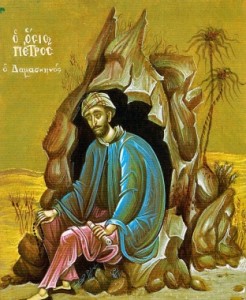
Stand fast on spiritual watch, because you don’t know when the Lord will call you to Himself. In your earthly life be ready at any moment to give Him an account. Beware that the enemy does not catch you in his nets, that he not deceive you causing you to fall into temptation. Daily examine your conscience; try the purity of your thoughts, your intentions.
There was a king who had a wicked son. Having no hope that he would change for the better, the father condemned the son to death. He gave him a month to prepare.
The month went by, and the father summoned the son. To his surprise he saw that the young man was noticeably changed: his face was thin and drawn, and his whole body looked as if it had suffered.
“How is it that such a transformation has come over you, my son?” the father asked.
“My father and my lord,” replied the son, “how could I not change when each passing day brought me closer to death?”
“Good, my son,” remarked the king. “Since you have evidently come to your senses, I shall pardon you. However, you must maintain this vigilant disposition of soul for the rest of your life.”
“Father,” replied the son, “that’s impossible. How can I withstand the countless seductions and temptations?”
Then the king ordered that a vessel be brought, full of oil, and he told his son:
“Take this vessel and carry it along all the streets of the city. Following you will be two soldiers with sharp swords. If you spill so much as a single drop they will cut off your head.”
The son obeyed. With light, careful steps, he walked along all the streets, the soldiers accompanying him, and he did not spill a drop.
When he returned to the castle, the father asked,
“My son, what did you see as you were walking through the city?”
“I saw nothing.”
“What do you mean, ‘nothing’?” said the king.
“Today is a holiday; you must have seen the booths with all kinds of trinkets, many carriages, people animals…”
“I didn’t notice any of that,” said the son. “All my attention was focussed on the oil in the vessel. I was afraid to spill a drop and thereby lose my life.”
“Quite right, my son,” said the king. “Keep this lesson in mind for the rest of you life. Be as vigilant over your soul as you were today over the oil in the vessel. Turn your thoughts away from what will soon pass away, and keep them focused on what is eternal. You will be followed not by armed soldiers but by death to which we are brought closer by every day. Be very careful to guard your soul from all ruinous temptations.”
The son obeyed his father, and lived happily.
Watch, stand fast in the faith, quit you like men, be strong. (I Cor. 16:13).
The Apostle gives Christians this important counsel to bring their attention to the danger of this world, to summon them to frequent examination of their hearts, because without this one can easily bring to ruin the purity and ardor of one’s faith and unnoticeably cross over to the side of evil and faithlessness.
Just as a basic concern is to be careful of anything that might be harmful to our physical health, so our spiritual concern should watch out for anything that might harm our spiritual life and the work of faith and salvation. Therefore, carefully and attentively assess your inner impulses: are they from God or from the spirit of evil? Beware of temptations from this world and from worldly people; beware of hidden inner temptations which come from the spirit of indifference and carelessness in prayer, from the waning of Christian love.
If we turn our attention to our mind, we notice a torrent of successive thoughts and ideas. This torrent is uninterrupted; it is racing everywhere and at all times: at home, in church, at work, when we read, when we converse. It is usually called thinking, writes Bishop Theophan the Recluse, but in fact it is a disturbance of the mind, a scattering, a lack of concentration and attention. The same happens with the heart. Have you ever observed the life of the heart? Try it even for a short time and see what you find.
Something unpleasant happens, and you get irritated; some misfortune occurs, and you pity yourself; you see someone whom you dislike, and animosity wells up within you; you meet one of your equals who has now outdistanced you on the social scale, and you begin to envy him; you think of your talents and capabilities, and you begin to grow proud… All this is rottenness: vainglory, carnal desire, gluttony, laziness, malice-one on top of the other, they destroy the heart.
And all of this can pass through the heart in a matter of minutes. For this reason one ascetic, who was extremely attentive to himself, was quite right in saying that
“man’s heart is filled with poisonous serpents. Only the hearts of saints are free from these serpents, the passions.”
But such freedom is attained only through a long and difficult process of self-knowledge, working on oneself and being vigilant towards one’s inner life, i.e., the soul.
Be careful. Watch out for your soul! Turn your thoughts away from what will soon pass away and turn them towards what is eternal. Here you will find the happiness that your soul seeks, that your heart thirsts for.
St. John Maximovitch

The passions are:
harshness,
trickery,
malice,
perversity,
mindlessness,
licentiousness,
enticement,
dullness,
lack of understanding,
idleness,
sluggishness,
stupidity,
flattery,
silliness,
idiocy,
madness,
derangement,
coarseness,
rashness,
cowardice,
lethargy,
dearth of good actions,
moral errors,
greed,
over-frugality,
ignorance,
folly,
spurious knowledge,
forgetfulness,
lack of discrimination,
obduracy,
injustice,
evil intention,
a conscienceless soul,
slothfulness,
idle chatter,
breaking of faith,
wrongdoing,
sinfulness,
lawlessness,
criminality,
passion,
seduction,
assent to evil,
mindless coupling,
demonic provocation,
dallying,
bodily comfort beyond what is required,
vice,
stumbling,
sickness of soul,
enervation,
weakness of intellect,
negligence,
laziness,
a reprehensible despondency,
disdain of God,
aberration,
transgression,
unbelief,
lack of faith,
wrong belief,
poverty of faith,
heresy,
fellowship in heresy,
polytheism,
idolatry,
ignorance of God,
impiety,
magic,
astrology,
divination,
sorcery,
denial of God,
the love of idols,
dissipation,
profligacy,
loquacity,
indolence,
self-love,
inattentiveness,
lack of progress,
deceit,
delusion,
audacity,
witchcraft,
defilement,
the eating of unclean food,
soft living,
dissoluteness,
voracity,
unchastity,
avarice,
anger,
dejection,
listlessness,
self-esteem,
pride,
presumption,
self-elation,
boastfulness,
infatuation,
foulness,
satiety,
doltishness,
torpor,
sensuality,
over-eating,
gluttony,
insatiability,
secret eating,
hoggishness,
solitary eating,
indifference,
fickleness,
self-will,
thoughtlessness,
self-satisfaction,
love of popularity,
ignorance of beauty,
uncouthness,
gaucherie,
lightmindedness,
boorishness,
rudeness,
contentiousness,
quarrelsomeness,
abusiveness,
shouting,
brawling,
fighting,
rage,
mindless desire,
gall,
exasperation,
giving offence,
enmity,
meddlesomeness,
chicanery,
asperity,
slander,
censure,
calumny,
condemnation,
accusation,
hatred,
railing,
insolence,
dishonour,
ferocity,
frenzy,
severity,
aggressiveness,
forswearing oneself,
oathtaking,
lack of compassion,
hatred of one’s brothers,
partiality,
patricide,
matricide,
breaking fasts,
laxity,
acceptance of bribes,
theft,
rapine,
jealousy,
strife,
envy,
indecency,
jesting,
vilification,
mockery,
derision,
exploitation,
oppression,
disdain of one’s neighbour,
flogging,
making sport of others,
hanging,
throttling,
heartlessness,
implacability,
covenant-breaking,
bewitchment,
harshness,
shamelessness,
impudence,
obfuscation of thoughts,
obtuseness,
mental blindness,
attraction to what is fleeting,
impassionedness,
frivolity,
disobedience,
dullwittedness,
drowsiness of soul,
excessive sleep,
fantasy,
heavy drinking,
drunkenness,
uselessness,
slackness,
mindless enjoyment,
self-indulgence,
venery,
using foul language,
effeminacy,
unbridled desire,
burning lust,
masturbation,
pimping,
adultery,
sodomy,
bestiality,
defilement,
wantonness,
a stained soul,
incest,
uncleanliness,
pollution,
sordidness,
feigned affection,
laughter,
jokes,
immodest dancing,
clapping,
improper songs,
revelry,
fluteplaying,
license of tongue,
excessive love of order,
insubordination,
disorderliness,
reprehensible collusion,
conspiracy,
warfare,
killing,
brigandry,
sacrilege,
illicit gains,
usury,
wiliness,
grave-robbing,
hardness of heart,
obloquy,
complaining,
blasphemy,
fault-finding,
ingratitude,
malevolence,
contemptuousness,
pettiness,
confusion,
lying,
verbosity,
empty words,
mindless joy,
daydreaming,
mindless friendship,
bad habits,
nonsensicality,
silly talk,
garrulity,
niggardliness,
depravity,
intolerance,
irritability,
affluence,
rancour,
misuse,
ill-temper,
clinging to life,
ostentation,
affectation,
pusillanimity,
satanic love,
curiosity,
contumely,
lack of the fear of God,
unteachability,
senselessness,
haughtiness,
self-vaunting,
self-inflation,
scorn for one’s neighbour,
mercilessness,
insensitivity,
hopelessness,
spiritual paralysis,
hatred of God,
despair,
suicide,
a falling away from God in all things,
utter destruction — altogether 298 passions.
St. Peter Damascene

One of the elders has said: "Before everything else humility of wisdom is needful for us, so that we may be ready to say to every word which we hear, forgive me; for by humility of wisdom all the arrows of the enemy and adversary are broken." Let us examine what meaning the words of the elder has. Why does he not say that continence (temperance) is needed first of all? For the Apostle says, (I Cor. 9:25) Every man that strivest for the mastery is temperate in all things. Or why did the elder not say that before everything else the fear of God is needful for us? For in the Scriptures it is said: (Ps. 110:10) The fear of the Lord is the beginning of wisdom, and again, (Prov. 15:27) By the fear of the Lord everyone departs from evil. Why did he not say that before everything else alms-giving or faith is necessary for us? For it is said, (Prov. 15:27), By alms and by faithful dealings sins are purged away, and the Apostle says, (Heb. 11:6) Without faith it is impossible to please Him (God).
Thus, if without faith it is impossible to please God, and if by means of almsgiving and faith sins are cleansed, if by the fear of the Lord everyone is brought away from evil, and if the beginning of wisdom is the fear of the Lord, and one who is laboring must be continent in everything, then why did the elder say before everything else that humility of wisdom is needful for us, setting aside everything else which is so needful? The elder wishes to show us by this that neither the very fear of God, nor almsgiving, nor faith, nor continence, nor any other virtue can be perfected without the humility of wisdom. This is why he says, "Before everything else, humility of wisdom is needful to us—so as to be ready to say to every word we hear forgive me; for by humility of wisdom are all the arrows of the adversary broken." And so you see, brethren, how great is the power of humility of wisdom; you see what force the word forgive has. But why is the devil called not only enemy, but also adversary? He is called enemy because he is the hater of mankind, the hater of good, and a slanderer; and he is called adversary because he strives to hinder every good deed. If one should wish to pray, he opposes and hinders him by means of evil remembrances, by means of captivity of the mind and despondency. If one wishes to give alms, he hinders by means of the love of money and stinginess. If one wishes to keep vigil, he hinders by means of laziness and carelessness, and in this way he opposes us in every deed when we wish to do something good. This is why he is called not only enemy, but also adversary. But by humility of wisdom, all the weapons of the enemy and adversary are broken. For in truth, great is humility of wisdom, and every one of the saints has travelled by this path; by labor they have made short their path, as the Psalmist says, Behold my lowliness and my toil, and forgive all my sins; (Ps. 24:18) and I was brought low, and He saved me (Ps. 114:6). And besides, it is humility alone that may conduct us into the Kingdom, as the elder Abba John has said—but only slowly.
Thus, let us also be humbled a little, and we shall be saved. If we who are infirm cannot labor, then let us try to be humbled; and I believe in the mercy of God that for the little we do with humility, even we shall be in the place of the saints who have labored much and worked for God. Even if we are infirm and cannot labor—can it be that we cannot become humble? Blessed, O brethren, is he who has humility. Great is humility! One saint who had true humility said it very well: "Humility does not become angry at anyone and angers no one, and it considers anger completely foreign to itself." Great is humility, for it alone opposes vainglory and preserves a man from it. And do not people become angry also over property and food? But how is it that the elder says that humility does not become angry at anyone and angers no one? Humility is great, as we have said, and it strongly attracts to the soul the grace of God. Having come, the grace of God protects the soul from the two onerous passions mentioned above. For what can be more onerous than to become angry and to anger one's neighbor? As someone has said: "It is not at all the nature of monks to become angry, nor likewise, to anger others." For in truth, if such a one, (i.e. one who becomes angry or angers others) is not soon covered with humility then he, little by little, comes into a demonic state, disturbing others and himself being disturbed. This is why the elder said that humility does not become angry and does not anger. But what am I saying? As if humility protected from only two passions… It protects the soul also from every passion and from every temptation.
When St. Anthony saw all the nets of the devil and, sighing, he asked God: "But who can escape them?" Then God replied to him: "Humility will escape them," and what is even more astonishing, He added: "They will not even touch you." Do you see the grace of this virtue? In truth there is nothing stronger than humility of wisdom—nothing vanquishes it. If something painful should happen to one who is humble, he immediately turns to himself, judges himself that he is worthy of this, and he does not begin to reproach anyone, or lay the blame on anyone else. In this way he bears whatever happens without disturbance, without sorrow, with complete calmness, and therefore he does not become angry, nor does he anger anyone. And thus, before everything else, humility of wisdom is needful for us.
There are two humilities, just as there are two prides. The first pride occurs when one reproaches his brother, when one judges and dishonors him as being of no importance, and deems himself superior. If that person does not soon come to himself and strive to correct himself, little by little comes to the second kind of pride, rising up against God Himself. He ascribes all his labors and virtues to himself and not to God, as if he performed them by himself, through his own reason and efforts, and not with the help of God. In truth my brethren, I know one person who once came to such a pitiable condition. At first when any of the brethren would say something to him, he would belittle each one and reply: "What is the meaning of that? There is no one worthy apart from Zosimas and those like him." Then he began to judge these persons also and say: "There is no one worthy except for Macarius." After a little time he began to say, "Who is Macarius? There is no one worthy except for Basil and Gregory." But soon he began to judge these also, saying: "Who is Basil, and who is Gregory? There is no one worthy except for Peter and Paul." I said to him: "In truth, brother, you will soon begin to belittle them also." And believe me, in a short time he began to say: "Who is Peter? And who is Paul? No one has any significance except for the Holy Trinity." Finally he raised himself up in pride against even God Himself, and in this way he went out of his mind. Therefore, O my brethren, we must labor with all our power against the first pride, so that we may not little by little fall into the second, that is, into complete pride.
There is a worldly pride and a monastic pride: worldly pride is when one becomes proud before his brother that he is richer or more handsome than he, or that he wears better garments than he or that he is more nobly born than he. When we see that we are becoming vainglorious over such qualities, or because our monastery is larger or richer than others, or because there are many brethren in it, then we must know that we are still in worldly pride. It likewise happens that one becomes vainglorious because of some kind of natural gifts: one, for example, is vainglorious because he has a good voice and sings well, or because he is modest, works zealously, and is efficient in service. These qualities are better than the first ones mentioned, however this is also worldly pride. Monastic pride, on the other hand, is when one becomes vainglorious because he is exercising himself in vigils, in fasting, that he is devout, that he lives well and is careful. It likewise happens that one might become humble for the sake of glory. All this has to do with monastic pride. It is possible for us not to become proud at all; but if one is unable to escape this entirely, then at least let him become proud over the qualities of monastic deeds, and not over something worldly.
We have talked about the first kind of pride is and what is the second. We have likewise talked about worldly pride and monastic pride. Let us examine now the two kinds of humility. The first kind of humility consists in respecting one's brother as more intelligent than oneself and more excellent in every way, and in a word, as the Holy Fathers have said, it consists in considering that one is lower than all." The second kind of humility consists in ascribing one's labors to God—this is the perfect humility of the saints. It is naturally born in the soul from the fulfillment of the commandments. It is just as with a tree—when there is much fruit on it, the fruits themselves bend the branches down; and the branches on which there is no fruit strive upwards and grow straight. There are certain trees which do not give fruit; but if someone were to take a stone and hang it to the branch and bend it down, then it would give fruit. The soul also, when it is humble, produces fruit, and the more fruit it produces, the humbler it becomes; and the nearer the saints came to God, the more they saw themselves as sinners.
I recall that once we were conversing about humility, and when one of the well-known citizens of Gaza heard us say that the closer one comes to God, the more one sees himself as a sinner, he was astonished and said: "How could this be?" Not understanding, he wished to know what these words meant. I said to him: "Noble citizen, tell me what you consider yourself to be in your city." He replied, "I consider myself to be great and the first one in the city." Then I said to him, "But if you were to go to Caeserea, then whom would you consider yourself to be there? He replied, "To be the last of the nobles who are there." "And if," I said, "you were to go to Constantinople, and come near to the Emperor, whom would you consider yourself to be there?" He replied, "Almost as a beggar." Then I said to him, "Even so, the nearer the saints came to God, the more they considered themselves to be sinners. So, when Abraham saw the Lord, he called himself earth and ashes. (Gen. 18:27); and Isaias said I am wretched and unclean (Isa. 6:5); and likewise Daniel, when he was in the pit with the lions and Habakkuk brought him bread saying: Receive the meal which God hath sent thee, replied: Thou has remembered me, O God (Dan. 14:36, 37). What humility his heart had! He was in the pit in the midst of the lions and was unharmed by them, and not once only, but twice, and after all this he was astonished and said, And thus God hath remembered me.
Do you see the humility of the saints and how their hearts were? They even refused out of humility what was sent from God to help them, fleeing glory. Just as one who is clothed in a silk garment would run away if someone were to throw an unclean garment at him, so as not to soil his own precious garment, so also the saints, being adorned with virtues, flee human glory so as not to be defiled by it. One who seeks glory is like a naked man who desires to find some shirt or anything else with which to cover his shame; so also one who is not clothed in virtue seeks human glory. Thus the saints, sent by God to help people, in their humility refused glory. Moses said (Exod. 4:10, 12), I beg Thee to place another one who is able, for I am a stutterer. Jeremiah said: I am the youngest one (Jer. 1:6). In a word, each of the saints acquired this humility, as we have said, through the fulfillment of the commandments. But what precisely this humility is and how it is born in the soul, no one can express in words, unless a man learn this by experience; for it is impossible to learn it from words alone.
Once Abba Zosimas spoke about humility, and a certain sophist who was present heard what he said and desired to understand it precisely. He asked him, "Tell me, why do you consider yourself sinful? Do you not know that you are holy? Do you not know that you have virtue? After all, you see how you fulfill the commandments—so how can you consider yourself sinful when you act in this way?" The elder did not know what answer to give him, but only said: "I do not know what to say to you, but I consider myself sinful." The sophist insisted, desiring to know how this could be. Then the elder, not knowing how to explain this to him, began to say to him in his holy simplicity, "Do not upset me; in truth I consider myself to be sinful."
Seeing that the elder was perplexed as to how to reply to the sophist, I said to him: "Does not the same thing happen in the arts of both sophistry and medicine? When someone has studied an art well and is practicing it, then according to the measure of his practice the physician or sophist acquires a certain habit, but he cannot say and does not know how to explain how he became experienced. In fact, the soul acquires the habit gradually and imperceptibly, through practice in the art. So it is also with humility—from the fulfillment of the commandments there comes a certain habit of humility, but it is impossible to express this in words." When Abba Zosimas heard this he rejoiced, immediately embraced me and said, "You have understood that matter, it is precisely as you have said." Having heard these words, the sophist was satisfied and agreed.
The elders also have told us something which helps us to understand humility. No one can explain the very condition into which the soul comes from humility. Thus, when Abba Agathon was near death and the brethren asked him, "Are you also afraid, Father?" he replied, "As much as I was able, I forced myself to keep the commandments, but I am a man, and how can I know if what I have done is pleasing to God? For one is the judgment of God, and another the judgment of man." Behold how he opened our eyes to understand humility and showed us the path whereby we acquire it. But how it is in the soul, as I have already said many times, no one can say or aphrehend through words alone—the soul can learn this but a little, and only from life. However, the Fathers have told us what brings us to humility, for in the Patericon it is written: "A certain brother asked an elder, "What is humility?" The elder replied, "Humility is a great and divine matter. Serving as a path to humility are bodily labors, performed reasonably. Also, it is when one considers himself below everyone else and constantly prays to God—this is the path to humility. But humility itself is divine and beyond understanding."
But why did the elder say that bodily labors bring a soul to humility? In what way do bodily labors become spiritual virtues? By considering himself below everyone, as we have already said, one opposes the demons and the first kind of pride—for how can one consider himself greater than his brother, or become proud towards another or reproach or belittle anyone, if he considers himself below everyone? Likewise, to pray without ceasing also clearly opposes the second kind of pride, for it is evident that one who is humble and reverent, knowing that it is impossible to perform any kind of virtue without the help and protection of God, does not cease always to pray to God that He might have mercy on him. For one who is ceaselessly praying to God, even if he should be able to do something, knows why he did this and cannot become proud. He does not ascribe this to his own power, but he ascribes all his success to God, always gives thanks to Him, and always calls upon Him, trembling lest he be deprived of such help and his infirmity and powerlessness be discovered. And thus with humility he prays, and by prayer he becomes humble, and the more he advances always in virtues, the more he always becomes humble. And to the degree he becomes humble he receives help and advances through humility of wisdom. But why does the elder say that bodily labors bring one to humility? What relation do bodily labors have to the disposition of the soul? I will explain this for you. After transgressing the commandments the soul was given over, as St. Gregory says, to the deception of the love of pleasure and self-will and came to love the bodily. It became, as it were, united or one with the body, and everything became flesh as, is written, (Gen. 6:4) My spirit shall not remain among these men, for they are flesh. The poor soul then sympathizes with the body and with everything which is done with the body. This is why the elder also said that bodily labor also brings the soul to humility. For there is one disposition of soul in a healthy man and another in a sick man; one disposition in one who is hungry and another in one who is full. Likewise, there is one disposition of soul in a man who is riding upon a horse, another in one who is sitting on a throne, and yet another in one who is sitting on the earth; there is one disposition in one who wears beautiful clothing and another in one who wears poor clothing. Thus, labor humbles the body; and when the body is humbled, the soul is also humbled with it. So, the elder said well that bodily labor leads to humility. Therefore, when Agapius was subjected to warfare from blasphemous thoughts, knowing as a wise man that the blasphemy proceeded from pride, and that when the body is humbled then the soul is also humbled with it, he spent forty days in the open air so that his body, as the writer of his life says, began to bring forth worms as happens with wild animals. He undertook such a labor not for the sake of the blasphemy, but for the sake of humility. Thus, the elder said truly that bodily labors also lead to humility. May the good God grant us humility, for it delivers a man from many evils and protects him from great temptations. May there be glory and dominion to God forever. Amen.
Abba Dorotheos
 Η ιστορία, που θα σας αφηγηθώ είναι πέρα για πέρα αληθινή, όσα απίστευτα στοιχεία και αν έχει. Συνέβη στις αρχές Δεκέμβρη 2007.
Οι έννοιες και οι φροντίδες της καθημερινότητας με είχαν καταβάλει εκείνο τον καιρό και ιδιαίτερα κάποιες οικογενειακές υποθέσεις μου είχαν προκαλέσει μεγάλη στεναχώρια. Τέλος πάντων σκεφτόμουν, τα έχει αυτά η ζωή. Αυτό, όμως, που ένοιωσα εκείνο το πρωί ήταν για μένα -έτσι σκεφτόμουν τότε- τελειωτικό.
Από την προηγούμενη είχα κάποιες εκκρεμότητες να φέρω σε πέρας και μάλιστα οικονομικές, που με είχαν στενοχωρήσει και με είχαν αγχώσει πολύ. Είχα πάει στο ταμείο των υπαλλήλων της υπηρεσίας που εργάζομαι και είχα εισπράξει το ποσό ενός δανείου 20.000 ευρώ, προκειμένου να εξοφλήσω την τράπεζα η οποία μας έβγαλε το εξοχικό σπίτι σε πλειστηριασμό και προχώρησε σε κατάσχεση. Ήμουν πολύ στεναχωρημένη, γιατί αυτό το σπίτι είχε φτιαχτεί με πολύ μόχθο και κάθε καλοκαίρι πηγαίναμε με τα παιδιά εκεί για διακοπές. Δεν ήθελα με κανένα τρόπο να το χάσω, αν και οικονομικά ήμουν σε πολύ δύσκολη κατάσταση, αφού βασιζόμουν μόνο στο μισθό μου. Τέλος πάντων ζήτησα από την υπηρεσία δάνειο, για το οποίο μου κρατάνε κάθε μήνα 250 ευρώ από το μισθό. Μόλις το εισέπραξα σε μετρητά πήγα στην τράπεζα και έστειλα 6.000 ευρώ σε έναν θείο, που είχε καταβάλει εγγύηση για να μη γίνει η κατάσχεση και τα υπόλοιπα 14.000 θα τα έβαζα σε λογαριασμό της τράπεζας, τον οποίο όμως δεν είχα και έπρεπε να τηλεφωνήσω να μου τον πουν. Και ώσπου να τελειώσω με όλα αυτά η τράπεζα έκλεισε.
Έτσι σκέφθηκα να αφήσω τα χρήματα, μαζί με όλα τα χαρτιά, όπως ήταν,μέσα στο αυτοκίνητό μου, στο τσεπάκι της πόρτας του οδηγού. Εκεί ποιός να τα πειράξει. Άλλωστε πρωί-πρωί θα πήγαινα να τα καταθέσω. Ποτέ δεν είχα χάσει κάτι από το αυτοκίνητο. Μάλιστα τα έβαλα σε ένα φάκελο από αυτούς των δημοσίων υπηρεσιών καθώς τους φύλαγα, όταν η ταμίας μας πλήρωνε και μας έβαζε τα χρήματα στο φάκελο. Εγώ πάντα της γκρίνιαζα γι’ αυτό ότι ο τρόπος αυτός είναι απαρχαιωμένος, αλλά εκείνη εξακολουθούσε το σύστημά της. Έτσι κρατούσα τους φακέλους κι όλο και κάπου μου χρησίμευαν. Ίσως σας κουράζω με λεπτομέρειες αλλά θα δείτε παρακάτω γιατί σας τις αναφέρω.
Εκείνο το πρωί λοιπόν ξεκίνησα να πάω στη τράπεζα για την κατάθεση των χρημάτων. Το αυτοκίνητο, ενώ συνήθως το παρκάρω στην πυλωτή της πολυκατοικίας, εκείνο το βράδυ το είχα παρκάρει λίγο παραπέρα από το σπίτι, γιατί κάποιος μου είχε πιάσει το πάρκιν. Πηγαίνω εκεί που το είχα παρκάρει, πολύ κοντά στο σπίτι και σε σίγουρο μέρος, αλλά το αυτοκίνητο πουθενά. Κοπήκανε τα πόδια μου. Δεν ήταν δυνατόν. Στη γειτονιά. Λίγα μέτρα από το σπίτι. Ποτέ κανείς δεν είχε παραπονεθεί για κλοπές. Είμαστε ήσυχη γειτονιά.Κόντεψα να τρελαθώ. Δεν ήταν μόνο το αυτοκίνητο που έχασα, κι αν το εύρισκα και πως θα το εύρισκα, και πως θα πηγαίνω στη δουλειά και πως θα πηγαίνει ο γιος μου στο σχολείο που τον πήγαινα εγώ κάθε πρωί, δεν ήταν που δεν είχα καθόλου χρήματα να αγοράσω άλλο, ήταν ότι είχα μέσα και τις 14.000 ευρώ. Πήγα να τρελαθώ πραγματικά.
Και εκτός αυτού και το σπίτι θα έχανα, αφού δεν πρόλαβα να στείλω τα χρήματα στην τράπεζα. Και το αυτοκίνητο και τα χρήματα, αλλά και θα μου κρατούσαν κι από τον μισθό μου 250 ευρώ το μήνα γι’ αυτό το δάνειο. Τρελάθηκα. Ένοιωσα δύσπνοια, κιτρίνισα. Γύρισα στο σπίτι και κάθισα μουδιασμένη. Τώρα τι να κάνω. Παίρνω αμέσως το 100 και καταγγέλλω τη κλοπή. -Τι να σας πω κυρία μου, μου λέει στην άλλη άκρη της γραμμής ο αστυνομικός, στην Αθήνα κάθε μέρα κλέβονται 100 αυτοκίνητα. Θα δώσουμε τα στοιχεία στα περιπολικά κι αν τύχει και πέσουμε επάνω.. αν είστε τυχερή… πηγαίνετε και στο αστυνομικό τμήμα να κάνετε και μήνυση κατά αγνώστων. Όλα μαύρα…Πηγαίνω στο αστυνομικό τμήμα της περιοχής μου, κι εκεί τα ίδια. Εκεί ένα παιδί, νέος αστυνομικός, μου φέρνει ένα μπουκαλάκι νερό -πως θα με είδε το παιδί- και μου λέει.
- Ηρεμήστε μπορεί και να το βρείτε…
Γυρίζω σπίτι και περιμένω…Στη στιγμή άρχισα να σκέφτομαι τα γεγονότα. Πως συνέβη αυτό, γιατί συνέβη αυτό, γιατί ο Θεός να μου δώσει αυτή τη δοκιμασία…Εκεί μου ήρθε τότε στο νου μια κουβέντα, που μου είχε πει ένα σεβάσμιος γέροντας κάποτε, που πήγα κοντά του να εξομολογηθώ. Ήμουν τότε πολύ στενοχωρημένη και ανήσυχη για τα παιδιά μου, για τη ζωή μου…έκλαιγα, μιλούσα κι έκλαιγα…τότε μου λέει.
- Μην κλαις. Ο Θεός μας δίνει τις δοκιμασίες για κάποιο λόγο. Είναι, όμως, πατέρας μας και αγαπάει τα παιδιά του. Το καλό μας θέλει. Πρέπει να του έχουμε εμπιστοσύνη. Για κάποιο λόγο μας τα στέλνει όλα τούτα. Μην κλαις. Είναι αμαρτία, γιατί δείχνεις ότι δεν τον εμπιστεύεσαι…Να κάνεις την προσευχή σου και να αφήνεσαι με εμπιστοσύνη στο θέλημά του.
Εγώ, όμως, είμαι ένας άνθρωπος κοσμικός. Ψάχνω βέβαια τα πνευματικά μονοπάτια, αλλά πολύ μικρή είναι η πίστη μου. Θυμήθηκα τα λόγια τούτα του γέροντα και σκέφτηκα ξανά τα γεγονότα κάτω από άλλη ματιά. Για ποιό λόγο γίνονται όλα, για κάποιο λόγο μας στέλνει ο Θεός τις δοκιμασίες. Για λίγο όμως, γιατί ξανά με κυρίευσε η απελπισία, αλλά πάλι ξανασκέφτηκα τα λόγια του γέροντα.. Και τότε ξαφνικά θυμήθηκα ότι μου είχε δώσει μια προσευχή να διαβάζω στα δύσκολα αλλά… και στα εύκολα μου είχε πει. Έψαξα πού την είχα καταχωνιάσει εδώ και τόσα χρόνια -θα είχαν περάσει 8-9 χρόνια από τότε. Τη βρήκα όμως, δεν την είχα πετάξει. Την διάβασα πολλές φορές. Ήταν η προσευχή των πατέρων της Όπτινα. Σε λίγο ξαναπήρα τηλέφωνο το 100. Τίποτα. Το αστυνομικό τμήμα τίποτα. Ήρθε μεσημέρι. Γύρισαν τα παιδιά από τα σχολεία τους. Του είπα τα καθέκαστα. Στεναχωρέθηκαν πολύ. Εγώ μουδιασμένη, αλλά κάπου άρχισα να σκέφτομαι ότι πρέπει να αποδέχομαι αυτά που μου τυχαίνουν στην ζωή. Να έχω εμπιστοσύνη στο Θεό.
Μάλλον, όμως, το ’κανα και αναγκαστικά, αφού δεν μπορούσα να κάνω και τίποτε άλλο. Όμως αυτή η κουβέντα του γέροντα όλο και μεγάλωνε στο μυαλό μου…Όλα γίνονται για κάποιο σκοπό… Όλα γίνονται για κάποιο σκοπό. Άρα πρέπει να σκεφτώ ποιός είναι ο σκοπός, είπα εγώ στον εαυτό μου, αφού αυτή είναι η πάγια τακτική μου, όλα να τα εξηγώ. Έλα, όμως, που ορισμένα είναι πάνω από τη δύναμη του νου μου.
Έτσι πέρασε η μέρα. Κάνοντας τηλεφωνήματα, αγωνιώντας, ξανακάνοντας προσευχή.
Κατά τις 11:30 η ώρα το βράδυ ξαφνικά χτυπάει το τηλέφωνο.
- Κυρία μου είμαστε από το αστυνομικό τμήμα Κάτω Πατησίων. Έχετε ένα αυτοκίνητο άσπρο, τάδε μάρκα με τάδε νούμερα. Η καρδιά μου κόντευε να σπάσει.
Ναι. Τι έγινε• Έχουμε εδώ δυο άτομα που είχαν το αυτοκίνητό σας• τους σταματήσαμε για έλεγχο και βρήκαμε το δίπλωμα και τα χαρτιά σας. Ελάτε αμέσως.
Έτρεξα κατευθείαν εκεί. Ήταν δυο νεαροί -όχι κακά παιδιά- με σκυμμένο το κεφάλι.
Κυρία μου, μου λέει ο διοικητής τι είχατε στο αυτοκίνητό σας εκτός από τα χαρτιά σας; Χρήματα κύριε διοικητά. Πόσα; 14.000 ευρώ. Καλά κυρία μου, αφήνουμε τόσα λεφτά στο αυτοκίνητο; Τι να του πω δίκιο είχε. Βγάζει τότε από το συρτάρι του ένα φάκελο, τον φάκελο της υπηρεσίας μου, που είχα βάλει μέσα τα χρήματα και μου λέει. Μετρήστε τα. Κοπήκανε τα πόδια μου. Μα ήταν δυνατόν; Αρχίζω και μετράω.
Τα χρήματα ήταν όλα εκεί δεν έλειπε ούτε ένα ευρώ. Δεν είναι δυνατόν λέω. Πως έγινε αυτό; Ρωτάει τότε ο διοικητής τους νεαρούς. Τι έγινε παιδιά; Πως και δεν πειράξατε τα χρήματα; Δεν τα βρήκατε;
Όχι απαντάει ο ένας. Δηλαδή βρήκαμε τον φάκελο, αλλά δεν τον ανοίξαμε. Γιατί τους ρωτά ο αστυνομικός. Να καθώς ψάχναμε το αυτοκίνητο, στο ντουλαπάκι μπροστά, του συνοδηγού βρήκαμε τα διπλώματα της κυρίας και των παιδιών της, την άδεια του αυτοκινήτου και βρήκαμε κι έναν φάκελο ίδιο που είχε μέσα ένα κομμάτι ψωμί από την εκκλησία, ξερό.
- Αντίδωρο το λένε , του λέει ο άλλος.
- Ναι αντίδωρο. Ε, και καθώς ψάχναμε βρήκαμε στο τσεπάκι στο πλάι του αυτοκινήτου και αυτό τον φάκελο και είπαμε ότι αντίδωρο θα ’χει πάλι μέσα αυτή, όπως είχε στο άλλο. Φαίνεται ότι θα ’ναι καμιά θρήσκα… Και έτσι δεν ανοίξαμε τον φάκελο..
Μείναμε όλοι άφωνοι. Μαζεύτηκαν όλοι οι αστυνομικοί γύρω-γύρω και κοιτούσαν παραξενεμένοι. Κανείς δε μιλούσε.
Δεν θα σας κουράσω με άλλες λεπτομέρειες. Σε λίγο ήρθαν οι γονείς τους -καλοί άνθρωποι- απέσυρα τη μήνυση και γύρισα σπίτι. Εκεί έγινε πάλι άλλο σκηνικό. Τα παιδιά μου δεν μπορούσαν να πιστέψουν ότι το αυτοκίνητο βρέθηκε άθικτο, μόνο η βενζίνη είχε τελειώσει, και τα χρήματα όλα. Ήταν συγκλονιστικό. Δηλαδή ένα μικρό κομματάκι αντίδωρο μπόρεσε να ανατρέψει μια σειρά γεγονότων. Γιατί, αν είχαν βρει τα χρήματα, σίγουρα τα πράγματα θα έβαιναν αλλιώς. Και πότε το είχα βάλει εκεί το αντίδωρο ούτε που θυμόμουν. Εκείνο το ντουλαπάκι σπάνια το ανοίγω. Και το αντίδωρο θα το είχα από το καλοκαίρι ίσως, που πηγαίνω καμιά φορά σε κάποιο προσκύνημα. Αλλά πάλι πως το έβαλα μέσα στο φάκελο. Ούτε που μπορώ να θυμηθώ.
Σημασία βέβαια έχει πως το γεγονός αυτό με έκανε να βλέπω τη ζωή αλλιώς. Να βλέπω με σεβασμό το καθετί και να αποδέχομαι με σεβασμό σχεδόν με ευγνωμοσύνη ακόμα και τα άσχημα, που μου συμβαίνουν στη ζωή.
Το περιστατικό έγινε αιτία να επηρεαστούν αρκετοί άνθρωποι. Πρώτη εγώ. Μετά τα παιδιά μου, που συνήθως με κοντράρουν πάνω σ’ αυτά τα ζητήματα, τώρα όλο και συζητούν θέματα πνευματικά και ο μικρός -τελειόφοιτος λυκείου- εφέτος για πρώτη φορά νήστεψε. Αυτό τον καιρό συμμετέχω σε κάποιο μεταπτυχιακό πρόγραμμα και επειδή εκείνη την ημέρα δεν πήγα στο μάθημα εξήγησα στον καθηγητή μου τι είχε συμβεί. Την άλλη μέρα, όταν του είπα την συνέχεια, κούνησε σκεφτικός το κεφάλι και με παρότρυνε να πάω να κοινωνήσω, πράγμα που έκανα καθώς πλησίαζε η γιορτή του αγίου Νικολάου. Περιττό να πω ότι ανέφερε το γεγονός σε όλο το τμήμα και έμειναν να με κοιτάζουν όλοι κατάπληκτοι.
Η μητέρα του ενός από τα παιδιά, που είχαν πάρει το αυτοκίνητό μου τηλεφώνησε λίγο μετά τα Χριστούγεννα και μου είπε πως ο γιος της τής ζήτησε να νηστέψει και να πάει να κοινωνήσει, γιατί του έκανε λέει μεγάλη εντύπωση το γεγονός με το αντίδωρο και το ότι δεν είχε συνέπειες η κακή του αυτή πράξη για την οποία και είχε μετανιώσει πικρά… Οι συνάδελφοι στη δουλειά άκουσαν το γεγονός, ορισμένοι μπορεί να το ξέχασαν, ορισμένοι, όμως, που και μου το θυμίζουν και συχνά κουβεντιάζουμε για το αν υπάρχουν δυνάμεις πάνω από μας, που ρυθμίζουν τις ζωές μας. Και ακόμα η διήγηση του γεγονότος αυτού με έκανε να έρθω κοντά με μια φίλη, που με βοηθά να βαδίσω στον δρόμο τον πνευματικό με όλο και πιο σίγουρα βήματα. Τη λένε Αγγελική.
Τα λόγια αυτά του γέροντα, τα λόγια της προσευχής, τα θυμάμαι πάντα στα δύσκολα, αλλά και στα εύκολα. Αυτή η προσευχή τυπώθηκε στο νου και στην καρδιά μου και τη ψιθυρίζω από τότε συχνά, σχεδόν κάθε μέρα…
«Κύριε…Στις απρόοπτες καταστάσεις μη μ’ αφήσεις να ξεχάσω ότι όλα παραχωρούνται από σένα… Δίδαξε με να δέχομαι με ακλόνητη πεποίθηση ότι τίποτε δεν συμβαίνει, χωρίς να το επιτρέψεις εσύ…
Κύριε, δος μου τη δύναμη να υποφέρω τον κόπο της ημέρας αυτής σε όλη τη διάρκειά της. Καθοδήγησε τη θέλησή μου και δίδαξε με να προσεύχομαι, να πιστεύω, να υπομένω, να συγχωρώ και ν’ αγαπώ. ΑΜΗΝ».
Και μέσα στο τρέξιμο της καθημερινότητας δεν βάζει ο νους του ανθρώπου τι μπορεί να του ξημερώσει και τι πράγματα μπορεί να του συμβούν.
«ΕΝΟΡΙΑΚΑ ΝΕΑ» Αγίου Γεωργίου Διονύσου Αττικής
Το Τουρκικό 'Εθνος είναι ασεβές, καθ' ότι έχει μεν λογική και πολύ κρίσι, όμως αντιπαθεί τον Χριστιανισμό που είναι έκφραση της ανθρωπιάς και της αρετής.
Αντιθέτως διαλέγει βολικές θεωρίες, βασισμένες στο ψεύδος και την αμαρτία.
'Ετσι έχει προορισμό να καταστραφεί, αν δεν μετανοήσει, αν δεν παραιτήση το ψεύδος και πιστέψη στο Ευαγγέλιο.
Γεροντας Παϊσιος

1. The Significance of the Lives of the Saints
In order to begin to understand the importance of the Lives of the Saints for our spiritual lives, I believe we can turn to no better or more thorough source than St. Justin Popovich's Introduction to his own compilation of the Lives of the Saints. A theologian, St. Justin saw no dichotomy between the Lives of the Saints and the theological writings of the Church. For him, as for the Church, theology and the Lives of the Saints form one whole. He called the Lives of the Saints "experiential theology" or "applied dogmatic theology," and he viewed them and wrote about them in a theological manner. Likewise, he viewed theological writings as an expression of the experience of the life of Grace in the Church, and not just an intellectual, abstract or polemical exercise.
How does St. Justin view the Lives of the Saints theologically? At the center of all of St. Justin's thought is the Theanthropic vision: the fact that God became man in Jesus Christ, uniting human nature with Divine Nature. The fact of the God-man, the Theanthropos, is the axis of the universe: it is the reality according to which everything else must be viewed, whether it be the nature of the Church or the problems and issues of everyday life.
Thus, when St. Justin looks at the Lives of the Saints, he does so in the light of the God-man. Real and true life—eternal life in God—became possible only with the Incarnation, death and Resurrection of the Saviour, and this life is the Life of the Saints. St. Justin saw the Lives of the Saints as bearing witness to one life: the Life in Christ.
St. Justin wrote: "What are Christians? Christians are Christ-bearers, and, by virtue of this, they are bearers and possessors of eternal life.... The Saints are the most perfect Christians, for they have been sanctified to the highest degree with the podvigs of holy faith in the risen and eternally living Christ, and no death has power over them. Their life is entirely Christ's life; and their thought is entirely Christ's thought; and their perception is Christ's perception. All that they have is first Christ's and then theirs.... In them is nothing of themselves but rather wholly and in everything the Lord Christ."
The Saints live in Christ, but Christ also lives in them through His Divine Energies, His Grace. And where Christ is, there is the Father and the Holy Spirit also. Christ says, Abide in Me, and I in you; and elsewhere He says, If a man love Me, he will keep My words: and My Father will love him, and We will come unto him, and make Our abode with him (John 15:4; 14:23).
Thus, St. Justin makes bold to say that the Lives of the Saints not only bear witness to the Life in Christ: they may even be said to be the continuation of the Life of Christ on earth. "The Lives of the Saints," says St. Justin, "are nothing else but the life of the Lord Christ, repeated in every Saint to a greater or lesser degree in this or that form. More precisely, it is the life of the Lord Christ continued through the Saints, the life of the incarnate God the Logos, the God-man Jesus Christ Who became man."
This is an amazing thing that St. Justin is saying: when we read the Lives of the Saints, we are reading the Life of our Lord Jesus Christ. This in itself should be enough to convince us of the importance of filling our souls with the Lives of the Saints.
St. Justin also says that the Lives of the Saints are a continuation of the Acts of the Apostles. "What are the 'Acts of the Apostles'?" he asks. "They are the acts of Christ, which the Holy Apostles do by the power of Christ, or better still: they do them by Christ Who is in them and acts through them. "And what are the 'Lives of the Saints'? They are nothing else but a certain kind of continuation of the 'Acts of the Apostles.' In them is found the same Gospel, the same life, the same truth, the same righteousness, the same love, the same faith, the same eternity, the same 'power from on high,' the same God and Lord. For the Lord Jesus Christ is the same yesterday and today and for ever (Heb. 13:8): the same for all peoples of all times, distributing the same gifts and the same Divine Energies to all who believe in Him.
With these words of St. Justin before us, we might well ask ourselves if Orthodox spiritual life is even possible without the testimony of the Lives of the Saints. The answer to this, I believe, must be "no." True spiritual life begins when we live in Christ and Christ lives in us, right here on this earth. And the Lives of the Saints bear witness to us that the Life of Christ on earth did not end with His Ascension into Heaven, nor with the martyrdom of His Apostles. His Life continues to this day in His Church, and is seen most brilliantly in His Saints. And we, too, in our own spiritual lives, are to enter into that continuing, never-ending Life.
I spoke recently to an Orthodox priest who had converted to Orthodoxy from Protestantism. He told me that, when he was received into the Church, the officiating priest told him: "You will never be truly Orthodox without reading the Lives of the Saints." Later, when he himself became a priest, he found that the most pious people in the churches are those who read the Lives of the Saints, and that those who make the most progress in the spiritual life are those who read the Saints' Lives.
The Orthodox Faith is not, first of all, of the head. First of all, it is of the heart: it is felt
and believed by the heart. Through the Lives of the Saints, we develop an Orthodox heart. Our monastery's co-founder, Fr. Seraphim Rose, emphasized constantly this "Orthodoxy of the heart," especially in his writings and talks at the end of his life; and he frequently referred to Lives of the Saints as a means of developing this.
2. How to Make Use of the Lives of the Saints
Having looked at the importance and meaning of the Lives of the Saints, let us look now at the various ways we can make use of them in our spiritual lives.
First, we look to the Saints as our examples. Be ye imitators of me, even as I also am of Christ (I Cor. 11:1), the Saints say to us along with the Holy Apostle Paul. As Christians, we want to grow in the likeness of Christ, to have that likeness shine in us. For this to occur, we need to look often to the Saints to see that shining likeness: we must look to them for real, practical examples of how to live. St. Basil the Great gives this analogy:
"Just as painters, in working from models, constantly gaze at their exemplar and thus strive to transfer the expression of the original to their own artistry, so too he who is eager to make himself perfect in all kinds of virtue must gaze upon the Lives of the Saints as upon statues, so to speak, that move and act, and must make their excellence his own by imitation."
Secondly, we must look to the Saints as our heavenly friends, as our brothers and sisters in the Faith, and as our preceptors. We read about them not as people who are dead, but as people who are living. And this is even more immediate than just reading a biography about someone who is still alive. Let's say we are reading the biography of some famous living person. As we read it, we may dream of perhaps one day meeting this person, or perhaps of writing him a letter and having it actually reach him, and even of receiving a reply from him, despite the fact that he is so famous that thousands of people are probably writing to him. Reading the Lives of the Saints offers us much more than this, because the Saints are alive in God, and are not bound by time and space in the same way we are. We can address them in prayer immediately and at any time, even right in the middle of reading their Lives. And they will hear us. Besides our private prayers to them, the Church offers us many other ways of communing with them as our friends and honoring them as our preceptors. We sing their troparia, we venerate their icons, we perform services to them, and with a blessing from our Bishop we can even compose services in their honor.
As we read the Lives of the Saints each day, we will discover little by little those Saints whom our hearts go out to. They will become our close friends, those whom we pray to most of all, those in whom we confide our joys and sorrows. As Archimandrite Aimilianos, the present Abbot of the Holy Monastery of Simonos Petras on Mount Athos, writes: "These close friends will be the guides of our choice and a great comfort to us along the strait and narrow way that leads to Christ. We are not alone on the road or in the struggle. We have with us our Mother, the All-Holy Mother of God, our Guardian Angel, the Saint whose name we bear, and those close friends we have chosen out of the Great Multitude of Saints who stand before the Lamb (Rev. 7:9). When we stumble through sin, they will raise us up again; when we are tempted to give up hope, they will remind us that they have suffered for Christ before us, and more than us; and that they are now the possessors of unending joy. So, upon the stony road of the present life, these holy companions will enable us to glimpse the light of the Resurrection. Let us search, then, in the Lives of the Saints, for these close friends, and with all the Saints let us make our way to Christ."
St. Justin Popovich, as we have said, called the Lives of the Saints "applied dogmatic theology." The Saints are proofs and illustrations of the reality of Christ, of His saving work of redemption. The Saints are transformed human beings, proof positive that people are redeemed, purified, illumined, transformed and recreated by Jesus Christ.
St. Justin also calls the Lives of the Saints "applied ethics." They are embodiments of the life of Divine virtue that is possible only in Jesus Christ. They are embodiments of the life of Grace in the Church, through the Holy Sacraments, through the life-giving Body and Blood of the Lord.
Fr. Seraphim Rose once counseled a budding Orthodox writer to make use of the Lives of the Saints as "applied dogmatic theology" and as "applied ethics." Fr. Seraphim said that, when one is writing on a spiritual subject, one should try to not only discuss it in the abstract, but to give living examples from the Lives of the Saints. Fr. Seraphim wrote to his fellow Orthodox writer: "If I have any suggestion for your future articles, it would simply be to keep in mind the Lives of the Saints. In your article, there is a point that would be more forceful by references to the life of the author of the citations, who is a Saint. You quote St. John of Kronstadt on 'love'—but he is not merely a great Orthodox Saint of this century, he is a very incarnation of the love he talks about, and there is scarcely to be found a parallel in the Lives of other Saints to his absolute self-crucifying love and service to others, blessed by God in the manifestation of an abundance of miracles that can only be compared to those of St. Nicholas."
3. An Example of How to Make Use of the Lives of the Saints
I will now attempt to implement Fr. Seraphim's advice here. In speaking about how to make use of the Lives of the Saints, I will give the example of a Saint who made use of them to an astounding degree. This is Fr. Seraphim's mentor, and the Bishop who blessed the establishment of our Brotherhood: St. John Maximovitch, Archbishop of Shanghai and San Francisco.
Archbishop John was born Michael Maximovitch in the city of Kharkov in southern Russia in 1896. As a boy he collected religious and historical books, and loved above all to read the Lives of the Saints. Being the oldest child, he had a great influence on his four brothers and one sister, who knew the Lives of the Saints through him.
When he was eleven years old Michael was sent to the Poltava Cadet Corps (military academy). When he graduated in 1914, he wished to attend the Kiev Theological Academy. His parents insisted, however, that he attend Law School in Kharkov, and out of obedience to them he put away his own desire and began to prepare for a career in law.
It was during his university years that the Orthodox education and outlook which Michael had received in his childhood came to maturity. Young Michael saw the point of this upbringing. He saw that the Lives of the Saints, in particular, contain a profound wisdom which is not seen by those who read them superficially, and that the proper knowledge of the Lives of the Saints is more important than any university course. And so it was, as his classmates noticed, that Michael spent more time reading the Lives of the Saints than attending academic lectures, although he did very well in his university studies also. One could say that he studied the Orthodox Saints precisely "on the university level': he assimilated their world-outlook and their orientation toward life, and studied the variety of their activity and ascetic labors and practice of prayer. He came to love them with all his heart, was thoroughly penetrated by their spirit—and began to live like them. Many years later, during the sermon he gave when he was consecrated a Bishop, he said: "While studying the worldly sciences, I went all the more deeply into the study of the science of sciences, into the study of the spiritual life."
In 1921, as the Russian Civil War was raging, Michael—then twenty-four years old—was evacuated with his entire family to Belgrade. There he entered the University of Belgrade, from which he graduated in 1925 in the faculty of theology. A year later he was tonsured a monk in Serbia and was given the name John, after his own distant relative, St. John Maximovitch of Tobolsk. During the same year he was ordained a hieromonk.
For five years Hieromonk John was a teacher and tutor at the Seminary of St. John the Theologian in Bitol, Serbia. The city of Bitol was in the diocese of Ohrid, and at that time the ruling bishop of this diocese was another future Saint: St. Nikolai Velimirovich. St. Nikolai valued and loved the young Hieromonk John, and exerted a beneficial influence on him. More than once he was heard to say, "If you wish to see a living Saint, go to Bitol to Father John."
One of the seminarians who was at the Bitol Seminary at that time recalls: "Bishop Nikolai often visited the seminary and spoke with the teachers and students. For us his meeting with Fr. John was unusual. After mutual prostrations, there was an unusually cordial, loving conversation. Once, before parting, Bishop Nikolai turned to a small group of students (of whom I was one) with these words: 'Children, listen to Fr. John; he is an angel of God in human form.' We ourselves became convinced that this was the correct characterization of him. His life was angelic. One can rightly say that he belonged more to Heaven than to earth. His meekness and humility were like that recorded in the Lives of the greatest ascetics and desert-dwellers."
By this time, it had indeed become evident that Fr. John was an entirely extraordinary man. It was his own students who first discovered what was perhaps his greatest feat of asceticism. They noticed at first that he stayed up long after everyone else had gone to bed; he would go through the dormitories at night and pick up blankets that had fallen down and cover the unsuspecting sleepers, making the sign of the Cross over them. Finally it was discovered that he scarcely slept at all, and never in a bed, allowing himself only an hour or two each night of uncomfortable rest in a sitting position, or bent over on the floor praying before icons. Years afterward he himself admitted that since taking the monastic vows he had not slept lying in a bed. Such an ascetic practice is a very rare one; yet it is not unknown in the Orthodox tradition of the Lives of the Saints. In the fourth century, St. Pachomius the Great of Egypt was told by an angel to have his monks follow this practice.
In 1934, Fr. John was consecrated a Bishop in the Russian Church in Belgrade, and he was assigned to the diocese of Shanghai in China. The first thing he did in Shanghai was to restore Church unity, establishing contact with the Serbs, Greeks, and Ukrainians. He paid special attention to religious education. He actively participated in charitable activities, especially after seeing the needy circumstances in which the majority of his flock, refugees from the Soviet Union, were placed. He organized a home for orphans and the children of needy parents. He himself gathered sick and starving children off the streets and dark alleys of Shanghai's slums: Russian children, Chinese children, and others. The orphanage housed up to a hundred children at a time, and some 3,500 in all.
It soon became apparent to his new flock that Archbishop John was a great ascetic. The core of his asceticism was prayer and fasting. He ate once a day at 11 p.m. During the first and last weeks of Great Lent he did not eat at all, and for the rest of this and the Christmas Lent he ate only bread from the altar. His nights he spent usually in prayer, and when he finally became exhausted he would put his head on the floor and steal a few hours of sleep near dawn.
Then it became known that Archbishop John not only was a righteous man and an ascetic, but was also so close to God that he was endowed with the gift of clairvoyance, and was a great miracle-worker. There are many, many firsthand accounts of both his clairvoyance and his miracle-working, which show him to be equal to the great Saints of ancient times. On more than one occasion, he was seen surrounded in the Uncreated Light of deification while praying.
In 1949, the Communists took over China. Archbishop John was forced to evacuate his flock, including his entire orphanage. He brought 5,000 refugees to camps in the Philippines. He himself went to Washington, D.C. to get his people to America. Legislation was changed and almost the whole camp came to the New World—thanks to St. John. Later he was assigned to Western Europe, and then to San Francisco, where reposed in 1966
Perhaps the most remarkable thing about St. John's life is that he manifested in himself so many different kinds of sanctity. It was as if, through the intense study of the Lives of the Saints that he had undertaken in his early years, he had internalized and made his own the whole realm of Orthodox sanctity, in all its varied forms. He was a true student of the Saints, one who sought to follow in their footsteps, and thus to follow in the footsteps of Christ. By living like the Saints, he became one of them.
Let's look at some of the varied forms of sanctity that could be seen in Archbishop John:
1. He was first of all a great ascetic in the tradition of the ascetic, monastic Saints of old, such as St. Macarius the Great, St. Pachomius the Great, and others.
2. He was a clairvoyant reader of hearts, and one who could identify and name people he had never seen before. Enlightened by the Grace of God, he could hear and answer people's thoughts before they would express them. He also foretold the future, including the time of his own death. In this way, he was very much in the tradition of the great monastic elders of the past, especially the clairvoyant Russian elders such as those of Optina Monastery.
3. He was an almsgiver in the tradition of St. Philaret the Almsgiver, St. John the Almsgiver, etc. We have seen how he sacrificed himself for orphaned children, going himself into dangerous slums and houses of prostitution in order to rescue children from starvation or unhealthy environments. He was constantly giving to and working to help the needy. He himself wore clothing of the cheapest Chinese fabric. He often went barefoot, sometimes after having given away his sandals to some poor man.
4. He was a hierarch and theologian, a Church writer and apologist who defended the Church against error, much in the tradition of St. Athanasius the Great, St. Gregory the Theologian, and others. Besides his many published sermons, rich in theological content, he wrote valuable theological treatises in order to defend traditional Orthodox teachings which were being undermined in modern times. One of these works, in which he presents the Orthodox teaching on the Mother of God in contrast to Protestant and Roman Catholic distortions, has been published in English.He also wrote an extensive essay pointing out the fallacies of the modern teaching of Sophiology.
5. He was an apostle, evangelist and missionary to new lands, in the tradition of Sts. Cyril and Methodius, St. Nahum of Ohrid and others. When he was in Western Europe, he worked hard to establish indigenous Orthodox Churches in France and the Netherlands: churches made up of the native peoples of these lands who had converted to the Orthodox Faith. He understood that the Orthodox Church is universal, and he said that the Orthodox Gospel of Christ must be spread throughout the world. Later, when he came to America, he instituted English Liturgies in addition to Slavonic Liturgies, in a Cathedral that had only known Slavonic Liturgies. He helped and supported our newly begun St. Herman Brotherhood, which was dedicated to bringing Orthodoxy to the English-speaking world.
6. He was a healer and miracle-worker, in the tradition of St. Martin of Tours, St. Nicholas of Myra in Lycia, and others. Through his prayers, he healed people of almost every imaginable malady; and he continues to do so after his repose.
7. He was a loving and self-sacrificing pastor, in the tradition of St. John of Kronstadt and all the other hierarch and priest Saints of ages past. So great was his love that everyone felt that he or she was his "favorite." He was overflowing with self-sacrificing love for his flock, and for those outside of his flock as well, such as a dying Jewish woman whom he suddenly healed with the words "Christ is Risen."
8. He was a deliverer of his people from captivity, in the tradition of St. Moses the God-seer. As we have seen, he brought 5,000 Orthodox believers out of Communist China and into freedom in America.
9. Finally, he was to a limited degree a fool-for-Christ in the tradition of St. Andrew the fool-for-Christ and others. He could not be a fool-for-Christ in the full sense of the term, since this would compromise the dignity of his hierarchical office. And yet at many times he did things which were at odds with the ideas of the world, and thus he evoked censure from people who did not see him for what he was: a man of God. He was criticized, for example, for serving barefoot, and for wearing a collapsible cardboard mitre that had been lovingly made for him by his orphans.
We have now looked at nine different types of sanctity manifested in this one Saint, St. John of Shanghai and San Francisco. Nine types which he had learned about through his study of the Lives of the Saints.
What the contemporary hagiographer Constantine Cavarnos says of modern Saints in general applies perfectly to St. John: "Modern Saints admire and imitate the older ones: they follow closely their example, study their teaching carefully, and—what is extremely significant—they confirm it. Those of the modern Saints who write or preach amplify and illustrate the teaching of the older Saints, and relate it to modern realities."
4. "Remember the Saints of God"
It should not be thought that, after his formative years at the Cadet Corps and at the University of Belgrade, St. John finished his profound study of the Lives of the Saints. Quite the contrary: he continued to learn about the Saints right up until the time of his repose.
St. John believed that, in whatever land an Orthodox Christian found himself, it was his responsibility to venerate and pray to its national and local Saints. Wherever St. John went—Russia, Serbia, China, France, Belgium, the Netherlands, Italy, Tunisia, America—he researched the Lives of the local Orthodox Saints. He went to the churches housing their relics, performed services in their honor, and asked the Orthodox priests there to do likewise. By the end of his life, his knowledge of Orthodox Saints, both Western and Eastern, was seemingly limitless.
Here is a story which illustrates St. John's love for the Saints, and how he went out of his way to learn about them and venerate them:
One of St. John's spiritual children was Archimandrite Spyridon, who later became the father confessor of our monastery in the 1970s. Like St. John, Fr. Spyridon was born in Russia, but went to Serbia following the Russian Revolution. He knew St. John from a young age, when St. John was still studying at the University of Belgrade.
When Serbia fell to the Communists, Fr. Spyridon and many of his fellow Russians settled on the border of Italy and Serbia, in a refugee camp in the Italian city of Trieste. Fr. Spyridon was ordained to the priesthood in 1951 and was assigned as a pastor of the camp church in Trieste.
At this time, St. John had just been assigned as the Bishop of Western Europe, and so he would visit Fr. Spyridon and his flock in the refugee camp in Trieste. When St. John came to the place where Fr. Spyridon served, he was already fully informed about the early Western Saints of Trieste—such as Justus the Martyr, after whom the city had originally been called Justinopolis, St. Sergio the Martyr, and St. Frugifer, the first bishop of Trieste. Finding that nothing had been done to venerate the local Saints, Archbishop John was disappointed. Fr. Spyridon later said how he regretted not having thought of it before. No one had done such a thing: the Saints of Trieste had largely been forgotten, and it was St. John who restored their local veneration. Before doing anything else in Trieste, he took Fr. Spyridon to the relics of the Saints, vested in an epitrachelion and a small omophorion. With a censer and a cross in his hand he would descend into the crypts under cathedrals where, according to his long lists of information, the Saints had been buried. He would sing troparia and kontakia written on pieces of paper which he would pull out his pockets, imploring the Saints to intercede for the city. And only then would he go to celebrate the services in Fr. Spyridon's camp church.
As Fr. Spyridon recalled, St. John acted as if the ancient local Saints were present wherever he walked. Before leaving Trieste, he contacted local Roman Catholic clergy, acquiring from them various permits so that the Orthodox church in Trieste would have free access to the relics and sites of the Saints. Then he gave Fr. Spyridon strict instructions on how to commemorate the Saints, how he should take his parishioners to the shrines of all local Saints on their feast-days, venerate them, sing services to them, and so on. St. John said that no services should be conducted without first addressing these local Saints, and no Liturgies performed without first commemorating them at the proskomedia.
While in Western Europe, St. John collected the Lives and icons of Orthodox Saints from many different Western European countries, who lived before the time of the schism of the Latin Church. Since most of these Saints were included in no Orthodox Calendar of Saints, St. John compiled a list of these Saints with information about their lives, and submitted this to his Synod of Bishops for inclusion in the Orthodox Calendar.
Since he was an Apostle of Christ, St. John called upon each local Saint he learned about to provide heavenly help in evangelizing new lands. As Archbishop of San Francisco, he called upon all the Saints of America, including the most local of all Saints, the Native American St. Peter the Aleut, who was martyred in California.
Archbishop John had an especially great devotion to St. Herman of Alaska as a patron of the American Orthodox mission. He sought to have St. Herman canonized, and this occurred four years after St. John's repose, in 1970.
On June 28, 1966, St. John came to the Orthodox bookshop in San Francisco that had been started with his blessing by our St. Herman Brotherhood. After he had blessed the shop and printing room with the icon, he proceeded to talk to the brothers about Saints of various lands. As Fr. Seraphim Rose later recalled: "He promised to give us a list of canonized Romanian Saints and disciples of Paisius VelichkovskyPaisius Velichkovsky, Elder. He mentioned having compiled (when in FrancFrancee) a list of Western pre-schism Saints, which he presented to the Holy Synod."
In particular, St. John Maximovitch, Archbp talked to the brothers in the shop about St. Alban, St.n, the first martyr of Britain. Out of his little portfolio he pulled a short life of the Saint, together with a picture postcard of a Gothic cathedral in the town of St. Albans, England. St. Albans near, London in which he had been buried. St. John looked into the brothers' eyes to see if they got the point. St. Alban, like most of the Saints of Western Europe, was not in the Orthodox Calendar; and St. John was letting them know that he should be venerated by Orthodox Christians, especially in English-speaking lands.
This turned out to be St. John's last contact with the shop and our Brotherhood while he was alive on this earth. Four days later he reposed in Seattle.
Right after St. John's repose, Fr. Seraphim Rose wrote in his Chronicle of our Brotherhood: "Amid the talk of the 'testament of Vladika John,' what has our Brotherhood to offer? This seems to be clearly indicated both by our very nature and by Vladika John Maximovitch, Archbp's instructions to us. On his last visit to us especially, he talked of nothing but Saints—Romanian, English, French, Russian. Is it not therefore our duty to remember the Saints of God, following as closely as possible Vladika's example? I.e., to know their lives, nourish our spiritual lives by constantly reading of them, making them known to others by speaking of them and printing them—and by praying to the Saints."
This, then, is St. John's testament to our Brotherhood, and I believe to all Orthodox Christians: To remember the Saints of God.
St. John himself wrote beautiful words about the Saints. These words well express what he saw as the essence of sanctity, as well as the blueprint of his own life. "Holiness is not simply righteousness," St. John wrote, "for which the righteous merit the enjoyment of blessedness in the Kingdom of God, but rather it is such a height of righteousness that men are filled with the Grace of God to the extent that it flows from them upon those who associate with them. Great is their blessedness; it proceeds from personal experience of the Glory of God. Being filled also with love for men, which proceeds from the love of God, they are responsive to men's needs, and upon their supplication they appear also as intercessors and defenders for them before God."
5. The Call to Sanctity
In remembering the Saints of God according to the testament of St. John, we must always remember, as he did, that each one of us is called to be a Saint.
The Saints, says St. Justin Popovich, are the most perfect Christians, who have been sanctified to the highest degree. The Saints, says St. John Maximovitch, are those who show forth in themselves a height of righteousness and are filled with the Grace of God to such an extent that it flows from them upon those around them. Both St. Justin and St. John are saying the same thing. The Saints are deified human beings, who are filled with the Grace, the Uncreated Energies of God, and who live the Divine-human life of Christ in the Church.
Every Orthodox Christian partakes to some extent of this Divine-human life. St. Justin Popovich writes: "Christ's life is continued through all the ages; every Christian is of the same body with Christ, and he is a Christian because he lives the Divine-human life of this Body of Christ as Its organic cell.
"Life according to the Gospel, holy life, Divine life, that is the natural and normal life for Christians. For Christians, according to their vocation, are holy." To become completely holy, both in soul and in body—that is our vocation. This is not a miracle, but rather the norm, the rule of faith. "Having united themselves spiritually and by Grace to the Holy One—the Lord Christ—with the help of faith, Christians themselves receive from Him the Holy Energies that they may lead a holy life."
It is our task as Christians, then, to acquire more and more of this Divine-human life, to go deeper and deeper into it, to grow more and more in the likeness of Christ, to be filled with more and more of his Grace. Perhaps we will never acquire such Grace as was seen in St. Nicholas the of Myra in Lycia, St. Sava of Serbia, St. Seraphim of Sarov, St. Nektarios of Pentapolis, or St. John of Shanghai and San Francisco, but we are called to be growing toward such an overflowing measure of Grace.
If we have much further to go in the spiritual life, we are not alone: even the greatest Saints had further to go. "Sanctification admits of degrees," explains Constantine Cavarnos. "The sanctification or perfection of a human being attained even in theosis [deification] is not complete during this life. It is an 'unfinished perfection,' as it is called in the Ladder of Divine Ascent by St. John Climacus."
Furthermore, spiritual perfection or holiness is not even complete in the other world; it grows endlessly in the life to come. St. Symeon the New Theologian, himself a deified human being, writes concerning this: "Through a clear revelation from Above, the Saints know that in fact their perfection is endless, that their progress in glory will be eternal, that in them there will be a continual increase in Divine radiance, and that an end to their progress will never occur."
6. Overcoming Doubt and Discouragement
The Saints of God—the martyrs and ascetics, miracle-workers and apostles—truly did accomplish those great feats which we read about in their Lives. If we have underlying doubts regarding the veracity of these accounts, we should acquaint ourselves more thoroughly with the Lives of Saints who lived in times close to our own—Saints like Archbishop John of Shanghai and San Francisco—so that by seeing what is possible in our own times through the power of Christ, we may believe in what occurred through that same power in the remote past. St. Nicodemus of the Holy Mountain, in his Introduction to The New Martyrologion, discusses this in connection with the New Martyrs of the Church: "The antiquity of the period during which the early Saints lived, the long time that has intervened from then to the present, can cause in some, if not unbelief, at least some doubt and hesitation. One may, that is, wonder how humans, who by nature are weak and timid, endured so many and frightful tortures. But these New Martyrs of Christ, having acted boldly on the recent scene of the world, uproot from the hearts of Christians all doubt and hesitation, and implant or renew in them unhesitating faith in the old Martyrs. Just as new food strengthens all those bodies that are weak from starvation, and just as new rain causes trees that are dried from drought to bloom again, so these New Martyrs strengthen and renew the weak, the withered, the old faith of present-day Christians."
What St. Nicodemus says about the relevance of the New Martyrs to contemporary Orthodox Christians can, of course, be applied to all the other orders of modern Saints: hierarchs, missionaries, monastics, etc.
Even if we do not have doubts concerning the veracity of the Lives of the Saints, we may come up against another stumbling block: discouragement that their feats of asceticism and faith are beyond us. If we ever experience this, we must pray for more humility. As Archimandrite Aimilianos of Simonos Petras says, "Reading about the exploits of the Saints discourages only the proud who rely on their own strength. For the humble it is a chance to see their own weaknesses, to weep over their insufficiency and to implore God's help."
St. John Climacus tells us: "The man who despairs of himself when he hears of the supernatural virtues of the Saints is most unreasonable. On the contrary, the Saints teach you supremely one of two things: Either they arouse you to emulation by their holy courage, or they lead you by way of thrice-holy humility to deep self-contempt and the realization of your inherent weakness.
As we study the Lives of the Saints, humility must be our safeguard. We need to soberly apply what we read to our own conditions and circumstances, realizing our own infirmity, not thinking too much of ourselves, not dreaming of ascetic feats that truly are beyond us. As Fr. Seraphim Rose used to say, we must take spiritual life step by step, and not expect to make one great leap into sanctity.
At the same time, however, we must not make excuses for ourselves, as if we are somehow separated from the Saints by some eternally unbridgeable gulf. The Saints are our fellow Orthodox Christians. The Saints have lived, and still live, the same life in the Church that we live. They are sinners like we are, but they have borne the fruits of repentance and have been transfigured by Christ. They are more perfect than we are, but we are called to seek their "unfinished perfection" as God gives us strength.
May St. Justin Popovich be a guide to us in understanding the theological significance of the Lives of the Saints, and may St. John Maximovitch be an example to us of how to make us of the Lives of the Saints in our own spiritual lives. The Saints are called stars in the spiritual firmament. May we, by remembering the Saints of God, also begin shine in that firmament. And by making the Saints our friends and preceptors now, may we have them as our heavenly companions in the never-ending Kingdom of Light. Amen.
St. Justin Popovich

The video recording from which this transcript was taken was made almost twenty-five years ago, on May 18, 1987. In those days, in connection with the millennial of the Baptism of Russia, international conferences were held in the Publishing Department of the Moscow Patriarchate. On that day, Metropolitan Anthony (Bloom) of Surouzh appeared with his famous report, “Spirituality and the Role of a Spiritual Father.” His talk was unforgettable for both its essence and the power of its pastoral word.
The videotape of this film that I made after Metropolitan Pitirim had given me my own wonderful video camera was recently unearthed, and I was filming everything I could get my hands on. I needed experience, and that is how this film came into being. The films were somewhat mediocre, but I am just happy that they were preserved.
How is it that this tape was not lost? If I find the time, I will be looking for other interesting films, and I will definitely put them on our website.
Archimandrite Tikhon (Shevkunov)
* * *
I should first of all ask forgiveness for not having a text for this talk; am hoping in the prayers of some of you here that this talk will turn out well today.
The theme of my talk is spirituality and the role of a spiritual father, or if you prefer, spiritual nourishment, or care of souls.
I would first like to define the word “spirituality”. Usually when we talk of spirituality, we are talking about specific religious expressions of our spiritual life—such as prayer and ascetic struggles (podvigs); this is all clearly expressed in such books as those of St. Theophan the Recluse, for example.
Just the same, it seems to me that in speaking of spirituality, we have to remember that spirituality consists in what the movement of the Holy Spirit works in us, and what we usually call spirituality is the manifestation of this mysterious movement of the Holy Spirit.
This places us in a very specific position with regard to the role of a spiritual father, because we are thus not educating a person according to one or another principle or teaching him how to grow in prayer or asceticism along the lines of a template. The role of a spiritual father does not consist in this, but rather in the fact that regardless of his spiritual level, the spiritual father must pay sharp attention to what the Holy Spirit is bringing to pass in a person and enable this process, protect him from temptations, falls, or wavering in his faith. As a result, the work of a spiritual father may seem on the one hand much less active, but on the other hand much more significant than we often think.
I would like to say a couple of words before going on about how the role of a spiritual father is not an unambiguous concept. There are, as it seems to me, three degrees, or three types of spiritual fathers.
On the one hand, on the very basic level, he is a priest to whom is given the grace of the priesthood, which consists not only in the right, but also the grace-filled power to serve the sacraments—the Eucharist, Baptism, and Chrismation, and also Confession, which is peace-making between man and God.
There is great danger lurking for a young, inexperienced priest, just graduated from seminary full of enthusiasm and hope, who imagines that ordination has given him intelligence, experience, and “discernment of spirits”, and then becomes what in ascetical literature is called a “young elder”. We are talking about young men who have not yet reached spiritual maturity, do not yet possess even the knowledge that comes with basic personal experience, but who think that they have been taught everything needed to help take a repentant sinner by the hand and lead him from earth to heaven.
Unfortunately this happens all too often, in all different countries: a young priest, by virtue of his priesthood—not because he is spiritually experienced, not because God had led him to it—begins to direct his spiritual children and command them: Don’t do this; do that; read this or that spiritual literature; go to church; make prostrations…
As a result, his victims become caricatures of spiritual life, doing everything that the ascetics of piety did. However, the ascetics of piety did all this out of their spiritual experience, and not because they were trained animals. For the spiritual father this is a catastrophe, because he has intruded upon a realm where he has neither the right nor the experience to intrude. I emphasize this because it is an essential matter for a priest.
One becomes an elder only by God’s grace; it is a charismatic phenomenon, a gift. A person cannot learn how to be an elder no more than he can choose to be a genius. We can all dream of becoming geniuses, but we know perfectly well that Beethoven or Mozart, Leonardo da Vinci or Andrei Rublev possessed genius that cannot be learned in any school, not even through long experience, and which is a divine gift of grace.
I am belaboring this point, perhaps for too long, because it seems to me to be an essential theme, here in Russia perhaps even more that in the West, because the role of a priest here is much more central. Often priests who are young, either in years or in spiritual maturity or immaturity, direct their spiritual children instead of cultivating them.
Cultivating them means treating them and working with them as a gardener would with flowers or other plants. He has to know the soil, the nature of the plant, the climactic or other conditions they are set in, and only then can he help. And help is all he can do, because one or another plant can only grow into what it should be by nature.
We should never break a person in order to make him like ourselves. One religious writer in the West said: A spiritual child can only be brought to his own self, and the road in his life can be very long.
If you read the lives of the saints you will see how great elders were able to do this, how they were able to be themselves, but also see in another person his exclusive, inimitable qualities, and to give that person—and another, or a third person—the opportunity to also be himself and not a replica of an elder; or in the worse case, a cookie-cutter repeat.
Take an example from the history of the Russian Church, the meeting of Saints Anthony and Theodosius of the Kiev Caves. Anthony was Theodosius’s spiritual father, but their lives were completely different in the sense that St. Anthony was a recluse while Theodosius was a founder of coenobitic life. One might ask, how could St. Anthony prepare Theodosius to do what he himself would not do, to become a man that he himself did not want to be, to fulfill a divine calling entirely different from his own?
It seems to me that here we can clearly discern the difference between the desire to make a person like ourselves and the desire to make him like unto Christ.
As I have said, eldership is a gift of grace, it is spiritual genius, and therefore none of us can think about behaving the way an elder would.
But there is a middle realm—spiritual fatherhood. Very often, just because both young and not so young priests are called “father”, they imagine that they are not only confessing priests, but true fathers in the sense that the Apostle Paul said of himself in the Epistles: “You have many schoolmasters, but I have given birth to you in Christ.” St. Seraphim of Sarov said the same thing in his time.
Fatherhood consists in a person—and he or she may not even be a priest—giving another person birth to spiritual life. Looking at his spiritual father, that person saw, as the old saying goes, the radiance of eternal life in his eyes, and therefore was able to approach him and ask him to be his instructor and guide.
The second thing that distinguishes a father is that a father is as if of the same blood and spirit as his disciple; and he can guide his disciple because there is not only a spiritual but also a psychological resonance between them. Probably you remember how the Egyptian desert was once filled with ascetics and instructors, but people did not choose their instructors according to signs of his glory. They did not go to the one about whom they had heard the best reports, but rather sought out instructors who they understood, and who understood them.
This is very important, because obedience does not mean blindly doing what someone who has either material-physical or emotional-spiritual authority over us says. Obedience is when a novice has chosen an instructor whom he trusts unconditionally, in whom he finds what he has sought for. He hearkens not only to his every word, but even his to tone of voice, and tries through all of what manifests the elder’s personality and his spiritual experience to re-cultivate himself, to partake of that experience and become a human being who has grown beyond the limits of what he could have done by himself.
Obedience is first and foremost a gift of hearing—not only with the mind, or with the ear, but with one’s whole being, with an open heart; a reverent contemplation of the spiritual mystery of another human being.
On the part of the spiritual father, who has perhaps given you birth or received you already born but became a father to you, there should be a deep reverence for what the Holy Spirit is working within you.
A spiritual father, just as the simple and ordinary, commonplace priest, should be in a condition to see the beauty of God’s image in a person that cannot be taken away. (This condition often takes effort, thoughtfulness, and reverence for the person who comes to him.) Even if a person is marred by sin, the priest should see an icon in him that has been harmed either by conditions in life, from human neglect, or blasphemy. He should see an icon in him and have reverence for what has remained of this icon; and only for the sake of this, for the sake of the divine beauty within that person, he should labor to remove everything that deforms that image of God.
When Fr. Evgraf Kovalevsky was still a layman, he once said to me that when God looks at a human being, He does not see the virtues that he may lack, or the successes he has not attained—He sees the unshakeable, radiant beauty of His own Image.
Thus, if a spiritual father is incapable of seeing this eternal beauty in a person, to see the beginning of the process of fulfilling his call to become a God-man in the image of Christ, then he is not capable of leading him, for people are not built or made. They are only aided in their growth according to the measure of their own calling.
At this juncture, the word “obedience” calls for a bit of an explanation. Usually we talk about obedience as submission, being under authority, and often as a kind of enslavement to a spiritual father or a priest whom we call our spiritual father or elder—not to own our detriment only, but also to his.
Obedience consists in, as I have said, hearing with all the powers of our soul. However, this obligates both the spiritual father and the “listener” equally, because a spiritual father should also be listening with all his experience, all his existence, and all his prayer. I will even go further to say that that he should listen with all the power of the Holy Spirit working in him to what the Holy Spirit is bringing to pass in the person entrusted to his care. He should know how to search out the paths of the Holy Spirit in him, to be in awe before what God is doing, and not bring him up according to his own image or how he thinks he should develop, making him a victim of his spiritual guidance.
This also requires that both have humility. It is easy and expected for a spiritual child to have humility. But what humility a priest or spiritual father must have in order not to intrude upon that sacred realm, to treat a person’s soul in the way that God commanded Moses to treat the ground surrounding the Burning Bush! Every human being—potentially or actually—is that very Bush. Everything surrounding him is sacred ground upon which the spiritual father may step only after removing his shoes, never stepping in any other way than that of the publican who stood in the back of the temple, looking in and knowing that this is the realm of the Living God, that this is a holy place, and he has no right to enter unless God Himself commands him, or as God Himself suggests he proceed or what words to say.
One of the tasks of a spiritual father consists in educating a person in spiritual freedom, in the royal freedom of God’s children. He must not keep him in an infantile state all his life, running to his spiritual father over every trifle, but growing into maturity and learning how to hear what the Holy Spirit is wordlessly speaking to him in his heart.
Humility in Russian means a state of being at peace, when a person has made peace with God’s will; that is, he has given himself over to it boundlessly, fully, and joyfully, and says, “Lord, do with me as Thou wilt!” As a result he has also made peace with all the circumstances of his own life—everything for him is a gift of God, be it good or terrible. God has called us to be His emissaries on earth, and He sends us into places of darkness in order to be a light; into places of hopelessness in order to bring hope; into places where joy has died in order to be a joy; and so on. Our place is not necessarily where it is peaceful—in church, at the Liturgy, where we are shielded by the mutual presence of the faithful—but in those places where we stand alone, as the presence of Christ in the darkness of a disfigured world.
On the other hand, if we think about the Latin roots of the word humility, we see that it comes from the word humus, which indicates fruitful earth. St. Theophan writes about this. Just think about what earth is. It lies there in silence, open, defenseless, vulnerable before the face of the sky. From the sky it receives scorching heat, the sun’s rays, rain, and dew. It also receives what we call fertilizer, that is, manure—everything that we throw into it. And what happens? It brings forth fruit. And the more it bears what we emotionally call humiliation and insult, the more fruit it yields.
Thus, humility means opening up to God perfectly, without any defenses against Him, the action of the Holy Spirit, or the positive image of Christ and His teachings. It means being vulnerable to grace, just as in our sinfulness we are sometimes vulnerable to harm from human hands, from a sharp word, a cruel deed, or mockery. It means giving ourselves over, that it be our own desire that God do with us as He wills. It means accepting everything, opening up; and then giving the Holy Spirit room to win us over.
It seems to me that if a spiritual father would learn humility in this sense—seeing the eternal beauty in a person; if he would know his place, which is nothing other (and this is a place that is so holy, so wondrous) than the place of a friend of the bridegroom, who is appointed to safeguard the meeting of the bride—not his own bride—with the Bridegroom. Then the spiritual father can truly be a travelling companion to his spiritual child, walk with him step by step, protect him, support him, and never intrude upon the realm of the Holy Spirit.
Then the role of the spiritual father becomes a part of that spirituality and that maturing into the sanctity to which each of us is called, and which each spiritual father should help his spiritual children attain.
Metropolitan Anthony of Sourozh
 Η Τουρκία είναι σαν την αλεπού. Όλο πονηριές κάνει. Όταν καταλάβει ότι έχουν στήσει δόκανα για να την πιάσουν, αρχίζει να πηδάει και με τα τέσσερα πόδια κι έτσι πιάνεται και με τα τέσσερα. Αυτό θα πάθει και η Τουρκία.
Γεροντας Παϊσιος
Η Τουρκία είναι σαν την αλεπού. Όλο πονηριές κάνει. Όταν καταλάβει ότι έχουν στήσει δόκανα για να την πιάσουν, αρχίζει να πηδάει και με τα τέσσερα πόδια κι έτσι πιάνεται και με τα τέσσερα. Αυτό θα πάθει και η Τουρκία.
Γεροντας Παϊσιος
Ο διάβολος πολεμάει τους πιστούς με τον οικουμενισμό, τούς πλούσιους με τον μασονισμό και τούς πτωχούς με τον κομμουνισμό”, παρετήρησε ο γέρων..