Wednesday, August 28, 2013

So Your Child Wants to be a Monastic?


The following talk (slightly condensed) was given [in 1984] at the Saint Herman Winter Pilgrimage in Redding, California.

I should like to ask you to think of something you may not have considered before, How would you feel if your son or daughter expressed the desire to enter a monastery? You may be Orthodox, and very devout; you may he diligent in attending services and reading spiritual books; you may have tried your best to raise your children in an Orthodox manner; you may even admire monasticism. Nonetheless, how would you really feel?


We live in a time and society quite different from Greece and Holy Russia, where monasticism was a visible and acceptable part of life. It was not uncommon for entire families to make pilgrimages to monasteries. Few people today, however, have any significant exposure to monasticism and it is little wonder that in our un-Orthodox and even anti-Christian society, the very thought of one’s child becoming a monastic can seem very threatening.

There are a number of reasons one can give for such a reaction. Lack of familiarity breeds fear. Not a few people imagine monasticism to be very grim and even inhuman. They may envision their child locked behind a grating and subsisting for the rest of his or her life on bread and water. The other extreme is an equally- erroneous view of a romanticized spiritual state in which the child spends his days floating above the ground in an exalted state of endless holiness. In both cases it is imagined that entering a monastery presupposes leaving behind the human race. The reality of the monastic life is a far cry from either of these extremes. Your son or daughter—who is always late, leaves socks and soda bottles everywhere and is generally infuriating–will not turn into an instant anchorite. Anyone who leaves the world for the monastery brings all of his weaknesses and defects with him. He may learn to overcome some of them; others he will have until bodies, In any case, if your child becomes a monastic, he or she will not be living without human warmth and human relationships, and in spite of everything, you will still recognize them as being one of your own progeny.

Whatever your initial reaction to the issue of monasticism and your child, it depends to a great extent on how you as a parent view the Orthodox family and your position as an Orthodox individual in the contemporary secular world. Surrounded as we are by worldly standards and a materialist culture, we forget that Christ calls all of His followers to separate themselves from the world: Be not of this world. This is the trumpet call of monasticism. With this understanding, you should be more ready to peacefully acquiesce to the son or daughter who has found it in his heart to answer this call by taking upon himself the monastic yoke.
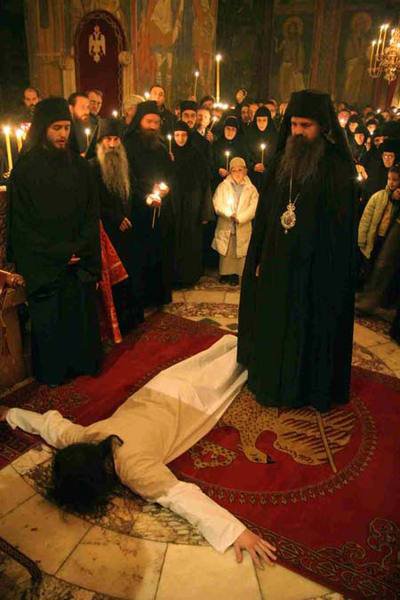


We are, however, the unfortunate products of our fallen nature, and it is rare that even a pious Orthodox parent is thrilled to hear that their offspring desires to enter a monastery. More often there arise some very strong reactions in the heart which, however innocent and well-intentioned, are nonetheless aspects of our fallen emotional and psychological nature – and a sad reflection of our un-Orthodox background and environment. With this in mind we can examine some of the emotional responses which this issue so often evokes.

Verbally, the various emotions stem from the pivotal question, “Why?” Why does anyone leave the world to enter a monastery? If the reason is legitimate, it is because in spite of all his failings and weaknesses, your child loves God more than anyone or anything in the world–more than the life you helped shape him for, more than his automobile, more than the school to which you were going to send him, more than his family… And here the very natural feeling of jealousy arises. As parents you may endeavor to replace God as being central in your child’s affections and persuade him to forsake monasticism, If you succeed, you will only make the child unhappy, and if you fail, you’ re going to feel very hurt.

Secondly. you may feel estranged or shut out from your child’s life. If your daughter goes to a monastery, and it’s a life you have not shared, you may feel you can’t relate to her. If she married, even if she moved a thousand miles away, you would very likely feel that you were still more a part of her life than if she became a nun and lived 50 miles away. A married daughter would still need advice on how to cope with the children’ s illnesses or how to manage a tight budget. On the other hand, if she were in a convent, you could hardly give her advice on how to do Matins, and even if you are Orthodox, you might feel emotionally adrift and very awkward with this suddenly foreign someone in black whose life is so different from your own. Then there is also the fact that most parents look forward to being grandparents, this is a big issue, especially with mothers.

You may feel threatened. You spend your whole life nurturing the well-being of your children: you feed them and worry over them; you help them to discover their abilities and you encourage them to develop their talents. Perhaps your son is a natural musician or your daughter a born lawyer, and you spend your life supporting them–emotionally and financially–and preparing them to be successful in the world. And after all these years of effort and anxiety, they suddenly decide they want no part of it, they don’t want the world, nor the life that you envisioned for them. This can be a very threatening and painful revelation. Very often parents feel that in rejecting the world, their child is also rejecting them. This is not necessarily true at all, but this feeling sparks most of the disputes between parents and their children over the issue of monasticism. Here also parents may feel they have failed in some way in their raising of the child, that he or she should choose such an “aberrant” path in life. This is also a painful thought.

The rather heated emotions which may arise over the issue of monasticism and one’s child frequently result in a barrage of reproaches. The following examples are not in the least hypothetical; they come from a list of actual remarks made by real mothers and fathers, some of whom consider themselves to be devout Orthodox. Their responses illumine the essence of the dispute as it is felt in the heart of those who are Orthodox and yet live in the world. They’ve said that we are not taking responsibility for ourselves; that we are just leaning on someone else so as to avoid having to make our own decisions. They say that if we love our neighbor we should be working to improve society and not dropping out of it into some euphoric dream. We often hear that monasticism is mere ostentation, some kind of fake spirituality: “Why don’t you stick it out in the world like the rest of us, where you have to deal with real life and real problems?” They say monasticism is selfish, egocentric, it divides and ruins the family; monasticism is “financially unstable”: What about your future security? Why don’t you just get a good job and send them all the money?…

While these remarks are quite varied, there is a common denominator, and that is worldliness. They are all rooted in a very worldly orientation. It is the complete and absolute rejection of this perspective on the part of the monastic aspirant which often makes the dispute between parents and child so violent, Although perhaps unconscious, the parents’ message underlying all this is: Conform yourself to the world; fit in; get a secure job; settle down; do what everyone else does…; spirituality is fine, but there’s no need to be extreme. We have already seen, however, that Christianity is otherworldly; by its very notate it is extreme: if you lose your life you shall gain it; if you try to hang onto it you will lose it; God became man that men might become gods. What could be more extreme?

Seek ye first the kingdom of God

Orthodoxy is the means by which we ascend unto God, through surrendering our own ego and self-will. Orthodoxy means war–against one’s fallen nature, against the devil, and against the world. This applies to all Orthodox Christians. Even those who live in the world–who have children and hold jobs–are required to keep themselves in some sense apart from the world. And there can be no compromise. The world is not and cannot be our home, and whether we choose to marry Christ or an earthly spouse, we can in no sense marry’ the world. We see, however, that it is precisely this desire–to have both God and the world–that is at the rooter the conflict evoked by the child’s entrance into monasticism. Experiencing their own reaction to the child’s rejection of the world may make the parents realize, perhaps as never before, their own attachment to the world, and how unwilling they are to sever themselves from the values and desires of the anti-Christian society in which they live.

It is especially difficult to struggle against the accepted view of the family which in this country has received a pseudo-religious status; youngsters are often all but worshipped as gods by their parents who see them as fulfilling their own egos. This is not Orthodox; it is, in fact, very destructive of our Orthodoxy which teaches that children are not the possession of their mothers and fathers: they are not playthings of their parents’ imaginations. Children are given by God for a time that they may be raised up in the knowledge of Him, and after that He summons them as He will. The duty of parents is not to prepare children to settle comfortably in the world, but to shepherd their souls, to prepare them to battle against the fallen world. Those who choose to fight in the front lines are those who hear the monastic calling. If your child wants to enlist in that war, he will swear before God and man that despite his sinfulness and frailties that overwhelm him at every hour of the day, he cannot find rest apart from God.

If such is the inclination of your child, do not hold him back, however logical your reasons For wanting to do so may be. If the desire for monasticism is simply a fanciful notion, they will find out soon enough, and nothing will be harmed by their trying. If, however, such a desire has indeed been planted by God as a means of their achieving salvation, don’t thwart it by trying to persuade him first to finish school or experience life in the world. Bring to mind the countless number of monastics, both men and women, whose spiritual legacy has so greatly enriched our holy Orthodox Church. If your child has the desire and determination to follow in their steps, however weakly, bless him, let him go. And may this blessing be also unto your own salvation and that of others.

Το Θανατο του παιδιου ( Γεροντας Παϊσιος )


- Μια μάνα, Γέροντα, που το παιδί της πέθανε πριν από εννέα χρόνια, σας παρακαλεί να
κάνετε προσευχή να το δη έστω στον ύπνο της, για να παρηγορηθή.
- Πόσων χρόνων ήταν το παιδί; ήταν μικρό; Είναι σημαντικό αυτό. Άμα το παιδί ήταν
μικρό και η μητέρα είναι σε κατάσταση που, αν της παρουσιασθή, δεν θα αναστατωθή, θα
παρουσιασθή. Αιτία είναι η μητέρα που δεν παρουσιάζεται το παιδί.
- Μπορεί, Γέροντα, αντί να παρουσιασθή το παιδί στην μητέρα που το ζητάει, να
παρουσιασθή σε κάποιον άλλον;
- Πως δεν μπορεί! Κανονίζει ανάλογα ο Θεός. Όταν ακούω για τον θάνατο κάποιου νέου,
λυπάμαι, αλλά λυπάμαι ανθρωπίνως. Γιατί, αν εξετάσουμε τα πράγματα πιο βαθιά, θα δούμε ότι, όσο μεγαλώνει κανείς, και περισσότερο αγώνα πρέπει να κάνη, αλλά και περισσότερες αμαρτίες προσθέτει. Ιδίως όταν είναι κοσμικός, όσο περνούν τα χρόνια, αντί να βελτιώση την πνευματική του κατάσταση, την χειροτερεύει με τις μέριμνες, με τις αδικίες κ.λπ. Γι' αυτό είναι πιο κερδισμένος, όταν τον παίρνη ο Θεός νέο.
-Γέροντα, γιατί ο Θεός επιτρέπει να πεθαίνουν τόσοι νέοι άνθρωποι;
- Κανείς δεν έχει κάνει συμφωνία με τον Θεό πότε θα πεθάνη. Ο Θεός τον κάθε άνθρωπο
τον παίρνει στην καλύτερη στιγμή της ζωής του, με έναν ειδικό τρόπο, για να δώση την ψυχή
του. Εάν δη ότι κάποιος θα γίνη καλύτερος, τον αφήνει να ζήση. Εάν δη όμως ότι θα γίνη
χειρότερος, τον παίρνει, για να τον σώση.

Μερικούς πάλι που έχουν αμαρτωλή ζωή, αλλά έχουν
την διάθεση να κάνουν καλό, τους παίρνει κοντά Του, πριν προλάβουν να το κάνουν, επειδή
ξέρει ότι θα έκαναν το καλό, μόλις τους δινόταν η ευκαιρία. Είναι δηλαδή σαν να τους λέη:
«Μην κουράζεσθε· αρκεί η καλή διάθεση που έχετε». Άλλον, επειδή είναι πολύ καλός, τον
διαλέγει και τον παίρνει κοντά Του, γιατί ο Παράδεισος χρειάζεται μπουμπούκια.
Φυσικά οι γονείς και οι συγγενείς είναι λίγο δύσκολο να το καταλάβουν αυτό. Βλέπεις,
πεθαίνει ένα παιδάκι, το παίρνει αγγελούδι ο Χριστός, και κλαίνε και οδύρονται οι γονείς, ενώ
έπρεπε να χαίρωνται, γιατί που ξέρουν τι θα γινόταν, αν μεγάλωνε; Θα μπορούσε άραγε να
σωθή;

Όταν του 1924 φεύγαμε από την Μικρά Ασία με το καράβι, για να έρθουμε στην Ελλάδα,
εγώ ήμουν βρέφος. Το καράβι ήταν γεμάτο πρόσφυγες και, όπως με είχε η μητέρα μου μέσα στις φασκιές, ένας ναύτης πάτησε επάνω μου. Η μάνα μου νόμισε ότι πέθανα και άρχισε να κλαίη.
Μια συγχωριανή μας άνοιξε τις φασκιές και διαπίστωσε ότι δεν είχα πάθει τίποτε. Αν πέθαινα
τότε, σίγουρα θα πήγαινα στον Παράδεισο. Τώρα που είμαι τόσων χρονών και έχω κάνει τόση
άσκηση, δεν είμαι σίγουρος αν πάω στον Παράδεισο.
Αλλά και τους γονείς βοηθάει ο θάνατος των παιδιών. Πρέπει να ξέρουν ότι από εκείνη
την στιγμή έχουν έναν πρεσβευτή στον Παράδεισο. Όταν πεθάνουν, θα 'ρθούν τα παιδιά τους με εξαπτέρυγα στην πόρτα του Παραδείσου να υποδεχθούν την ψυχή τους.

Δεν είναι μικρό πράγμα αυτό!

Στα παιδάκια πάλι που ταλαιπωρήθηκαν εδώ από αρρώστιες ή από κάποια αναπηρία ο
Χριστός θα πη: «Ελάτε στον Παράδεισο και διαλέξτε το καλύτερο μέρος». Και τότε εκείνα θα
Του πουν: «Ωραία είναι εδώ, Χριστέ μας, αλλά θέλουμε και την μανούλα μας κοντά μας». Και ο Χριστός θα τα ακούση και θα σώση με κάποιον τρόπο και την μητέρα.
Βέβαια δεν πρέπει να φθάνουν οι μητέρες και στο άλλο άκρο. Μερικές μανάδες
πιστεύουν ότι το παιδί τους που πέθανε αγίασε και πέφτουν σε πλάνη.

Μια μητέρα ήθελε να μου δώση κάτι από τον γιο της που είχε πεθάνει, για ευλογία, γιατί πίστευε ότι αγίασε. «Έχει ευλογία, με ρώτησε, να δίνω τα πράγματά του;» «Όχι, της είπα, καλύτερα να μη δίνης». Μια
άλλη είχε κολλήσει την Μεγάλη Πέμπτη το βράδυ στον Εσταυρωμένο την φωτογραφία του
παιδιού της που το είχαν σκοτώσει οι Γερμανοί και έλεγε: «Και το παιδί μου σαν τον
Χριστό έπαθε». Οι γυναίκες που κάθονταν και ξενυχτούσαν στον Εσταυρωμένο την άφησαν, για να μην την πληγώσουν. Τι να έλεγαν; Πληγωμένη ήταν.


Γεροντας Παϊσιος

Να συγκρίνουμε την δοκιμασία μας με την δοκιμασία του άλλου. ( Γεροντας Παϊσιος )


Να συγκρίνουμε την δοκιμασία μας με την μεγαλύτερη δοκιμασία του άλλου. Το καλύτερο φάρμακο για την κάθε δοκιμασία μας είναι η μεγαλύτερη δοκιμασία των συνανθρώπων μας, αρκεί να την συγκρίνουμε με την δική μας δοκιμασία, για να διακρίνουμε την μεγάλη διαφορά και την μεγάλη αγάπη που μας έδειξε ο Θεός και επέτρεψε μικρή δοκιμασίασ' εμάς.

Τότε θα Τον ευχαριστήσουμε, θα πονέσουμε για τον άλλον που υποφέρει πιο πολύ καιθα κάνουμε καρδιακή προσευχή να τον βοηθήση ο Θεός. Μου έκοψαν λ.χ. το ένα πόδι: «Δόξα Σοι ο Θεός, να πω, που έχω τουλάχιστον ένα πόδι· του άλλου του έκοψαν και τα δύο».

Και αν
ακόμη μείνω ένα κούτσουρο, χωρίς χέρια και πόδια, πάλι να πω: «Δόξα Σοι ο Θεός, που περπατούσα τόσα χρόνια, ενώ άλλοι γεννήθηκαν παράλυτοι».
Εγώ, από την στιγμή που άκουσα ότι ένας οικογενειάρχης έχει έντεκα χρόνια αιμορραγία, είπα: «Τι κάνω εγώ; Κοσμικός άνθρωπος αυτός και να έχη έντεκα χρόνια αιμορραγία, να έχη παιδιά, να πρέπη να σηκωθή το πρωί να πάη στην δουλειά, και εγώ ούτε επτά χρόνια δεν συμπλήρωσα που έχω αιμορραγίες!».

Αν σκέφτωμαι τον άλλον που υποφέρει τόσο πολύ, δεν μπορώ να δικαιολογήσω τον εαυτό μου. Ενώ, αν σκέφτωμαι ότι εγώ υποφέρω και οι άλλοι είναι μια χαρά, ότι σηκώνομαι την νύχτα κάθε μισή ώρα, επειδή έχω πρόβλημα με το έντερο και δεν μπορώ να κοιμηθώ, ενώ οι άλλοι κοιμούνται ήσυχα, δικαιολογώ τον εαυτό
μου, αν γογγύσω. Εσύ, αδελφή, πόσον καιρό έχεις τον έρπητα;
- Οκτώ μήνες, Γέροντα.
- Βλέπεις; Ο Θεός σε άλλους τον αφήνει δύο μήνες, σε άλλους δέκα μήνες, σε άλλους δεκαπέντε. Καταλαβαίνω, είναι μεγάλος ο πόνος. Μερικοί φθάνουν σε απόγνωση.

Ένας κοσμικός όμως που έχει έρπητα έναν-δύο μήνες και από τον πολύ πόνο απελπίζεται, να μάθη ότι ένας πνευματικός άνθρωπος τον έχει έναν χρόνο και κάνει υπομονή και δεν γογγύζει, τότε αμέσως παρηγοριέται. «Βρε, λέει, εγώ τον έχω δύο μήνες και έφθασα στην απελπισία· ο άλλος ο καημένος έναν χρόνο τον έχει και δεν μιλάει!
Εγώ κάνω και αταξίες, ενώ εκείνος ζη πνευματικά!». Οπότε βοηθιέται χωρίς συμβουλή!

π. Παισιος

Tuesday, August 27, 2013

ΓΕΡΟΝΤΑΣ ΕΦΡΑΙΜ ΤΗΣ ΑΡΙΖΟΝΑ "Από Σεπτέμβρη αρχίζουν τα δύσκολα"


Και δύο λόγια από τον γέροντα Εφραίμ της Αριζόνα, τον μόνο εν ζωή εκ των τριών μεγάλων Γερόντων της Ορθοδοξίας (οι άλλοι δύο ήταν ο Ιωσήφ ο Βατοπαιδινός, και ο Παϊσιος): "ετοιμασία επειδή ΣΥΝΤΟΜΑ θα αρχίσουν τα πολύ δύσκολα"...

Από το Σεπτέμβριο έρχονται δύσκολα... "Δεν μπορώ να καταλάβω τον κόσμο. Όλοι ρωτάνε: "εμένα με πιάνουν τα νέα μέτρα;"!!! Ειλικρινά, δεν μπορώ να κατανοήσω πόσο πολύ έχει διαβρωθεί η σύγχρονη κοινωνία και οι άνθρωποι που ζούνε σε αυτή τη χώρα. Κανείς δε νοιάζεται για τον διπλανό του.

Κανείς δε νοιάζεται για το πρόβλημα που έχει χτυπήσει την πόρτα του συμπολίτη του, του γείτονά του. Όλοι σκέφτονται αν "τα μέτρα" προσβάλουν τα δικά τους μικροσυμφέροντα...! Ποιά ηθική υπάρχει πλέον;

Το κακό έχει χτυπήσει την οικογένεια, την Παιδεία. Έχει χτυπήσει σε κάθε υγιές κύτταρο της κοινωνίας και σήμερα ζούμε τα αποτελέσματα αυτού του πολέμου. Τρέχουν οι άνθρωποι χωρίς να νοιάζονται για τον διπλανό τους. Η κοινωνία που ξέραμε δεν υπάρχει πια. Σήμερα κυριαρχεί ο ατομικισμός...

Γιατί; Επειδή κάποιοι έπαιξαν με τον χαρακτήρα του Έλληνα και διάβρωσαν όλα εκείνα τα χαρακτηριστικά που θα μπορούσαν να τον βοηθήσουν. Είναι αδιανόητο! Ο ατομικισμός ζει και βασιλεύει, ενώ η απάτη έγινε "χάρισμα". Μεγάλωσαν γενιές που διδάχτηκαν πως να αρπάξουν. Και αυτό σε ένα καθεστώς πλήρους ατιμωρησίας...

Μάλιστα, όσα πιο πολλά "αρπάζεις" τόσο περισσότερο απομακρύνεσαι από την τιμωρία. Αυτό το βλέπει ο Θεός. Σήμερα επιτρέπει να δεχτούμε μερικές σφαλιάρες, ελπίζοντας πως θα συνέλθουμε, όπως συμβαίνει και στους μεθυσμένους..." "Να πεις και σε άλλους να προσέχουν. Μην αφήνετε την λογική σας να παραδίνεται σε όσα σας λένε.

Πού είναι μωρέ η λεβεντιά εκείνων που δεν επέτρεπαν σε κανέναν να τους μειώσει; Πού είναι εκείνα τα λεβεντόπαιδα που έδωσαν το αίμα τους για όλους εμάς; Αυτή η γη ποτίστηκε με αίμα. Είναι μεγάλο κρίμα να την κυβερνάνε ξένοι και ανάξιοι... Να προσέχετε"...


ΓΕΡΟΝΤΑΣ ΕΦΡΑΙΜ ΤΗΣ ΑΡΙΖΟΝΑ 


 http://nefthalim.blogspot.ca/2013/08/blog-post_8671.html

Τα Παθη - Γεροντα Νικων

God's Love for us


I did not know His love before, the way I know it now.

I could not see my need for Him, my pride would not allow.

I had it all, without a care, the “Self-sufficient” lie.

My path was smooth, my sea was still, not a cloud was in my sky.


I thought I knew His love for me, I thought I’d seen His grace,

I thought I did not need to grow, I thought I’d found my place.

But then the way grew rough and dark, the storm clouds quickly rolled;

The waves began to rock my ship, I found I had no hold.

..


The ship that I had built myself was made of foolish pride.

It fell apart and left me bare, with nowhere else to hide.

I had no strength or faith to face the trials that lay ahead,

And so I simply spoke His name and bowed my weary head.

..


His loving arms enveloped me, and then He helped me stand.

He said, “You still must face this storm, but I will hold your hand.”

So through the dark and lonely night He guided me through pain.

I could not see the light of day or when I’d smile again.

..


Yet through the pain and endless tears, my faith began to grow.

I could not see it at the time, but my light began to glow.

I saw God’s love in brand new light, His grace and mercy, too.

For only when all self was gone could Jesus’ love shine through.

..


It was not easy in the storm, I sometimes wondered why.

At times I thought, “I can’t go on.” I’d hurt, and doubt, and cry.

But Jesus never left my side He guided me each day

Through pain and strife, through fire and flood, He helped me all the way.

..


And now I see as never before how great His love can be.

How in my weakness He is strong, how Jesus cares for me!

He worked it all out for my good, although the way was rough.

He only sent what I could bear, and then He said, “Enough!”

..


He raised His hand and said, “Be still!” He made the storm clouds cease.

He opened up the gates of joy and flooded me with peace.

I saw His face now clearer still, I felt His presence strong,

I found anew His faithfulness, He never did me wrong.

..


And now I know more storms will come, but only for my good,

For pain and tears have helped me grow as nothing ever could.

I still have so much more to learn as Jesus works in me;

If in the storm I’ll love Him more, that’s where I want to be.

A.S.A.P.


Ever wonder about the abbreviation of

A.S.A.P.
As Soon As Possible
Generally we think in terms of even more
hurry and stress in our lives. If we
think of this abbreviation in a different
manner, we may begin to find a new way
to deal with those rough days along the way


…………………
Always Say A Prayer
There’s work to do, deadlines to meet.
you’ve got no time to spare.
But as you hurry and scurry…
A.S.A.P.
…………………
Always Say A Prayer
In the midst of family chaos,
“quality time” is rare.
Do your best; let God do the rest…
ASAP
…………………
Always Say A Prayer
It may seem like your worries
are more than you can bear.
Slow down and take a breather…
ASAP
…………………
Always Say A Prayer
God knows how stressful life can be
and wants to ease our cares.
He’ll respond to all your needs…
ASAP
…………………
Always Say A Prayer
Today I’m saying a little prayer
that God will send a smile to you
and send you special blessings
through everything you have to do
A.S.A.P.

Δεν αμάρτησες που “δοκίμασες” το φαγητό ( Ἅγιος Πορφύριος )


Εγώ πάντα νήστευα. Έκανα όπως όλες οι μητέρες που δεν θέλουν δυστυχώς να στερούν τα παιδιά τους. Τα έβαζα να νηστεύουν τρεις μέρες μόνο.

Επίσης είχα τη συνήθεια, όταν έκανα κρέμα, να βάζω το δάχτυλό μου μέσα και να τη γεύομαι. Κάπου με βασάνιζε αυτό αν ήταν αμαρτία, και το σκεφτόμουνα.

Μια μέρα το Δεκαπενταύγουστο συγκεκριμένα, είχα ξένους και ντρεπόμουνα να πω: «Εγώ δεν τρώω, να ετοιμάσω μόνο για σας». Έφερα λοιπόν, μπριζόλες και πατάτες και αναγκάστηκα να φάω μαζί τους. Πήγα μετά στον Γέροντα και του είπα και για τα δυο.

Μου λέει: «Έλα μωρέ που έκανες έτσι και τάχα αμάρτησες.

Απλώς γεύτηκες κάτι για να δεις εάν είναι γλυκό ή αλμυρό. Για το φαγητό όμως δεν έπρεπε να το κάνεις. Άλλη φορά να μην το ξανακάνεις».
Από το βιβλίο «Ανθολόγιο Συμβουλών»


Ἅγιος Πορφύριος

Η δύναμη της εξομολογήσεως ( Γεροντας Παϊσιος )


- Γέροντα, μερικοί χαρακτήρες που είναι δύσκολοι, στριμμένοι, πως θα βοηθηθούν;

- Εγώ σαν μαραγκός δούλευα και στριμμένα ξύλα. Χρειαζόταν όμως υπομονή, γιατί τα στριφτά ξύλα τα πλανίζεις από ‘δώ, σηκώνουν αντιξυλιά, τα πλανίζεις από ‘κεί, σηκώνουν πάλι αντιξυλιά. Τα έτριβα λοιπόν με το διπλό λεπίδι λίγο από τι μια μεριά κόντρα, λίγο από την άλλη, και έτσι τα έφερνα σε λογαριασμό. Γίνονταν μάλιστα πολύ όμορφα, επειδή και ωραία νερά έχουν και δεν σπάζουν εύκολα· έχουν πολλή αντοχή. Αν δεν το ήξερες αυτό, μπορεί να τα έβλεπες έτσι και να τα πετούσες. Θέλω να πω, και οι άνθρωποι που έχουν δύσκολο χαρακτήρα, έχουν μέσα τους δυνάμεις και, να αφεθούν να τους δουλέψης, μπορούν να κάνουν άλματα στην πνευματική ζωή, αλλά χρειάζεται να διαθέσης αρκετό χρόνο.

Ύστερα, ποτέ δεν χρησιμοποιούσα μεγάλες πρόκες, για να σφίξω δυο στραβές σανίδες, αλλά πρώτα τις πλάνιζα, τις έφερνα σε λογαριασμό, και τις ένωνα με ένα καρφάκι. Δεν τις ζόριζα, για να σφίξουν, γιατί, όταν τις στραβές σανίδες προσπαθούμε να τις κάνουμε να εφαρμόσουν με μεγάλες πρόκες, θα σχισθούν και πάλι θα βγουν από την ζορισμένη εφαρμογή τους, οπότε τι καταλάβαμε;

Χρειάζεται διάκριση και ξανά διάκριση, όταν έχη κανείς να κάνη με ψυχές. Στην πνευματική ζωή δεν υπάρχει μία συνταγή, ένας κανόνας. Η κάθε ψυχή έχει την δική της ποιότητα και χωρητικότητα. Υπάρχουν δοχεία με μεγάλη χωρητικότητα και δοχεία με μικρή χωρητικότητα. Άλλα είναι πλαστικά και δεν αντέχουν πολύ και άλλα είναι μεταλλικά και αντέχουν. Όταν ο πνευματικός γνωρίση την ποιότητα και την χωρητικότητα της ψυχής, θα ενεργή ανάλογα με τις δυνατότητες και με την κληρονομικότητα που έχει, και με την πρόοδο που έχει κάνει. Η συμπεριφορά του θα είναι ανάλογη με την κατάσταση στην οποία βρίσκεται ο εξομολογούμενος, με την αμαρτία που έκανε, και με ένα σωρό άλλα. Στον αναιδή θα προσέξη να μη δίνη δικαίωμα για αναίδεια. Την ευαίσθητη ψυχή θα κοιτάξη πώς να την βοηθήση να αντιμετωπίση με ανδρισμό τα προβλήματά της.

Επίσης θέλει προσοχή να μη βασίζεται κανείς σ’ αυτό που βλέπει εξωτερικά σ’ έναν άνθρωπο και να μην πιστεύη εύκολα αυτά που του λένε και βγάζει συμπεράσματα, ειδικά αν δεν έχη το χάρισμα να βλέπη βαθύτερα. Μερικές σανίδες, ενώ φαίνονται κατάγερες απ’ έξω, μέσα είναι όλο ίνες. Όταν πλανισθή το χνούδι που έχουν απ’ έξω, τότε δείχνουν τι είναι. Άλλες πάλι, ενώ απ’ έξω φαίνονται άχρηστες, μέσα είναι δαδένιες.

Ο χειρισμός της ψυχής είναι λεπτός. Δεν πρέπει να γίνωνται λάθη στις συνταγές. Ο κάθε οργανισμός, βλέπετε, έχει ανάγκη από την βιταμίνη που του λείπει και η κάθε πάθηση από τα ανάλογα φάρμακα.


Γεροντας Παϊσιος

Monday, August 26, 2013

The several types of Bows in Church


Orthodox worship is characterized by a complete utilization of the senses sight, smell, hearing, speech and touch. We see the candles, Icons, frescoes, etc., we hear the sounds of singing and reading, at times lifting up our own voices, and we smell the characteristic odor of the incense. The whole of the human person is involved in worship, and important among the senses is the actual deportment of the human body. The attitude of the Orthodox Believer to worship is reverential, and certain types of bodily movements are utilized to reinforce this sense of reverential piety we stand during the services, we make bows and prostrations, and with great frequency, we make the Sign of the Cross. Accordingly, there are several types of Bows, depending on the solemnity of the moment.


Prostration (Great Metanoia Great Poklon).

Here the worshipper prostrates the whole body, throwing the weight forwards onto the hands and touching the ground with the forehead.

Bow (Small Metanoia Poklon).

The worshipper bows from the waist, touching the ground with the fingers of the right hand. Both Prostrations and Bows are preceded by the Sign of the Cross.

Reverence.

At certain times the worshipper merely bows the head; sometimes this is accompanied by the Sign of the Cross.

Sign of the Cross.

The Sign of the Cross is made with the thumb and the first two fingers of the right hand joined at the tips (the third and fourth fingers being closed on the palm). By joining the thumb and the first two fingers, we express our belief in the Most-Holy Trinity. The two fingers closed on the palm represent the two natures of Christ divine and human. With the thumb and first two fingers joined, we touch first the brow, then the breast, the right shoulder and then the left, making on ourselves the Sign of the Cross and signifying by the four points that the Holy Trinity has sanctified our thoughts (mind), feelings (heart), desires (soul) and acts (strength) to service of God. By making the Sign of the Cross on ourselves we also signify that Christ has saved us by His sufferings on the Cross.

Bishops and Priests, in bestowing a blessing, make the Sign of the Cross from left to right (appearing to us from right to left), while holding the fingers in such a manner as to represent the Greek letters IC and XC the first and last letter of the name Jesus Christ.

Life and personality of Abbess Taisia ( Elder Joseph of Vatopedi )


Our Church, with its rich patristic tradition, is not devoid of examples and stories on spiritual matters in order to coach its people. Both our Fathers and the martyrs have left abundant material of remarkable splendor which refers to their life stories. Their sweet smelling sayings and their teachings have drawn the luminous trail for the salvation of those who would like to take the narrow and sorrowful path which leads to the Kingdom of God.


However, the enormousness of our Lord Jesus Christ’s godlike might, which is the same “yesterday and today and to all Eternity” continues, not just those days but also today and until the end of times, to promote the spiritual stature of the heroes of our faith. This is something which is very consoling and encouraging for our generation.

To the dismay of humanism and of those attitudes which deny everything, which are the invention of our enemy, our living, fructified Church, endlessly promotes the splendid achievements of its children, even nowadays, not just in our tiny country but in all Orthodoxy.

The present story is a living testimony in the tradition of the sister Russian Church, which is fighting the good struggle of faith in accordance with the exact line of our holy tradition.

Abbess Taisia’s biography seems to be a bright and worthy of imitation example of vividness and rhythm to those who would like to copy her cross-carrying model. Of course it does not refer to anything new, simply because there is nothing new. But it seals our holy tradition with confidence and evaluates the merits and the contributions that our Holy Monasteries make to history.

Her special personality with the cohabiting Divine Grace even from an early age is the main element which has contributed to her success in spiritual life. The presence of spiritual Elders in her life has also become the strong weapon and means with which she used to accomplish her significant mission.

Assisted by her personality, which was dstable and decisive, she managed to correctly evaluate the power of faith. Thus everything was becoming possible and achievable, even at the times when all conspired to the contrary. If however the saying that “everything is possible to those who believe” is true, then it was not possible for this blessed soul, which was dressed in the garment of faith, to be disappointed.

Indeed! How much can faith achieve if it is connected to prayer! It is true that faith and prayer, like wings, can raise the struggler beyond the laws of nature. This blessed sister has handed over herself to the realm of submission and obedience with true self- denial. The resulting deadening of her former self, granted her perseverance and patience in the face of various tribulations, since according to our Lord “it is impossible for calamities not to occur”.

The blessed deadening and suppression of her passions and especially of the monstrous selfishness, by persevering in the various temptations, have provoked quietude of thoughts and the blessed hope. Thus, divine love, through its double energy towards God and towards our fellow humans, granted this blessed Abbess the virtue to constantly sacrifice herself for the sake of others.

The brilliant achievements of this blessed soul are so timely and instructive, that I believe that ,with her blessing, she will be able to console well into the future all faithful souls and especially the most pious ones, who have discerned the futility of this world.

Elder Joseph monk.

Vatopedi monastery 11 October 1991. Source: Preface to the Greek edition of the book : Abbess Taisia Leouseni- A spiritual daughter of Saint John of Kronstadt

Γερόντισσα Γαβριηλία - Gerontissa Gabriela


Thou hast made me known to friendsWhom I knew not.Thou hast given me seats in homes not my own. Thou hast brought the distant near
And made a brother of the stranger.
I am uneasy at heart
When I have to leave my accustomed shelter, I forget that there abides the old in the new, and that there also, Τhou abidest.
Through birth and death,
in this world or in others,
wherever Τhou leadest me,
it isΤhou the same,
the One Companion of my endless life, who ever linkest my heart
with bonds of joy to the Unfamiliar.
When one knows Τhee, then alien there is none, then no door is shut.
Oh! Grant me my prayer
That I may never lose the bliss
Of the touch of the One
In the play of the many.
Συ με γνώρισες στον άγνωστο κι έγινε φίλος.Ζεστή μου χάρισες γωνιάΣε σπιτικά που δε με ξέραν. Με σε, το πέρα είναι εδώ
Και αδελφός μου ο κάθε ξένος.
Κι αν φοβηθώ ποτέ ν’ αφήνω το χθεσινό μου το απάγγιο, είναι που θα ξεχνώ πως στο καινούριο το παλιό θα βρίσκω πάλι,
Αφού Εσύ κι εκεί υπάρχεις.
Με την γέννηση, με τον θάνατο,σ’ αυτόν τον κόσμο ή τον άλλον, όπου κι αν με πας θα ‘σαι Εσύ, πάντα Εσύ, ο ίδιος και ο μόνος συνοδοιπόρος και σύντροφος της ατελεύτητης ζωής μου.
Σύ που ξέρεις, που μπορείς, με χαρμόσυνα δεσμά την καρδιά μου με το Άγνωστο να δένεις.
Για κέινον που σε γνώρισε. Άγνωστος δεν είναι κανείς, πορτά καμμιά κλειστή δεν μένει.
Εισάκουσε την προσευχή μου,
Να μη χάσω ποτέ τον όλβο αυτόν
Της άρρηκτης συνδέσεως με τον Ένα,
Μες στων πολλών ανθρώπων την βοή.

Does Satan Know All the Thoughts & Plans of Man? ( St. Macarius the Great )


If one man is with another person and knows things concerning him, and if you, twenty years old, know things concerning your neighbour, can Satan, who has been with you from birth, not know your thoughts? For he is already many years old. Still we do not say that before he tempts he knows what man will intend to do. For the tempter tempts, but he does not know whether a person will obey him or not until one gives up his will as a slave. Neither again do we maintain that the devil knows all the thoughts of a person’s heart and its desires. Like a tree, it has many branches and limbs. So the soul has certain branches of thoughts and plans and Satan grasps some of them. There are other thoughts and intentions that are not grasped by Satan.


For in one matter the side of evil takes an upper hand in thoughts that arise. In another matter, again, the thought of man is superior as he receives help and deliverance from God and he resists the evil. In one thing he is overcome and in another he has his will. For sometimes he comes to God with fervor and Satan knows this and sees that man is repelling him and that he is incapable of restraining him. Why is this? Because a person has the desire to cry out to God. He has the natural fruits of loving God, of believing him, of seeking him and coming to him.

Excerpt taken from the book:

Pseudo-Macarius, The Fifty Spiritual Homilies & the Great Letter


St. Macarius the Great

How did the Apostles die....


1 Matthew

Suffered martyrdom in Ethiopia , killed by a sword wound.
2  Mark

Died in Alexandria , Egypt , after being dragged by horses through the streets until he was dead.
 

3 Luke

Was hanged in Greece as a result of his tremendous preaching to the lost.


4 John

Faced martyrdom when he was boiled in huge basin of boiling oil during a wave of persecution in Rome. However, he was
miraculously delivered from death. John was then sentenced to the mines on the prison island of Patmos, Greece. He wrote his prophetic Book of Revelation on Patmos . The apostle John was later freed and returned to serve as Bishop of Edessa in modern Turkey. He died as an old man, the only apostle to die peacefully.
5  Peter

He was crucified upside down on an x-shaped cross. According to church tradition it was because he told his tormentors that he felt unworthy to die in the same way that Jesus Christ had died.


6  James the Just

The leader of the church in Jerusalem, was thrown over a hundred feet down from the southeast pinnacle of the Temple
when he refused to deny his faith in Christ.. When they discovered that he survived the fall, his enemies beat James to death with a fuller’s club.
* This was the same pinnacle where Satan had taken Jesus during the Temptation.


7 James the Great

Son of Zebedee, was a fisherman by trade when Jesus called him to a lifetime of ministry. As a strong leader of the church, James was ultimately beheaded at Jerusalem . The Roman officer who guarded James watched amazed as James defended his faith at his trial. Later, the officer walked beside James to the place of execution. Overcome by conviction, he declared his new faith to the judge and knelt beside James to accept beheading as a Christian.


8 Bartholomew

Also known as Nathaniel, was a missionary to Asia. He witnessed for our Lord in present day Turkey. Bartholomew was martyred for his preaching in Armenia where he was flayed to death by a whip.


9 Andrew

Was crucified on an x-shaped cross in Patras , Greece. After being whipped severely by seven soldiers they tied his body to the cross with cords to prolong his agony. His followers reported that, when he was led toward the cross, Andrew saluted it in these words: ‘I have long desired and expected this happy hour. The cross has been consecrated by the body of Christ hanging on it.’ He continued to preach to his tormentors for two days until he expired.


10 Thomas

Was stabbed with a spear in India during one of his missionary trips to establish the church in the sub-continent.


11 Jude

Was killed with arrows when he refused to deny his faith in Christ.


12 Matthias

The apostle chosen to replace the traitor Judas Iscariot, was stoned and then beheaded.


13 Paul

Was tortured and then beheaded by the evil Emperor Nero at Rome in A.D. 67. Paul endured a lengthy imprisonment, which
allowed him to write his many epistles to the churches he had formed throughout the Roman Empire. These letters, which taught many of the foundational doctrines of Christianity, form a large portion of the New Testament.


Perhaps this is a reminder to us that our sufferings here are indeed minor compared to the intense persecution and cold cruelty faced by the apostles/disciples during their times for the sake of the Faith. And ye shall be hated of all men for my name’s sake:

But he that endureth to the end shall be saved.

Matthew 10:22

Ο Χριστός δεν μαλώνει


…Να γονατίσεις μπροστά στον Χριστό και να πεις:


”Κύριέ μου, εγώ κρύβομαι από τους ανθρώπους. Αλλά θέλω εσύ να με δεις όπως είμαι! Αυτός που είμαι! Να μ’ αγαπάς όπως είμαι. Να μη με μαλώσεις, γιατί δεν αντέχω να με μαλώνεις, γιατί απογοητεύομαι εύκολα αν με τσακίζεις…”. Και θα πει ο Χριστός:
”Πού είσαι παιδί μου; Σε περίμενα! Όχι! Εγώ καλάμι συντετριμμένο δεν θα το τσακίσω! Ούτε φλόγα που τρεμοσβήνει θα τη σβήσω,όχι!”
Όταν δει ο Χριστός ότι το κεράκι της ψυχής σου είναι σα να το φυσάνε οι άνεμοι, θα βάλει το χέρι Του μπροστά και τη φλόγα αυτή θα τη μεγαλώσει! Δεν θα σε τρομάξει! Δεν θα σε μαλώσει! Αλλά να γονατίσεις! Να ταπεινωθείς!

The 3D scan of a disabled baby’s smile that convinced his mother not to abort him


The 3D scan of a disabled baby’s smile that convinced his mother not to abort him – and why she is grateful she was able to cuddle him with joy for a few precious hours
Katyia Rowe was told her baby would never be able to walk or talk
But real-time moving scan showed him blowing bubbles and waving arms
She decided to go through with the birth but he died nine hours later

By LARISA BROWN


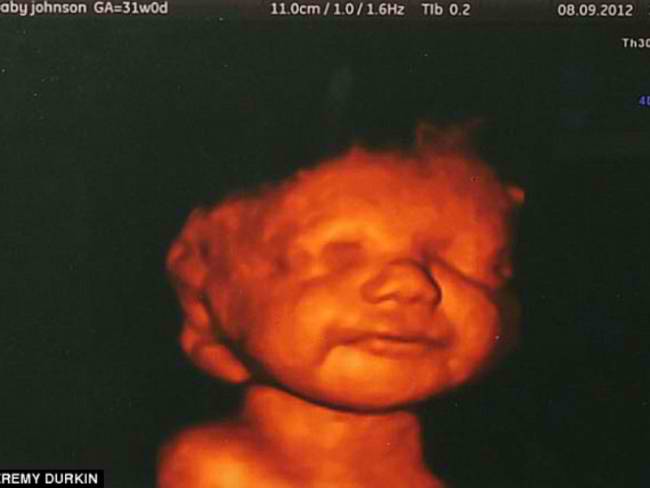
A mother was unable to abort her severely disabled son despite doctors’ warnings after seeing her baby’s smile in a 3D scan picture.

Katyia Rowe was told her baby’s brain had not formed properly and that he would never walk or talk and would need 24-hour care.

But after seeing real-time moving scans of him smiling, blowing bubbles, kicking and waving his arms she made the heartbreaking decision to go through with the birth.

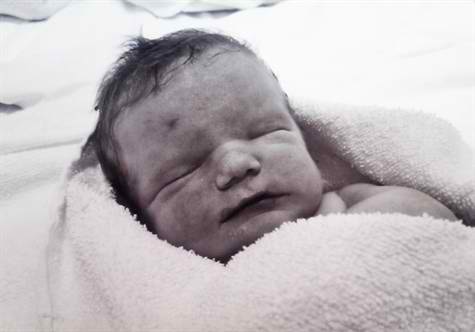
Tragically Lucian, as she named him, died nine hours after he was born.


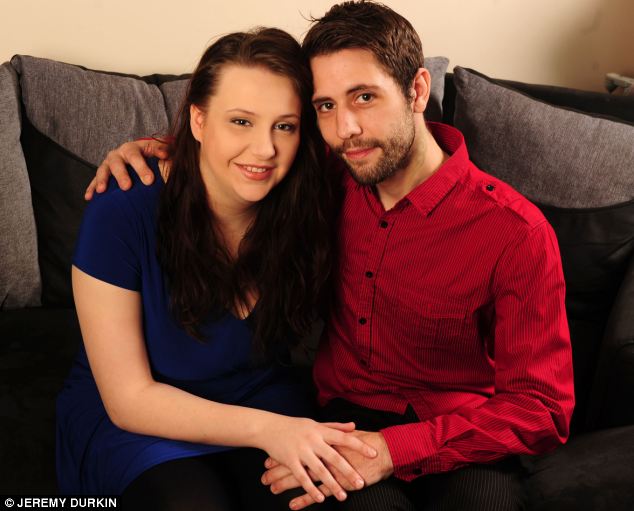
Mother Katyia Rowe gave birth to her severely disabled son Lucian, despite doctors advising her to have an abortion, after seeing a 3D scan of him smiling, pictured

Despite the ordeal, Ms Rowe said she had no regrets going through with the birth as she was able to cuddle her baby son.

Katyia, 26, a training administrator, said: ‘We were devastated to be told our son’s brain abnormalities were so severe they were life limiting we should consider a termination.

‘Further scans were arranged to asses the extent of his disabilities but when I saw him smiling and playing inside me I knew I couldn’t end his life.

‘If he could smile and play and feel then despite his disabilities he deserved to enjoy whatever life he had left, no matter how short. Just because his life would be shorter or different, didn’t mean he didn’t deserve to experience it.

‘As long as he was pain free I vowed to let him enjoy his life both while inside me and outside, no matter how long that be.’

Miss Rowe, from Telford, Shropshire was thrilled to discover she was expecting a baby with partner of four years security officer Shane Johnson, 26, in March last year.

She added: ‘It was a shock but we were thrilled. Shane and I were so excited and looking forward to the birth. We had so many plans for the future and could not wait to meet our baby.


Katyia Rowe and her partner Shane decided to have the baby despite the complications, saying the child deserved to live

‘Our first scan at three months was wonderful. When we saw our baby on screen for the first time we fell in love straight away. As far as we were concerned everything was perfect.’

The couple decided to wed when their son was old enough to walk down the aisle with them.

Only the 20-week scan highlighted complications.

Following further tests, doctors told Miss Rowe and her partner of four years that their baby’s brain had no formed properly and he would be severely disabled.

They were then told the tragic news by experts at Birmingham Children’s Hospital that their child would never walk or talk and would need 24-hour care.

The couple were offered the chance to terminate the baby at 24-weeks.

But despite his poor prognosis, being able to watch her son in real time 3D scans during the screening tests, Miss Rowe said she was astonished to see him smiling, blowing bubbles, kicking and waving his arms.

She said: ‘Despite all the awful things I was being told, while he was inside me his quality of life looked to be wonderful and no different to any other baby’s, he was a joy to watch.

‘I was told he would never walk or talk yet the scans showed him constantly wriggling and moving.

‘As I watched I knew that while I was carrying him he still had a quality of life and it was my duty as a mother to protect that no matter how long he had left, he deserved to live.’


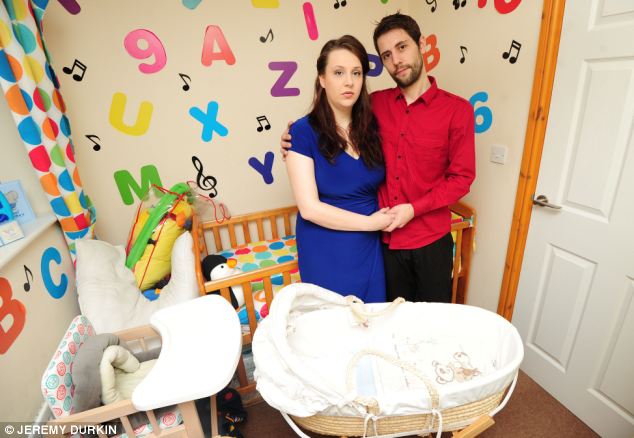
The couple pictured together in the room that was decorated for their baby boy Lucian. Tragically he died nine hours after his birth

Katyia was told if her son survived birth he would require 24 -hour care for the duration of his life expected to be anything up to five years.

She added: ‘It didn’t phase me at all. It was ironic because I had never considered myself particularly maternal but now I wanted nothing more than to care for my son and give him the best quality of life possible. I was more than happy to dedicate my life fully to his care.

‘I researched all his disabilities to prepare myself fully for his needs. I never had a moment of doubt. I only had to look at the scan pictures of him enjoying life in the womb to know I was doing the right thing by giving him a chance.

‘Not knowing how long he would live meant we were determined to enjoy him for as long as we could. We learned he loved the shower and would kick when I sprayed the water on my tummy.

‘As he grew bigger I could see his little feet and hands prodding through my bump when he wriggled. He may not have been born but he was already our son and I took each movement as a sign we had done the right thing.

‘I would talk to him and play him music because I wanted him to experience as much as possible.’

Because of her son’s disabilities he couldn’t swallow the amniotic fluid surrounding him meaning Kaytia had to undergo painful draining procedures for the last nine weeks of her pregnancy.

She said: ‘It was agony and I knew some people questioned if it was worth putting myself through all this for a severely disabled baby that may not live for long.

‘But I never ever thought like that. As a mother you will do anything for your child and for me I became a mother as soon as I fell pregnant, that job had started already.’

And for Katyia the rewards for her pregnancy were she says the most joyful and fulfilling nine hours of her life – the time she spent with her son.

‘It was without doubt the happiest moment of my life. Lucian could have died at anytime in my womb but he held on long enough for us to meet properly.’

- Mother Katyia Rowe


Katyia Rowe who went through the birth of her baby, pictured in a frame, and said she didn’t regret her decision


He was delivered after being induced when her waters went on October 23rd last year at the Royal Shrewsbury hospital and as expected was rushed straight to special baby care for his condition to be assessed.

She says: ‘I was prepared not to be taking our baby straight home like all the other new parents, but beyond that I didn’t know what the future held.’

But shortly after the birth midwives burst into the delivery suite and warned Katyia her son had just minutes to live.

She says: ‘I was shocked but we had already decided that after his birth we would let Lucian lead the way. I didn’t want him given any unnecessary treatment if ultimately it wouldn’t help him.

‘He had already given me the greatest honour of being his mummy for the last nine months. It was up to him now if he was ready to go.’

Katyia rushed to his side and finally the son she had nurtured for nine months was placed in her arms.

She said: ‘It was without doubt the happiest moment of my life. Lucian could have died at anytime in my womb but he held on long enough for us to meet properly.

‘My son looked utterly perfect.

‘The love and joy I felt the moment they put Lucian in my arms told me it had all been worth it.’

She added: ‘I thought I didn’t want to be a mother but Lucian taught me it is the most wonderful job in the world and I will always be grateful for that.’

Before his death he was held in his mother’s arms and he even met his grandparents.

Γέροντας Σωφρόνιος: Ποιος κάνει “κουμάντο” μέσα στην οικογένεια;


Αν η γυναίκα εργάζεται εξίσου με τον άνδρα, τότε πάλι καταργείται η δικαιοσύνη, επειδή η γυναίκα στην οικογένεια, παράλληλα με την εργασία, βαστάζει και άλλα βάρη, επιπρόσθετα καθήκοντα, επειδή ακριβώς αυτή είναι η μητέρα των παιδιών. Θα νόμιζε κάποιος ότι, επειδή η γυναίκα βαρύνεται από μεγαλύτερες ευθύνες και ασκεί πολυπλοκότερο ρόλο, σε αυτήν πρέπει να ανήκει το προνόμιο να «κατευθύνει» την οικογένεια. Ασφαλώς κάποιος πρέπει να κατευθύνει την οικογένεια, όπως και κάθε άλλο ανθρώπινο καθίδρυμα. Έτσι, σε πολλές οικογένειες ανακύπτει η πάλη για εξουσία, που πολύ συχνά γίνεται καταστροφική για την οικογένεια. Συνεπώς, όπου και αν στρέψουμε τήν προσοχή μας, παντού βλέπουμε υπερβολικά πολύπλοκα προβλήματα, και δεν πλησιάσαμε ακόμη στην επίλυσή τους.

Έκανα τις λίγες αυτές παρατηρήσεις, για να δω τα πράγματα έτσι όπως τα βλέπει η πλειονότητα των ανθρώπων. Νομίζω όμως ότι εμείς ως χριστιανοί βλέπουμε ακόμη και εκείνα που οι άλλοι δεν προσέχουν. Θεωρούμε ότι το σπουδαιότερο θέμα γενικά για κάθε άνθρωπο είναι το ερώτημα: Τί είναι ο άνθρωπος; Ποιός είναι ο προορισμός του; Γιατί και για ποιό λόγο εμφανίστηκε στον κόσμο; Ποιός σκοπός υπάρχει μπροστά του; Ποιό είναι το νόημα της υπάρξεώς του; Αν δεν απαντήσουμε στα ερωτήματα αυτά, δεν θα μπορέσουμε ποτέ να λύσουμε τα προβλήματα που αντιμετωπίζουμε ούτε σε ένα επίπεδο. Είναι αδύνατον για παράδειγμα να επιτύχουμε αληθινά δίκαια δομή της κοινωνίας χωρίς τη γνώση αυτή. Δεν μπορούμε να λύσουμε το πρόβλημα της κρατικής οργανώσεως, αν δεν έχουμε απάντηση στο κύριο αυτό ερώτημα. Όλη η ιστορία της ανθρωπότητας γράφεται με άσκοπη περιδίνηση, παράλογους πολέμους, άδικη καταπίεση του ισχυρού επάνω στον ασθενή, όπως βλέπουμε στο ζωικό κόσμο. Συνεπώς, τί είναι ο άνθρωπος; Τήν απάντηση στο ερώτημα αυτό την παίρνουμε από την Άγια Γραφή: «Και εποίησεν ο Θεός τον άνθρωπον, κατ’ εικόνα Θεού… άρσεν και θήλυ εποίησεν αυτούς» (Γέν. 1,27). Και λίγο πιο κάτω διαβάζουμε: «Έπλασεν ο Θεός τον άνθρωπον, χουν από της γης, και ενεφύσησεν εις το πρόσωπον αυτού πνοήν ζωής, και εγένετο ο άνθρωπος εις ψυχήν ζώσαν» (Γέν. 2,7).

Αν λοιπόν ο Θεός δημιούργησε τον άνδρα και την γυναίκα ως ενιαία ανθρωπότητα, τότε είναι φυσικό ότι το θέμα της σχέσεως μεταξύ ανδρός και γυναικός ήταν και θα είναι πάντοτε ένα από τα σπουδαιότερα ζωτικά θέματα. Αν στρέψουμε την προσοχή μας στα φυσικά χαρίσματα της γυναίκας και τα συγκρίνουμε με τα αντίστοιχα τους στον άνδρα, θα δούμε από την μακρόχρονη πείρα ότι τα χαρίσματα αυτά είναι ποικίλα· κάποτε συμπίπτουν, ενώ κάποτε γίνονται συμπληρωματικά το ένα του άλλου. Γνωρίζουμε επίσης από την ιστορία και από την Αγία Γραφή ότι στην Ανατολή, όπου γεννήθηκαν όλες οι μεγάλες θρησκείες, η κυριότητα του άνδρα επάνω στη γυναίκα ήταν υπερβολικά ισχυρή. Η γυναίκα στη συνείδηση της Ανατολής ήταν κατά κάποιο τρόπο κατώτερο ον. Ακόμη και στο Ευαγγέλιο βλέπουμε παρόμοια χωρία, όπως για παράδειγμα: «ΟΙ δε εσθίοντες ήσαν άνδρες ωσεί πεντακισχίλιοι χωρίς γυναικών και παιδίων» (Ματθ. 14,21). Ελάμβαναν οπ’ όψιν μόνο τους άνδρες, ενώ τις γυναίκες ούτε καν τις μετρούσαν. Αλλά αυτό δεν το βλέπουμε μόνο στην Ανατολή.

Έτυχε να διαβάσω, όταν ήμουν νέος, κάποιες στατιστικές που έκαναν μερικοί Γερμανοί μορφωμένοι άνθρωποι για τον ρόλο του άνδρα και τον ρόλο της γυναίκας στην ιστορία του πολιτισμού. Οι πολυμαθείς αυτοί Γερμανοί παρουσίαζαν τα κατορθώματα του άνδρα ως άκρως σημαντικά (παρομοιάζοντας τα ως όρη υψηλά), ενώ από τα κατορθώματα της γυναίκας σημείωναν μόνο μερικά που ούτως ή άλλως γράφτηκαν στην ιστορία του πολιτισμού.

Μου φαίνεται ότι η παρεξήγηση αυτή εμφανίστηκε ως συνέπεια της απώλειας της συνειδήσεως εκείνης, που περιέχεται στη Γραφή: «Και εποίησεν ο Θεός τον άνθρωπον κατ’ εικόνα Θεού… άρσεν και θήλυ εποίησεν αυτούς» (Γεν. 1,27).

Αυτό το ξεχνούν όχι μόνο οι άνδρες, αλλά και οι ίδιες οι γυναίκες. Για να διορθώσουμε λοιπόν τη ζωή μας σε όλα τα επίπεδά της, αρχίζοντας από την οικογένεια, οφείλουν οι γυναίκες να ανυψωθούν με το πνεύμα και να φανερώσουν στον κόσμο την αυθεντική αξία τους, τον υψηλό ρόλο τους. Για την χριστιανική Εκκλησία το θέμα του ρόλου της γυναίκας γίνεται κάθε χρόνο διαρκώς οξύτερο.

Βλέπουμε ότι στις χώρες όπου ο άθεος κομμουνισμός διεξάγει ανοικτή πάλη εναντίον της Εκκλησίας με την εφαρμογή κάθε είδους εκβιασμών, διασώζει την Εκκλησία η ανδρεία των γυναικών, η αυτοθυσία τους, η ετοιμότητά τους για κάθε είδους παθήματα. Παντού παρατηρούμε ότι οι γυναίκες στις Εκκλησίες αποτελούν το μεγαλύτερο ποσοστό. Μπορούμε να πούμε ότι στις Εκκλησίες κατά τις ακολουθίες οι γυναίκες συνιστούν την πλειονότητα, κάποτε τα τρία τέταρτα, κάποτε όμως και περισσότερο. Αν τώρα όλες οι γυναίκες αποχωρούσαν από την Εκκλησία, τότε αυτή δεν θα μπορούσε να υπάρχει, γιατί οι άνδρες που εκπληρώνουν υψηλή ποιμαντική διακονία, κατέχοντας υψηλές ιεραρχικές θέσεις, θα έμεναν ολιγάριθμοι και, με απλά λόγια, θα ήταν γι’ αυτούς από υλικής πλευράς αδύνατον να διατηρήσουν την Εκκλησία.

Συνεπώς ο ρόλος της γυναίκας στην Εκκλησία είναι μεγάλος, και όλοι μας πρέπει να σκεφτούμε το φαινόμενο αυτό. Στη χριστιανική μας διδασκαλία για τον άνθρωπο, μιλώντας θεολογικά, η γυναίκα παρουσιάζεται στο ίδιο ακριβώς μέτρο ως άνθρωπος, όπως και ο άνδρας. Οι δυνατότητες της διακονίας της μέσα στην ιστορία είναι απεριόριστες. Το γεγονός ότι ο Θεός Λόγος σαρκώθηκε από γυναίκα καταδεικνύει ότι η γυναίκα δεν είναι καθόλου μειωμένη ενώπιον του Θεού.

αποσπάσματα από: Αρχιμ. Σωφρονίου, Το Μυστήριο της χριστιανικής ζωής, Ι.Μ. Τιμίου Προδρόμου, Έσσεξ, 2010


http://www.diakonima.gr

ΝΑ ΔΕΧΕΣΤΕ Ο ΕΝΑΣ ΤΟΝ ΑΛΛΟ, ΟΠΩΣ ΔΕΧΤΗΚΕ ΚΙ ΕΣΑΣ Ο ΧΡΙΣΤΟΣ


Η ενότητα των μελών της Εκκλησίας
Ως μελών του ενός σώματος του Χριστού
Καθορίζει το χαρακτήρα που πρέπει να έχουν
Οι σχέσεις μεταξύ των Χριστιανών.

Η αγάπη και η αλληλοϋποστήριξη
Η μέριμνα για τους αδελφούς είναι ιδίωμα του Χριστιανού.
Οφείλομεν δε ημείς οι δυνατοί
Τα ασθενήματα των αδυνάτων βαστάζειν
Και μη εαυτοίς αρέσκειν.
Αυτός είναι ο αληθινά χριστιανικός δρόμος...
Να βοηθά ο ισχυρός τον αδύνατο
Και ο ένας τον άλλο στην αρετή.
Να μην κρίνουμε κατά το προσωπικό συμφέρον, αλλά να αποδεχόμαστε τον άλλον
Όπως μας υπέδειξε με τον δικό του τρόπο ο Κύριός μας Ιησούς Χριστός.
Όλοι να εκφράζουν έμπρακτη αγάπη προς όλους και όλοι να κάνουν ότι το καλύτερο για τους άλλους.
Για να επιτευχθούν βέβαια τα καλώς πιο πάνω εκφραζόμενα
Πρέπει να αποκτήσουμε υπομονή, και κυρίως αυτοκριτική.
Μεγάλη αρετή η υπομονή, την οποία μας υπέδειξε ο ίδιος Κύριος μέσα από τη ζωή.
Η αυτοκριτική εξίσου, βοηθά τον πιστό να αντιλαμβάνεται τα δικά του πάθη και αδυναμίες

Βοηθώντας τον έτσι να κατανοεί και να υπομένει τα λάθη των άλλων.
Θα βοηθηθούμε ακόμη περισσότερο αν κατανοήσουμε καλά τα λόγια του Παύλου:
"Έκαστος ημών τω πλησίον αρεσκέτω εις το αγαθόν προς οικοδομήν".
Να βλέπουμε τα λάθη των άλλων προσώπων με αγάπη και λύπη
Βάζοντας τον εαυτό μας στη δική τους θέση.

Διότι έτσι θα σταματήσουμε να κατακρίνουμε το πλησίον μας
Και συνάμα θα κάνουμε υπομονή στα τυχόν παραπτώματα τους.
Καθήκον λοιπόν κάθε Χριστιανού είναι να προωθεί το καλό, την αγάπη την ειρήνη
Που ο ίδιος ο Κύριος μας υπόδειξε με την Ενσάρκωση και στη συνέχεια με τη Σταύρωση του.
Σωστό είναι, όπως και εμείς με τη σειρά μας ακολουθήσουμε τη θυσιαστική πορεία του Κυρίου
Ο οποίος "ουχ εαυτώ ήρεσεν".

Καλείται λοιπόν ο καθένας από εμάς με τις προσωπικές του πράξεις
Να προσφέρει για το καλό του σώματος της Εκκλησίας. 


lllazaros.blogspot.gr 

Sunday, August 25, 2013

Taming our passions


Our challenge as Christians is to learn how to take hold of the reins of our passions––To tame them and direct them for the good of God’s Kingdom as He originally intended. This involves a struggle. As Saint Paul cries out,


For what I am doing, I do not understand. For what I will not to do, that I do not practice; but what I hate that I do… I find then a law, that evil is present with me. I delight in the law of God according to the inward man. But I see another law in my members, warring against the law of my mind, and bringing me into captivity to the law of sin... (Rom 7:15, 21-23)


Like Adam and Eve, we are tempted by our pride to disobey our Creator and God. We are fooled into believing that we know better than God, just like Eve was deceived by the snake in Paradise. We trust in our own will, not realizing that we are under the influence of negative forces of evil nature.


Our challenge is to learn obedience––”Thy will be done.” Unfortunately, obedience is a bad word in our society. Most of us rebel at the thought of obedience of almost any kind. But this is what Jesus taught us. He prayed to His Father; Not my will but Thine be done. (Luke 22:42). He willing gave up his life for us to carry out the will of the Father. Just like He offered his full life to His Father, so too must we offer our full life to our God and Father.


The Church gives practical guides for this obedience:


1. Following the liturgical cycle of divine services.


2. Adherence to the canons established for our well being by the Councils of the Church which call for prayer, fasting, and regular participation in Confession and Holy Communion.


3.Following the direction of our spiritual Father.


This is the foundation of an Orthodox Way of Life.


We are required to undertake an ascetical or disciplined way of life focused on God’s Kingdom. But it cannot be aimed solely at our own benefit. We must be willing to give ourselves for God’s work. God is all merciful and can help us, but only if we can cry out “Thou hast come into the world to save sinners, of whom I am chief (cf I Tim 1:15).


This ascetical life serves a twofold purpose.


1. To remind us to “fulfill the call to mission… to take serious stock of our struggle and our lives, and work to better what is wanting.”


2. To remind us that “it is precisely in our serious attentiveness to the struggle and its right contours, that we have the power to speak to the world the true message of Christ, of the Spirit, of the Father.”


This requires boldness to think, speak, act, and orientate one’s whole life toward a Kingdom, the very existence of which may be questioned by those around us.


Saint Basil writes,


Examine what sort of being you are. Know your own nature, that your body is mortal but your soul is immortal, and that our life is twofold in kind. One kind is proper to the flesh, quickly passing by, while the other is akin to the soul, not admitting of circumscription. Therefore be attentive to yourself (Deut 15:9), neither remaining in mortal things as if they were eternal, nor despising eternal things as if they were passing. […] Understand yourself with all exactness, that you may know what gift to apportion to each––for the flesh nourishment and coverings, and for the soul doctrines of piety, education in courtesy, training in virtue, correction of the passions.


Through the defeat of the passions the self-will can be overcome.

Broker Who Became A Monk


Brother Nikanor, a Nasdaq broker turned monk, advises former colleagues to put a jar with soil on their desks to remind them where we are all heading and what matters in life.

As western banks fold into each other like crumpled tickets and commentators portray the current crisis as the last gasp of modern capitalism, Hristo Mishkov, 32, shares the pain -- and offers home truths.

His story partly resembles that of Brother Ty, the monk-tycoon protagonist of the 1998 satire "God is my Broker" by U.S. writers Christopher Buckley and John Tierney -- he failed on Wall Street and became a monk.

But 10 years later, the similarities are superficial: the Bulgarian had a successful broking career, does not write self-help manuals and aims to get happy, not rich.

His interest in financial markets began under communism in the 1980s when he and other children created their own play stock exchange in their apartment block's basement in Sofia.

Five years ago, after failing to find happiness in the life he lived, the Christian Orthodox who hadn't practiced as a child quit the New York-based market for a dilapidated Bulgarian monastery that once served as a communist labor camp.

Retaining one luxury -- a mobile phone, which connects him with both potential donors and former trading colleagues -- he has brought the rigor of his broking experience to his faith.

He has helped to raise hundreds of thousands of levs (dollars) to rebuild the monastery -- a hard task in a country where charity is not part of the mentality and building shopping malls and golf courses is a priority.

"Many people... in the world do not realize that they have not earned the food they eat, that they take without giving," Mishkov said. "But if someone consumes more than they have earned, it means someone else is starving.

"It is right to see people who consume more than they deserve shattered by a financial crisis from time to time, to suffer so that they can become more reasonable."

Being a trader has seldom been more traumatic: placing bets on political decisions about billion-dollar bank bailouts which, if they fail, could mean much more than a bad day for yourself or colleagues, but also jeopardize livelihoods.

Some have found solace in religion, others in humor, but a few fall. Surveys show traders reporting more stress and every news report of a trader suicide is accompanied by suggestions the pressure may have been too much.

HAPPINESS

"We always search for happiness in the outside world, in material things, which makes us constantly unsatisfied, angry with ourselves and the world," said Mishkov, who exudes a sense of tranquility, intelligence, and humor.

Greed and the marketization of our lives have reached the point where people have been turned into a commodity -- even their health can be traded like a stock, he said.

"We have so quickly lost our human appearance, we have become beasts ... There's no-one to count on and say 'hey neighbor come help me.' He will come but demand a payment."

His monastery, tucked among hills 50 km (31 miles) west of Sofia, was founded in the 12th century. The communist regime which banned religion turned it into a labor camp, then a children's pioneer camp and a livestock farm.

Now Mishkov works hard every day milking buffalo cows and building stone walls. He says he is not against rich people but can only respect those who contribute to the good of society -- pointing to Microsoft founder Bill Gates as an example.

As a younger man working for more than two years for Karoll, one of Bulgaria's leading brokerages, Mishkov was good at his job, former colleagues say.

"He was a religious person and that annoyed me sometimes," said Alexander Nikolov, head of international capital markets at Karoll. "There were occasions when he would not show up at work because of some religious holiday."

His colleagues were stunned when he decided to become a monk, but Mishkov felt the time had come to look after people's souls.

"Everybody can be a good broker but this does not bring much benefit for the world," he said. Religion can help people cope in today's stressful times and find answers, Mishkov added.

Churches in New York's financial district reported last month increased attendance at lunchtime meetings, with many more people in business attire than usual, when some of the world's biggest investment banks collapsed.

Steven Bell, chief economist of London hedge fund GLC, said keeping a sense of reality is what traders needed.

"It is very important to just remind yourself that there is a real world out there. In any job but particularly in financial markets, you need to try and keep your feet on the ground," Bell told Reuters by phone.

Mishkov says the crash should also help correct a dangerous global trend of an excessive outflow of labor to the service sectors, by people attracted by high pay and an easy life.

"Milk is not produced by computers, bread doesn't come from a good company PR. It is necessary to plow, sow and harvest before that," says the monk.

Dealing with a death ( Metropolitan Anthony of Sourozh )


Awareness of the present

Death is the touchstone of our attitude to life. People who are afraid of death are afraid of life. It is impossible not to be afraid of life with all its complexity and dangers if one is afraid of death. This means that to solve the problem of death is not a luxury. If we are afraid of death we will never be prepared to take ultimate risks; we will spend our life in a cowardly, careful and timid manner. It is only if we can face death, make sense of it, determine its place and our place in regard to it that we will be able to live in a fearless way and to the fulness of our ability. Too often we wait until the end of our life to face death, whereas we would have lived quite differently if only we had faced death at the outset.

There is a patristic injunction, constantly repeated over the centuries, that we should be mindful of death throughout our life. But if such a thing is repeated to modern man, who suffers from timidity, and from the loss of faith and experience which prevails in our time, he will think he is called upon to live under the shadow of death, in a condition of gloom, haunted always by the fear that death is on its way and that then there will be no point in having lived. And death, if remembered constantly and deeply, would act as a sword of Damocles for him, suspended over his head by a hair, preventing the enjoyment of life and the fulfilment of it. Such an approach to the saying must be rejected. We need to understand mindfulness of death in its full significance: as an enhancement of life, not a diminution of it.

Most of the time we live as though we were writing a draft for the life which we will live later. We live not in a definitive way, but provisionally, as though preparing for the day when we really will begin to live. We are like people who write a rough draft with the intention of making a fair copy later. But the trouble is that the final version never gets written. Death comes before we have had the time or even generated the desire to make a definitive formulation. We always think that it can be done tomorrow. 'I will live approximately today. Tomorrow is when I shall act in a definitive way. It is true that things are wrong, but give me time. I will sort them out somehow, or else they will come right of themselves'. Yet we all know that the time never actually comes.

The injunction 'be mindful of death' is not a call to live with a sense of terror in the constant awareness that death is to overtake us and that we are to perish utterly with all that we have stood for. It means rather: 'be aware of the fact that what you are saying now, doing now, hearing, enduring or receiving now may be the last event or experience of your present life'. In which case it must be a crowning, not a defeat; a summit, not a trough. If only we realized whenever confronted with a person that this might be the last moment either of his life or ours, we would be much more intense, more much attentive to the words we speak and the things we do.

There is a Russian children's story in which a wise man is asked three questions: What is the most important moment in life? What is the most important action in life? And who is the most important person? As in all such stories, he seeks everywhere for an answer and finds none. Finally he meets a peasant girl who is surprised that he should even ask. ‘The most important moment in life is the present - it is the only one we have, for the past is gone, the future not yet here. The most important action in this present is to do the right thing. And the most important person in life is the person who is with you at this present moment and for whom you can either do the right thing or the wrong'. That is precisely what is meant by mindfulness of death.

The value of the present moment may be realized when someone dear to us has a terminal illness and, more particularly, when we are aware that he or she may be dead within minutes. It is then that we recognize the importance of every gesture and action, then that we realize how slight the differences between what we usually consider the great things in life and those which are insignificant. The way we speak, the manner in which we prepare a tray with a cup of tea, the way in which we adjust an uncomfortable cushion become as important as the greatest thing we have ever done. For the humblest action, the simplest word, may be the summing up of a whole relationship, expressing to perfection all the depth of that relationship, all the love, concern and truth that are within it.

If only we could perceive the urgency of every moment in the awareness that it may be the last, our life would change profoundly. The idle words which the Gospel condemns (Matt 12:36), all those statements and actions which are meaningless, ambiguous or destructive — for these there would be no place. Our words and actions would be weighed before they are spoken or performed so that they might be culminating point in life and express the perfection of a relationship, never less.

Only awareness of death will give life this immediacy and depth, will bring life to life, will make it so intense that its totality is summed up in the present moment. Such precisely is the way in which the ascetics fought against mindlessness, lack of attention and carelessness, against all the attitudes which allow us to miss the moment of opportunity, to pass the other person by, not to notice the need. One of the chief things that we are called upon to learn is awareness - awareness of our own self and of the other person's situation, an awareness that will stand the test of life and death. All life is at every moment an ultimate act.

Fear of death, longing for death

We know from experience, our own and other people's, that we are afraid of death or uncertain about it. To be precise, I think that we are more afraid of the process of dying than of the fact of death. Most people might be ready to accept death if they were sure that death would come as sleep, without an intermediate period of fear and uncertainty.

Indeed, there is even something beguiling and attractive about death. How often people say, 'I wish I were dead': it is a way of saying, 'I wish I could be free of all responsibility either to myself or God or anyone else, I wish I could return to the condition of my early childhood when there was no need for me to live responsibly and I could simply play'. Most of us would prefer to play at living rather than to live commitedly. Consequently there is a fascination in death, seen as a liberation from the burden and responsibility of life. But in that sense death must be seen as an adversary, for it is one of the ways in which we are beguiled into turning away from what life offers in terms of a challenge and in terms of relationship. When people say, 'I am not afraid of death', we should always be ready to challenge them and ask whether their acceptance or even longing for death does not disguise a fear of life: 'I am terrified of life and would like to escape from it at all costs - if only I could go to sleep and never wake up, if only I could leave others to face my responsibilities, all the things which I have left undone or done amiss'. We should not be romantic in our attitude to death.

If we look to the saints we discover an altogether different attitude to death. Their love of death was not founded on a fear of life. When St. Paul says, 'For me to live is Christ and to die is gain [...]. I should like to depart and to be with Christ, which is far better' (Phil 1:21, 23), he is expressing a completely positive attitude to death. Death appears to him as a gate that will open on to eternity, enabling him to meet face to face the Lord who is all his love and all his life. But this cannot be achieved by wishful thinking. There is more to it than that. In order to be able to long for death in this particular way and to see death as the crowning of our life, as its unfolding to the measureless measure of eternity (to use a paradoxical phrase of St Maximus the Confessor), we must have an experience of eternal life here and now. We must not think of eternal life as something that will come later, as future happiness or future security. The apostles became fearless only when they themselves became - here and now - partakers of eternal life. As long as they had not received the witness of Christ's resurrection, as long as they had not received the Spirit, they were still afraid and clung in fear to their temporal life. But the moment they had access to life eternal, their fear of losing temporal life disappeared; for they knew that hatred, persecution and murder could do nothing more than free them from this life's limitations and enable them to enter into the boundless depths of eternal life. And this eternal life was known as a present experience, not only in an act of faith. The same is true of the martyrs. They were ready to die and possessed the sovereign freedom of self-giving because they knew life eternal and had in some measure already entered into it.

Death as an event in daily life

We could learn much about death if we took the trouble to look at our own experience. Death is much closer to us than we imagine, and we all could speak of experiences of 'death' which are in no sense frightening. What I have to say on this subject is neither new nor my own: perhaps more than anything else in my talk it is borrowed from others.

First of all, dying from a practical point of view means to drop out of self-awareness into an oblivion of self. This is something many people are afraid to do. Yet each of us goes to sleep every evening, loses himself completely in sleep, and without any fear. Why? Because we feel certain - to a great extent unjustifiably pertain - that we shall wake the next morning. We trust that the next morning will dawn for us, that sleep is a temporary experience. Could we not treat this as a parable of the process by which we die and wake in eternity? For in reality there is a great risk in closing one's eyes and going to sleep. There is no more dangerous place than one's bed, as noted in the story of the sailor and the peasant, who were considering the dangers of their respective conditions. The peasant insisted that he would never risk his life on the sea: 'It is far too dangerous'. When the sailor asked why he should think so, the peasant replied: 'Where did your father die?' 'At sea.' 'And your grandfather?' 'Also at sea.' 'And you still can't see how dangerous it is to go to sea?' But the sailor countered the question with his own: 'And where did your father die?' 'He died in his bed.' 'And his father?' 'Also in his bed.' 'And yet you dare to go to bed each night?' In this sense we ourselves face death trustfully and confidently each night. And when this kind of temporary death does not come easily to us, we even go so far as to take sleeping pills or nightcaps. Is it not curious that we fail to draw conclusions from the simplest things of life?

There is another way in which the experience of death is familiar to us all. As Romano Guardini has pointed out in his book The Last Things, there are several ways of dying in the course of a life. When we move from infancy to childhood, then to youth and adolescence and so to maturity and old age, we imagine that we grow out of one stage into the next. But if we are to develop, a number of things which were previously our condition must die in us: for a youth or adult preserves the characteristics of his childhood becomes childish, even infantile. In order to acquire maturity at the next stage of development, we must accept that something in us dies. And this dying may be a painful and difficult process, in a way as difficult as the actual dying of our body in the dissolution of death. Many parents know this all too well. They may long for their child to remain a little boy and they may be deeply disturbed at the sight of the young adult emerging out of the youngster. The process of dying in order to live is going on within us all the time: by contrast with such parents we must become aware of it and participate more actively in it. Then shall we be less afraid of death as an irrevocable loss. Rather shall we learn to regard it as an inevitable part of the process by which we grow into a more mature and complete life.

Death to self

Christ calls us to die to ourselves. What does this mean? The phrase is ambiguous, like everything else that is said about death. Does it mean self-destruction? Many imagine that it does, and try to apply it in that sense. Fortunately they fail, but they remain wounded by the terror of it. Properly understood, dying to oneself means acceptance of this progressive dying of things within us, until we come to the point when we realize that there is in us a real and deep self that belong to eternity, and a superficial self that has to be dissolved. We must let go of the superficial self in order to live fully.

Many feel that they cannot be aware of their own existence unless they assert themselves and demand recognition; and others of course react by trying to defend themselves against this kind of aggression. We can accept not to assert ourselves, not to impress upon others this awareness that we exist, only if we can believe - and we can believe it only on the strength of experience - that we are loved and affirmed by others. We must learn to be far greater than we are. It is not enough to know that God loves us and affirms us. We need to be affirmed by our neighbour, by at least one person, who says to us, 'You matter ultimately to me'. Gabriel Marcel insists in one of his books that to tell a person 'I love you' is tantamount to saying 'You shall never die', meaning as it does 'You matter to me so ultimately that I will assert you before the face of God, even if no one asserts you but God and myself'. We could achieve a great deal if we were prepared to recognize one another and to say, however tentatively, 'Yes, I am prepared to assert you. Although I am not sure how to do it completely, since your existence so far is a challenge, even an aggression, although I am afraid to do so, yet I will assert you as much as I can'. In this way, we could grow to the maturity that will allow us to assert the other and proclaim his ultimate value whatever the cost. The person who is asserted in such a way can forget about himself and live. Such is the line along which we are called to go.

We must have the courage to struggle through layers of fear in asserting one another ever more, fighting fear, yet overcoming it. At every step we have to renounce ourselves so that the other can be. As St John the Baptist spoke of himself decreasing in order that the Other might increase (John 3:30), so are we called to die progressively to ourselves that the other, our neighbour, may live. So to die means to leave nothing within us except that which is essential to the fullness of life.

Death as enemy and friend

Yet things are not so simple. It is true that, as St. Paul says, to live is Christ and to die is gain. It is true that to die is not to be divested of temporal life, but to be clothed with eternity. But there is a further point emphasised by St Paul, as also by the rest of Scripture. Man was not created for death; his calling is for eternal life; death is the result of sin in the sense of separation from God, breach with neighbour, loss of contact with man's real and deeper self. From that point of view, death is the last enemy that shall be destroyed (1 Cor 15:26). Death is the enemy, God's as much as ours. Indeed, it is God's enemy in the most striking and dramatic way, for it extends even to Christ himself. But while on the one hand death is such an enemy, the fact that it does reach out to Christ, that it kills him who is perfect man and God himself incarnate, also shows that it is not an evil devoid of meaning. For however much a result of sin and evil death may be, it is not in itself a sin or an evil which necessarily corrupts whoever it touches. Christ was not defiled in his death on the Cross, in his descent into hell, in his partaking of the total tragedy of death: his person was not polluted by communing in its mystery.

So there is an ambiguity here. On the one hand death should not exist, death is the result of evil and is to be defeated. On the other hand death alone enables us to break through the vicious circle of endlessness (and endlessness is something quite different from eternity). If there were no death in a world of sin, evil and corruption, we would slowly decay and disintegrate without ever being able to escape the horror of such gradual destruction.

There was a soldier in a Russian fable who managed to capture death and put it into a bag. He carried the bag on his back, safely secured, and was regarded at first as a benefactor who had saved mankind from its greatest scourge. But then it became obvious that while death might have gone, illness and old age were as much present as before. And when the soldier one day met an old woman, bent with age and illness, she shook her fist at him and shouted: 'Look what you have done, you evil good-for-nothing. You may have captured death, but you have deprived me of my freedom. Here am I, a prisoner of endlessness, part of a process that has no resolution'. The soldier realized what harm he had done and unleashed death. I need hardly add that it is still free and abroad.

Physical and spiritual death

Each Easter midnight and throughout the forty days that follow we sing that Christ is risen, having undone death by death. And yet what do we see? Death free and abroad, people dying as before. It would seem as if we are affirming something that we know to be untrue.

But we should keep in mind that there are two aspects or death. There is physical death, but there is also death, understood as separation from God, as descent into Sheol, the place where God is not, the place of his radical and definitive absence. It is this second aspect of death which is certainly the more cruel and atrocious. When we look at icons of Christ's harrowing of hell or speak of it in the Apostle's Creed, we are confronted by something unquestionably real. The Lord experienced not only the first aspect of death, but the second also. He chose to share with us in all the consequences of evil - including the final separation from God ('My God, my

God, why has thou forsaken me?'). But although he descends to the place where all those who have lost God descend, he brings with him the fullness of the divine presence. Consequently there is now no place left where God is not. And it is this which allows us to understand our situation since Christ's death and resurrection. We have still to undergo a temporary death, what St Paul describes as a falling asleep (1 Cor 15:6). But there is no longer the death which was the terror of mankind, the final dissolution and separation from God. And in that sense death is indeed undone by death. Even now - however germinally and tentatively - we are the heirs of eternal life.

Facing death

I once went to preach about death at a British university. Afterwards, the chaplain said to me, 'Do you know, I have never seen a dead person'. I was utterly amazed that a priest, a man in his fifties moreover, had never met death in his family life or in his priestly function - even during the war. It was an incident that made me take more note of my surroundings, and I realized that there is a very strong feeling here that death is a subject to avoid. The dead person should be committed to the care of the undertakers, while the living should turn away from the problem, and the less said about it the better. I found all this very offensive. Since giving that sermon I have taken every opportunity to speak about preparation for death to medical students, doctors, nurses, and to anyone else who is willing to listen. And I have made the discovery that people are quite ready to think about preparing for the death of others. At the same time very few are prepared to reflect that their own turn will come, and that preparation for death really begins with assessing death for oneself, taking a stand, and learning how to live well in order to die well - not so much in moral terms as skilfully, in the right way.

Yet we are all of us sick with the terminal disease known as mortality. It may take us some time to die of it, possibly thirty, sixty years or more. But we are all without exception sick with it and there is no doubt but that death will ensue. It follows that preparing for death cannot concern merely the other person or persons in our care, it concerns ourselves.

Freedom from the power of death

How then shall we prepare? From one point of view death has power over us. We were born and we shall die. It is as simple as that. But there is another aspect of death over which we can have some control.

Some years ago one of our parishioners fell ill. He was taken to hospital, where it was discovered that he had inoperable cancer and would die. He was not told about it at first. But his family was, and so was I. When I went to see him his first reaction (as so often is the case) was one of protest and recrimination. 'There is so much still to do, and here am I lying in this bed, unable to do a thing. How long is it to be?' I reminded him of something he had often said: 'If only I could put a stop to time, if only I could simply be'. I reminded him also that as yet he had never made any serious attempt to put a stop to time. Now God had done it for him. Thus he had no reason to complain, nor any reason to feel guilty. The whole thing was beyond his power to change. Yet lying still as he was, with time flowing by on either side of him, he was given the stillness of his present condition. And he could be as freely, completely and perfectly as he chose.

When I asked him whether he felt that he was yet in a condition of being, he answered, ‘There is still turmoil within me. I can do nothing, yet I go through the motions in respect of all sorts of things'. I put it to him that illness always confronts us with the things that are ultimate, most obviously with death. In death there are two elements or powers in action. The one power is extrinsic: the germs, the virus, the cancer or whatever it is that seeks to destroy the body. The other consists of all the negative attitudes and feelings that suck away vitality from within: resentment, bitterness, remorse, regrets, lack of peace. I urged him to concentrate on all the power of death that lay within him, and to let the doctors look after the rest.

After that we went through a long process (extending over several months) during which, day by day, he assessed his attitude to those who were closest to him. He had the time to do it; moreover was able to do it in the right spirit, seeing things as they were, not from a pragmatic point of view, but from an absolute angle. In the process he made his peace with all those around him.

Next we went back into his past, moving from one thing to another, seeking to understand his own sense of guilt, to assess what he had done or left undone, what others had done or omitted to do. Gradually all this field was cleared. It took a great deal of courage. For it is by no means easy for a man to look at his own life from the stability of the present moment and to make this moment the beginning of God's judgement on himself.

Eventually, he reached the point when he was almost transparent, so weak that he could hardly use his hands to bring food to his lips. Yet he said to me, 'How extraordinary it is. I am a dying man, there is nothing left of my strength. Yet I have never felt so intensely alive as I feel now'. He had found himself at that point of absolute cogency and stability which was free and independent of whatever might happen to his body.

Only if we free ourselves from all the germs of death which are within us can we reach such a point, where we become aware that we are ultimately immortal, though our bodies die.

It is not too late

When we recall our past as this man did, we sometimes remember someone we have harmed, but who is now long since dead; and it seems as if there is no way of setting things right. Let me give an example. I met a man in his eighties who, nearly sixty years before, when he was an officer in the Russian Civil War, had accidentally shot the girl he loved, a nurse in his unit. For the rest of his life he could never find peace. He told me that he had repented deeply, had confessed and received absolution. But it made no difference: nothing could free him from his sense of guilt. So I said to him, 'Why do you turn only to God, to Christ, to a priest to be forgiven? These were not your victims. Turn to the one you killed, to the girl'. He was taken aback. 'What do you mean, "turn to the girl"? I killed her sixty years ago.' 'Indeed you did', I answered. 'For that very reason, when you are at prayer this evening turn to her and say, "It is sixty years ago now, but I still carry the guilt and reproach of what I did to you. As the victim, you are the only one who has the power to forgive. Forgive me. And ask God to give me an assurance of forgiveness through peace".' He acted on my suggestion and indeed gained such assurance.

Too often we fail to resolve something in our past because we turn in the wrong direction. If God is not the God of the dead but of the living (Matt 22:33), then all those who have departed this life are alive in him; we, for our part, can turn to them for their intercession and forgiveness. All too frequently people who have lost someone whom they loved feel that they have not loved them as perfectly as they should; that they are indebted to them in terms of love, but that now it is too late to do anything about it. This is a mistake which we should never allow ourselves to make. It is never too late if we truly believe that God is the God of the living. Never should we say that we loved one another in the past tense. The death of the body does not involve a breach in a relationship that was, is and always remains between people who met and loved each other on earth.

The seeds we sow

Death is never the end. The good we have done continues after us and bears fruit in the lives of others. Unfortunately, the corollary is also true: we can also leave a legacy of evil.

On the positive side, consider the effect of the Gospels. There are countless people who have been converted and transformed by reading even a small passage from them. This they gain from what someone, many centuries ago, formulated and wrote down for the sake of Christ. I myself owe my faith to St Mark. If there is anything good that has come out of my life it is because one day, when I was fifteen years of age, I read St Mark's Gospel and Christ revealed himself and entered into my life.

By contrast, I think of quite other people who have written books, such as the French nineteenth century writer Gobineau. Gobineau wrote some remarkable short stories, but also a miserable little treatise on the inequality of races. It is a treatise that would now be altogether and deservedly forgotten, except for one thing: it was read by Hitler. It is difficult to suppose that Gobineau shares no responsibility before God for all that resulted from his book. He was a theoretician. But his theories became practice, and they were to cost millions of innocent lives.

In this connection, I remember a fable by Krylov. Two individuals were sentenced to hell and placed in neighbouring cauldrons. One was a murderer, the other had merely written some trashy novels. The author took a quick look over the rim of his cauldron to see how the murderer was faring. He himself was being boiled so fiercely that he could not imagine how his neighbour might be treated. To his indignation he saw the murderer basking in tepid water. He summoned the devil on duty and expressed his dissatisfaction: 'I merely wrote some novels, and yet you give me such a violent boiling. Whereas this man committed murder and he is relaxing as if that were his bath'. 'True', said the devil, 'but that's no accident, it's deliberate.' 'How so?' 'Well', said the devil, 'this man murdered someone in a fit of rage. So we give him a hard boiling every now and again because that's how his rage flared up, then we give him a rest because it subsided. As for you, whenever anyone buys one of your books we stoke up the fire under your cauldron and add extra fuel'.

There is a theological point here. Our life does not end conveniently when we die, even on earth. It continues over the centuries through heredity and through the by-products of our existence; and we continue to carry a responsibility for its repercussions. Thus, we have met today; I have spoken; I shall be answerable for anything that you will have received and for the way in which it may affect your life.


Metropolitan Anthony of Sourozh

Related Posts Plugin for WordPress, Blogger...