Monday, August 26, 2013

The several types of Bows in Church


Orthodox worship is characterized by a complete utilization of the senses sight, smell, hearing, speech and touch. We see the candles, Icons, frescoes, etc., we hear the sounds of singing and reading, at times lifting up our own voices, and we smell the characteristic odor of the incense. The whole of the human person is involved in worship, and important among the senses is the actual deportment of the human body. The attitude of the Orthodox Believer to worship is reverential, and certain types of bodily movements are utilized to reinforce this sense of reverential piety we stand during the services, we make bows and prostrations, and with great frequency, we make the Sign of the Cross. Accordingly, there are several types of Bows, depending on the solemnity of the moment.


Prostration (Great Metanoia Great Poklon).

Here the worshipper prostrates the whole body, throwing the weight forwards onto the hands and touching the ground with the forehead.

Bow (Small Metanoia Poklon).

The worshipper bows from the waist, touching the ground with the fingers of the right hand. Both Prostrations and Bows are preceded by the Sign of the Cross.

Reverence.

At certain times the worshipper merely bows the head; sometimes this is accompanied by the Sign of the Cross.

Sign of the Cross.

The Sign of the Cross is made with the thumb and the first two fingers of the right hand joined at the tips (the third and fourth fingers being closed on the palm). By joining the thumb and the first two fingers, we express our belief in the Most-Holy Trinity. The two fingers closed on the palm represent the two natures of Christ divine and human. With the thumb and first two fingers joined, we touch first the brow, then the breast, the right shoulder and then the left, making on ourselves the Sign of the Cross and signifying by the four points that the Holy Trinity has sanctified our thoughts (mind), feelings (heart), desires (soul) and acts (strength) to service of God. By making the Sign of the Cross on ourselves we also signify that Christ has saved us by His sufferings on the Cross.

Bishops and Priests, in bestowing a blessing, make the Sign of the Cross from left to right (appearing to us from right to left), while holding the fingers in such a manner as to represent the Greek letters IC and XC the first and last letter of the name Jesus Christ.

Life and personality of Abbess Taisia ( Elder Joseph of Vatopedi )


Our Church, with its rich patristic tradition, is not devoid of examples and stories on spiritual matters in order to coach its people. Both our Fathers and the martyrs have left abundant material of remarkable splendor which refers to their life stories. Their sweet smelling sayings and their teachings have drawn the luminous trail for the salvation of those who would like to take the narrow and sorrowful path which leads to the Kingdom of God.


However, the enormousness of our Lord Jesus Christ’s godlike might, which is the same “yesterday and today and to all Eternity” continues, not just those days but also today and until the end of times, to promote the spiritual stature of the heroes of our faith. This is something which is very consoling and encouraging for our generation.

To the dismay of humanism and of those attitudes which deny everything, which are the invention of our enemy, our living, fructified Church, endlessly promotes the splendid achievements of its children, even nowadays, not just in our tiny country but in all Orthodoxy.

The present story is a living testimony in the tradition of the sister Russian Church, which is fighting the good struggle of faith in accordance with the exact line of our holy tradition.

Abbess Taisia’s biography seems to be a bright and worthy of imitation example of vividness and rhythm to those who would like to copy her cross-carrying model. Of course it does not refer to anything new, simply because there is nothing new. But it seals our holy tradition with confidence and evaluates the merits and the contributions that our Holy Monasteries make to history.

Her special personality with the cohabiting Divine Grace even from an early age is the main element which has contributed to her success in spiritual life. The presence of spiritual Elders in her life has also become the strong weapon and means with which she used to accomplish her significant mission.

Assisted by her personality, which was dstable and decisive, she managed to correctly evaluate the power of faith. Thus everything was becoming possible and achievable, even at the times when all conspired to the contrary. If however the saying that “everything is possible to those who believe” is true, then it was not possible for this blessed soul, which was dressed in the garment of faith, to be disappointed.

Indeed! How much can faith achieve if it is connected to prayer! It is true that faith and prayer, like wings, can raise the struggler beyond the laws of nature. This blessed sister has handed over herself to the realm of submission and obedience with true self- denial. The resulting deadening of her former self, granted her perseverance and patience in the face of various tribulations, since according to our Lord “it is impossible for calamities not to occur”.

The blessed deadening and suppression of her passions and especially of the monstrous selfishness, by persevering in the various temptations, have provoked quietude of thoughts and the blessed hope. Thus, divine love, through its double energy towards God and towards our fellow humans, granted this blessed Abbess the virtue to constantly sacrifice herself for the sake of others.

The brilliant achievements of this blessed soul are so timely and instructive, that I believe that ,with her blessing, she will be able to console well into the future all faithful souls and especially the most pious ones, who have discerned the futility of this world.

Elder Joseph monk.

Vatopedi monastery 11 October 1991. Source: Preface to the Greek edition of the book : Abbess Taisia Leouseni- A spiritual daughter of Saint John of Kronstadt

Γερόντισσα Γαβριηλία - Gerontissa Gabriela


Thou hast made me known to friendsWhom I knew not.Thou hast given me seats in homes not my own. Thou hast brought the distant near
And made a brother of the stranger.
I am uneasy at heart
When I have to leave my accustomed shelter, I forget that there abides the old in the new, and that there also, Τhou abidest.
Through birth and death,
in this world or in others,
wherever Τhou leadest me,
it isΤhou the same,
the One Companion of my endless life, who ever linkest my heart
with bonds of joy to the Unfamiliar.
When one knows Τhee, then alien there is none, then no door is shut.
Oh! Grant me my prayer
That I may never lose the bliss
Of the touch of the One
In the play of the many.
Συ με γνώρισες στον άγνωστο κι έγινε φίλος.Ζεστή μου χάρισες γωνιάΣε σπιτικά που δε με ξέραν. Με σε, το πέρα είναι εδώ
Και αδελφός μου ο κάθε ξένος.
Κι αν φοβηθώ ποτέ ν’ αφήνω το χθεσινό μου το απάγγιο, είναι που θα ξεχνώ πως στο καινούριο το παλιό θα βρίσκω πάλι,
Αφού Εσύ κι εκεί υπάρχεις.
Με την γέννηση, με τον θάνατο,σ’ αυτόν τον κόσμο ή τον άλλον, όπου κι αν με πας θα ‘σαι Εσύ, πάντα Εσύ, ο ίδιος και ο μόνος συνοδοιπόρος και σύντροφος της ατελεύτητης ζωής μου.
Σύ που ξέρεις, που μπορείς, με χαρμόσυνα δεσμά την καρδιά μου με το Άγνωστο να δένεις.
Για κέινον που σε γνώρισε. Άγνωστος δεν είναι κανείς, πορτά καμμιά κλειστή δεν μένει.
Εισάκουσε την προσευχή μου,
Να μη χάσω ποτέ τον όλβο αυτόν
Της άρρηκτης συνδέσεως με τον Ένα,
Μες στων πολλών ανθρώπων την βοή.

Does Satan Know All the Thoughts & Plans of Man? ( St. Macarius the Great )


If one man is with another person and knows things concerning him, and if you, twenty years old, know things concerning your neighbour, can Satan, who has been with you from birth, not know your thoughts? For he is already many years old. Still we do not say that before he tempts he knows what man will intend to do. For the tempter tempts, but he does not know whether a person will obey him or not until one gives up his will as a slave. Neither again do we maintain that the devil knows all the thoughts of a person’s heart and its desires. Like a tree, it has many branches and limbs. So the soul has certain branches of thoughts and plans and Satan grasps some of them. There are other thoughts and intentions that are not grasped by Satan.


For in one matter the side of evil takes an upper hand in thoughts that arise. In another matter, again, the thought of man is superior as he receives help and deliverance from God and he resists the evil. In one thing he is overcome and in another he has his will. For sometimes he comes to God with fervor and Satan knows this and sees that man is repelling him and that he is incapable of restraining him. Why is this? Because a person has the desire to cry out to God. He has the natural fruits of loving God, of believing him, of seeking him and coming to him.

Excerpt taken from the book:

Pseudo-Macarius, The Fifty Spiritual Homilies & the Great Letter


St. Macarius the Great

How did the Apostles die....


1 Matthew

Suffered martyrdom in Ethiopia , killed by a sword wound.
2  Mark

Died in Alexandria , Egypt , after being dragged by horses through the streets until he was dead.
 

3 Luke

Was hanged in Greece as a result of his tremendous preaching to the lost.


4 John

Faced martyrdom when he was boiled in huge basin of boiling oil during a wave of persecution in Rome. However, he was
miraculously delivered from death. John was then sentenced to the mines on the prison island of Patmos, Greece. He wrote his prophetic Book of Revelation on Patmos . The apostle John was later freed and returned to serve as Bishop of Edessa in modern Turkey. He died as an old man, the only apostle to die peacefully.
5  Peter

He was crucified upside down on an x-shaped cross. According to church tradition it was because he told his tormentors that he felt unworthy to die in the same way that Jesus Christ had died.


6  James the Just

The leader of the church in Jerusalem, was thrown over a hundred feet down from the southeast pinnacle of the Temple
when he refused to deny his faith in Christ.. When they discovered that he survived the fall, his enemies beat James to death with a fuller’s club.
* This was the same pinnacle where Satan had taken Jesus during the Temptation.


7 James the Great

Son of Zebedee, was a fisherman by trade when Jesus called him to a lifetime of ministry. As a strong leader of the church, James was ultimately beheaded at Jerusalem . The Roman officer who guarded James watched amazed as James defended his faith at his trial. Later, the officer walked beside James to the place of execution. Overcome by conviction, he declared his new faith to the judge and knelt beside James to accept beheading as a Christian.


8 Bartholomew

Also known as Nathaniel, was a missionary to Asia. He witnessed for our Lord in present day Turkey. Bartholomew was martyred for his preaching in Armenia where he was flayed to death by a whip.


9 Andrew

Was crucified on an x-shaped cross in Patras , Greece. After being whipped severely by seven soldiers they tied his body to the cross with cords to prolong his agony. His followers reported that, when he was led toward the cross, Andrew saluted it in these words: ‘I have long desired and expected this happy hour. The cross has been consecrated by the body of Christ hanging on it.’ He continued to preach to his tormentors for two days until he expired.


10 Thomas

Was stabbed with a spear in India during one of his missionary trips to establish the church in the sub-continent.


11 Jude

Was killed with arrows when he refused to deny his faith in Christ.


12 Matthias

The apostle chosen to replace the traitor Judas Iscariot, was stoned and then beheaded.


13 Paul

Was tortured and then beheaded by the evil Emperor Nero at Rome in A.D. 67. Paul endured a lengthy imprisonment, which
allowed him to write his many epistles to the churches he had formed throughout the Roman Empire. These letters, which taught many of the foundational doctrines of Christianity, form a large portion of the New Testament.


Perhaps this is a reminder to us that our sufferings here are indeed minor compared to the intense persecution and cold cruelty faced by the apostles/disciples during their times for the sake of the Faith. And ye shall be hated of all men for my name’s sake:

But he that endureth to the end shall be saved.

Matthew 10:22

Ο Χριστός δεν μαλώνει


…Να γονατίσεις μπροστά στον Χριστό και να πεις:


”Κύριέ μου, εγώ κρύβομαι από τους ανθρώπους. Αλλά θέλω εσύ να με δεις όπως είμαι! Αυτός που είμαι! Να μ’ αγαπάς όπως είμαι. Να μη με μαλώσεις, γιατί δεν αντέχω να με μαλώνεις, γιατί απογοητεύομαι εύκολα αν με τσακίζεις…”. Και θα πει ο Χριστός:
”Πού είσαι παιδί μου; Σε περίμενα! Όχι! Εγώ καλάμι συντετριμμένο δεν θα το τσακίσω! Ούτε φλόγα που τρεμοσβήνει θα τη σβήσω,όχι!”
Όταν δει ο Χριστός ότι το κεράκι της ψυχής σου είναι σα να το φυσάνε οι άνεμοι, θα βάλει το χέρι Του μπροστά και τη φλόγα αυτή θα τη μεγαλώσει! Δεν θα σε τρομάξει! Δεν θα σε μαλώσει! Αλλά να γονατίσεις! Να ταπεινωθείς!

The 3D scan of a disabled baby’s smile that convinced his mother not to abort him


The 3D scan of a disabled baby’s smile that convinced his mother not to abort him – and why she is grateful she was able to cuddle him with joy for a few precious hours
Katyia Rowe was told her baby would never be able to walk or talk
But real-time moving scan showed him blowing bubbles and waving arms
She decided to go through with the birth but he died nine hours later

By LARISA BROWN


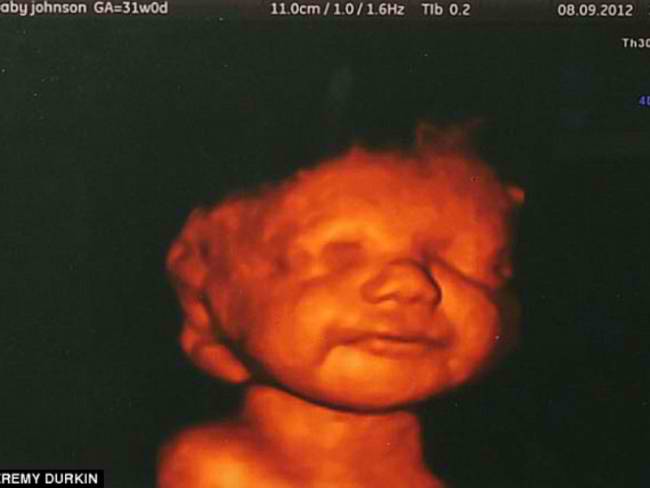
A mother was unable to abort her severely disabled son despite doctors’ warnings after seeing her baby’s smile in a 3D scan picture.

Katyia Rowe was told her baby’s brain had not formed properly and that he would never walk or talk and would need 24-hour care.

But after seeing real-time moving scans of him smiling, blowing bubbles, kicking and waving his arms she made the heartbreaking decision to go through with the birth.

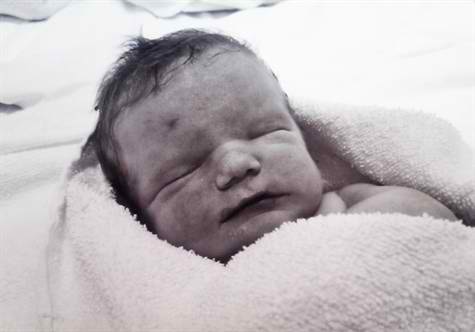
Tragically Lucian, as she named him, died nine hours after he was born.


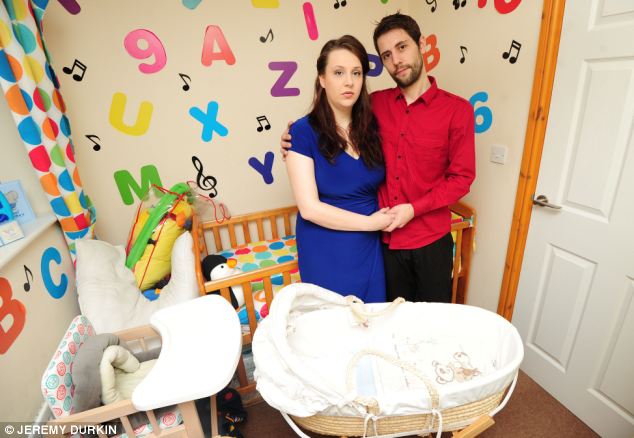
Mother Katyia Rowe gave birth to her severely disabled son Lucian, despite doctors advising her to have an abortion, after seeing a 3D scan of him smiling, pictured

Despite the ordeal, Ms Rowe said she had no regrets going through with the birth as she was able to cuddle her baby son.

Katyia, 26, a training administrator, said: ‘We were devastated to be told our son’s brain abnormalities were so severe they were life limiting we should consider a termination.

‘Further scans were arranged to asses the extent of his disabilities but when I saw him smiling and playing inside me I knew I couldn’t end his life.

‘If he could smile and play and feel then despite his disabilities he deserved to enjoy whatever life he had left, no matter how short. Just because his life would be shorter or different, didn’t mean he didn’t deserve to experience it.

‘As long as he was pain free I vowed to let him enjoy his life both while inside me and outside, no matter how long that be.’

Miss Rowe, from Telford, Shropshire was thrilled to discover she was expecting a baby with partner of four years security officer Shane Johnson, 26, in March last year.

She added: ‘It was a shock but we were thrilled. Shane and I were so excited and looking forward to the birth. We had so many plans for the future and could not wait to meet our baby.


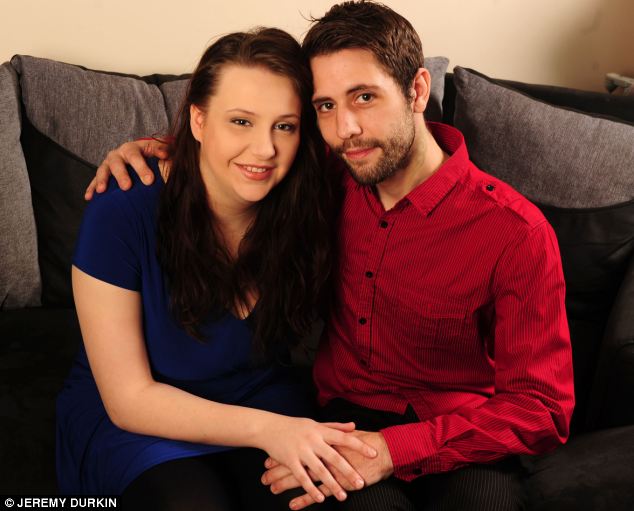
Katyia Rowe and her partner Shane decided to have the baby despite the complications, saying the child deserved to live

‘Our first scan at three months was wonderful. When we saw our baby on screen for the first time we fell in love straight away. As far as we were concerned everything was perfect.’

The couple decided to wed when their son was old enough to walk down the aisle with them.

Only the 20-week scan highlighted complications.

Following further tests, doctors told Miss Rowe and her partner of four years that their baby’s brain had no formed properly and he would be severely disabled.

They were then told the tragic news by experts at Birmingham Children’s Hospital that their child would never walk or talk and would need 24-hour care.

The couple were offered the chance to terminate the baby at 24-weeks.

But despite his poor prognosis, being able to watch her son in real time 3D scans during the screening tests, Miss Rowe said she was astonished to see him smiling, blowing bubbles, kicking and waving his arms.

She said: ‘Despite all the awful things I was being told, while he was inside me his quality of life looked to be wonderful and no different to any other baby’s, he was a joy to watch.

‘I was told he would never walk or talk yet the scans showed him constantly wriggling and moving.

‘As I watched I knew that while I was carrying him he still had a quality of life and it was my duty as a mother to protect that no matter how long he had left, he deserved to live.’


The couple pictured together in the room that was decorated for their baby boy Lucian. Tragically he died nine hours after his birth

Katyia was told if her son survived birth he would require 24 -hour care for the duration of his life expected to be anything up to five years.

She added: ‘It didn’t phase me at all. It was ironic because I had never considered myself particularly maternal but now I wanted nothing more than to care for my son and give him the best quality of life possible. I was more than happy to dedicate my life fully to his care.

‘I researched all his disabilities to prepare myself fully for his needs. I never had a moment of doubt. I only had to look at the scan pictures of him enjoying life in the womb to know I was doing the right thing by giving him a chance.

‘Not knowing how long he would live meant we were determined to enjoy him for as long as we could. We learned he loved the shower and would kick when I sprayed the water on my tummy.

‘As he grew bigger I could see his little feet and hands prodding through my bump when he wriggled. He may not have been born but he was already our son and I took each movement as a sign we had done the right thing.

‘I would talk to him and play him music because I wanted him to experience as much as possible.’

Because of her son’s disabilities he couldn’t swallow the amniotic fluid surrounding him meaning Kaytia had to undergo painful draining procedures for the last nine weeks of her pregnancy.

She said: ‘It was agony and I knew some people questioned if it was worth putting myself through all this for a severely disabled baby that may not live for long.

‘But I never ever thought like that. As a mother you will do anything for your child and for me I became a mother as soon as I fell pregnant, that job had started already.’

And for Katyia the rewards for her pregnancy were she says the most joyful and fulfilling nine hours of her life – the time she spent with her son.

‘It was without doubt the happiest moment of my life. Lucian could have died at anytime in my womb but he held on long enough for us to meet properly.’

- Mother Katyia Rowe


Katyia Rowe who went through the birth of her baby, pictured in a frame, and said she didn’t regret her decision


He was delivered after being induced when her waters went on October 23rd last year at the Royal Shrewsbury hospital and as expected was rushed straight to special baby care for his condition to be assessed.

She says: ‘I was prepared not to be taking our baby straight home like all the other new parents, but beyond that I didn’t know what the future held.’

But shortly after the birth midwives burst into the delivery suite and warned Katyia her son had just minutes to live.

She says: ‘I was shocked but we had already decided that after his birth we would let Lucian lead the way. I didn’t want him given any unnecessary treatment if ultimately it wouldn’t help him.

‘He had already given me the greatest honour of being his mummy for the last nine months. It was up to him now if he was ready to go.’

Katyia rushed to his side and finally the son she had nurtured for nine months was placed in her arms.

She said: ‘It was without doubt the happiest moment of my life. Lucian could have died at anytime in my womb but he held on long enough for us to meet properly.

‘My son looked utterly perfect.

‘The love and joy I felt the moment they put Lucian in my arms told me it had all been worth it.’

She added: ‘I thought I didn’t want to be a mother but Lucian taught me it is the most wonderful job in the world and I will always be grateful for that.’

Before his death he was held in his mother’s arms and he even met his grandparents.

Γέροντας Σωφρόνιος: Ποιος κάνει “κουμάντο” μέσα στην οικογένεια;


Αν η γυναίκα εργάζεται εξίσου με τον άνδρα, τότε πάλι καταργείται η δικαιοσύνη, επειδή η γυναίκα στην οικογένεια, παράλληλα με την εργασία, βαστάζει και άλλα βάρη, επιπρόσθετα καθήκοντα, επειδή ακριβώς αυτή είναι η μητέρα των παιδιών. Θα νόμιζε κάποιος ότι, επειδή η γυναίκα βαρύνεται από μεγαλύτερες ευθύνες και ασκεί πολυπλοκότερο ρόλο, σε αυτήν πρέπει να ανήκει το προνόμιο να «κατευθύνει» την οικογένεια. Ασφαλώς κάποιος πρέπει να κατευθύνει την οικογένεια, όπως και κάθε άλλο ανθρώπινο καθίδρυμα. Έτσι, σε πολλές οικογένειες ανακύπτει η πάλη για εξουσία, που πολύ συχνά γίνεται καταστροφική για την οικογένεια. Συνεπώς, όπου και αν στρέψουμε τήν προσοχή μας, παντού βλέπουμε υπερβολικά πολύπλοκα προβλήματα, και δεν πλησιάσαμε ακόμη στην επίλυσή τους.

Έκανα τις λίγες αυτές παρατηρήσεις, για να δω τα πράγματα έτσι όπως τα βλέπει η πλειονότητα των ανθρώπων. Νομίζω όμως ότι εμείς ως χριστιανοί βλέπουμε ακόμη και εκείνα που οι άλλοι δεν προσέχουν. Θεωρούμε ότι το σπουδαιότερο θέμα γενικά για κάθε άνθρωπο είναι το ερώτημα: Τί είναι ο άνθρωπος; Ποιός είναι ο προορισμός του; Γιατί και για ποιό λόγο εμφανίστηκε στον κόσμο; Ποιός σκοπός υπάρχει μπροστά του; Ποιό είναι το νόημα της υπάρξεώς του; Αν δεν απαντήσουμε στα ερωτήματα αυτά, δεν θα μπορέσουμε ποτέ να λύσουμε τα προβλήματα που αντιμετωπίζουμε ούτε σε ένα επίπεδο. Είναι αδύνατον για παράδειγμα να επιτύχουμε αληθινά δίκαια δομή της κοινωνίας χωρίς τη γνώση αυτή. Δεν μπορούμε να λύσουμε το πρόβλημα της κρατικής οργανώσεως, αν δεν έχουμε απάντηση στο κύριο αυτό ερώτημα. Όλη η ιστορία της ανθρωπότητας γράφεται με άσκοπη περιδίνηση, παράλογους πολέμους, άδικη καταπίεση του ισχυρού επάνω στον ασθενή, όπως βλέπουμε στο ζωικό κόσμο. Συνεπώς, τί είναι ο άνθρωπος; Τήν απάντηση στο ερώτημα αυτό την παίρνουμε από την Άγια Γραφή: «Και εποίησεν ο Θεός τον άνθρωπον, κατ’ εικόνα Θεού… άρσεν και θήλυ εποίησεν αυτούς» (Γέν. 1,27). Και λίγο πιο κάτω διαβάζουμε: «Έπλασεν ο Θεός τον άνθρωπον, χουν από της γης, και ενεφύσησεν εις το πρόσωπον αυτού πνοήν ζωής, και εγένετο ο άνθρωπος εις ψυχήν ζώσαν» (Γέν. 2,7).

Αν λοιπόν ο Θεός δημιούργησε τον άνδρα και την γυναίκα ως ενιαία ανθρωπότητα, τότε είναι φυσικό ότι το θέμα της σχέσεως μεταξύ ανδρός και γυναικός ήταν και θα είναι πάντοτε ένα από τα σπουδαιότερα ζωτικά θέματα. Αν στρέψουμε την προσοχή μας στα φυσικά χαρίσματα της γυναίκας και τα συγκρίνουμε με τα αντίστοιχα τους στον άνδρα, θα δούμε από την μακρόχρονη πείρα ότι τα χαρίσματα αυτά είναι ποικίλα· κάποτε συμπίπτουν, ενώ κάποτε γίνονται συμπληρωματικά το ένα του άλλου. Γνωρίζουμε επίσης από την ιστορία και από την Αγία Γραφή ότι στην Ανατολή, όπου γεννήθηκαν όλες οι μεγάλες θρησκείες, η κυριότητα του άνδρα επάνω στη γυναίκα ήταν υπερβολικά ισχυρή. Η γυναίκα στη συνείδηση της Ανατολής ήταν κατά κάποιο τρόπο κατώτερο ον. Ακόμη και στο Ευαγγέλιο βλέπουμε παρόμοια χωρία, όπως για παράδειγμα: «ΟΙ δε εσθίοντες ήσαν άνδρες ωσεί πεντακισχίλιοι χωρίς γυναικών και παιδίων» (Ματθ. 14,21). Ελάμβαναν οπ’ όψιν μόνο τους άνδρες, ενώ τις γυναίκες ούτε καν τις μετρούσαν. Αλλά αυτό δεν το βλέπουμε μόνο στην Ανατολή.

Έτυχε να διαβάσω, όταν ήμουν νέος, κάποιες στατιστικές που έκαναν μερικοί Γερμανοί μορφωμένοι άνθρωποι για τον ρόλο του άνδρα και τον ρόλο της γυναίκας στην ιστορία του πολιτισμού. Οι πολυμαθείς αυτοί Γερμανοί παρουσίαζαν τα κατορθώματα του άνδρα ως άκρως σημαντικά (παρομοιάζοντας τα ως όρη υψηλά), ενώ από τα κατορθώματα της γυναίκας σημείωναν μόνο μερικά που ούτως ή άλλως γράφτηκαν στην ιστορία του πολιτισμού.

Μου φαίνεται ότι η παρεξήγηση αυτή εμφανίστηκε ως συνέπεια της απώλειας της συνειδήσεως εκείνης, που περιέχεται στη Γραφή: «Και εποίησεν ο Θεός τον άνθρωπον κατ’ εικόνα Θεού… άρσεν και θήλυ εποίησεν αυτούς» (Γεν. 1,27).

Αυτό το ξεχνούν όχι μόνο οι άνδρες, αλλά και οι ίδιες οι γυναίκες. Για να διορθώσουμε λοιπόν τη ζωή μας σε όλα τα επίπεδά της, αρχίζοντας από την οικογένεια, οφείλουν οι γυναίκες να ανυψωθούν με το πνεύμα και να φανερώσουν στον κόσμο την αυθεντική αξία τους, τον υψηλό ρόλο τους. Για την χριστιανική Εκκλησία το θέμα του ρόλου της γυναίκας γίνεται κάθε χρόνο διαρκώς οξύτερο.

Βλέπουμε ότι στις χώρες όπου ο άθεος κομμουνισμός διεξάγει ανοικτή πάλη εναντίον της Εκκλησίας με την εφαρμογή κάθε είδους εκβιασμών, διασώζει την Εκκλησία η ανδρεία των γυναικών, η αυτοθυσία τους, η ετοιμότητά τους για κάθε είδους παθήματα. Παντού παρατηρούμε ότι οι γυναίκες στις Εκκλησίες αποτελούν το μεγαλύτερο ποσοστό. Μπορούμε να πούμε ότι στις Εκκλησίες κατά τις ακολουθίες οι γυναίκες συνιστούν την πλειονότητα, κάποτε τα τρία τέταρτα, κάποτε όμως και περισσότερο. Αν τώρα όλες οι γυναίκες αποχωρούσαν από την Εκκλησία, τότε αυτή δεν θα μπορούσε να υπάρχει, γιατί οι άνδρες που εκπληρώνουν υψηλή ποιμαντική διακονία, κατέχοντας υψηλές ιεραρχικές θέσεις, θα έμεναν ολιγάριθμοι και, με απλά λόγια, θα ήταν γι’ αυτούς από υλικής πλευράς αδύνατον να διατηρήσουν την Εκκλησία.

Συνεπώς ο ρόλος της γυναίκας στην Εκκλησία είναι μεγάλος, και όλοι μας πρέπει να σκεφτούμε το φαινόμενο αυτό. Στη χριστιανική μας διδασκαλία για τον άνθρωπο, μιλώντας θεολογικά, η γυναίκα παρουσιάζεται στο ίδιο ακριβώς μέτρο ως άνθρωπος, όπως και ο άνδρας. Οι δυνατότητες της διακονίας της μέσα στην ιστορία είναι απεριόριστες. Το γεγονός ότι ο Θεός Λόγος σαρκώθηκε από γυναίκα καταδεικνύει ότι η γυναίκα δεν είναι καθόλου μειωμένη ενώπιον του Θεού.

αποσπάσματα από: Αρχιμ. Σωφρονίου, Το Μυστήριο της χριστιανικής ζωής, Ι.Μ. Τιμίου Προδρόμου, Έσσεξ, 2010


http://www.diakonima.gr

ΝΑ ΔΕΧΕΣΤΕ Ο ΕΝΑΣ ΤΟΝ ΑΛΛΟ, ΟΠΩΣ ΔΕΧΤΗΚΕ ΚΙ ΕΣΑΣ Ο ΧΡΙΣΤΟΣ


Η ενότητα των μελών της Εκκλησίας
Ως μελών του ενός σώματος του Χριστού
Καθορίζει το χαρακτήρα που πρέπει να έχουν
Οι σχέσεις μεταξύ των Χριστιανών.

Η αγάπη και η αλληλοϋποστήριξη
Η μέριμνα για τους αδελφούς είναι ιδίωμα του Χριστιανού.
Οφείλομεν δε ημείς οι δυνατοί
Τα ασθενήματα των αδυνάτων βαστάζειν
Και μη εαυτοίς αρέσκειν.
Αυτός είναι ο αληθινά χριστιανικός δρόμος...
Να βοηθά ο ισχυρός τον αδύνατο
Και ο ένας τον άλλο στην αρετή.
Να μην κρίνουμε κατά το προσωπικό συμφέρον, αλλά να αποδεχόμαστε τον άλλον
Όπως μας υπέδειξε με τον δικό του τρόπο ο Κύριός μας Ιησούς Χριστός.
Όλοι να εκφράζουν έμπρακτη αγάπη προς όλους και όλοι να κάνουν ότι το καλύτερο για τους άλλους.
Για να επιτευχθούν βέβαια τα καλώς πιο πάνω εκφραζόμενα
Πρέπει να αποκτήσουμε υπομονή, και κυρίως αυτοκριτική.
Μεγάλη αρετή η υπομονή, την οποία μας υπέδειξε ο ίδιος Κύριος μέσα από τη ζωή.
Η αυτοκριτική εξίσου, βοηθά τον πιστό να αντιλαμβάνεται τα δικά του πάθη και αδυναμίες

Βοηθώντας τον έτσι να κατανοεί και να υπομένει τα λάθη των άλλων.
Θα βοηθηθούμε ακόμη περισσότερο αν κατανοήσουμε καλά τα λόγια του Παύλου:
"Έκαστος ημών τω πλησίον αρεσκέτω εις το αγαθόν προς οικοδομήν".
Να βλέπουμε τα λάθη των άλλων προσώπων με αγάπη και λύπη
Βάζοντας τον εαυτό μας στη δική τους θέση.

Διότι έτσι θα σταματήσουμε να κατακρίνουμε το πλησίον μας
Και συνάμα θα κάνουμε υπομονή στα τυχόν παραπτώματα τους.
Καθήκον λοιπόν κάθε Χριστιανού είναι να προωθεί το καλό, την αγάπη την ειρήνη
Που ο ίδιος ο Κύριος μας υπόδειξε με την Ενσάρκωση και στη συνέχεια με τη Σταύρωση του.
Σωστό είναι, όπως και εμείς με τη σειρά μας ακολουθήσουμε τη θυσιαστική πορεία του Κυρίου
Ο οποίος "ουχ εαυτώ ήρεσεν".

Καλείται λοιπόν ο καθένας από εμάς με τις προσωπικές του πράξεις
Να προσφέρει για το καλό του σώματος της Εκκλησίας. 


lllazaros.blogspot.gr 

Sunday, August 25, 2013

Taming our passions


Our challenge as Christians is to learn how to take hold of the reins of our passions––To tame them and direct them for the good of God’s Kingdom as He originally intended. This involves a struggle. As Saint Paul cries out,


For what I am doing, I do not understand. For what I will not to do, that I do not practice; but what I hate that I do… I find then a law, that evil is present with me. I delight in the law of God according to the inward man. But I see another law in my members, warring against the law of my mind, and bringing me into captivity to the law of sin... (Rom 7:15, 21-23)


Like Adam and Eve, we are tempted by our pride to disobey our Creator and God. We are fooled into believing that we know better than God, just like Eve was deceived by the snake in Paradise. We trust in our own will, not realizing that we are under the influence of negative forces of evil nature.


Our challenge is to learn obedience––”Thy will be done.” Unfortunately, obedience is a bad word in our society. Most of us rebel at the thought of obedience of almost any kind. But this is what Jesus taught us. He prayed to His Father; Not my will but Thine be done. (Luke 22:42). He willing gave up his life for us to carry out the will of the Father. Just like He offered his full life to His Father, so too must we offer our full life to our God and Father.


The Church gives practical guides for this obedience:


1. Following the liturgical cycle of divine services.


2. Adherence to the canons established for our well being by the Councils of the Church which call for prayer, fasting, and regular participation in Confession and Holy Communion.


3.Following the direction of our spiritual Father.


This is the foundation of an Orthodox Way of Life.


We are required to undertake an ascetical or disciplined way of life focused on God’s Kingdom. But it cannot be aimed solely at our own benefit. We must be willing to give ourselves for God’s work. God is all merciful and can help us, but only if we can cry out “Thou hast come into the world to save sinners, of whom I am chief (cf I Tim 1:15).


This ascetical life serves a twofold purpose.


1. To remind us to “fulfill the call to mission… to take serious stock of our struggle and our lives, and work to better what is wanting.”


2. To remind us that “it is precisely in our serious attentiveness to the struggle and its right contours, that we have the power to speak to the world the true message of Christ, of the Spirit, of the Father.”


This requires boldness to think, speak, act, and orientate one’s whole life toward a Kingdom, the very existence of which may be questioned by those around us.


Saint Basil writes,


Examine what sort of being you are. Know your own nature, that your body is mortal but your soul is immortal, and that our life is twofold in kind. One kind is proper to the flesh, quickly passing by, while the other is akin to the soul, not admitting of circumscription. Therefore be attentive to yourself (Deut 15:9), neither remaining in mortal things as if they were eternal, nor despising eternal things as if they were passing. […] Understand yourself with all exactness, that you may know what gift to apportion to each––for the flesh nourishment and coverings, and for the soul doctrines of piety, education in courtesy, training in virtue, correction of the passions.


Through the defeat of the passions the self-will can be overcome.

Broker Who Became A Monk


Brother Nikanor, a Nasdaq broker turned monk, advises former colleagues to put a jar with soil on their desks to remind them where we are all heading and what matters in life.

As western banks fold into each other like crumpled tickets and commentators portray the current crisis as the last gasp of modern capitalism, Hristo Mishkov, 32, shares the pain -- and offers home truths.

His story partly resembles that of Brother Ty, the monk-tycoon protagonist of the 1998 satire "God is my Broker" by U.S. writers Christopher Buckley and John Tierney -- he failed on Wall Street and became a monk.

But 10 years later, the similarities are superficial: the Bulgarian had a successful broking career, does not write self-help manuals and aims to get happy, not rich.

His interest in financial markets began under communism in the 1980s when he and other children created their own play stock exchange in their apartment block's basement in Sofia.

Five years ago, after failing to find happiness in the life he lived, the Christian Orthodox who hadn't practiced as a child quit the New York-based market for a dilapidated Bulgarian monastery that once served as a communist labor camp.

Retaining one luxury -- a mobile phone, which connects him with both potential donors and former trading colleagues -- he has brought the rigor of his broking experience to his faith.

He has helped to raise hundreds of thousands of levs (dollars) to rebuild the monastery -- a hard task in a country where charity is not part of the mentality and building shopping malls and golf courses is a priority.

"Many people... in the world do not realize that they have not earned the food they eat, that they take without giving," Mishkov said. "But if someone consumes more than they have earned, it means someone else is starving.

"It is right to see people who consume more than they deserve shattered by a financial crisis from time to time, to suffer so that they can become more reasonable."

Being a trader has seldom been more traumatic: placing bets on political decisions about billion-dollar bank bailouts which, if they fail, could mean much more than a bad day for yourself or colleagues, but also jeopardize livelihoods.

Some have found solace in religion, others in humor, but a few fall. Surveys show traders reporting more stress and every news report of a trader suicide is accompanied by suggestions the pressure may have been too much.

HAPPINESS

"We always search for happiness in the outside world, in material things, which makes us constantly unsatisfied, angry with ourselves and the world," said Mishkov, who exudes a sense of tranquility, intelligence, and humor.

Greed and the marketization of our lives have reached the point where people have been turned into a commodity -- even their health can be traded like a stock, he said.

"We have so quickly lost our human appearance, we have become beasts ... There's no-one to count on and say 'hey neighbor come help me.' He will come but demand a payment."

His monastery, tucked among hills 50 km (31 miles) west of Sofia, was founded in the 12th century. The communist regime which banned religion turned it into a labor camp, then a children's pioneer camp and a livestock farm.

Now Mishkov works hard every day milking buffalo cows and building stone walls. He says he is not against rich people but can only respect those who contribute to the good of society -- pointing to Microsoft founder Bill Gates as an example.

As a younger man working for more than two years for Karoll, one of Bulgaria's leading brokerages, Mishkov was good at his job, former colleagues say.

"He was a religious person and that annoyed me sometimes," said Alexander Nikolov, head of international capital markets at Karoll. "There were occasions when he would not show up at work because of some religious holiday."

His colleagues were stunned when he decided to become a monk, but Mishkov felt the time had come to look after people's souls.

"Everybody can be a good broker but this does not bring much benefit for the world," he said. Religion can help people cope in today's stressful times and find answers, Mishkov added.

Churches in New York's financial district reported last month increased attendance at lunchtime meetings, with many more people in business attire than usual, when some of the world's biggest investment banks collapsed.

Steven Bell, chief economist of London hedge fund GLC, said keeping a sense of reality is what traders needed.

"It is very important to just remind yourself that there is a real world out there. In any job but particularly in financial markets, you need to try and keep your feet on the ground," Bell told Reuters by phone.

Mishkov says the crash should also help correct a dangerous global trend of an excessive outflow of labor to the service sectors, by people attracted by high pay and an easy life.

"Milk is not produced by computers, bread doesn't come from a good company PR. It is necessary to plow, sow and harvest before that," says the monk.

Dealing with a death ( Metropolitan Anthony of Sourozh )


Awareness of the present

Death is the touchstone of our attitude to life. People who are afraid of death are afraid of life. It is impossible not to be afraid of life with all its complexity and dangers if one is afraid of death. This means that to solve the problem of death is not a luxury. If we are afraid of death we will never be prepared to take ultimate risks; we will spend our life in a cowardly, careful and timid manner. It is only if we can face death, make sense of it, determine its place and our place in regard to it that we will be able to live in a fearless way and to the fulness of our ability. Too often we wait until the end of our life to face death, whereas we would have lived quite differently if only we had faced death at the outset.

There is a patristic injunction, constantly repeated over the centuries, that we should be mindful of death throughout our life. But if such a thing is repeated to modern man, who suffers from timidity, and from the loss of faith and experience which prevails in our time, he will think he is called upon to live under the shadow of death, in a condition of gloom, haunted always by the fear that death is on its way and that then there will be no point in having lived. And death, if remembered constantly and deeply, would act as a sword of Damocles for him, suspended over his head by a hair, preventing the enjoyment of life and the fulfilment of it. Such an approach to the saying must be rejected. We need to understand mindfulness of death in its full significance: as an enhancement of life, not a diminution of it.

Most of the time we live as though we were writing a draft for the life which we will live later. We live not in a definitive way, but provisionally, as though preparing for the day when we really will begin to live. We are like people who write a rough draft with the intention of making a fair copy later. But the trouble is that the final version never gets written. Death comes before we have had the time or even generated the desire to make a definitive formulation. We always think that it can be done tomorrow. 'I will live approximately today. Tomorrow is when I shall act in a definitive way. It is true that things are wrong, but give me time. I will sort them out somehow, or else they will come right of themselves'. Yet we all know that the time never actually comes.

The injunction 'be mindful of death' is not a call to live with a sense of terror in the constant awareness that death is to overtake us and that we are to perish utterly with all that we have stood for. It means rather: 'be aware of the fact that what you are saying now, doing now, hearing, enduring or receiving now may be the last event or experience of your present life'. In which case it must be a crowning, not a defeat; a summit, not a trough. If only we realized whenever confronted with a person that this might be the last moment either of his life or ours, we would be much more intense, more much attentive to the words we speak and the things we do.

There is a Russian children's story in which a wise man is asked three questions: What is the most important moment in life? What is the most important action in life? And who is the most important person? As in all such stories, he seeks everywhere for an answer and finds none. Finally he meets a peasant girl who is surprised that he should even ask. ‘The most important moment in life is the present - it is the only one we have, for the past is gone, the future not yet here. The most important action in this present is to do the right thing. And the most important person in life is the person who is with you at this present moment and for whom you can either do the right thing or the wrong'. That is precisely what is meant by mindfulness of death.

The value of the present moment may be realized when someone dear to us has a terminal illness and, more particularly, when we are aware that he or she may be dead within minutes. It is then that we recognize the importance of every gesture and action, then that we realize how slight the differences between what we usually consider the great things in life and those which are insignificant. The way we speak, the manner in which we prepare a tray with a cup of tea, the way in which we adjust an uncomfortable cushion become as important as the greatest thing we have ever done. For the humblest action, the simplest word, may be the summing up of a whole relationship, expressing to perfection all the depth of that relationship, all the love, concern and truth that are within it.

If only we could perceive the urgency of every moment in the awareness that it may be the last, our life would change profoundly. The idle words which the Gospel condemns (Matt 12:36), all those statements and actions which are meaningless, ambiguous or destructive — for these there would be no place. Our words and actions would be weighed before they are spoken or performed so that they might be culminating point in life and express the perfection of a relationship, never less.

Only awareness of death will give life this immediacy and depth, will bring life to life, will make it so intense that its totality is summed up in the present moment. Such precisely is the way in which the ascetics fought against mindlessness, lack of attention and carelessness, against all the attitudes which allow us to miss the moment of opportunity, to pass the other person by, not to notice the need. One of the chief things that we are called upon to learn is awareness - awareness of our own self and of the other person's situation, an awareness that will stand the test of life and death. All life is at every moment an ultimate act.

Fear of death, longing for death

We know from experience, our own and other people's, that we are afraid of death or uncertain about it. To be precise, I think that we are more afraid of the process of dying than of the fact of death. Most people might be ready to accept death if they were sure that death would come as sleep, without an intermediate period of fear and uncertainty.

Indeed, there is even something beguiling and attractive about death. How often people say, 'I wish I were dead': it is a way of saying, 'I wish I could be free of all responsibility either to myself or God or anyone else, I wish I could return to the condition of my early childhood when there was no need for me to live responsibly and I could simply play'. Most of us would prefer to play at living rather than to live commitedly. Consequently there is a fascination in death, seen as a liberation from the burden and responsibility of life. But in that sense death must be seen as an adversary, for it is one of the ways in which we are beguiled into turning away from what life offers in terms of a challenge and in terms of relationship. When people say, 'I am not afraid of death', we should always be ready to challenge them and ask whether their acceptance or even longing for death does not disguise a fear of life: 'I am terrified of life and would like to escape from it at all costs - if only I could go to sleep and never wake up, if only I could leave others to face my responsibilities, all the things which I have left undone or done amiss'. We should not be romantic in our attitude to death.

If we look to the saints we discover an altogether different attitude to death. Their love of death was not founded on a fear of life. When St. Paul says, 'For me to live is Christ and to die is gain [...]. I should like to depart and to be with Christ, which is far better' (Phil 1:21, 23), he is expressing a completely positive attitude to death. Death appears to him as a gate that will open on to eternity, enabling him to meet face to face the Lord who is all his love and all his life. But this cannot be achieved by wishful thinking. There is more to it than that. In order to be able to long for death in this particular way and to see death as the crowning of our life, as its unfolding to the measureless measure of eternity (to use a paradoxical phrase of St Maximus the Confessor), we must have an experience of eternal life here and now. We must not think of eternal life as something that will come later, as future happiness or future security. The apostles became fearless only when they themselves became - here and now - partakers of eternal life. As long as they had not received the witness of Christ's resurrection, as long as they had not received the Spirit, they were still afraid and clung in fear to their temporal life. But the moment they had access to life eternal, their fear of losing temporal life disappeared; for they knew that hatred, persecution and murder could do nothing more than free them from this life's limitations and enable them to enter into the boundless depths of eternal life. And this eternal life was known as a present experience, not only in an act of faith. The same is true of the martyrs. They were ready to die and possessed the sovereign freedom of self-giving because they knew life eternal and had in some measure already entered into it.

Death as an event in daily life

We could learn much about death if we took the trouble to look at our own experience. Death is much closer to us than we imagine, and we all could speak of experiences of 'death' which are in no sense frightening. What I have to say on this subject is neither new nor my own: perhaps more than anything else in my talk it is borrowed from others.

First of all, dying from a practical point of view means to drop out of self-awareness into an oblivion of self. This is something many people are afraid to do. Yet each of us goes to sleep every evening, loses himself completely in sleep, and without any fear. Why? Because we feel certain - to a great extent unjustifiably pertain - that we shall wake the next morning. We trust that the next morning will dawn for us, that sleep is a temporary experience. Could we not treat this as a parable of the process by which we die and wake in eternity? For in reality there is a great risk in closing one's eyes and going to sleep. There is no more dangerous place than one's bed, as noted in the story of the sailor and the peasant, who were considering the dangers of their respective conditions. The peasant insisted that he would never risk his life on the sea: 'It is far too dangerous'. When the sailor asked why he should think so, the peasant replied: 'Where did your father die?' 'At sea.' 'And your grandfather?' 'Also at sea.' 'And you still can't see how dangerous it is to go to sea?' But the sailor countered the question with his own: 'And where did your father die?' 'He died in his bed.' 'And his father?' 'Also in his bed.' 'And yet you dare to go to bed each night?' In this sense we ourselves face death trustfully and confidently each night. And when this kind of temporary death does not come easily to us, we even go so far as to take sleeping pills or nightcaps. Is it not curious that we fail to draw conclusions from the simplest things of life?

There is another way in which the experience of death is familiar to us all. As Romano Guardini has pointed out in his book The Last Things, there are several ways of dying in the course of a life. When we move from infancy to childhood, then to youth and adolescence and so to maturity and old age, we imagine that we grow out of one stage into the next. But if we are to develop, a number of things which were previously our condition must die in us: for a youth or adult preserves the characteristics of his childhood becomes childish, even infantile. In order to acquire maturity at the next stage of development, we must accept that something in us dies. And this dying may be a painful and difficult process, in a way as difficult as the actual dying of our body in the dissolution of death. Many parents know this all too well. They may long for their child to remain a little boy and they may be deeply disturbed at the sight of the young adult emerging out of the youngster. The process of dying in order to live is going on within us all the time: by contrast with such parents we must become aware of it and participate more actively in it. Then shall we be less afraid of death as an irrevocable loss. Rather shall we learn to regard it as an inevitable part of the process by which we grow into a more mature and complete life.

Death to self

Christ calls us to die to ourselves. What does this mean? The phrase is ambiguous, like everything else that is said about death. Does it mean self-destruction? Many imagine that it does, and try to apply it in that sense. Fortunately they fail, but they remain wounded by the terror of it. Properly understood, dying to oneself means acceptance of this progressive dying of things within us, until we come to the point when we realize that there is in us a real and deep self that belong to eternity, and a superficial self that has to be dissolved. We must let go of the superficial self in order to live fully.

Many feel that they cannot be aware of their own existence unless they assert themselves and demand recognition; and others of course react by trying to defend themselves against this kind of aggression. We can accept not to assert ourselves, not to impress upon others this awareness that we exist, only if we can believe - and we can believe it only on the strength of experience - that we are loved and affirmed by others. We must learn to be far greater than we are. It is not enough to know that God loves us and affirms us. We need to be affirmed by our neighbour, by at least one person, who says to us, 'You matter ultimately to me'. Gabriel Marcel insists in one of his books that to tell a person 'I love you' is tantamount to saying 'You shall never die', meaning as it does 'You matter to me so ultimately that I will assert you before the face of God, even if no one asserts you but God and myself'. We could achieve a great deal if we were prepared to recognize one another and to say, however tentatively, 'Yes, I am prepared to assert you. Although I am not sure how to do it completely, since your existence so far is a challenge, even an aggression, although I am afraid to do so, yet I will assert you as much as I can'. In this way, we could grow to the maturity that will allow us to assert the other and proclaim his ultimate value whatever the cost. The person who is asserted in such a way can forget about himself and live. Such is the line along which we are called to go.

We must have the courage to struggle through layers of fear in asserting one another ever more, fighting fear, yet overcoming it. At every step we have to renounce ourselves so that the other can be. As St John the Baptist spoke of himself decreasing in order that the Other might increase (John 3:30), so are we called to die progressively to ourselves that the other, our neighbour, may live. So to die means to leave nothing within us except that which is essential to the fullness of life.

Death as enemy and friend

Yet things are not so simple. It is true that, as St. Paul says, to live is Christ and to die is gain. It is true that to die is not to be divested of temporal life, but to be clothed with eternity. But there is a further point emphasised by St Paul, as also by the rest of Scripture. Man was not created for death; his calling is for eternal life; death is the result of sin in the sense of separation from God, breach with neighbour, loss of contact with man's real and deeper self. From that point of view, death is the last enemy that shall be destroyed (1 Cor 15:26). Death is the enemy, God's as much as ours. Indeed, it is God's enemy in the most striking and dramatic way, for it extends even to Christ himself. But while on the one hand death is such an enemy, the fact that it does reach out to Christ, that it kills him who is perfect man and God himself incarnate, also shows that it is not an evil devoid of meaning. For however much a result of sin and evil death may be, it is not in itself a sin or an evil which necessarily corrupts whoever it touches. Christ was not defiled in his death on the Cross, in his descent into hell, in his partaking of the total tragedy of death: his person was not polluted by communing in its mystery.

So there is an ambiguity here. On the one hand death should not exist, death is the result of evil and is to be defeated. On the other hand death alone enables us to break through the vicious circle of endlessness (and endlessness is something quite different from eternity). If there were no death in a world of sin, evil and corruption, we would slowly decay and disintegrate without ever being able to escape the horror of such gradual destruction.

There was a soldier in a Russian fable who managed to capture death and put it into a bag. He carried the bag on his back, safely secured, and was regarded at first as a benefactor who had saved mankind from its greatest scourge. But then it became obvious that while death might have gone, illness and old age were as much present as before. And when the soldier one day met an old woman, bent with age and illness, she shook her fist at him and shouted: 'Look what you have done, you evil good-for-nothing. You may have captured death, but you have deprived me of my freedom. Here am I, a prisoner of endlessness, part of a process that has no resolution'. The soldier realized what harm he had done and unleashed death. I need hardly add that it is still free and abroad.

Physical and spiritual death

Each Easter midnight and throughout the forty days that follow we sing that Christ is risen, having undone death by death. And yet what do we see? Death free and abroad, people dying as before. It would seem as if we are affirming something that we know to be untrue.

But we should keep in mind that there are two aspects or death. There is physical death, but there is also death, understood as separation from God, as descent into Sheol, the place where God is not, the place of his radical and definitive absence. It is this second aspect of death which is certainly the more cruel and atrocious. When we look at icons of Christ's harrowing of hell or speak of it in the Apostle's Creed, we are confronted by something unquestionably real. The Lord experienced not only the first aspect of death, but the second also. He chose to share with us in all the consequences of evil - including the final separation from God ('My God, my

God, why has thou forsaken me?'). But although he descends to the place where all those who have lost God descend, he brings with him the fullness of the divine presence. Consequently there is now no place left where God is not. And it is this which allows us to understand our situation since Christ's death and resurrection. We have still to undergo a temporary death, what St Paul describes as a falling asleep (1 Cor 15:6). But there is no longer the death which was the terror of mankind, the final dissolution and separation from God. And in that sense death is indeed undone by death. Even now - however germinally and tentatively - we are the heirs of eternal life.

Facing death

I once went to preach about death at a British university. Afterwards, the chaplain said to me, 'Do you know, I have never seen a dead person'. I was utterly amazed that a priest, a man in his fifties moreover, had never met death in his family life or in his priestly function - even during the war. It was an incident that made me take more note of my surroundings, and I realized that there is a very strong feeling here that death is a subject to avoid. The dead person should be committed to the care of the undertakers, while the living should turn away from the problem, and the less said about it the better. I found all this very offensive. Since giving that sermon I have taken every opportunity to speak about preparation for death to medical students, doctors, nurses, and to anyone else who is willing to listen. And I have made the discovery that people are quite ready to think about preparing for the death of others. At the same time very few are prepared to reflect that their own turn will come, and that preparation for death really begins with assessing death for oneself, taking a stand, and learning how to live well in order to die well - not so much in moral terms as skilfully, in the right way.

Yet we are all of us sick with the terminal disease known as mortality. It may take us some time to die of it, possibly thirty, sixty years or more. But we are all without exception sick with it and there is no doubt but that death will ensue. It follows that preparing for death cannot concern merely the other person or persons in our care, it concerns ourselves.

Freedom from the power of death

How then shall we prepare? From one point of view death has power over us. We were born and we shall die. It is as simple as that. But there is another aspect of death over which we can have some control.

Some years ago one of our parishioners fell ill. He was taken to hospital, where it was discovered that he had inoperable cancer and would die. He was not told about it at first. But his family was, and so was I. When I went to see him his first reaction (as so often is the case) was one of protest and recrimination. 'There is so much still to do, and here am I lying in this bed, unable to do a thing. How long is it to be?' I reminded him of something he had often said: 'If only I could put a stop to time, if only I could simply be'. I reminded him also that as yet he had never made any serious attempt to put a stop to time. Now God had done it for him. Thus he had no reason to complain, nor any reason to feel guilty. The whole thing was beyond his power to change. Yet lying still as he was, with time flowing by on either side of him, he was given the stillness of his present condition. And he could be as freely, completely and perfectly as he chose.

When I asked him whether he felt that he was yet in a condition of being, he answered, ‘There is still turmoil within me. I can do nothing, yet I go through the motions in respect of all sorts of things'. I put it to him that illness always confronts us with the things that are ultimate, most obviously with death. In death there are two elements or powers in action. The one power is extrinsic: the germs, the virus, the cancer or whatever it is that seeks to destroy the body. The other consists of all the negative attitudes and feelings that suck away vitality from within: resentment, bitterness, remorse, regrets, lack of peace. I urged him to concentrate on all the power of death that lay within him, and to let the doctors look after the rest.

After that we went through a long process (extending over several months) during which, day by day, he assessed his attitude to those who were closest to him. He had the time to do it; moreover was able to do it in the right spirit, seeing things as they were, not from a pragmatic point of view, but from an absolute angle. In the process he made his peace with all those around him.

Next we went back into his past, moving from one thing to another, seeking to understand his own sense of guilt, to assess what he had done or left undone, what others had done or omitted to do. Gradually all this field was cleared. It took a great deal of courage. For it is by no means easy for a man to look at his own life from the stability of the present moment and to make this moment the beginning of God's judgement on himself.

Eventually, he reached the point when he was almost transparent, so weak that he could hardly use his hands to bring food to his lips. Yet he said to me, 'How extraordinary it is. I am a dying man, there is nothing left of my strength. Yet I have never felt so intensely alive as I feel now'. He had found himself at that point of absolute cogency and stability which was free and independent of whatever might happen to his body.

Only if we free ourselves from all the germs of death which are within us can we reach such a point, where we become aware that we are ultimately immortal, though our bodies die.

It is not too late

When we recall our past as this man did, we sometimes remember someone we have harmed, but who is now long since dead; and it seems as if there is no way of setting things right. Let me give an example. I met a man in his eighties who, nearly sixty years before, when he was an officer in the Russian Civil War, had accidentally shot the girl he loved, a nurse in his unit. For the rest of his life he could never find peace. He told me that he had repented deeply, had confessed and received absolution. But it made no difference: nothing could free him from his sense of guilt. So I said to him, 'Why do you turn only to God, to Christ, to a priest to be forgiven? These were not your victims. Turn to the one you killed, to the girl'. He was taken aback. 'What do you mean, "turn to the girl"? I killed her sixty years ago.' 'Indeed you did', I answered. 'For that very reason, when you are at prayer this evening turn to her and say, "It is sixty years ago now, but I still carry the guilt and reproach of what I did to you. As the victim, you are the only one who has the power to forgive. Forgive me. And ask God to give me an assurance of forgiveness through peace".' He acted on my suggestion and indeed gained such assurance.

Too often we fail to resolve something in our past because we turn in the wrong direction. If God is not the God of the dead but of the living (Matt 22:33), then all those who have departed this life are alive in him; we, for our part, can turn to them for their intercession and forgiveness. All too frequently people who have lost someone whom they loved feel that they have not loved them as perfectly as they should; that they are indebted to them in terms of love, but that now it is too late to do anything about it. This is a mistake which we should never allow ourselves to make. It is never too late if we truly believe that God is the God of the living. Never should we say that we loved one another in the past tense. The death of the body does not involve a breach in a relationship that was, is and always remains between people who met and loved each other on earth.

The seeds we sow

Death is never the end. The good we have done continues after us and bears fruit in the lives of others. Unfortunately, the corollary is also true: we can also leave a legacy of evil.

On the positive side, consider the effect of the Gospels. There are countless people who have been converted and transformed by reading even a small passage from them. This they gain from what someone, many centuries ago, formulated and wrote down for the sake of Christ. I myself owe my faith to St Mark. If there is anything good that has come out of my life it is because one day, when I was fifteen years of age, I read St Mark's Gospel and Christ revealed himself and entered into my life.

By contrast, I think of quite other people who have written books, such as the French nineteenth century writer Gobineau. Gobineau wrote some remarkable short stories, but also a miserable little treatise on the inequality of races. It is a treatise that would now be altogether and deservedly forgotten, except for one thing: it was read by Hitler. It is difficult to suppose that Gobineau shares no responsibility before God for all that resulted from his book. He was a theoretician. But his theories became practice, and they were to cost millions of innocent lives.

In this connection, I remember a fable by Krylov. Two individuals were sentenced to hell and placed in neighbouring cauldrons. One was a murderer, the other had merely written some trashy novels. The author took a quick look over the rim of his cauldron to see how the murderer was faring. He himself was being boiled so fiercely that he could not imagine how his neighbour might be treated. To his indignation he saw the murderer basking in tepid water. He summoned the devil on duty and expressed his dissatisfaction: 'I merely wrote some novels, and yet you give me such a violent boiling. Whereas this man committed murder and he is relaxing as if that were his bath'. 'True', said the devil, 'but that's no accident, it's deliberate.' 'How so?' 'Well', said the devil, 'this man murdered someone in a fit of rage. So we give him a hard boiling every now and again because that's how his rage flared up, then we give him a rest because it subsided. As for you, whenever anyone buys one of your books we stoke up the fire under your cauldron and add extra fuel'.

There is a theological point here. Our life does not end conveniently when we die, even on earth. It continues over the centuries through heredity and through the by-products of our existence; and we continue to carry a responsibility for its repercussions. Thus, we have met today; I have spoken; I shall be answerable for anything that you will have received and for the way in which it may affect your life.


Metropolitan Anthony of Sourozh

Saturday, August 24, 2013

Ομιλία για την αγάπη - Γέροντας Εφραίμ της Αριζόνας

Take Care How You Hear!


The Lord Jesus said something once that I found odd. He said, take care HOW you hear.” I would have thought that he would have said to take care WHAT you hear. Apparently, the way in which you hear something is about as important as what you are hearing. When you think of it, the Lord warned often about ears becoming so dull that people would hear, but they would not hear.


You know I’ve never really given much thought about how I listen. Of course, my mom used to tell me that I wasn’t a good listener. Women often complain that men never really listen to them. Most of the time, we are so distracted we don’t really hear what is being said. I wonder how we listen when the Bible is read or when the sermon is preached. Do we hear, or are our ears dull.

If our ears are dull, it may be the reason why our faith is so weak. The Bible makes it very simple: “Faith comes by hearing, and hearing by the word of God.” So, the way we get faith is through our ears, and if our ears are dull, it’s no wonder our faith is so small. How we hear makes all the difference.

We need to understand why our ears grow dull. St. James gives us a clue – “Be doers of the word and not hearers only. For if anyone is a hearer of the word and not a doer, he is like a man who sees his face in a mirror, but when he turns away, he forgets what he looks like.” This happens in Orthodoxy. We get excited about the things we’ve learned or heard that convince us that Orthodoxy is truth. We say, “YES, this is the truth.” Then, we don’t do what we have heard. The next we hear the same thing we say, “Yes, this is the truth.” Again, we don’t do what we have heard. Then we hear the same thing and now we say, “Yawn! Yes, that’s the truth, I guess.”

Yet, if we act upon what we hear, then St. James says that we will be blessed in everything that we do. Imagine that – blessed in everything we do. Such is the power of being careful about HOW we hear.

Then, it’s hard to hear when you are emotional. Have you ever tried to speak to someone who is very angry, or very sad, or even very happy? They hardly hear what you say. Many of us are such a roller coaster of emotions, it’s a wonder we hear anything at all. We need emotional sobriety. We need Jesus to command us as he did the storm and the waves –“Peace, be still.”

Finally, we don’t often hear because our brains aren’t fully engaged. Women are right that often men only listen with 10% of their brain while the rest of the brain is somewhere else. Do we do the same in Church? Do we listen with divided attention? I often wonder if people hear the sermon that I preach. There’s a simple way to find out. About an hour later, just ask someone, “Well, what was the sermon about?” The answers are usually quite amusing if not somewhat sad.

We need to become active listeners with our brains fully engaged. I have some “radical” suggestions. First, read the relevant scriptures for each Sunday, and if you have time, read an orthodox commentary on the passage. Study the Saints who are to be commemorated. If you let Father know that you come to Church prepared to listen, he will knock himself out to write the best sermons possible. Second, I know that not everything that I say in a sermon is straight from God. Jeremiah, the Prophet, said that God’s Word is like chaff to wheat. Well, in the old days they would beat the wheat on the threshing floor and then it would be thrown into the air so that the chaff would blow away, and the heavier wheat will fall back to the floor. Maybe my sermons and blogs are 95% chaff and only 5% wheat. If so, the 5% of wheat is worth keeping. So, if something you hear in the reading or the sermon impresses you as the truth, then God has just spoken to you. Realize that this is being impressed upon you as the truth because it is something that you are meant not only to hear, but to do as well.

Jesus said, “Take care how you hear. For whoever has, to him more will be given; and whoever does not have, even what he seems to have will be taken from him.” It is a blessing to stand in the Holy Orthodox Church and hear the word of God, but it is not enough if all you do is hear, but never do. Even your Orthodoxy can be taken from you. Is this hard to believe? Well, in my short time, I have seen many come to the Faith with great enthusiasm and piety. Sadly, like the seed sown on bad ground, the word did not take root. Eventually, these people left the Church and so far they haven’t returned.

Be doers of the Word and not hearers only. Take care how you hear!

Why Jesus is both God and Man


It is not easy to be an Orthodox Christian in the modern world. Or more accurately, in what is now called by the historians and sociologists, the “postmodern” age, where the only truth is personal opinion, and where the fallen human will to will whatever it wants, no matter what the consequences may be, is the only supreme and sovereign good.

But then again, to be a follower of Christ has never been easy in any age or culture, pagan, secular, or otherwise.

Even in the so-called “golden era” of the patristic age, from the 4th through the 8th centuries ad, troubles and tribulations abounded. St. Athanasius the Great, ardent defender of the Nicene Creed, took to the desert in order to be hid from death by the Egyptian monastics no less than 5 times. St. Basil the Great, author of the Church’s most beautiful Liturgy, died with only a few bishops at his side who had not “bowed their knees to the Baal” of the Arian heresy. At that time, towards the end of the 4th century, the entire Byzantine Church had succumbed to the Arian creed, as decreed by the Emperor! St. John Chrysostom was exiled from his throne at the Great Church of St. Sophia’s in Constantinople not once, but twice, dying from the hardships he encountered during his second exile. A century later, St. Maximus the Confessor was tortured, once again by the Byzantine authorities, on account of his refusal to give in to the heresy of “monotheletism,” the false teaching that Christ only had one divine will. While imprisoned, his tongue and right hand were cut off in order to prevent him from confessing the truth of the faith – no longer could he speak, no longer could he write. These are just a few examples showing that things were not so “golden” during these earlier centuries of Church history.

Today there is no doubt in my mind that the greatest error of this age is the denial of something more elemental than let’s say, the Church’s doctrine of the two natures of Christ, or that the Virgin Mary is indeed, the “Theotokos,” the Mother of the Son of God – the Second Person of the Holy Trinity. The problem we currently face is, instead, more fundamental in that it deals not with the “Who and What” of the Divine Reality, but with the “who and what” of human reality. For at the heart of the secular view of the world, is the assumption that we human beings are at the very best, “tool-making” mammals, naked apes. Any talk of the beauty of the soul, of eternity and the love of God, or the transcendent calling of life has been proscribed from our vocabulary, simply because such dangerous ideas belong not to world rational thought, but to the realm of superstition and myth. So they say.

The difficulty of living in this era as an Orthodox Christian is thus realizing that we have been seated in the corner of the world’s classroom and that a cone with the label “dunce” has been placed on our heads for all to see. Even worse, at least in my mind, is the fact that there are many Christians content to sit there with their faces to the wall and pretend that things are not so bad as they would seem. But deny it or not, the reality is that we Christians have been expelled from the public forum, and the so-called “secular elite” has made sure that the power of law, politics, and academia, remains squarely in their hands. One is no longer allowed to speak with any seriousness of thought to the possibility that human existence contains within itself anything higher and nobler than the physical brain, which thereby regulates all emotions, thoughts, decisions, and actual behaviors through the firing of electrical impulses through its billions and billions of neurons. All of human life is here seen as being an electrical-chemical phenomenon, and nothing more.

Yet to preach Christ in this “day and age” simply means to remind everyone we possibly can, and in whatever way we possibly can, that we cannot be truly human unless we move beyond that which is merely physical in order to see the eternal mystery of Christ within the human soul. We human beings are made from the dust of the earth, no doubt. And yes, we do share vital a solidarity with all living things – flora and fauna. But it is wrong to think that this is all there is to the phenomenon of a living, human person.

Which brings us to the final point. For if the holy fathers of the Church suffered and died for their belief in the full divinity of the Virgin’s Son, (“light from light, true God of true God”) we today must not be afraid to defend the next logical supposition of this teaching, which is that the Son of God became the Son of the Virgin precisely in order to show us the way towards our truest goal, to achieve deification, to become by grace all that God is Himself by nature. “And the LORD God formed man of the dust of the ground, and breathed into his nostrils the breath of life; and man became a living being.” (Gen. 2:7).

The breath of life by which we live is the eternal life of Christ given to us as gift through the outpouring of the Holy Spirit. Apart from this divine breath, we remain at a “sub-human” level of existence, not really living the way we are meant to live “in the beginning.” So here is the message we whisper into the ears of those who would rather not hear what we have to say: “Are you ready to become something more than you presently are? Are you ready to become an authentic human person with all its wondrous and infinite spiritual potentialities?” “If so, then come, and let us to show you a higher and far more joyful way. “

Ένα θαύμα ζωής.


Πολλές φορές οι άνθρωποι φοβούνται να παραδεχθούν την παρουσία του Θεού, το θαύμα, και προσπαθούν μέσα από διάφορες επιστημονικές εξηγήσεις να διώξουν το «φόβο», την «άγνοια» ή όπως αλλιώς θα μπορούσαν να το ερμηνεύσουν. Η διαδικασία της πίστης στο θαύμα είναι λίγο ακατάληπτη για τους περισσότερους, όχι όμως και γι αυτούς που το έχουν νιώσει, βιώσει, αισθανθεί, πιστέψει. Αυτό είναι μία ευλογία.

Στη ζωή μου είχα αυτή την ευλογία αρκετές φορές, κάτι που με έκανε να αισθάνομαι αυτή την υπέροχη ευωδία της παρουσίας ενός Αγίου που άλλοι θα προσπαθούσαν να ερμηνεύσουν με χίλιους, άσχετους, κατ’ εμένα τρόπους.

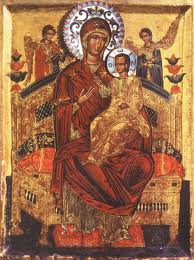
Είχα μία πρόσκληση στο χωριό Γούρι πρόσφατα. Προχωρώντας λίγο έξω από την Κλήρου, ένιωσα ένα μεγάλο και οξύ πόνο στο στήθος, εφίδρωση, και διάχυση του πόνου αριστερά. Με δεδομένο ένα σοβαρό πρόβλημα στην καρδιά, τα συμπτώματά μου δεν ήταν και τα καλύτερα. Σε κάποια στιγμή νόμιζα ότι είχα πάθει έμφραγμα. Θέλησα να επιστρέψω και να πάω στο νοσοκομείο, ή και να καλέσω βοήθεια. Όταν ετοιμάστηκα να επιστρέψω, κάτι μέσα μου με έσπρωχνε προς το Γούρι. Ο πόνος ήταν αφόρητος και με μικρές στάσεις και παρακλήσεις προς την Παναγία κατάφερα να φτάσω. Ο πόνος συνέχισε για αρκετή ώρα. Όταν συνάντησα κάποιο γνωστό μου στην κοινότητα, μου είπε πως η Εικόνα της Παντάνασσας, το ακριβές αντίγραφο της εικόνας που βρίσκεται στο Άγιο Όρος, βρίσκεται στην εκκλησία και πως την επομένη θα γίνει παράκληση.

Αμέσως κάτι μέσα μου, μου είπε πως ίσως γι’ αυτό έπρεπε να είμαι στην Κοινότητα.

Όταν την επομένη το πρωί, προσκύνησα το εικόνισμα, μετά από λίγες ώρες κατευθύνθηκα για τη Λευκωσία. Κοιτάζοντας τον καθρέφτη με έκπληξη συνειδητοποίησα πως το πρήξιμο στη φλέβα είχε εξαφανιστεί και πως η βραχνή φωνή μου είχε αλλάξει και επανήλθε κανονικά. Το πρόβλημα με τη φωνή μου άρχισε πολύ έντονα να με βασανίζει από τον Φεβρουάριο του 2013, σύμπτωμα όπως μου είχαν πει οι γιατροί της πάθησης μου (και για τη φωνή και για τη φλέβα).

Ίσως, αυτά για κάποιους να ακούγονται απλά, άσχετα, χαζά, εκπληκτικά όμως και εντυπωσιακά για κάποιους άλλους.

Προσωπικά , λέω πως ήταν μία σειρά από θαύματα, τα οποία η Παναγία φρόντισε να κάνει για κάποιον που την κάλεσε σε βοήθεια.

Καθημερινά συμβαίνουν θαύματα. Εμείς όμως ίσως δεν είμαστε σε θέση να τα αποδεχθούμε και να τα αγκαλιάσουμε.

Γέροντας Ιάκωβος Τσαλίκης: Ο κανόνας του πνευματικού δεν λύνεται από κανέναν!


Ο γέροντας ‘Ιάκωβος Τσαλίκης (1991) εξομολόγησε κάποτε μία γερόντισσα και της έβαλε κανόνα νά μην κοινωνήσει για τρία χρόνια.

Γιατί δεν κοινωνάς; τη ρώτησε μία μέρα ο ιερέας της ενορίας της. Μου έβαλε κανόνα ο π. ‘Ιάκωβος, απάντησε

Εκείνη, και του είπε την αιτία. Όχι γιαγιά, μη στενοχωριέσαι. Αυτός είναι αγράμματος καλόγερος.

Εγώ είμαι μορφωμένος και σόι λύνω τον κανόνα. Νά έρθεις την Κυριακή νά σε κοινωνήσω.

Καθώς όμως πλησίασε ή γιαγιά νά μεταλάβει, ένιωσε στο στόμα της την άγία λαβίδα άδεια και κρύα, δεν κατάλαβε τη γεύση της-θείας Κοινωνίας.

Το θαυμαστό γεγονός επαναλήφθηκε άλλες δύο Κυριακές, όπότε ή γυναίκα ανησύχησε και ξαναπήγε στο γέροντα ‘Ιάκωβο.


Παιδί μου, της είπε εκείνος, ο κανόνας δεν λύνεται. Πρέπει νά κάνεις τον κανόνα πού σου έβαλα.

Το 1987, ο π. Ιάκωβος εξομολόγησε μία κοπέλα, αλλά της απαγόρευσε νά κοινωνήσει.

Εκείνη τότε επισκέφθηκε κάποιον επίσκοπο, πού της επέτρεψε τη θεία μετάληψη.

Όταν όμως πλησίασε νά κοινωνήσει, ή άγία λαβίδα μπήκε άδεια στο στόμα της.

Αυτό ο παράδοξο και θαυμαστό επαναλήφθηκε κι άλλη φορά, όπότε ή κοπέλα τρόμαξε, μετανόησε και πήγαινα εξομολογηθεί πάλι στον π. ‘Ιάκωβο.

Όταν κοινωνώ τούς ανθρώπους, διηγιόταν χαρακτηριστικά άλλοτε ο μακαριστός γέροντας Ιάκωβος, ποτέ δεν κοιτάζω τα πρόσωπά τους.

Μερικές φορές όμως μου λέει ο λογισμός νά τα κοιτάξω.

Τότε βλέπω μερικά πρόσωπα νά έχουν μορφή σκύλου, πιθήκου ή άλλων ζώων.

Είναι φοβερή ή μορφή τους. Βλέπω όμως και μερικά ήρεμα και ιλαρά πού μετά τη θεία μετάληψη λάμπουν σαν τον ήλιο.

Μία φορά του είπε κάποιος συλλειτουργός του:Μ’ έκαψε ή θεία Κοινωνία!…

Εγώ, απάντησε ο γέροντας, δεν αισθάνθηκα νά με καίει.

Αντίθετα, ζούσε τόσο έντονα τη μέθεξη του δεσποτικού Σώματος, ώστε ανακαινιζόταν ψυχικά και σωματικά.

Σήμερα πού κοινώνησες, είπε σ’ ένα πνευματικό του παιδί, βλέπεις πώς αισθάνεσαι; Εγώ αισθάνομαι έτσι πάντοτε. Ό Χριστός βρίσκεται μέσα μου πάντα.


ΘΑΥΜΑΤΑ ΚΑΙ ΑΠΟΚΑΛΥΨΕΙΣ ΑΠΟ ΤΗ ΘΕΙΑ ΛΕΙΤΟΥΡΓΙΑ

Έκδοση Ιεράς Μονής Παρακλήτου Αττικής


Γέροντας Ιάκωβος Τσαλίκης


http://www.diakonima.gr

Νέο θαυμαστό γεγονός στον Αγ. Ιωάννη τον Ρώσο


Του Γιώργου Θεοχάρη
Πριν δυο εβδομάδες στο Ιερό προσκύνημα του Αγίου Ιωάννη του Ρώσου στο Προκόπι Ευβοίας συνέβη ένα συγκλονιστικό γεγονός αφήνοντας άφωνους πιστούς και κληρικούς.
Κατά το προσκύνημα της μία γυναίκα θέλησε εν κρυπτώ να πάρει μαζί της τη ζώνη του Αγίου, που μόλις είχε φορέσει στη μέση της, ώστε να θεραπευτεί συγγενικό της πρόσωπο, όπως υποστήριξε εκ των υστέρων.

Χωρίς να γίνει αντιληπτή, εξήλθε από τον Ιερό Ναό με τη ζώνη στη τσάντα της και κατευθύνθηκε στο λεωφορείο του ΚΤΕΛ για Αθήνα. Το λεωφορείο δεν ξεκινούσε, κατέβηκε ο οδηγός έλεγξε τα πάντα και διαπίστωσε ότι δεν υπήρχε ένδειξη για τεχνικό πρόβλημα .
Ξαφνικά άρχισαν να χτυπάνε οι καμπάνες οι οποίες λειτουργούν μόνο χειροκίνητα, όπως υποστήριξαν στο΄΄Αγιορείτικο Βήμα΄΄ άνθρωποι από οργανισμό της Ιεράς Μητρόπολης.


Μετά από αυτά τα σημάδια, η γυναίκα που είχε τη ζώνη του Αγίου στη τσάντα της έτρεξε στον οδηγό και του είπε ΄΄ πρέπει να γυρίσω στο Ναό να αφήσω κάτι που πήρα για να θεραπευτεί ένας δικός μου άνθρωπος΄΄.

Πήγε στο Ναό, άφησε διακριτικά τη ζώνη του Αγίου πάνω στο Ιερό Λείψανο του και επέστρεψε στο λεωφορείο. Αμέσως το λεωφορείο ξεκίνησε προκαλώντας έκπληξη στους επιβάτες.

Το θαυμαστό γεγονός σκόρπισε δέος στην ευρύτερη περιοχή του Νομού Ευβοίας και έκανε ακόμα περισσότερους πιστούς να προσέρχονται στη χάρη του θαυματουργού Αγίου για να του ζητήσουν να τους ελεεί .

ΠΗΓΗ: http://www.pentapostagma.gr/2013/08/thavma-agiou-ioanni-rwsou.html#ixzz2cvt542T8

The awful stench of impure spirits


Among other mysterious perceptions from the world of spirits, the saints also had perceptions of sweet fragrances from good spirits and foul stenches from impure spirits.

During every appearance of luminous, pure spirits, a life-giving and sweet fragrance wafted about; and during every appearance of dark and impure spirits, a suffocating, unbearable stench filled the air.

The saints were able to discern which passion possessed a man by the kind of stench he emanated. Thus it was that St. Euthymius the Great recognized the stench of the passion of adultery in the monk Emilian of the Lavra of St. Theoctistus. Going to Matins one morning, Euthymius passed by Emilian's cell and smelled the stench of the demon of adultery. Emilian had not committed any physical sin, but had adulterous thoughts that were being forced into his heart by the demon, and the saint already sensed it by its smell.

The power of this perception once revealed itself even more wondrously in St. Hilarion the Great. A certain avaricious miser had sent some of his vegetables to Hilarion. When they were brought to Hilarion for a meal, the saint said: "Take these away from here. I cannot stand the stench that comes from these vegetables! Do you not smell how they reek of avarice?" When the brethren were amazed by these words, Hilarion told them to take the vegetables to the oxen, and they would see that not even the oxen would eat them. Indeed, the oxen merely sniffed at them, and turned their heads away in disgust.


St. Nikolai Velimirovich


How does sin arise? ( St. Nikolai Velimorivich )


"My wounds are foul and festering because of my foolishness" (Psalm 38:5).

The prophet speaks of the wounds of sin that he himself committed, and from which he sensed in himself the stench of sin. As much as this acknowledgment reveals the impurity of previous sins, so is the subsequent purity of the repentant one also shown. For as long as man follows the corrupt path of sin, he does not sense its suffocating stench; but when he withdraws from this path and sets off on the pure path of righteousness, he senses the inexpressible difference between purity and impurity, between the path of virtue and the path of vice.

Imagine a man who has spent the night in a stinking tavern and finds himself in a garden of roses the next morning. In the former there was stench, poison, debasement of soul and body, anger, discord, and the tormenting of himself and others. In the latter is God's great sun overhead, beautiful flowers everywhere, fresh air, wondrous fragrance, serenity and health. Imagine this, and understand that there is an even greater difference between the path of sin and the path of God.

My wounds are foul and festering. Thus the great king describes the fruits of his sinful past. Nothing is as foul as sin, nothing festers as much and nothing spreads as much as sin. The stench of bodily wounds suggests, in only a small way, the unbearable stench of a sinful soul. That is why every holy thing distances itself from such a soul. The pure heavenly spirits hide from such a one, and the impure spirits of hades seek its company. Every new sin is a fresh wound on the soul; every sin is corruption and stench.

How does sin arise? From my foolishness explains the prophet. A mind derailed from its divine track leads man to sin. Until the mind is cleansed, man cannot be cleansed. "But we have the mind of Christ" (I Corinthians 2:16), says the Apostle. In other words, we have a mind put back on track, as was Adam's mind before the sinful stench.

Hence brethren, all Orthodox teaching on asceticism concentrates on one main point: on the mind of man; on the cleansing and correcting of the mind.

O Lord Jesus Christ, Purity and eternal Source of purity, help us to reject our foolishness; help us to reason according to Thy mind. To Thee be glory and praise forever. Amen.

St. Nikolai Velimorivich
Related Posts Plugin for WordPress, Blogger...