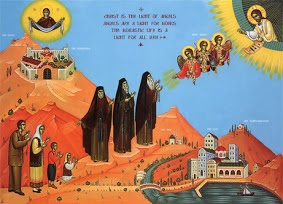
When a man once truly repents, he need not think any more about the sins he committed so that he will not sin again.
St. Anthony counsels: "Be careful that your mind not be defiled with the remembrance of former sins and that the remembrance of those sins not be renewed in you."
Again, in another place, St. Anthony says: "Do not establish your previously committed sins in your soul by thinking about them so that they not be repeated in you. Be assured that they are forgiven you from the time that you gave yourself to God and repentance. In that, do not doubt."
It is said of St. Ammon that he attained such perfection that from much goodness he was not aware that evil exists anymore. When they asked him what is that "narrow and difficult path" (Matthew 7:14), he replied: "That it is the restraining of one's thoughts and severing of one's desires in order to fulfill the will of God."
Whoever restrains sinful thoughts, does not think of his own sins or the sins of others neither of anything corruptible nor of anything earthly. The mind of such a man is continually in heaven where there is no evil. Thus, in him, sin gradually ceases to be, even in his thoughts.
St. Nikolai Velimirovich
 Το καλοκαίρι καταγράφονται τα περισσότερα τσιμπήματα από μέλισσες, σφήκες, μπούμπουρες, σκορπιούς, σαρανταποδαρούσες, ακόμη και από φίδια.
Και αυτό γιατί λίγο η εξοχή, λίγο η χαλαρότητα των διακοπών μας καθιστούν ευάλωτους σε τέτοιου είδους περιπέτειες. Τι πρέπει να κάνουμε όταν μας τσιμπήσει ένα έντομο ή κάποιο φίδι; Κινδυνεύουμε και αν ναι πόσο πολύ; Διαβάστε ένα χρήσιμο οδηγό... επιβίωσης και μην ξεχνάτε, πάνω από όλα χρειάζεται ψυχραιμία.
Σφήκα- μέλισσα: Τα τσιμπήματα της σφήκας ή της μέλισσας δεν είναι θανατηφόρα και σε γενικές γραμμές μπορεί να πονάμε, αλλά δεν κινδυνεύουμε. Κινδυνεύουν μόνο όσοι είναι αλλεργικοί και δεν το ξέρουν. Εκείνοι που είναι αλλεργικοί και το γνωρίζουν και πιο προσεκτικοί είναι αλλά και εφοδιασμένοι με τα κατάλληλα φάρμακα είναι (πχ ένεση αδρεναλίνης). Επίσης είναι επικίνδυνο για όλους μας να δεχτούμε πολλαπλά και απανωτά τσιμπήματα, κάτι που συμβαίνει εάν “πέσουμε” σε κυψέλη και ταράξουμε τα έντομα.
Όταν μας τσιμπήσει μια μέλισσα ή σφήκα το δέρμα πρήζεται και κοκκινίζει σαν τοπική φλεγμονώδη αντίδραση στο δηλητήριο του κεντριού. Ο πόνος είναι αρκετά έντονος και μπορεί να διαρκέσει από κάποιες ώρες, μέχρι λίγες ημέρες. Το πρήξιμο στην περιοχή εντείνει τον πόνο αυτό. Ιδιαίτερη προσοχή πρέπει να δείξουμε εάν η σφήκα ή η μέλισσα μας τσιμπήσει στον λαιμό ή μέσα στο στόμα και αυτό γιατί το πρήξιμο μπορεί να φράξει τον αέρα και να δυσκολέψει την αναπνοή μας.
Μόλις μας τσιμπήσει μια μέλισσα/σφήκα, το πρώτο πράγμα που πρέπει να κάνουμε είναι να βγάλουμε το κεντρί, προσεκτικά με ένα τσιμπιδάκι. Προσοχή μην πιέσετε το κεντρί για να το βγάλετε γιατί μπορεί να εισχωρήσει βαθύτερα, ή ακόμη με την πίεση να χυθεί περισσότερο δηλητήριο μέσα μας.
Μόλις το αφαιρέσουμε πρέπει να τοποθετήσουμε πάγο, ή κάποια κορτιζονούχα αλοιφή. Εάν έχουμε την δυνατότητα μπορούμε να πάρουμε και ένα αντισταμινικό χάπι που θα μας ανακουφίσει από τα συμπτώματα.
Αν ύστερα από λίγη ώρα νιώσουμε δυσκολία στην αναπνοή, ζαλάδα, ιδρώνουμε, ή μελανιάσουμε, τότε είμαστε αλλεργικοί και δεν το ξέρουμε και έχουμε πάθει σοκ. Σε τέτοια περίπτωση, πρέπει ΑΜΕΣΩΣ να πάμε στο νοσοκομείο δίχως άλλη καθυστέρηση.
Οι αλλεργικοί θα πρέπει να είναι εφοδιασμένοι με ειδική ταυτότητα, περασμένη στον λαιμό ή στο χέρι, που θα αναφέρει την αλλεργία τους, γιατί μπορεί να χάσουν τις αισθήσεις τους από το τσίμπημα και κανείς να μην γνωρίζει τι έχουν πάθει.
Σκορπιοί-Φίδια: Ευτυχώς στην Ελλάδα τόσο τα φίδια, όσο και οι σκορπιοί δεν είναι τόσο επικίνδυνοι για θάνατο, όσο στην Αφρική, ή την Αυστραλία. Σε κάθε περίπτωση όμως το τσίμπημα, ή το δάγκωμα τους και επώδυνο είναι και εάν δεν αντιμετωπιστεί μπορεί να σκοτώσει.
Και σε αυτές τις περιπτώσεις το δέρμα κοκκινίζει και πρήζεται. Ό πόνος όμως είναι ασύγκριτα δυνατότερος σε σχέση με το τσίμπημα της μέλισσας.
Αμέσως πρέπει να τοποθετήσουμε πάγο ενώ απαραίτητη είναι η χορήγηση αντισταμινικού χαπιού, μαζί με ισχυρό παυσίπονο, γιατί πραγματικά ο πόνος δεν αντέχεται. Η μεταφορά στο νοσοκομείο πρέπει να είναι ΑΜΕΣΗ. Εκεί θα χορηγηθεί κορτιζόνη (εάν έχουμε χάπι κορτιζόνης μαζί μας το λαμβάνουμε αμέσως) και οροί.
ΠΡΟΣΟΧΗ: παλιά έλεγαν ότι πρέπει να χαράξουμε με ξυράφι την πληγή και να πιέσουμε για να βγει το μολυσμένο αίμα. Αυτό δεν ισχύει. ΜΗΝ το κάνετε. Το μόνο που θα καταφέρετε θα είναι να χυθεί περισσότερο και πιο γοργά το δηλητήριο στον οργανισμό. Επίσης το ρούφηγμα της πληγής θα πρέπει να γίνει με προσοχή και όχι από άτομα που στο στόμα τους έχουν ανοιχτές πληγές (πχ ουλίτιδα).
Σε κάθε περίπτωση η ψυχραιμία σώζει. Ενώ και το θύμα δεν πρέπει να πανικοβληθεί και να βρεθεί σε κατάσταση σοκ.
“LORD Jesus Christ, have mercy upon me.”
“If you haven’t heard this, then listen now.
If you have never done this, begin now.”
(St Theophan the Recluse)

In this Beatitude we have reached the peak of our quest. Our reward of our efforts is to become worthy of the Kingdom of Heaven.
St Gregory says,
No longer do we go astray, pinning our hope on what is unstable and subject to change. For earth is the place of variation and flux; but in the things that appear moving in heaven we observe nothing like that, because they do not behave in such a way; but all heavenly things move in their own courses in series of orderly sequence.
The examples we have for this final step are the martyrs of the Church.
Gregory says
It seems that in the last words He holds out to them the highest Beatitude like a crown. For it is truly blessed to suffer persecution for the sake of the Lord. And why? Because being chased by evil becomes the cause of attaining to the good, since separation from the wicked one is made the occasion for drawing near to the Good, that Good that is above every good, the Lord Himself, to whom runs the man who is persecuted. Therefore he is truly blessed, because he uses the enemy to help him attain the Good…
Hence the immediate aspect of the persecution which tyrants unleash against the martyrs is indeed painful to the senses; but the outcome of it exceeds all beatitude.
We all know how difficult it is to deal with those who scheme against us and who do not show their love for us. Gregory uses the story of Joseph as an example. His brothers plotted against him, sold him, yet by this action he became a king over those who had plotted against him. But the persecution in the days of the early Church (which still continues to this days in parts of the world) horrible and was something known by all. Many of Saint Gregory's peers had horrific scars to show this (This is the reason the veiled headgear that monks wear to this day was initiated.). To become blessed because someone has plotted against you, or worse physically harmed you, is not a logical thought. We do not normally see the outcome of inflicted pain as something that is good.
Gregory says,
The fact that the persecution the tyrants inflict on the faithful brings much sensible pain, makes it difficult for the more carnally minded to accept the hope of the Kingdom that is to be realized through these pains. But the Lord, who looks down upon the infirmity of our nature, tells the weak beforehand what is to be the goal of the struggle, so that they may more easily overcome the transitory feelings of pain.
The first martyr Stephen who willingly received the stones that killed him is another example he uses. As Stephen confessed his faith he saw the glory of the Lord shine down on him from heaven. Who else could be more blessed?
Now it is really difficult to prefer what is invisible versus the good things of this world, like the martyrs were able to do.
Gregory says,
Now the soul is in some way attached to the pleasant things of life through the senses of the body. Through the eyes it delights in material beauty, through the ears it inclines to melodious sounds, and so it is also affected by smell, taste, and touch, as nature has disposed to be proper to each. Hence, as it is attached to the pleasant things of life through the sensible faculty as if by a nail, it is hard to turn away from them. It has grown up together with these attachments much in the same way as the shellfish and snails are bound to their covering of clay; and so it is slow to make such movements, since it drags along the whole burden of a lifetime. As such is its condition, the soul is easily captured by its persecutors with the threat of confiscation of property or loss of sonic other things that are coveted in this life; and so it gives in easily, and yields to the power of its persecutor.
But when we God’s grace penetrates our being it is transformed. As Paul says, “For the word of God is living and powerful, and sharper than any two-edged sword…” (Heb 4:12)
Gregory says,
It cuts through the things that have badly grown together, and disrupts the fetters of habit… He is not pained by the loss of earthly things, but gladdened by the gain of heavenly ones. Therefore he will readily accept every form of torture as a means that will help him to attain to the joy before him: the fire, as a purification from matter; the sword, as disrupting the union of the mind with what is material and carnal. Every device for inflicting pain he will receive eagerly as an antidote against the dangerous poison of pleasure.
Gregory conclude with this:
Therefore affliction is the flower that will yield the hoped-for fruits. Hence let us pick the flower for the sake of the fruit. Let us be persecuted so that we may run, but if we run, let us not run in vain. Let us race towards the prize of our supernal vocation; so let us run that we may obtain. What is it that we shall obtain? What is the prize, what the crown? It seems to me that what we hope is nothing else but the Lord Himself. For He Himself is the Judge of those who fight, and the crown of those who win. He it is who distributes the inheritance, He Himself is the goodly inheritance. He is the portion and the giver of the portion, He makes rich and is Himself the riches. He shows you the treasure and is Himself your treasure. He draws you to desire the beautiful pearl; He offers it to you as it were for sale, if you will trade fairly. In order to gain it, therefore, as if in the market, let us compare the things we have not with those we have. Let us not be sorrowful, then, if we are persecuted, but rather let us rejoice, because by being chased away from earthly honors, we are driven towards the heavenly Good. For this He has promised, that those who have been persecuted for His sake shall be blessed, for theirs is the Kingdom of Heaven, by the grace of Our Lord Jesus Christ, to whom be glory and power for ever and ever.
St Gregory of Nyssa

Once the Elder was invited on board a frigate that had come from St. Petersburg. The captain of the frigate was a man quite learned, highly educated; he had been sent to America by Imperial command to inspect all the colonies. With the captain were some 25 officers, likewise educated men. In this company there sat a desert-dwelling monk of small stature, in an old garment, who by his wise conversation brought all his listeners to such a state that they did not know how to answer him. The captain himself related: "We were speechless fools before him!"
Father Herman gave them all one common question: "What do you, gentlemen, love above all, and what would each of you wish for his happiness?" Diverse answers followed. One desired wealth, one glory, one a beautiful wife, one a fine ship which he should command, and so on in this fashion. "Is it not true," said Father Herman at this, "that all your various desires can be reduced to one - that each of you desires that which, in his understanding, he considers best and most worthy of love?" "Yes, it is so," they all replied. "Well, then, tell me," he continued, "can there be anything better, higher above everything, more surpassing everything and in general more worthy of love, than our Lord Jesus Christ Himself, who created us, perfectly adorned us, gave life to all, supports all, nourishes and loves all, who Himself is love and more excellent than all men? Should not a person then love God high above all and desire and seek Him more than all else?" All began to say: "Well, yes! That is understood! That speaks for itself!"
"And do you love God?" the Elder then asked. All replied: "Of course, we love God. How can one not love God?" "And I, sinful one, for more than forty years have been striving to love God, and cannot say that I perfectly love Him," answered Father Herman; then he began to show how a person should love God. "If we love someone," he said, "we always think of him, strive to please him, day and night our heart is occupied with this subject. Is it thus that you, gentlemen, love God? Do you often turn to Him, do you always think of Him, do you always pray to Him, and fulfill His holy commandments?" It had to be acknowledged that they did not! "For our good, for our happiness," concluded the Elder, "at least let us make a promise to ourselves, that from this day, from this hour, from this very moment we shall strive to love God above all, and fulfill His holy will!"
Behold what an intelligent, superb conversation Father Herman conducted in society; without doubt this conversation must have imprinted itself on the hearts of his listeners for their whole life!
Saint Herman of Alaska

Ο ΔΙΚΑΙΟΣ ΓΕΡΟΝΤΑΣ ΝΙΚΟΔΗΜΟΣ Ο ΚΥΠΡΙΟΣ .
Βρισκόμαστε στη Σκήτη της Αγίας Άννας, τη μεγαλύτερη Σκήτη τού Αγίου Όρους. Τα βήματα μας, μας έφεραν στην καλύβα «Είσόδια της Θεοτόκου». Γέροντας εδώ είναι ό πατήρ Άνθιμος, ό Πνευματικός. Γέρων στην ηλικία, είχε ζήσει την εποχή πού ό μοναχός Νικόδημος ό Κύπριος ασκήτευε κι αυτός στη Σκήτη της Αγίας Άννας. Πολλά θα γνώριζε να μας πει για το συμπατριώτη και μοναχό, γι' αυτό τον πλησιάζομαι και τον παρακαλούμε να ξαναφέρει στη μνήμη του εκείνες τις ευλογημένες μέρες πού έζησε, εν όσο χρόνο βρισκόταν στην επίγειο ζωή ό μακαριστός γέροντας Νικόδημος. Ό πατήρ Άνθιμος με πολλή καλοσύνη κι ευγένεια μας δέχθηκε και προθυμότατα υπάκουσε στις παρακλήσεις μας (να μας διηγηθεί ότι θυμάται από τη ζωή τού Κυπρίου μοναχού). Ή γλώσσα του απλή, σε ύφος αγιορείτικο και σε καθαρεύουσα γλώσσα προς αρχαιοπρεπή πού την αφήνουμε αυτούσια, για να μη χάσει από το χαριτωμένο της διηγήσεως.
«Ό γέρο - Νικόδημος», άρχισε να διηγείται, «καταγόταν από την Κύπρο. Εκεί στην πατρίδα του ήταν μάγειρος στον Άγγλο αρμοστή της Κύπρου. Ήταν πολύ καλός. Τον συμπαθούσε πολύ ό αρμοστής και ήταν επιθυμία τού γέρο-Νικόδημου να έλθει στο Αγιον Όρος. Τον εφοδίασε με διαβατήριο και συστατικά από τον Τούρκο διοικητή (καϊμακάμη). ' Αφού ήλθε στο Αγιον Όρος, περίπου στα 1895, περιήλθε το Αγιον Όρος, τα διάφορα μοναστήρια, σκήτες κλπ, και τού άρεσε πιο πολύ ή Σκήτη της ' Αγίας Αννης. Εκεί κοινοβίασε στην Καλύβι της θείας Αναλήψεως, κάτωθεν τού Κυριακού εις τον γέροντα Ιωάννη. Εις αυτήν την καλύβι είχε ασκηθεί και προετοιμαστεί για το μαρτύριο ό Άγιος όσιομάρτυς Νικόδημος, καταγόμενος από το Έλβασάν της Αλβανίας εις το όποιον και μαρτύρησε κατά το 1720. Ή μνήμη αυτού είναι εις τας 10 Ιουλίου όπως βλέπετε εις το συναξάρια. Γι' αυτό και προς μνήμην τού μάρτυρος ό Γέροντας του τον ονόμασε Νικόδημο.
Ήταν φύσις άκρως αγαθή, Φιλάδελφος, ελεήμων εις όλους όσους διέβαιναν διά της οδού πού διέρχεται διά της καλύβης του. Ασκητικός το έπακρον, τακτικός εις τας ιεράς ακολουθίας, κανόνας, νηστείας, αγρυπνίας, προσευχάς, όπως χαρακτηρίζεται ό αληθής, φιλόθεος μοναχός, υπήκοος εις τον γέροντα του στο έπακρον. Διά τούτο και ο θεός τον είχε χαριτώσει με πολλή χάριν, ώστε κι ή απλή ομιλία του να παρήγορη τον άκούοντα και να βοηθή τον κάθε ζητούντα λίγη παρηγοριά. Μιλούσε με τόση βεβαιότητα με την δύναμιν της πίστεως, ώστε οποίος τον άκουε, απορούσε για το σταθερό της γνώμης του. Επί παραδείγματι: Εις την Γερμανική κατοχή , όπου υπέφερε όλος ό Ελληνισμός και ιδιαιτέρως το Άγιο Όρος, επειδή δεν είχε παραγωγή, έλεγε: «Ολίγην υπομονή και ό Θεός θα βοηθήσει και θα μας φέρουν όλα τα αγαθά, ως και ζεστό ψωμί», τα όποια και ήξιώθη και τα είδε και τα απόλαυσε, «οι δέ Γερμανοί θα καταστραφούν», έλεγε.
Ή φιλοξενία προς τούς αδελφούς του ξεπέρασε και αυτήν τού Πατριάρχη Αβραάμ. Δεν υπήρχε διαβάτης πού να κτύπησε την πόρτα του και να μην ευεργετήθηκε, πεινασμένος πού να μη χόρτασε. Ήταν ό καλύτερος μάγειρος της Σκήτης και μοναδικός όλων των πανηγύρεων τού ' Αγίου Όρους. Ένα περιστατικό έκ παραδόσεως αναφέρει τα εξής: Άνωθεν της Αγίας Αννης προς την Κερασιάν, υπάρχει κελίον με την επωνυμία «Άγιος Αρτέμιος». Γενομένης αγρυπνίας εις τον Άγιο 'Αρτέμιο, ό γέρο - Νικόδημος ήτανε ό μάγειρας στην αγρυπνία και από την υπερβολική κόπωση, ενώ μαγείρευε, τον πήρε ό ύπνος. Μόλις ξύπνησε, νομίζοντας πώς είχε καεί το φαγητό, ξαφνιασμένος καθώς ήταν, κοιτάζει και βλέπει ένα στρατιώτη ντυμένο, ν' ανακατεύει το φαγητό και_ τού λέει: «Γέρο, μη στενοχωριέσαι, εγώ είμαι εδώ», και αμέσως έγινε άφαντος. Ήτανε ό ίδιος ό Άγιος Αρτέμιος, πού διά της παρουσίας του ευλογούσε την αγρυπνία.
Μια φράση πού έλεγε συχνά καθώς φιλοξενούσε κάποιον αδελφό ήτανε: «Έλα, ψυχή μου!».
Έκαμε μοναχούς και εκοιμήθη εις βαθύ γήρας, περίπου εκατονταετής. Ή καλύβι συνεχίζει την πορεία της και είναι εκεί τώρα άλλος γέροντας, Ματθαίος λεγόμενος, και δεύτερος Νικόδημος, φέρων την επωνυμία τού μακαριστού γέροντος Νικόδημου.
Ό, τι καλόν φαντασθεί κανείς και αγαθόν έργον εποίησε. Θερμός στην πίστη. Ευλαβής και επιμελής εις όλα τα αγαθά έργα και τώρα ευρίσκεται εις τούς ουρανούς, στην θριαμβεύουσαν Εκκλησία κακείθεν να πρεσβεύει προς τον Θεόν, να εύλογη την Σκήτη και να ελευθέρωση την γενέτειρα του μεγαλόνησο Κύπρο από των κατεχόντων αυτήν δεινών και να βοηθήσει τούς υποφέροντας αδελφούς Ελληνορθόδοξους Χριστιανούς.
Ας επικαλεσθούμε τας εύχάς του, να διέλθωμεν τον δόλιχον της ζωής και να καταντήσωμεν εις την αιώνιον μακαριότητα. Αμήν».
ΠΑΝΑΓΙΩΤΗΣ ΧΡΙΣΤΟΔΟΥΔΟΥ ΒΙΒΛΙΟΓΡΑΦΙΑ ΠΕΡΙΟΔΙΚΟ ΟΡΘΟΔΟΞΗ ΜΑΡΤΥΡΙΑ. ΤΕΥΧΟΣ 100.
http://apantaortodoxias.blogspot.ca/2013/07/blog-post_7249.html

Πέρασε τὸ χθές, πέρασε καὶ ἡ σημερινὴ ἡμέρα, πέρασε κι αὐτὴ ἡ ἑβδομάδα κι αὐτὸς ὁ μήνας, κι αὐτὸς ὁ χρόνος. Πόσο εὔκολα περνᾶ τὸ χθὲς κι ἔρχεται τ' αὔριο! Πότε πέρασαν τὰ χρόνια τῆς ζωῆς μας! Ἄλλαξαν πολλὰ πράγματα στὸ πέρασμα τοῦ χρόνου. Χωρὶς νὰ τὸ καταλάβουμε φθάνουμε στὸ τέλος τῆς ζωῆς μας.
Ὁ ἄπ. Ἰάκωβος γράφει: «ποὶα γὰρ ἡ ζωὴ ὑμῶν; ἀτμὶς γὰρ ἔσται ἡ πρὸς ὀλίγον φαινομένη, ἔπειτα δὲ καὶ ἀφανιζομένη» . Ἡ ζωὴ τοῦ ἀνθρώπου φεύγει τόσο γρήγορα, ὅπως ὁ ἀτμός.
Πολλοὶ ἀπό μᾶς δὲν ἀξιοποιήσαμε σωστὰ τὸ χρόνο τῆς ζωῆς μας. Τὸν ξοδεύσαμε ἱκανοποιώντας τὶς σαρκικὲς καὶ ὑλικές μας μόνο ἐπιθυμίες. Ἡ παρουσία τοῦ Θεοῦ μᾶς ἄφησε ἀδιάφορους. Βέβαια, θὰ πεῖ κανείς, ζήσαμε τὴν ζωὴ ὅπως ἐμεῖς θέλαμε, χωρὶς φραγμοὺς καὶ ἐμπόδια. Ναί, ἀλλὰ τὸ χθὲς πέρασε καὶ τώρα βρισκόμαστε στὸ σήμερα. Γνωρίζεις τί σημαίνει αὐτό; Εἶναι ἡ τελευταία ἴσως εὐκαιρία ποὺ μᾶς δίνει ἡ ἀγάπη τοῦ Θεοῦ γιὰ νὰ σωθοῦμε. Ξέρεις πόσοι ἄνθρωποι σήμερα, αὐτὴν τὴν στιγμὴ φεύγουν ἀπὸ τὴ ζωή, καὶ πόσοι ἄλλοι ἑτοιμάζονται νὰ φύγουν τὴν ἑπόμενη ἡμέρα;
Ὁ Κύριος γεμάτος ἔλεος καὶ ἀγάπη μᾶς προτρέπει: «Σήμερον ἐὰν τῆς φωνῆς αὐτοῦ ἀκούσητε, μὴ σκληρύνητε τὰς καρδίας ὑμῶν» . Μὴν ξεχνοῦμε ὅτι τὸ χθὲς ἀνήκει στὸ παρελθόν. Τὸ σήμερα εἶναι δικό μας, ἀλλὰ καὶ αὐτὸ φεύγει σύντομα. Ὁ Κύριος μᾶς ἀγαπᾶ καὶ θέλει νὰ μᾶς σώσει. Ἂς ἐκμεταλλευθοῦμε τὸ παρόν, τὸ σήμερα.
Ἃς μὴν προφασιζόμαστε ὅτι ἔχουμε καιρὸ μπροστά μας. Αὐτὴ ἡ σκέψη εἶναι ἀπατηλή. Ὁ διάβολος ποὺ μᾶς ἔκλεψε τὸ χθὲς θέλει νὰ μᾶς κλέψει καὶ τὸ σήμερα. Εἶναι καιρὸς νὰ ἐνδιαφερθοῦμε καὶ γιὰ τὴν ψυχή μας. Ὁ Θεός μᾶς δίνει τὴν εὐκαιρία σήμερα νὰ ἐπιστρέψουμε σ' αὐτόν.
Μὴν ξεχνοῦμε ὅτι ὁ ἄνθρωπος εἶναι πλασμένος γιὰ τὴν αἰωνιότητα. Ἐκεῖνο τὸ ὁποῖο φθείρεται καὶ πεθαίνει εἶναι ἡ σάρκα. Ἡ ψυχὴ τοῦ ἀνθρώπου εἶναι ἀθάνατη. Γι' αὐτὴν τὴν ψυχὴ πέθανε καὶ ἀνέστη ὁ Κύριος.
Ἀδελφέ μου, χάσαμε τὸ χθές, ἂς μὴ χάσουμε καὶ τὸ σήμερα. Σήμερα μᾶς δίνεται ἡ εὐκαιρία γιὰ νὰ κερδίσουμε καὶ τὸ αὔριο καὶ τὸ αἰώνιο. Ὁ Κύριος μᾶς καλεῖ στὴ μετάνοια. Ἄνθρωποι εἴμαστε. Ἁμαρτήσαμε, παραβήκαμε τὸ θέλημα τοῦ Θεοῦ. Ὁ Κύριος ὅμως μᾶς ἀνέχεται καὶ μᾶς χαρίζει τὸ σήμερα γιὰ νὰ μετανοήσουμε, νὰ ἀλλάξουμε ζωὴ καὶ πορεία, νὰ ζήσουμε τὸ θέλημα τοῦ Θεοῦ.
Πάρε τὴν ἀπόφαση! Πήγαινε σ' ἕναν καλὸ πνευματικό.
Ἄνοιξε τὴν καρδιά σου, ἀδείασε τὸ περιεχομενό της καὶ πάρε τὴν ἄφεση τῶν ἁμαρτιῶν ποὺ σοῦ δίνει ὁ Κύριος. Νὰ εἶσαι βέβαιος ὅτι ὁ Κύριος θὰ σὲ δεχθεῖ, θὰ σὲ εὐλογήσει, θὰ σοῦ χαρίσει μία ζωὴ αἰώνια. Μὴν ξεχνᾶς πὼς τὸ σήμερα εἶναι δικό σου, τὸ αὔριο ἀνήκει στὸν Κύριο.

Through their prayers and alms for the deceased, Christians display the relationship between this world and the world to come. The Church in this world and the Church in the other world are one and the same - one body, one in being - as does the root of a tree beneath the earth comprise one organism with the trunk and the branches of the tree above the earth. It is clear from this how we who comprise the Church on earth can receive help from the saints and the righteous ones from the Heavenly Church as well as the deceased sinners in the other world can receive help from us on earth. St. Athanasius says: "As it happens with wine inside a barrel which, when the vineyard blooms in the field, senses it and the wine itself blossoms together with it, so it is with the souls of sinners. They receive some relief from the Bloodless Sacrifice offered for them and from charity" performed for their repose. St. Ephraim the Syrian cites that same example with wine and the vineyard and concludes: "And so, when there exists such mutual sensitivity even among plants, is not the prayer and sacrifice felt even more for the departed ones?"
St. Nikolai Velimirovich

The Holy Scriptures describe that the stones used to build the Temple of Solomon were first shewn
and chiseled outside of the Temple. Once the stones had been prepared and carved with utmost attention and diligence, they were then transported to the Temple and set in place gently, without being struck by a
hammer or other tool again: “And the house, when it was in building, was built of stone made ready before it was brought thither; so that there was neither hammer nor axe nor any tool of iron heard in the house, while it was in building” (3 Kings 6:7).
Similarly, it is necessary for the people who will be placed as precious stones within the framework of the
divine manor found in Jerusalem above to be struck here in this present world with the hammer and chisel
of discipline and sorrow. This is because in the heavenly manor on high, there is no sorrow, trouble, hunger, thirst, punishment, or pain, as St. John the Evangelist describes in the book of the Revelation(cf. Rev. 21:4)
. This is why God allows His friends to suffer and face various sorrows here in this present life. Thus,we
must be extremely happy when adversities appear: we should receive them as a gift, as a blessing, and as medicine, which our Heavenly Father sends to us with much love.
Our Lord censured the Apostle Peter when he attempted to prevent Him from being apprehended and led to
death: “Put thy sword into the sheath! The cup which My Father hath given Me, shall I not drink it?” (Jn.18:11). If the Lord referred to the imminent ridicules, torments, and death itself (that He would endure for our salvation) as a cup sent from His Father, why shouldn’t we repeat the same words, “Shall I not drink it?”
and believe that all the sorrows and difficulties that we encounter area therapeutic cup containing medicine sent to us by the Heavenly Physician with paternal love for our salvation?
Behold, dear reader, how every sorrow (whether it originates from the devil, people, or some other source) is in fact a therapeutic remedy sent to you by your Heavenly Father, in order to purify your soul. Do not become upset if the drink tastes bitter,because this bitterness will help you acquire your cherished health, just as bitter and unpalatable medications prescribed by physicians help us get better.
All the sorrows and difficulties we are faced with in this life are spiritual medications sent to us by the Heavenly Physician for the benefit of our soul. According to St. Gregory the Theologian, the gall that Tobit placed on his eyes,through which he regained his sight (cf. Tob. 11:8-14), signified this truth—that every sinful person is delivered from spiritual blindness through bitter sorrows. Indeed, eyes that have been blinded by sin are enlightened and recover their vision through suffering.
Πως συμβαίνει, όμως, Γέροντα, ένας μάγος να πη για τρεις κοπέλες ότι η μία θα αποκατασταθή, η άλλη θα ατυχήση και η άλλη θα μείνη ανύπανδρη, και να γίνη έτσι;
- Ο διάβολος έχει πείρα. Όπως, π.χ. ένας μηχανικός , όταν δη ένα σπίτι που κινδυνεύει να πέση, είναι σε θέση να πη πόσο θα κρατήση κ.λπ., έτσι και αυτός βλέπει κάποιον πώς βαδίζει και με την πείρα που έχει, λέει πώς θα καταλήξη.
Ο διάβολος δεν έχει εξυπνάδα είναι πολύ κουτός. Είναι όλος ένα μπέρδεμα, άκρη δεν του βρίσκεις. Κάνει και εξυπνάδες και χαζομάρες.
Τα τερτίπια του είναι χονδρά. Ο Θεός οικονόμησε έτσι, για να τον καταλαβαίνουμε. Πρέπει να είναι κανείς πολύ σκοτισμένος από υπερηφάνεια, για να μην το καταλαβαίνη.
Όταν έχουμε ταπείνωση, μπορούμε να καταλάβουμε τις παγίδες του διαβόλου, γιατί με την ταπείνωση φωτίζεται ο άνθρωπος και συγγενεύει με τον Θεό.
Η ταπείνωση είναι που σακατεύει τον διάβολο.
Από το βιβλίο: «ΓΕΡΟΝΤΟΣ ΠΑΪΣΙΟΥ ΑΓΙΟΡΕΙΤΟΥ

- Γ έ ρ ο ν τ α ,την υπερηφάνεια συνήθως την καταλαβαίνω εκ των υστέρων,όταν πέσω.
- Σκοπός είναι να την καταλάβης πρίν πέσης.΄Οταν σου λέη κάποιος ότι έκανες κάτι καλό,να μην αισθάνεσαι ικανοποίηση.Να μην πιάνη,να μην κολλάη επάνω σου ο έπαινος.
- Τι θα με βοηθούσε σ΄αυτό ;
- Το να γνωρίσης τον εαυτό σου.Αν ο άνθρωπος γνωρίσει τον εαυτό του,τελείωσε.Οι έπαινοι είναι μετά ξένα σώματα΄δεν κολλάνε επάνω του.΄Οταν λ.χ. ένας ξέρη ότι είναι γύφτος,δεν μπορεί να του κολλήση ο λογισμός ότι είναι βασιλιάς.Κι εσύ,αν νομίζης ότι είσαι πριγκίπισσα,θα είσαι λειψή.
- ΄Αν είμαι έτοιμη εκ των προτέρων να μην δέχωμαι τον έπαινο,αυτό θα με βοηθούσε;
- Αυτό φυσικά πρέπει να γίνεται,αλλά άλλοτε θα είσαι έτοιμη άλλοτε όχι.Σκοπός είναι να γνωρίσης τον εαυτό σου.Αν δεν γνωρίση κανείς τον παλαιό του άνθρωπο,δεν ταπεινώνεται και δεν μπορεί να γίνη η πνευματική διάσπαση του ατόμου του,για να μπη στην πνευματική τροχιά,και παραμένει στην κοσμική τροχιά.
- Μπορεί,Γέροντα, να γνωρίζω τον εαυτό μου λανθασμένα ;
- Μα δεν μιλάμε για λανθασμένη κατάσταση.Αυτός που γνωρίζει σωστά τον εαυτό του έχει ταπείνωση.Και όταν ο άνθρωπος ταπεινωθή,θα έρθη οπωσδήποτε η Χάρις του Θεού.-
ΓΕΡΟΝΤΟΣ ΠΑΊΣΙΟΥ

Not one passion is conquered without a great struggle. The Holy Fathers have referred to adulterous passion as death. When the adulterer is saved from an adulterous passion it is as though he resurrected from the dead. For those who live in the world the passion of adultery is inflamed principally by seeing and for those who live a life of asceticism in the wilderness that passion is inflamed by thoughts and by imagination.
Saint Sarah, a great female ascetic, was tortured by the insane passion of adultery for thirty years. She always defeated it by prayer and drove it away from her. At one time, the foul insanity of adultery came to her in bodily form and said to her: "Sarah, you have defeated me!" Sarah humbly answered: "I have not defeated you but the Lord Christ has defeated you." From that time on, the thought of adultery left her forever.
When Saint Pimen was asked how can a man struggle against the adulterous insanity, he replied: "If man surpresses his stomach and tongue then he will be able to rule over himself."
St. Anthony said that there exists three kinds of movements in the body: "First, the natural movement, second, unrestrained in food, and third, from the demons."
Again, others have said that the vice of adultery is strengthened by anger and pride. However, all agree that along with man's sobriety and effort the help of God is necessary in order that this repulsive passion be uprooted completely. And that it is possible for man to preserve himself in purity, witness, among many others, St. Moses of Urgin, who lived fifty years in the world and ten years in the monastery, altogether a total of sixty years in completely virginal purity.
St. Nikolai Velimirovich

By true repentance with tears, prayer and good works the most defiled soul can be completely cleansed and changed. Therefore be careful that you do not maliciously mention the sins of a repentant sinner but offer thanksgiving to God and be astonished how from darkness, light is made and from slime, pure water.
The Egyptian Pharaoh Amasis was of lowly birth and when he became king, men respected him very little, remembering his origin. In order to outwit the people and to gain their respect, he took a metal basin in which, according to custom, the feet of the visitors to the palace were washed. He ordered the basin to be melted down and from it to make a likeness of a certain idol. The pharaoh then placed this idol on the street. Seeing this idol, the people began to worship it and to render it divine honor. Then the pharaoh revealed what this idol was made of. The people then understood that, by this, the pharaoh wanted to show that they need not think anymore about what he once was but what he is now. Then the people began to render the pharaoh the respect due to royalty.
One needs to distinguish a sinner from a penitent. If you have taken upon yourself the role to rebuke the sinner, guard yourself well, that you do not rebuke the penitent also. How dear the repentant sinner is to God; call to mind the Parable of the Prodigal Son. Therefore, let it be very dear for you, he who has become dear to God.
At one time it happened that a monk succumbed to sin for which he was banished from the monastery. This monk went to St. Anthony, confessed his sin, repented and remained with Anthony for a period of time. Then Anthony sent him back again to the monastery but they did not receive him and, again, they banished him. Again, the penitent came to Anthony. Again, Anthony sent him back to the monastery with a message to the fathers of the monastery: "One boat experienced shipwreck and lost its cargo; with great difficulty did that boat arrive in the harbor and you wish to drown even that which was saved from drowning!" Hearing this wise message, the fathers received with joy the penitent brother into the monastery.
St. Nikolai Velimirovich

«Μόνο έτσι γεμίζει η ψυχή»
«Σήμερα οι άνθρωποι ζητούν να τους αγαπήσουν και γι’ αυτό αποτυγχάνουν.
Το σωστό είναι να μην ενδιαφέρεσαι αν σε αγαπούν, αλλά αν εσύ αγαπάς τον Χριστό και τους ανθρώπους.
Μόνο έτσι γεμίζει η ψυχή».
«Αγάπα όλους»
«Δεν πρέπει να κάνεις τον χριστιανικό σου αγώνα με κηρύγματα και αντιδικίες, αλλά με πραγματική μυστική αγάπη. Όταν αντιδικούμε, οι άλλοι αντιδρούν. Όταν τους αγαπάμε, συγκινούνται και τους κερδίζουμε.
Όταν αγαπάμε, νομίζουμε ότι προσφέρουμε στους άλλους, ενώ στην πραγματικότητα προσφέρουμε πρώτα στον εαυτό μας. Η αγάπη χρειάζεται θυσίες. Να θυσιάζουμε ταπεινά κάτι δικό μας, που στην πραγματικότητα είναι του Θεού»
«Όταν αγαπάς τον Χριστό, αγαπάς όλους»
«Ο Χριστός είναι η Εκκλησία και η Εκκλησία είναι ο Χριστός, που μας έχει προσλάβει όλους στον Εαυτό Του. Όταν αγαπάς τον Χριστό, αγαπάς συγχρόνως όλους τους ανθρώπους, χωρίς να ρωτάς αν οι άνθρωποι είναι άξιοι της αγάπης ή ακόμη αν την αποδεχθούν ή την απορρίψουν. Όταν θέλεις να συναντήσεις τον Χριστό, θα Τον βρεις στο χώρο της Εκκλησίας, γιατί εδώ είναι ενωμένη ολόκληρη η ανθρωπότητα με τον Θεό στο Πρόσωπο του Χριστού. Δεν μπορεί να επικοινωνείς με τον Χριστό και να μην τα έχεις καλά με τους άλλους ανθρώπους».
«Ο Θεός δεν τιμωρεί»
«Όχι, ο Θεός δεν τιμωρεί, ο άνθρωπος αυτοτιμωρείται, απομακρυνόμενος από τον Θεό.
Είναι, ας πούμε: Εδώ νερό, εκεί φωτιά.
Είμαι ελεύθερος να διαλέξω. Βάζω το χέρι μου στο νερό, δροσίζομαι, το βάζω στη φωτιά, καίγομαι».
«Η αγάπη προς το Θεό»
Μια άλλη μέρα ερωτώ το Γέροντα πώς πρέπει να είναι η αγάπη μας προς το Θεό και μου λέει:
«Η αγάπη μας προς το Θεό, παιδί μου, πρέπει να είναι πάρα πολύ μεγάλη και χωρίς να υπάρχει καμιά διάσπαση σε άλλα πράγματα. Σου φέρνω σαν παράδειγμα το εξής: Ο άνθρωπος μοιάζει να έχει εντός του μια μπαταρία με ορισμένη ενέργεια. Όταν αυτή την ενέργεια την ξοδεύει σε άλλα διάφορα πράγματα εκτός της αγάπης προς τον Θεό, η ενέργεια που απομένει μέσα του γι ́ Αυτόν είναι ελάχιστη και ίσως πολλές φορές μηδαμινή. Όταν όμως διαθέτουμε όλη μας την ενέργεια προς τον Θεό, τότε η αγάπη μας είναι μεγάλη προς Αυτόν».
«Σου λέω και τούτο το άλλο».
«Ήταν μια φορά μια κοπέλα που είχε ερωτευθεί πάρα πολύ ένα νέο, που τον έλεγαν Νίκο. Αυτή που λες, σηκωνόταν κάθε νύκτα και κρυφά από τους δικούς της, πηδούσε το παράθυρό της και πήγαινε ξυπόλητη μέσα απ ́ τα χωράφια που υπήρχαν αγκάθια για να συναντήσει τον αγαπημένο της ματώνοντας τα πόδια της. Όταν επίσης γύριζε στο σπίτι της και καθόταν μέσα, πάντοτε ο Νίκος της ήταν εδώ, και μου έδειχνε το μέτωπό του. Ό,τι δουλειές και να έκανε, ο Νίκος της εδώ, και μου ξανάδειχνε το μέτωπό του. Έτσι πρέπει και συ, παιδί μου, να δίνεις όλη σου τη δύναμη στο Θεό και ο νους σου να είναι πάντα σ ́ Αυτόν, γιατί έτσι του αρέσει».
«Αγάπη με απλότητα χωρίς φόβο»
Μου έλεγε ο παππούλης πολλές φορές:
«Αγάπη σου συνιστώ να έχεις πάντοτε. Πρώτα αγάπη και μετά όλα τα άλλα».
«Πρέπει ν ́ αγαπάμε εν απλότητι καρδίας, όπως το ίδιο πρέπει και να προσευχόμαστε».
«Δεν θέλω με το φόβο του θανάτου να πλησιάσεις το Θεό. Θέλω με την πολλή αγάπη προς Αυτόν να το κάνεις. Αυτό είναι το ανώτερο, παιδί μου».
«Ο Χριστός είναι το παν»
Ο γέροντας Πορφύριος είπε:
«Λοιπόν, ζωή χωρίς Χριστό δεν είναι ζωή. Πάει, τελείωσε.
Αν δε βλέπεις το Χριστό σε όλα σου τα έργα και τις σκέψεις, είσαι χωρίς Χριστό.
Πώς το κατάλαβες; Θυμάμαι κι ένα τραγούδι. «Σύν Χριστώ πανταχού, φόβος ουδαμού».
Το ’χετε ακούσει; Έ; Το λένε τα παιδιά, δε το θυμάμαι.
Λοιπόν, έτσι πράγματι πρέπει να βλέπομε το Χριστό. Είναι φίλος μας, είναι αδελφός μας, είναι ό,τι καλό και ωραίο.
Είναι το Παν. Αλλά είναι φίλος και το φωνάζει: «Σας έχω φίλους, βρέ, δεν το καταλαβαίνετε; Είμαστε αδέλφια.
Βρε εγώ δεν είμαι... δεν βαστάω την κόλαση στο χέρι, δεν σας φοβερίζω, σας αγαπάω.
Σας θέλω να χαίρεσθε μαζί μου τη ζωή». Κατάλαβες;
Έτσι είναι ο Χριστός. Δεν έχει κατήφεια, ούτε μελαγχολία, ούτε ενδοστρέφεια, που ο άνθρωπος σκέπτεται ή βασανίζεται από διάφορους λογισμούς και διάφορες πιέσεις, που κατά καιρούς στη ζωή του τον τραυμάτισαν.
Ο Χριστός είναι νέα ζωή. Πώς το λέω; Ο Χριστός είναι το Παν. Είναι η χαρά, είναι η ζωή, είναι το φως, το φως το αληθινόν, που κάνει τον άνθρωπο να χαίρεται, να πετάει, να βλέπει όλα, να βλέπει όλους, να πονάει για όλους, να θέλει όλους μαζί του, όλους κοντά στο Χριστό.
Όταν εμείς βρίσκουμε κάποιονε θησαυρό ή ό,τι άλλο, δεν θέλομε να το λέμε πουθενά.
Ο Χριστιανός όμως, όταν βρει το Χριστό, όταν γνωρίσει τον Χριστό, όταν ο Χριστός εγκύψει μέσα στην ψυχούλα του και τον αισθανθεί, θέλει να φωνάζει και να το λέει παντού, θέλει να λέει για το Χριστό, τι είναι ο Χριστός.
Αγαπήσατε το Χριστόν και μηδέν προτιμήστε της αγάπης Αυτού.
Ο Χριστός είναι το πάν, είναι η πηγή της ζωής, είναι το άκρον των εφετών, είναι το Πάν. Όλα στο Χριστό υπάρχουν τα ωραία. Και μακράν του Χριστού η θλίψις, η μελαγχολία, τα νεύρα, η στεναχώρια, οι αναμνήσεις των τραυμάτων της ζωής, των πιέσεων, των αγωνιωδών, έτσι, ωρών. Όλα, ζούμε εκείνα εκεί της ζωής μας. Και πάμε εδώ και πάμε εκεί, και τίποτα, και πουθενά δεν στεκόμαστε. Όπου βρούμε το Χριστό, ας είναι μια σπηλιά, καθόμαστε εκεί και φοβούμαστε να φύγουμε, να μη χάσουμε το Χριστό. Διαβάστε να ιδείτε. Ασκηταί, που εγνώρισαν το Χριστό, δεν ήθελαν να φύγουν από τη σπηλιά, ούτε βγαίναν έξω να κάνουνε πιο πέρα« θέλαν να είναι εκεί που αισθανόντουσαν το Χριστό μαζί τους. Ο Χριστός είναι το Πάν.
Ο Χριστός είναι η πηγή της ζωής, της χαράς. Το Πάν».
Ἀποσπάσματα ἀπό τούς λόγους τοῦ μακαριστοῦ Γέροντα Πορφυρίου Καυσοκαλυβίτη
Κοζάνη Μάρτιος 2006

Ιn examining the value which sorrow has for human life in our previous text, we had mentioned the temptations which cause it, and the tears which often accompany it. We therefore had an opportunity to see quite briefly the positive -or rather the beneficial- aspects of certain things in this world which, according to current logic, are initially considered as being negative and undesirable.
While we had said whatever was necessary concerning sorrow and temptation, we had intended to speak extensively about tears in a separate article. Not only because there is a great variety of tears, as we shall see below, but especially because the desert Fathers place tears at the peak of all "good things" in the present world. It is not by chance that during the most contrite time of prayer, they did not ask God for wisdom or endurance or courage, not even for holiness. Their chief request was always, invariably, "grant me tears, O God, tears of repentance". This alone would be enough to make us think more deeply about tears and lead us to examine two related questions. First of all, the nature and source of tears and, second, their value in spiritual life.
It is clear that both these questions are closely tied together, but not only because they both refer to tears. Their relationship is much more substantial. The latter is completely dependent on the former. This means that the vaIue of tears depends upon what kind of tears they are. We must therefore arrange tears in some order. To categorise them and rank them accordingly. We can speak about an "order of tears" just as we would say a system of tears. Is this not how we speak of systems and orders of angels, people, waters etc?
Of course, the most important feature of tears is not the liquid which comes from the eyes. This naturally has the same chemical synthesis in every case. Yet, according to the cause of them each time, we have a corresponding quality and category of tears. The main ones are perhaps the following:
Tears of repentance / Tears of fear of God / Tears of contrition
***
Tears of emotion / Tears of joy / Tears of pain and horror / Tears of indignation
***
Tears of hypocrisy
When the Fathers and the great ascetics speak about tears, they always mean those three of the first category. Repentance is the most astounding miracle and experience in the life of a person. It is his or her most integral and forceful act. It is the radical ripping out of all features of one's previous life. Ιn such a way that nothing stands up in worldly terms. Literally everything is made "upside down". You feel as if everything is being turned backwards. Being doubted. Being overturned. Being frustrated. Being annihilated forever. This is what repentance is (meta-noia, a change of mind). Is it possible for such an impalement of soul and spirit not to bring tears, not to cause pain?
The root of tears, their very first and inexhaustible source, is repentance. The first and major fruit of this is the "fear of God". A fear which is characterised by Scripture as the "beginning of wisdom" (Psalm ΙΙΙ:10). The more one is made wise in the fear of God, the more one sees and senses miracles within and all around. A miracle is not a miracle unless someone has wondered at it in all its magnitude. Miracle (thavma) is then a wonder (thavmasma).
Only for this reason did God create humankind. To marvel and discover continuously, for a whole lifetime, deeper aspects of the truth, in other words of God's love. Here then is yet another meaning of the Biblical saying: "Those who increase knowledge increase sorrow" (Ecclesiastes 1:18), which is the most mystical equalisation in human life.
It is only natural, following such a deep dive into the mystery of life and death, that the person of faith should feel more and more privileged compared to the rest of creation. It is an incomparable privilege to be a partaker in the deeper rhythm of the world, thereby discovering by first hand the boundless love of God. The only human answer to this "initiation", which reaches a climax in "participation" and eventually leads to "deifιcation", if God is pleased to allow this, are tears. Tears of compunction, contrition and appreciation, which as a result become "supplicatory tears", as they redeem us from all worldly uncertainties and doubts.
St. Isaac the Syrian wrote the following on such a correlation between the fear of God and tears of repentance: "Ι do not have a sorrowful heart to search for you, Ι do not have repentance, Ι do not have compunction, nor tears which return children to their homeland. Ι do not have, Lord, a supplicatory tear; my mind is darkened by the νanity of the world, and it is not able to gaze upon you with pain; my heart has grown cold from the multitude of temptations, and it cannot become warm through tears of love towards you. But you, Lord Jesus Christ my God, the treasury of good things, grant me perfect repentance and a toilsome heart, so that I may come to search for you with all my heart; for without you Ι wish to be estranged from every good thing" (2nd Discourse, Concerning renunciation of the world etc).
Even if we only isolated and underlined one phrase out of this stirring passage, we would see the value which the Saint recognises in tears, when he observes that they alone "return children to their homeland".
Clearly, all of the above comments refer to godly tears. They are what the Fathers called the greatest "gift" of the present world. For it is natural that, since tears arise from the fear of God and repentance, they should lead directly towards God Himself, according to His grace. Thus the character and the value of tears co-incide absolutely.
The second group of tears is also second in terms of importance. This is because it is confined, first of all, to the values of this world for which it either laments or rejoices. This is the group of four which follows the previous group of three. They are tears of pain and horror or joy on the one hand, or indίgnation and emotion on the other. These tears do not cease to have some value, since they spring from sincerity, spontaneously. Indeed they may, by cultivating and refining people, lead them at some stage to repentance, namely to God. Therefore, we enter the mystical process of godly tears which has already been described "through the back door". That is why someone like Victor Hugo could state that "no one can see God unless they have teary eyes".
Ιn concluding this brief reference to the order of tears, we must state that, if there are any kind of tears which are totally futile and which have nothing to do with the cultivation and fate of the soul, they are the tears of hypocrisy. They, as tears which stem from ulterior motives, might be useful only to actors, on a professional level. And even more so to the crocodiles which use them as a means to secure their food. By Archbishop Stylianos of Australia

Ὁ Χριστιανός εἶναι ἕνας μικρός Χριστός ἐπάνω στήν γῆ. Ναί! Ὁ Χριστιανός πρέπει νά εἶναι μιά σμικρογραφία τοῦ Χριστοῦ. Ὅπως, ὅταν ἀποσπάσουμε μιά σταγόνα νεροῦ ἀπό τήν θάλασσα, ἔχουμε στά χέρια μας μία σμικρογραφία τῆς θαλάσσης, ἔτσι καί ὅταν ἀποσπάσουμε ἕναν Χριστιανό ἀπό τό μυστικό σῶμα τοῦ Χριστοῦ, ἔχουμε μία σμικρογραφία Χριστοῦ.
Γιά νά εἶναι κάθε Χριστιανός ἕνας μικρός Χριστός, ὀφείλει νά ἀποκτήση νοῦ Χριστοῦ, μάτια Χριστοῦ, γλῶσσα Χριστοῦ, χέρια Χριστοῦ, καρδιά Χριστοῦ. Νοῦ Χριστοῦ, πού νά εἶναι πάντα φωτεινός, πού νά μήν φιλοξενῆ σκέψι κακή, νά μήν σκέπτεται καί νά μήν σχεδιάζη τό κακό.
Μάτια Χριστοῦ, πού νά μήν βλέπουν τήν ματαιότητα τοῦ κόσμου, ἀλλά τήν αἰωνιότητα τοῦ οὐρανοῦ. Μάτια καθαρά, βλέμμα ἁγνό, γεμᾶτο συμπόνια καί καλωσύνη.
Γλῶσσα Χριστοῦ, πού νά ὑπηρετῆ τήν ἀλήθεια, νά ὑπερασπίζεται τήν δικαιοσύνη καί νά εἶναι ἄγρυπνος φρουρός τῶν δικαιωμάτων τοῦ Θεοῦ.
Χέρια Χριστοῦ, πού νά μήν διαπράττουν κλοπή, πού νά μήν παλαμίζουν τό Εὐαγγέλιο, νά μή χειροδικοῦν καί καθίστανται δολοφονικά.
Καρδιά Χριστοῦ, πού νά ἀγαπᾶ χωρίς ὑπολογισμούς. Μιά καρδιά πού νά χωροῦν ἀκόμη καί οἱ πλέον ἄσπονδοι ἐχθροί. Μιά καρδιά, πού νά μή σείεται ἀπ’ τό κακό, πού νά μήν πληγώνεται ἀπό τόν πονηρό· μιά καρδιά γεμάτη ἀπό θεϊκή ἀγάπη. Αὐτός εἶναι ὁ Χριστιανός. Ναί, αὐτό θά πῆ Χριστιανός.
Πηγή: Ἀπό τό βιβλίο «Γρηγορεῖτε» τοῦ Ἀρχιμ. Θεοφίλου Ζησοπούλου.

(Ἕνας μανιώδης καπνιστὴς ἀπὸ τὴν Ἁγία Πετρούπολη, ὁ Ἀλέξιος Στεπάνοβιτς Μαγιόρωφ, ἄρχισε κάποτε νὰ αἰσθάνεται τὶς ἐπιζήμιες συνέπειες τοῦ καπνίσματος στὴν ὑγεία του. Οἱ πολλὲς συμβουλὲς καὶ παραινέσεις τῶν φίλων του ἀποδείχθηκαν μάταιες.Τελικὰ τὸ ἔτος 1888 ὁ Ἀλέξιος Στεπάνοβιτς κατέφυγε στὴν βοήθεια τοῦ στάρετς Ἀμβρόσιου καὶ μὲ ἐπιστολὴ τοῦ ζήτησε νὰ τοῦ ὑποδείξει τὸν τρόπο ποὺ θὰ καταπολεμήσει τὸ πάθος του. Σὲ γράμμα του μὲ ἡμερομηνία 12 Ὀκτωβρίου 1888 ὁ ὅσιος Ἀμβρόσιος ἀπάντησε στὸν Ἀλέξιο Μαγιόρωφ τὰ ἑξῆς:)
«Γράφεις ὅτι δὲν μπορεῖς νὰ κόψης τὸ κάπνισμα! Αὐτὸ ποὺ εἶναι ἀδύνατο γιὰ τὸν ἄνθρωπο, εἶναι δυνατὸ μὲ τὴ βοήθεια τοῦ Θεοῦ. Τὸ μόνο ποὺ χρειάζεται εἶναι νὰ ἀποφασίσεις μὲ σταθερότητα νὰ ἀπαλλαγῆς ἀπ' αὐτό, ἀφοῦ ἀναγνωρίζεις τὴν ζημία ποὺ προξενεῖ στὴν ψυχὴ καὶ στὸ σῶμα σου.
Διότι ὁ καπνὸς ἐξασθενίζει τὴν ψυχή, αὐξάνει καὶ δυναμώνει τὰ πάθη, σκοτίζει τὸ νοῦ καὶ καταστρέφει σιγὰ-σιγὰ τὴ σωματικὴ ὑγεία μὲ ἕναν ἀργὸ θάνατο. Ταυτόχρονα οἱ πνευματικὲς ἀσθένειες τῆς ὀξυθυμίας καὶ μελαγχολίας ἐμφανίζονται στὴν ψυχὴ σὰν συνέπεια τοῦ καπνίσματος. Σὲ συμβουλεύω νὰ χρησιμοποίησης πνευματικὴ θεραπεία γιὰ τὴν καταπολεμήσει τοῦ πάθους σου.
Νὰ κάνης λεπτομερῆ ἐξομολόγηση ὅλων τῶν ἁμαρτιῶν ποὺ διέπραξες ἀπὸ τὴν ἡλικία τῶν ἑπτὰ χρόνων ἕως σήμερα καὶ νὰ μεταλάβεις τὰ Ἄχραντα Μυστήρια. Κάθε μέρα νὰ διαβάζεις ὄρθιος ἕνα ἤ περισσότερα κεφάλαια τοῦ Εὐαγγελίου. Μόλις ἀρχίζει νὰ ἐμφανίζεται ἡ ἀποθάρρυνση καὶ ἡ ἀπελπισία, νὰ διαβάζεις καὶ πάλι μέχρι νὰ περάσει. Ἂν ξαναεμφανισθεῖ, ἄρχισε πάλι τὴν μελέτη τοῦ Εὐαγγελίου. Ἤ, ἂν θέλεις, πήγαινε σὲ κάποιον ἀπομονωμένο χῶρο καὶ κάνε τριάντα τρεῖς ἐδαφιαῖες μετάνοιες σὲ ἀνάμνηση τῆς ἐπίγειας ζωῆς τοῦ Κύριου καὶ πρὸς τιμὴ τῆς Ἁγίας Τριάδος».
Μόλις ἔλαβε τὸ γράμμα ὁ Ἀλέξιος Στεπάνοβιτς τὸ διάβασε καὶ « ἄναψε ἕνα τσιγάρο», ὅπως ἐξηγεῖ ὁ ἴδιος σὲ ἰδιόγραφο σημείωμά του.
" Ἄρχισα νὰ τὸ καπνίζω, ἀλλὰ ἔνιωσα ξαφνικὰ ἕνα φοβερὸ πονοκέφαλο καὶ μιά ἀπέχθεια πρὸς τὸ καπνὸ τοῦ τσιγάρου. Ἐκεῖνο τὸ βράδυ δὲν κάπνισα. Τὴν ἑπόμενη ἡμέρα τέσσερις φορὲς ἄρχισα νὰ καπνίζω μηχανικὰ καὶ ἀπὸ συνήθεια. Δὲν μποροῦσα ὅμως νὰ καταπιῶ τὸν καπνό, γιατί μὲ ἔπιανε δυνατὸς πονοκέφαλος. Ἔτσι ἔκοψα τὸ κάπνισμα μὲ εὐκολία.
Τὰ δύο προηγούμενα χρόνια δὲν εἶχα μπορέσει νὰ ἀπαλλαγῶ ἀπὸ τὸ κάπνισμα, ὅσο κι ἂν εἶχα πιέσει τὸν ἑαυτό μου. Παρ` ὅλο ποὺ ἡ ὑγεία μου ἐπιδεινώθηκε σοβαρά, συνέχισα νὰ καπνίζω γύρω στὰ 75 τσιγάρα τὴν ἡμέρα. Ὅταν λοιπὸν ἄρχισα νὰ αἰσθάνομαι ἄρρωστος καὶ ἀνίκανος νὰ ξεριζώσω τὸ πάθος μου, ἀκολούθησα τὶς συμβουλὲς τῶν φίλων μου καὶ κατέφυγα στὸ στάρετς Ἀμβρόσιο. Μὲ εἰλικρινῆ μετάνοια τοῦ ζήτησα νὰ προσευχηθεῖ γιὰ μένα.
Ἀργότερα, ὅταν πῆγα νὰ τὸν εὐχαριστήσω, ὁ πατὴρ Ἀμβρόσιος ἄγγιξε μὲ τὸ ραβδὶ του τὸ κεφάλι μου ποὺ πονοῦσε καὶ ἀπὸ ἐκείνη τὴ στιγμὴ δὲν αἰσθάνομαι πιὰ κανενὸς εἴδους πονοκέφαλο."
Ἀμβρόσιος Ὅσιος τῆς Ὄπτινα

"Not everyone who says, `Lord, Lord' will enter the Kingdom of Heaven" (Matthew 7:21).
Brethren, one does not gain the Kingdom of God with the tongue, but with the heart. The heart is the treasury of those riches by which the kingdom is purchased; the heart and not the tongue! If the treasury is full with the riches of God, i.e., a strong faith, good hope, vivid love and good deeds, then the messenger of those riches, the tongue, is faithful and pleasant. If the treasury is void of all those riches, then its messenger [the tongue] is false and impudent. The kind of heart, the kind of words. The kind of heart, the kind of deeds. All, all depends on the heart.
Hypocrisy is helpless before men, and is even more helpless before God. "If then I am a father," says the Lord through the Prophet Malachi, "If then I am a father where is the honor due to me?" And If I am a master, where is the reverence due to me?" (Malachi 1:6). That is, I hear you call me father, but I do not see you honoring me with your heart. I hear you call me master, but I do not see fear of me in your hearts.
Our prayer: "Lord! Lord!" is beautiful and beneficial only when it emerges from a prayerful heart. The Lord Himself commanded that we pray unceasingly, but not only with the tongue to be heard by men, but rather enclosed in the cell of the heart so that the Lord could hear and see us.
Lord, majestic and wonderful, deliver us from hypocrisy and pour Your fear into our hearts so that our hearts could stand continually upright in prayer before You.
St. Nikolai Velimirovich

Can a sinner repent of his sins in ten days? According to the immeasurable compassion of God he can. During the reign of Emperor Maurice, there was a well-known bandit in the vicinity of Constantinople. He inspired fear and trembling both within the capital and without. One day, the Emperor Maurice himself sent the robber a cross as a sign of faith that he would do him no harm if he surrendered. The robber took the cross and surrendered. Arriving in Constantinople, he fell before the feet of the emperor and begged for forgiveness. The emperor kept his word, had mercy on him and released him. Immediately after that, the robber became gravely ill and sensed that death was drawing near. He bitterly repented of all his sins and tearfully prayed to God that He forgive him, as the emperor had forgiven him. He shed so many tears at prayer that his handkerchief was completely soaked. After ten days of weeping and praying, the repentant man reposed. The same night he passed away, his physician saw a wondrous vision in a dream: when the robber had given up his soul, there gathered around him black, manlike demons with pieces of paper on which were written all his sins. Two radiant angels also appeared. The angels set a scale between them, and the joyful demons placed all those papers on it, weighing down their side of the scale; but the other side was empty. The angels held counsel: ``What shall we place on it? Let us seek something good in his life!'' And then that handkerchief soaked with tears of repentance appeared in the hands of one angel. The angels quickly placed it on their side of the scale and it outweighed all the demons' papers. Then the black demons fled, howling sorrowfully, and the angels took the soul of the repentant thief and carried it to Paradise, glorifying the man-loving God.
Saint Nikolai Velimirovich.

-Elder,I'm tormented by some unpleasant dreams...
-When you have a bad dream,never examine what you saw,how you saw it, or whether you're guilty or how much you may be at fault.The evil one,having failed to tempt you during the daytime,comes to you at night.Sometimes God permits the devil to tempt us in our sleep,so that we may see that the old self has not entirely died.Other times,the enemy approaches a person in his sleep and presents various dreams in order to upset him when he awakes.This is why you shouldn't pay any attention to them.Cross yourself and the pillow,place a cross and an icon on your pillow,and say the Jesus Prayer until you fall asleep.The more importance you attach to such dreams,the more the enemy will come to disturb you.This is something that happens to children,too, even though they are little angels.The enemy comes and scares them in their sleep,and they wake up frightened,running into their mother's arms.Often times,they are approached by Angels who make them smile in their sleep out of joy,or they may wake up from their great joy.As such,dreams brought about by temptations are an external influence of the enemy upon man while he's asleep.
-Elder,what about feeling a certain burden while you're sleeping?
-Sometimes this comes from a stressful situation that one has experienced during the day,or from various fears,various suspicions and so forth.Naturally,the little devil can take advantage of this,forming confusing combinations in order to make the person feel dizzy.Often we sleep so lightly that we may think that we are awake and praying for this unbearably heavy burden to go away.
Once in a while the devil may take the form of a human or of a saint and appear to someone in his sleep.Once he appeared in the form of Saint Arsenios to a sick man who was sleeping and told him,"I am Saint Arsenios;I have come to tell you that you will die.Do you hear me?You will die!"The man was frightened and horrified.A Saint never speaks to a sick person like that.And even if a sick person is about to die and a Saint appears to inform him about his death,he will do so gently and kindly:"God sees how much you are suffering here and this is why he has decided to take you out of this world.See that you prepare yourself."He will never say,"Do you hear me?You will die!"
-Elder,what happens when someone cries out in his sleep?
-It's good,he wakes up...Many dreams are due to worry.When someone is worrying over things or when he is very tired, these things are struggling inside him and he sees them in his dreams.It happens often to me,too;when I deal with various people and their problems during the day,such as unfairness and so on.I later find myself scolding the unjust ones in my sleep:"You godless man,have you no feelings?" and I wake up because of my yelling.
-Elder,can someone foresee something that will happen to him from the dreams he has?
-No,don't pay any attention to dreams.Whether they are pleasant or unpleasant,you are not to pay any attention to them,because there is the danger of being deluded.Ninety five percent of dreams are deceptive.This is why the Holy Fathers say that we should not pay any attention to them.Very few dreams are from God,but in order for someone to interpret even these,he must have purity and other prerequisites,much like Righteous Joseph and the Prophet Daniel in the bible,who both had the gift from God.Daniel said to Nabuchadnezzar,I will tell you what dream you had and what it means.But consider the spiritual maturity he had attained!He was in the den of lions.and they,even though they were hungry,did not hurt him.Habbakuk brought him food and Daniel said,"Has God remembered me?"If God didn't remember the Prophet Daniel in the lions den,whom would He remember?
-Elder,some people don't have any dreams.
-It is better that they don't!But by dreaming,of course,people spend no money for tickets or fuel!In our dreams we can see in an instant something that in reality would take hours,even days,because the concept of time is abolished.This is where one can understand the verse from he psalm:For a thousand years in Thy sight are but as yesterday when it is past.
Beware of Visions
-Elder,What should we say when people come and tell us of visions or of saints they have seen?
-It is better to tell them to be cautious.This is safer,because not everyone can discern if a vision is from God or from the devil.Even if a vision is from God,one should not really accept it.After all,God is moved,in a sense,when He sees His creature not accepting the vision immediately,because this indicates humility.If indeed a Saint appeared in a vision,God would surely find another way to inform the soul and guide it to the desirable purpose.We must be careful and aware that it is possible for the devil to come,press the button and turn on the "television"...
There was a soul who had not received help from people,and for this reason she was entitled to divine help.God revealed something to her in order to help her.But then the devil put some thoughts in her head:"It seems that God has something more sublime in store for you,who knows?Otherwise,why would He have endowed you with that vision?"From the moment she believed this,the devil started his work and controlled her!But in the end,God had pity on her and helped her again.She had a vision and heard a voice telling her,"Write to Father Paisios and tell him all the visions you have seen."So she wrote me a letter relating all the visions she had had.The tempter,the devil,had really confused her.They were real visions;but they were all from the tempter.Of all the visions she had related,only the first and the last were from God.The last one was permitted by God to help her come to her senses and to be rid of the deception.In the end,the poor woman took heart what I told her,and she was freed.
Taken from ELDER PAISIOS OF MOUNT ATHOS,Spiritual Counsels Vol3 "Spiritual Struggle"
Be zealous after love: all things shall pass away, but love shall eternally remain, as God Himself, who is Love.

Excerpts from the diary of St. John of Kronstadt on Love
Love calms and agreeably expands the heart and vivifies it, whilst hatred painfully contracts and disturbs it. Those who hate others torture and tyrannise themselves
What is sweeter than love? And yet there is not much love in us! Wherefore? We love our flesh exceedingly, and with it everything carnal, material and earthly! Let us, therefore, despise the flesh and walk by the spirit, mortifying the works of the flesh by the spirit.
Lord! Thou, Whose love to us infinitely surpasses the love of every father, of every mother, of the tenderest wife, have mercy upon us!
Looking upon the Saviour's cross, contemplate Love, crucified upon it for our salvation; and think, for what blessedness He has saved us, and from what torments He has redeemed us! He has snatched us from the jaws of the beast and has brought us to the Father! O love! O redemption! O terrors of everlasting torments! O indescribable, endless blessedness!
The most abominable enemy [the devil] endeavours to destroy love by love itself: love for God and our neighbour — by love for the world, for its fleeting blessings and its corrupt, impious habits, by carnal love, by the love of riches, of honours, of pleasure, of various amusements. Therefore let us extinguish every love for this world in ourselves, and let us kindle in ourselves, by self-denial, love for God and our neighbour. Every beauty in this world (personal beauty) is only a faint, insignificant shadow of the uncreated beauty, of the unspeakable goodness of God's face; every earthly enjoyment is nothing in comparison to future delights. I pray, Lord, that the faith of Christ may penetrate into the depths of my heart, that Christ's Gospel may penetrate all my thoughts, feelings, words, and deeds, into all my bones and my brains, and not me only, but all men, as the universal truth, the highest wisdom, and the life eternal. " And this is life eternal, that they might know Thee, the only true God, and Jesus Christ, Whom Thou hast sent."[806]
The heart that loves carnal delights is unfaithful to the Lord. "Ye cannot serve God and Mammon."[509]
What is mercy? Mercy is to love our enemies, to bless those who curse us, to do good to those who hate us, who do us harm, who drive us away, to defend those who are persecuted, and so on.
What is the name of our God? Love, Mercy, Compassion, Bountifulness. When you pray, contemplate with the eyes of your heart Love and Mercy standing before you — the Lover of men listening to you.
God is love, and I am an image of God; therefore I ought to be all love. God is the most perfect good, free from the least shadow of evil; I am an image of God; therefore I ought also to be perfectly good, without even a shadow of evil.
Love does not suffer self-justification, does not exalt itself, is not puffed up.
In order to test yourself, whether you love your neighbour in accordance with the Gospel, pay attention to yourself at the time when others offend you, abuse you, mock at you, or do not render you the respect due to you, and which is customary in social intercourse, or when your subordinates err against the rules of the service, and are negligent. If you remain calm on such occasions, are not filled with the spirit of enmity, hatred, impatience — if you continue to love these persons as much as previously, before their offences or negligence, then you do love your neighbour in accordance with the Gospel; but if you become irritable, angry, agitated, then you do not do so. "If ye salute your brethren only, what do ye more than others?"[792]
The purer the heart is, the larger it is, and the more able it is to find room within it for a greater number of beloved ones; whilst the more sinful it is, the more contracted it becomes, and the less number of beloved can it find room for, because it is limited by self-love, and that love is a false one; we love ourselves in objects unworthy of the immortal soul — in silver and gold, in adultery, in drunkenness, and such like.
We stand before the altar of love in the presence of Incarnate Love Itself, but we have no love to each other. How strange it is! And we do not even care about this. But love will not come of itself without our zeal, efforts and activity.
Up till now you have not learned to love your neighbour. You answer men's dislike towards you by dislike on your part. But do the contrary; answer others' dislike by heartfelt goodwill and love; the more dislike you see towards you, the more you should love. Dislike is a malady, and a sick person should be more pitied, should be shown greater care and greater love, exactly because he is ill. Do you not know that the bodiless enemy uses his craftiness against all, infects all with the poison of his hatred? And you, too, are not exempt from his craftiness. Do not serve him, then, the spirit of enmity, but serve the God of love with the utmost zeal. Remember that God the Word died for your brethren.
The Lord is my life, my breath, my strength, my light, peace and joy, my food and drink; what shall I bring to such a Benefactor, or what shall I render unto Him? I will render unto Him, with His help, obedience to His Will, the fulfilment of His commandments. "If ye love Me," says He Himself, "keep My commandments."[1227] I will endeavour to please Him by seeking the Kingdom of God and His righteousness, and by counting earthly blessings as naught in comparison to heavenly ones; I will not let my heart cleave to anything earthly. O, Lord! grant me strength to accomplish this. Strengthen me Thyself by Thy right hand. My Strength, do not forsake me! Grant that I may put my trust in Thee alone, my Nourisher — in Thee, Who hast never forsaken me!
St. John of Kronstadt

Την οικογένεια αποτελούν οι γονείς και τα παιδιά. Περί αυτών απλά και πρακτικά θα μιλήσουμε με πόνο και αγάπη, όχι ως δάσκαλοι αλλά ως συμπαθούντες αδελφοί.
Το πνεύμα του κόσμου έφερε μέσα στην οικογένεια ταραχή, αποσύνδεση, εν ονόματι της ελευθερίας και των δικαιωμάτων, ρήξη και διαμάχη.
Η αντιλογία, η γκρίνεια, ο καυγάς, η απειλή, η ψυχρότητα σκιάζουν πολλά σπίτια. Απουσιάζει η αλληλοπεριχώρηση, η αλληλοκατανόηση και ο αλληλοσεβασμός. Η εκκλησιαστική ζωή μόνο θα μας επαναφέρει στην ευθεία. Τότε είναι περιττές όποιες άλλες γνώμες, νουθεσίες και συμβουλές. Η απεκκλησιοποίησή μας θέριεψε το εγώ μας και μας θέλει κυρίαρχους και εξουσιαστές των πάντων, ακόμη και των πολύ δικών μας ανθρώπων, των συζύγων, των παιδιών. Όταν λέμε εκκλησιαστική ζωή δεν θεωρούμε μια γενικά καλή αντίληψη για την εκκλησία, μια πίστη σε ένα ανώτατο ον, μια ευχάριστη ιδεολογία. Η ζωή της Εκκλησίας είναι συγκεκριμένη, με ορθή πίστη στο ζώντα Τριαδικό Θεό, λατρευτική ζωή, αγωνιστική πορεία καθάρσεως και αγιασμού.
Οι γονείς αξίζει από μικρά να οδηγούν τα παιδιά τους τακτικά στην Εκκλησία. Να συνηθίζουν, να λειτουργούνται, να ασπάζονται τις εικόνες, να κάνουν σωστά το σταυρό τους, να κοινωνούν των αχράντων μυστηρίων. Ας είναι ζωηρά και άτακτα, ας κλαίνε, δεν πειράζει, μαθαίνουν, μυρίζουν τα ρούχα τους λιβάνι, ευλογούνται, αγιάζονται. Με μεγάλη μου λύπη είδα σε ορθόδοξους ναούς στην Αμερική, την ώρα της θείας Λειτουργίας να είναι στο υπόγειο τα παιδάκια με την νηπιαγωγό, για να μην ενοχλούν στο ναό τους προσευχόμενους ...Είναι απαραίτητο από μικρά τα παιδιά να μάθουν τον τακτικό εκκλησιασμό. Ας μη καταλαβαίνουν, η χάρη ενεργεί πλούσια εντός τους.
Με το «δι' ευχών» δεν τελειώνει η θεία Λειτουργία και τα «θρησκευτικά μας καθήκοντα». Χριστιανοί δεν είμαστε μόνο στην εκκλησία. Η εκκλησία θα πρέπει να επεκταθεί στο σπίτι μας. Να υπάρχει εκεί το προσευχητάρι, όχι μόνο για τις δύσκολες ώρες, αλλά καθημερινά. Εκεί ν' αρχίζει και να τελειώνει η ημέρα. Μακάρι να είναι όλη μαζί η οικογένεια. Αν είναι δύσκολο κι ένας ένας. Τι ωραίο να συνδεθεί κανείς από μικρός με την προσευχή. Δεν θάχει ποτέ μοναξιά. Θάχει ανοικτό μόνιμο δίαυλο με τον Θεό. Αν κανείς παραπονείται από έλλειψη χρόνου, μπορεί να προσεύχεται και στον δρόμο, και στο αυτοκίνητο και στο γραφείο. Δεν χρειάζονται βιβλία και γνώσεις" κι ένα «Κύριε ελέησον» εγκάρδιο, είναι ωραία προσευχή. Αρκεί να λέγεται με συναίσθηση, με ταπείνωση. Οι μητέρες, οι νοικοκυρές, οι δασκάλες, οι νοσοκόμες, όλες οι γυναίκες, οι άνδρες, στα κτήματα, στις οικοδομές, στις τράπεζες, στα ταξίδια" τα παιδιά και στο παιχνίδι και στο σχολείο και στο δωμάτιό τους μπορούν να λένε μία μικρή προσευχή μόνο πέντε μικρών λέξεων: «Κύριε Ιησού Χριστέ ελέησόν με!»
Να μάθει κανείς από νωρίς να κάνει τον σταυρό του, που ξυπνά, που κοιμάται, που ξεκινά κι επιστρέφει στο σπίτι, που αρχίζει και τελειώνει το φαγητό του ή την εργασία του, που πιάνει το τιμόνι ή το μολύβι. Τι ωραίο να ζητάμε πάντα τη βοήθεια του Θεού για όλα. Και θα την έχουμε. Γι' αυτό υπάρχει, για να δίνει σε αυτούς που του ζητούν, για ν' ανοίγει σε αυτούς που του κρούουν, για ν' ακούει αυτούς που τον επικαλούνται.
Εμπνευστής, χειραγωγός, συνδετικός κρίκος της οικογένειας είναι ένας καλός κι έμπειρος πνευματικός πατέρας. Καλό είναι να είναι ένας για όλα τα μέλη της οικογένειας. Όταν όμως για διάφορους λόγους δεν γίνεται, δεν πειράζει πολύ. Σημασία έχει να υπάρχει πνευματικός κι ας μην είναι κοινός, ώστε να δίνει κοινή γραμμή πλεύσεως. Καλό επίσης είναι από μικρά και τα παιδιά -από τότε που καταλαβαίνουν- να μάθουν την εξομολόγηση. Ούτε να τα ξεθαρρεύουμε ούτε και να τα φοβίζουμε γι' αυτό. Φυσιολογικά, απλά, ειρηνικά, με φόβο Θεού, με σεβασμό, ειλικρίνεια και τιμιότητα. Σε αυτό θα βοηθήσουν και οι γονείς και οι πνευματικοί, δίχως βία, πίεση και καταπίεση, που φέρνουν αντίδραση κι άσχημα αποτελέσματα.
Μοναχός Μωυσής Αγιορείτης

Ο ΟΣΙΟΣ Εφραίμ, που η Εκκλησία μας εορτάζει στις 28 Ιανουαρίου, είναι ο μεγαλύτερος Σύρος ασκητικός πατέρας, θεολόγος και ποιητής.
Γεννήθηκε το 306 και ανατράφηκε μέσα σε χριστιανικό περιβάλλον. Πολύ νέος, φλεγόμενος από την αγάπη προς το Θεό, έγινε μοναχός. Γρήγορα αναδείχθηκε σε μεγάλο διδάσκαλο μοναχών και λαικών.
Συνέθεσε πολυάριθμους και συγκλονιστικούς ύμνους και λόγους. Η διδαχή του όλους τους συνάρπαζε και πολλούς έσωζε. Οι κατανυκτικές του ομιλίες, ιδίως για τη μέλλουσα κρίση και τον παράδεισο, συνοδεύονταν από ακατάπαυστα δάκρυα.
Πορεύθηκε στους ουρανούς το 373. Η ηχώ όμως των λόγων του φτάνει με την ίδια ζωντάνια μέχρι την εποχή μας.
Ο άγιος Γρηγόριος Νύσσης, σ ένα εγκώμιό του σ αυτόν, με μεγάλο θαυμασμό αναφέρει: «Ποιός απ' όσους αναζητούν τη χαρά στις υλικές απολαύσεις και αποστρέφονται τα δάκρυα, όταν ακούσει λίγα από τα λόγια του άγιου Εφραίμ, δεν θα θρηνήσει, δεν θα κλάψει και δεν θα θυμηθεί τη μέλλουσα ανταπόδοση; Ποιός θα μελετήσει τους λόγους του για τη μέλλουσα κρίση, δηλαδή τη δευτέρα παρουσία του Χριστού, και δεν θα νομίσει ότι βρίσκεται από τώρα μπροστά στο δικαστήριο εκείνο, περιμένοντας έντρομος την τελική απόφαση της καταδίκης του; Έτσι ζωγράφισε το μελλοντικό δικαστήριο του Θεού ο φημισμένος και προφητικότατος άγιος, ώστε τίποτα πλέον να μην παραμένει άγνωστο γι' αυτό».
Η δεύτερη έλευση του Κυρίου είναι μία αναμφισβήτητη αλήθεια. Πολλοί από μας, ίσως ασυναίσθητα, προσπαθούμε να την απωθήσουμε, ως ενοχλητική, σε κάποια σκοτεινή γωνιά της ψυχής μας. Άλλοι, ίσως παγιδευμένοι από την οίηση, την αντιμετωπίζουμε με φαρισαική αυτοπεποίθηση.
Σκοπός του παρόντος φυλλαδίου είναι να γίνει γνωστό στο ευρύτερο κοινό το κατανυκτικό και αφυπνιστικό κήρυγμα του όσιου Εφραίμ. Ίσως έτσι μερικές καλοπροαίρετες ψυχές να βγούν από το λήθαργο των ψευδαισθήσεων, καθώς θα δούν παραστατικά από τώρα τη μεγαλειώδη και συγκλονιστική δευτέρα παρουσία του Κυρίου μας.
ΟΣΙΟΥ ΕΦΡΑΙΜ ΤΟΥ ΣΥΡΟΥ

All the saints of our Church "ended their lives after a good struggle and keeping the faith".
The saints are good-conquering strugglers and undaunted confessors. They were visited by the Holy Spirit and graced. They were not just good, kind, noble, smiling, and ethical, but they were icons of Christ. They are the ones that remain always indissolubly united with Christ, who reveal to the world and lead people to Christ. The saints assure us that the gospel is feasible and practicable throughout the centuries and we can if we want strive to unite with Christ. The saints by accepting Christ in their lives unreservedly are made christ-like, and become christ-bearers and christ-seers. In this way they testify, confess, preach, and present everywhere and always Him. They cannot live without Christ. For them He is everything.
Quite often we are given various opportunities to confess Christ. Sometimes we do it promptly and pleasantly, sometimes with difficulty and sometimes out of fear or shame not at all. The true believer confesses Christ always fearlessly, because they keep living in repentance and humility. He feels weak, but trusts fully in Christ and is richly strengthened. He confesses Christ Who is in him. Sometimes it is hard to confess Christ even to those very near and dear to us. Then, according to the Gospel, they become "household enemies of this man". It happens that our own people do not understand us, but shouldn't we make an attempt to discreetly talk about Christ. Or sometimes we go to the opposite end. We talk to them so much about Christ, where in the end we fatigue them, sicken them, and repress them, so they do not even want to hear about Christ. We can never push or dominate or threaten anyone, and even more our own people, to follow Christ.
Christ is freedom and love. He invites, and requires no blackmail. We are called to inspire people to love Christ. When man is self-imprisoned by the mighty "ego", suffering from selfishness, individualism, egopathy and pride, it is difficult to love others, more so God. And thus he is unable to confess in front of people. Whoever does not confess, this means that they don't have love. Whoever does not love is self-sentenced to an icy loneliness, which will begin in this life and continue to eternity. The selfish egoist feels the love of God as fire, and cannot resist it, does not want it, is bothered by it, and it burns him.
...
Today there are Christians who love the saints, study the lives of the saints, running to their feasts, lighting oil lamps to them, venerating their icons, building temples in their honor, as well as shrines, icons, lamps, bread, prosfora, boiled wheat and so on. There also exist those who do not love the saints, and I am not speaking about atheists, the impious and the irreligious, but those influenced by rationalism, from an intellectual modern theology, which considers all these things as sicknesses of non-theological popular piety. Unfortunately much of the Christian world has not fully realized the great value and importance of saints in our lives.
The reverence, piety and fervor of the faithful lovers of saints have not disappeared in our days. One can see and rejoice over houses full of icons, with an unwaning vigil lamp, unquenchable candle and censer; simple grandmothers speaking with tears about the wonderful presence of the saints in their lives, hoping in the intercessions of the saints and the Theotokos to save them and help them to enter into Paradise. The lovers of saints are those who seek also today real saints to be upheld and benefited. They do not create and imagine saints, nor follow those who play a god or false saints, but bow to true and genuine holiness. The lovers of saints are the finest of the congregation in the parishes. They continue the tradition, honor reverently the memories of our saints, are not easily scandalized by false saints and are not affected and ridden by ecclesiastical scandals, real or not. When found in difficult conditions, such as being under a totalitarian regime, they endure bravely, hopeful and victorious.
The saints always remain humble, because they have the certain conviction that what is good has been given from above, and are not their own spoils. So the saints can't boast about their gifts, being given by the Father of Lights. Our saints, in full consciousness of their gifts, give all glory, honor and worship to God the Gift-giver. When they are praised by people they praise the Source of all good, the All-Good God. The more God sees man humble himself, the more He blesses him and graces him, since always "to the humble He gives grace". A charismatic who uses his gifts to his own glory and gain, surely will soon lose it, and be exhibited miserably in the eyes of people he exploited. From this life he will be confused, bewildered and wretched and he will expect eternal hell.
There exists, my beloved, plenty of hidden holiness in our troubled times. Not only in life nameless, unknown, obscure monks in the deserts and monasteries, but also in the world. Spouses who endure the resignation and capricious prodigality of spouses - drunkards, night owls, worthless and indifferent. Who are not led to divorce, but endure and hope and pray and leave a good example for their children. The attitude of the mother teaches the children, she is an excellent example, an incitement to virtue. This course they will not ever forget in their lives. This heroic attitude can convert a violent husband and definitely give you the crown of patience for the long, and sometimes a life of, suffering. We have known such rare heroines of faith, who for many years lived a horrible secret and torment in silence, patience, prayer, tears, humility, trust and hope in God. How can God not grace such beautiful souls?
You see, holiness has many aspects. Those in the world will not be judged because they do not do a lot of prayer, though there are some who do more than monks. St. John Chrysostom said: the laity will be saved by almsgiving. Almsgiving shows a humble soul who knows how to love. In this wicked and challenging era, whoever is humbled, chaste, pure, honorable, honest, fair, righteous and prudent will have much in heaven.
Monk Moses the Athonite
 This is a story of a child called Charlie who was diagnosed with cancer when he was only five years old. In fact, on the fifth day of the fifth month of 2005.
My name is Charlie Williams. I could have died by now. I recently found out I was not going to die. At Addenbrooke‘s Hospital I had to endure medical treatments that included radiotherapy, which involved me going into a cylindrical tunnel for about half an hour, which is quite scary for a 6 year old, as I was at the time.
I also had several MRI scans, also in a cylindrical tunnel, with all kinds of noises while you are inside. The chemotherapy was through a drip which was inserted into my body, in my upper chest, like a transfusion, and went on for a few hours at a time every month. I also had to have lots of blood transfusions. Needles aren’t the nicest thing in the world, and I used to be petrified of them, so you can imagine what it felt like for me to have them inserted into me so often as a child. But I’m used to them now.
Do you think you could cope with all that medical treatment? How do you think it would change you as a person? Being ill, and knowing that there may be a chance that you will lose the things that make up your life, makes you value those things. For instance, material things like computers and calculators, even pens and pencils, become special things in a way, because you realise that without them you would not have the tools for your education. A simple pencil may mean nothing to a child in my school, but to a child in, say, a poor village in Uganda, it may just be the start of a lifetime of education. I think about these kinds of things now after being ill for so long. In most classes in this school, there will always be one child (sometimes more, sometimes even three) who will distract the rest of the children by doing something daft or ~. It happens so often, maybe every five minutes, sometimes every minute. The person doing it seems to want to be the centre of attention he uses the whole class as his stage, to do his performance. He doesn’t really care that there are other people there who really want to learn the subject the teacher is teaching. He just wants to distract anyone else who, like him, doesn’t care about learning. He is basically being selfish. I just look at people like him and think, ‘why’? Once in a blue moon, I will also misbehave, don’t we all, whether we are children or adults, it’s part of growing up, and part of life. But like I said, it’s once in a blue moon, not every minute of the day.
Being seriously ill makes you think about these sorts of things, because you think about what is important and what’s not. I wonder if those children, who don’t care and don’t behave, all had cancer one day, like me. Would it change them? For all you children, food is not just vital, you love good food, think about all those things you love to eat: chocolate, cheeseburgers, fries, sweets, cakes, sausages, roast dinner, and loads of other things. But imagine several days of not being able to put anything, even a drop of water, in your mouth. When you have to have so many operations and medicines, you just can’t keep anything down. While in hospital, I would go to the canteen and watch people eating, but not be able to eat anything myself. Just think if you were that person dying for something to eat and all you can think about is food, but you have to fast for so many hours. Since I couldn’t eat much, I was fitted with a tube up my nose (sounds horrible but you have to have what you need or die). It was a little machine fitted with a glass bottle which gave me everything I needed for nourishment. All that time I couldn’t eat like a normal child, made me fussy about my food; now I know what I am safe with and what I like. I have sausages every night! Parents may seem unfair or not let you do things you want, but they will always help you. They feed you, they clothe you and they give you a home, but most of all they help you when you are hurt. My mum and dad sat with me day after day in the hospital, and watched me being pulled about, having all kinds of medical treatment I couldn’t stand. I know first hand what parents go through when they see their child in pain. I’m sure that when I was diagnosed with the brain tumour, they thought I would not get through it. Can you imagine if your parents thought you were going to die?
Now you have heard from a real life cancer survivor, I hope my story has shocked you in some way into thinking about your own lives. Here I am a normal child but one who has had an awful journey in the start of his childhood. But I have also had something positive from it all in that I am more serious and thoughtful about life. It makes me behave better at school and work harder. Cancer has made me take a step back and look through the window of life at what is ahead of me.

One night I dreamed I was walking along the beach with the Lord.Many scenes from my life flashed across the sky.In each scene I noticed footprints in the sand.
Sometimes there were two sets of footprints,other times there were one set of footprints.
This bothered me because I noticedthat during the low periods of my life,when I was suffering from
anguish, sorrow or defeat,I could see only one set of footprints.
So I said to the Lord,”You promised me Lord,that if I followed you,you would walk with me always.
But I have noticed that duringthe most trying periods of my life there have only been one set of footprints in the sand.
Why, when I needed you most, you have not been there for me?”
The Lord replied, ”The times when you have
seen only one set of footprints,
is when I carried you.”